TBF
TBF is defined as follows in 44.160 - 5.2.1 Temporary Block Flow :
A TBF is a logical connection used by two MAC entities to support the unidirectional transfer of upper-layer PDUs on basic physical sub-channels.
It is a connection established between a Mobile Station (MS) and a Base Station (BS) to enable packet exchanges between the BS and MS entities in GPRS networks.
In a typical GPRS system, the network needs to establish a downlink (DL) TBF to transfer data in the DL direction and an uplink (UL) TBF to transfer data in the UL direction. TBFs are typically short-lived and are generally only active during data transfers. i.e. until there are no more RLC (Radio Link Control) / MAC (Medium Access Control) blocks to be transmitted
One example of TBFs in a protocol stack is illustrated below :
< 44.160 - Figure 4.2: Radio Interface Protocol architecture with FLO only >
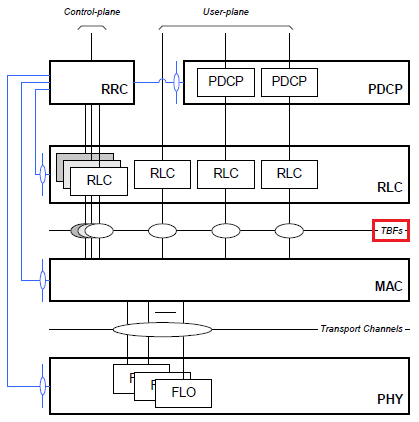
TBF operation varies depending onto which channel it mapped as described below (based on 44.160-5.2.1 Temporary Block Flow) :
|
Channel |
TBF Operation |
|
PDTCH |
operate in either GPRS TBF mode or EGPRS TBF mode |
|
SBPSCH |
the network sets the TBF mode in following messages
|
|
DBPSCH |
the network sets the TBF mode using RRC procedures (see 3GPP TS 44.118) |
|
FACCH SACCH SDCCH |
operates implicitly in DCCH TBF mode |
|
TCH |
operates implicitly in TCH TBF mode. |
|
UDCH |
UDCH TBF mode is applicable only when FLO is used. |
|
CDCH |
CDCH TBF mode is applicable only when FLO is used. |
|
URB |
may operate in either GPRS TBF mode, EGPRS TBF mode, DCCH TBF mode, TCH TBF mode or UDCH TBF mode. |
|
SRB |
may operate in either GPRS TBF mode (CS-1 coding only), DCCH TBF mode or CDCH TBF mode. It shall not operate in EGPRS TBF mode |