The overall RRC design for Artificial Intelligence and Machine Learning in 3GPP Release 19 represents a fundamental shift from static, rule-based signaling to a dynamic, data-driven framework. This architecture is built on a non-critical extension of the UE capability reporting system, specifically nested within the Release 19 capability structures to ensure backward compatibility with legacy 5G NR deployments. The design philosophy centers on model observability and control, allowing the network to manage the entire lifecycle of an AI model—from initial capability discovery and activation to continuous performance monitoring and eventual fallback.
At the heart of this RRC design is the abstraction of AI models into specific functional blocks, such as channel state information prediction and beam management. Rather than standardizing the internal black-box logic of a neural network, 3GPP focuses on standardizing the interfaces: the specific input data (Set B) provided to the model, the expected output format (Set A), and the computational budget required for processing. This approach preserves vendor innovation in algorithm design while ensuring that the gNodeB and UE share a mutual understanding of the model's intent and reliability.
The signaling framework is further refined by a sophisticated resource management protocol that accounts for the unique computational demands of AI inference. By incorporating parameters for CPU pooling across carrier components and introducing relaxation timelines, the RRC design allows the UE to negotiate the necessary latency "buffer" required to complete complex mathematical operations. This ensures that the integration of AI does not compromise the strict timing requirements of the 5G air interface, but instead enhances it through proactive, multi-slot predictions of the radio environment
- UE Capability
- CSI Prediction
- Beam Management
- Applicability Reporting
- Data Collection
- Positioning
- Model Specification
- Reference
UE Capability
The introduction of AIML-Parameters-r19 shows the transition toward an AI/ML-based air interface. Instead of the network trying to infer how the UE sees the radio environment, the UE can now use trained models to support functions such as beam management and CSI prediction.
The ASN.1 shown in this section follows the usual 3GPP non-critical extension structure. By placing these fields under UE-NR-Capability-v1900, 3GPP is making it clear that Release 19 is the formal starting point for standardized AI/ML capability signaling.
This matters because AI and ML in mobile networks cannot work as an uncontrolled black box. The network needs to know whether the UE is capable of AI-related processing, whether the UE’s model is still valid in the current environment, and whether the UE can contribute useful data for improving future models. This capability framework makes AI and ML a controlled and predictable part of radio resource management rather than just an experimental feature.
Following is based on
UE-NR-Capability-v1860 ::= SEQUENCE {
    ntn-CHO-OnlyLocationTimeTrigger-r18    ENUMERATED { supported } OPTIONAL,
    nonCriticalExtension                   UE-NR-Capability-v1900 OPTIONAL
}
UE-NR-Capability-v1900 ::= SEQUENCE {
    aiml-Parameters-r19                        AIML-Parameters-r19 OPTIONAL,
    ue-RadioPagingInfo-r19                     OCTET STRING (CONTAINING UE-RadioPagingInfo-r19) OPTIONAL,
    ntn-VSAT-AntennaTypeKuBand-r19             ENUMERATED { electronic, mechanical } OPTIONAL,
    ntn-VSAT-MobilityTypeKuBand-r19            ENUMERATED { fixed, mobile } OPTIONAL,
    ntn-ERedCap-FR1-r19                        ENUMERATED { supported } OPTIONAL,
    onDemandSIB1-r19                           ENUMERATED { supported } OPTIONAL,
    onDemandPosSIB-ConnectedCtrlParam-r19      ENUMERATED { supported } OPTIONAL,
    ntn-Redirection-r19                        ENUMERATED { supported } OPTIONAL,
    drx-PreferenceCellDTX-DRX-r19              ENUMERATED { supported } OPTIONAL,
    lpwus-SupportedBandsIdleInactiveOFDM-r19   SEQUENCE (SIZE (1..maxBands)) OF FreqBandIndicatorNR OPTIONAL,
    lpwus-SupportedBandsIdleInactiveOOK-r19    SEQUENCE (SIZE (1..maxBands)) OF FreqBandIndicatorNR OPTIONAL,
    nonCriticalExtension                       UE-NR-Capability-v1920 OPTIONAL
}
AIML-Parameters-r19 ::= SEQUENCE {
    applicabilityReportingCSI-r19              ENUMERATED { supported } OPTIONAL,
    applicabilityReportingOther-r19            ENUMERATED { supported } OPTIONAL,
    loggedDataCollection-r19                   ENUMERATED { supported } OPTIONAL,
    eventBasedLoggedDataCollection-r19         ENUMERATED { supported } OPTIONAL,
    dataThresholdAvailabilityIndication-r19    ENUMERATED { supported } OPTIONAL
}
Followings are short descriptions on important parameters
-
applicabilityReportingCSI-r19 : Indicates whether the UE can report the applicability of its AI model specifically for Channel State Information. This helps the network determine whether the current AI model is reliable under the current radio conditions. -
applicabilityReportingOther-r19 : Indicates whether the UE can report model applicability for supported AI/ML use cases other than CSI prediction, such as beam management. It is not a positioning-specific capability flag. -
loggedDataCollection-r19 : Confirms that the UE can collect and store radio signal data for use as training data for machine learning models. -
eventBasedLoggedDataCollection-r19 : Indicates that the UE can trigger data logging only when specific radio events occur, such as a handover failure or a signal drop. -
dataThresholdAvailabilityIndication-r19 : Allows the UE to inform the network that it has collected enough data to be useful for model training or model updates.
CSI Prediction
The core idea here is that the UE does not just measure the channel as it exists at the current moment. It uses an AI model to predict how the channel will evolve in the near future, especially in high-mobility conditions where Doppler effects become significant.

Overall, the flow is straightforward. The UE first informs the network about its AI processing capability, including its CPU budget and the resource types it supports. The network then configures a prediction or monitoring session. The UE uses the configured CSI-RS resources, including parameters such as N4, as input to its AI model. It then generates predicted CSI and reports it back to the network. If additional inference time is needed, the UE can rely on the relaxation timeline so that the report is delayed just enough to allow the neural-network-based processing to complete properly.
RRC Procedure
The following statements are copied directly from TS 38.331 and describe the RRC procedures related to AI/ML-based CSI prediction. They cover how the UE reports the applicability of CSI prediction configurations during RRC reconfiguration, RRC resume, and UE Assistance Information procedures, including how the applicability status and configuration-release preference are conveyed to the network.
5.3.5.3 Reception of an RRCReconfiguration by the UE
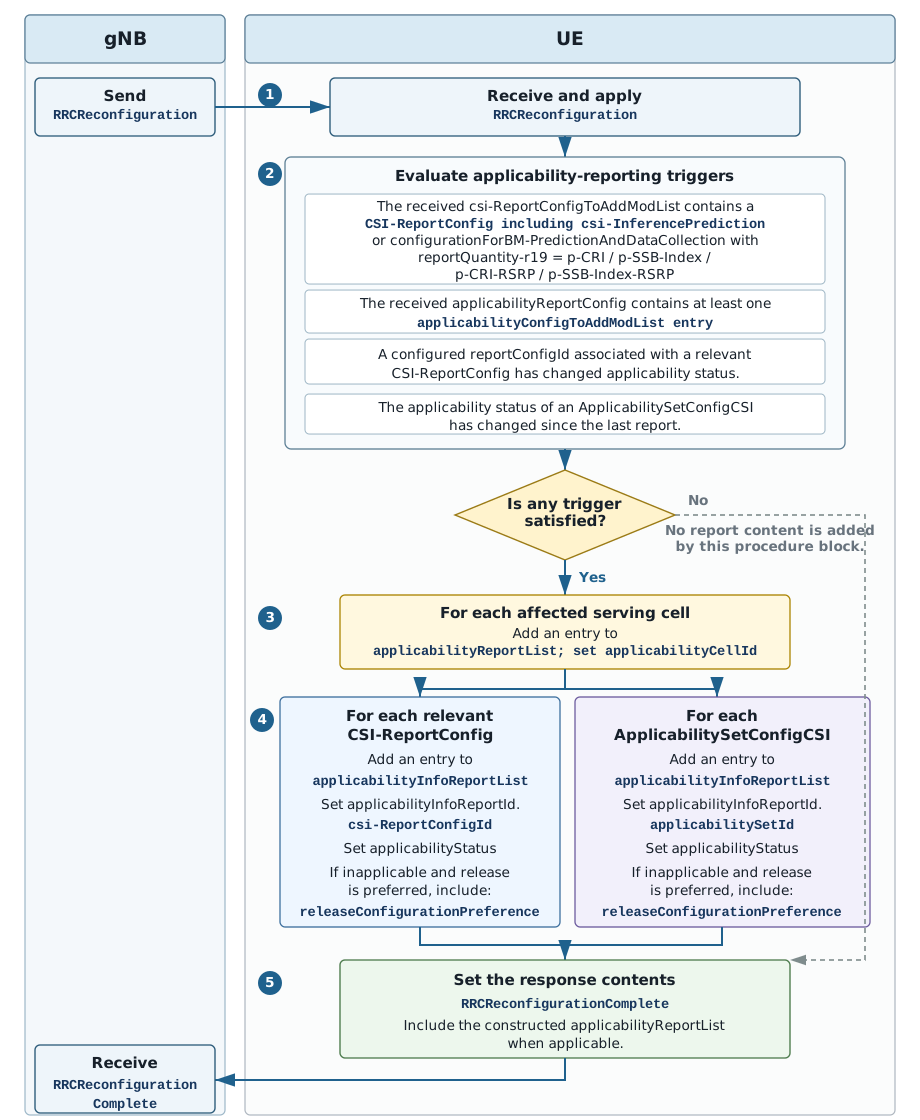
Followings are the direct quote of the specification just for confirm. Just refer to this part only when you want to check on the procedure described above directly with the specification.
1> set the content of the RRCReconfigurationComplete message as follows:
2> if, for at least one serving cell, the RRCReconfiguration message includes in csi-ReportConfigToAddModList at least one CSI-ReportConfig including csi-InferencePrediction, or, if disableApplicabilityCSI-ReportConfig in applicabilityReportConfig is not configured, including configurationForBM-PredictionAndDataCollection with reportQuantity-r19 set to p-CRI or p-SSB-Index or p-CRI-RSRP or p-SSB-Index-RSRP; or
2> if the RRCReconfiguration message includes at least one entry in applicabilityConfigToAddModList within applicabilityReportConfig; or
2> if, for at least one serving cell, the UE is configured with at least one reportConfigId associated to a CSI-ReportConfig including csi-InferencePrediction, or, if disableApplicabilityCSI-ReportConfig in applicabilityReportConfig is not configured, including configurationForBM-PredictionAndDataCollection with reportQuantity-r19 set to p-CRI or p-SSB-Index or p-CRI-RSRP or p-SSB-Index-RSRP, for which the applicability status has changed since the last transmission of a message containing applicabilityReportList (in RRCReconfigurationComplete or in UEAssistanceInformation or in RRCResumeComplete); or
2> if the UE is configured with at least one ApplicabilitySetConfigCSI configuration for which the applicability status has changed since the last transmission of a message containing applicabilityReportList (either in RRCReconfigurationComplete or in UEAssistanceInformation):
3> for each serving cell associated with any of the configurations above, include an entry in the applicabilityReportList and set the content as follows:
4> set the applicabilityCellId to the serving cell index of the cell;
4> for each configured reportConfigId associated to a CSI-ReportConfig including csi-InferencePrediction, or, if disableApplicabilityCSI-ReportConfig in applicabilityReportConfig is not configured, including configurationForBM-PredictionAndDataCollection with reportQuantity-r19 set to p-CRI or p-SSB-Index or p-CRI-RSRP or p-SSB-Index-RSRP, that is included in the RRCReconfiguration message or for which the applicability status has changed since the last transmission of a message containing applicabilityReportList (in RRCReconfigurationComplete or in UEAssistanceInformation or in RRCResumeComplete):
5> include an entry in the applicabilityInfoReportList and set the content as follows:
6> set the csi-ReportConfigId within applicabilityInfoReportId to the corresponding reportConfigId;
6> set the applicabilityStatus to the applicability status of the configuration corresponding to the applicabilityInfoReportId;
6> if the applicabilityStatus is set to inapplicable:
7> if the UE prefers to release the concerned CSI-ReportConfig, include releaseConfigurationPreference;
4> for each ApplicabilitySetConfigCSI configuration stored at the UE, associated with the concerned serving cell, that is included in the RRCReconfiguration message or for which the applicability status has changed since the last transmission of a message containing applicabilityReportList (either in RRCReconfigurationComplete or in UEAssistanceInformation):
5> include an entry in the applicabilityInfoReportList and set the content as follows:
6> set the applicabilitySetId within applicabilityInfoReportId to the corresponding applicabilitySetConfigId;
6> set the applicabilityStatus to the applicability status of the configuration corresponding to the applicabilityInfoReportId;
6> if the applicabilityStatus is set to inapplicable:
7> if the UE prefers to release the concerned configuration, include releaseConfigurationPreference;
5.3.13.4 Reception of the RRCResume by the UE
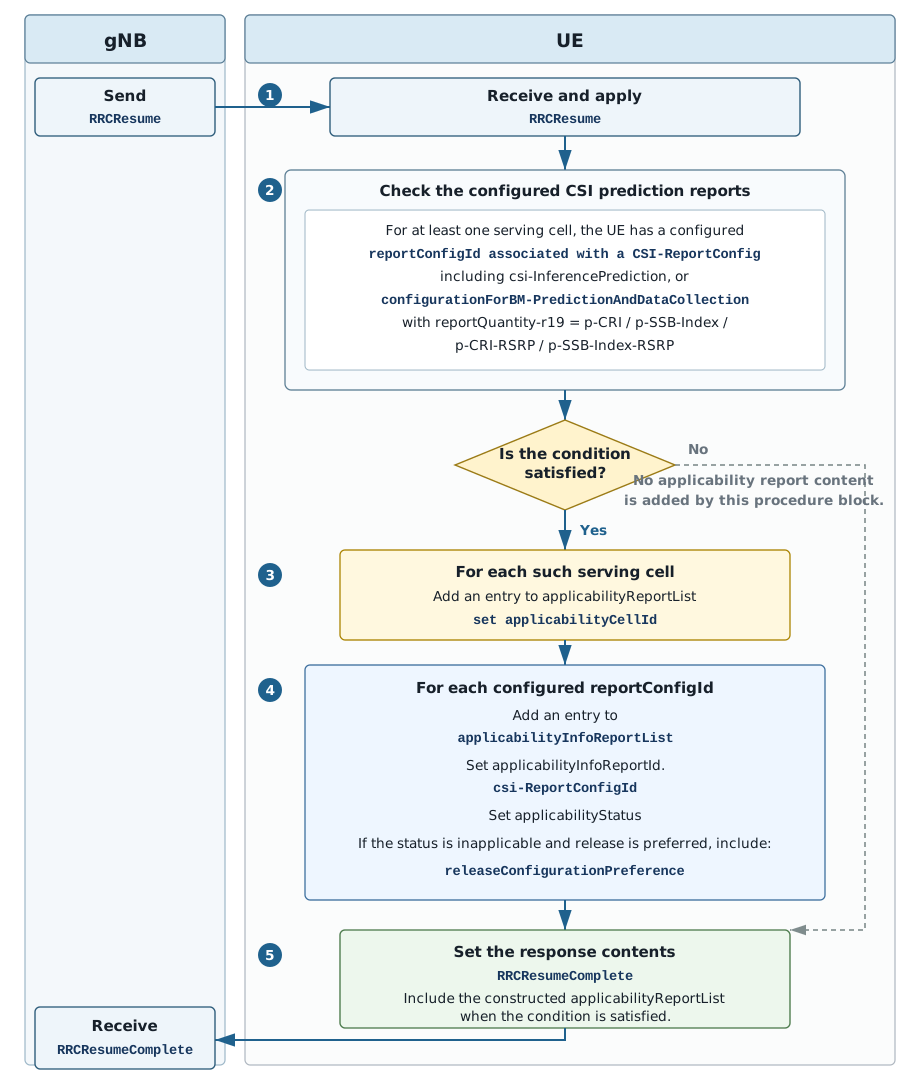
Followings are the direct quote of the specification just for confirm. Just refer to this part only when you want to check on the procedure described above directly with the specification.
1> set the content of the of RRCResumeComplete message as follows:
2> if, for at least one serving cell, the UE is configured with at least one reportConfigId associated to a CSI-ReportConfig including csi-InferencePrediction, or including configurationForBM-PredictionAndDataCollection with reportQuantity-r19 set to p-CRI or p-SSB-Index or p-CRI-RSRP or p-SSB-Index-RSRP:
3> for each such serving cell, include an entry in the applicabilityReportList and set the content as follows:
4> set the applicabilityCellId to the serving cell index of the cell;
4> for each configured reportConfigId associated to a CSI-ReportConfig including csi-InferencePrediction, or including configurationForBM-PredictionAndDataCollection with reportQuantity-r19 set to p-CRI or p-SSB-Index or p-CRI-RSRP or p-SSB-Index-RSRP:
5> include an entry in the applicabilityInfoReportList and set the content as follows:
6> set the csi-ReportConfigId within applicabilityInfoReportId to the corresponding reportConfigId;
6> set the applicabilityStatus to the applicability status of the configuration corresponding to the applicabilityInfoReportId;
6> if the applicabilityStatus is set to inapplicable:
7> if the UE prefers to release the concerned CSI-ReportConfig, include releaseConfigurationPreference;
5.7.4 UE Assistance Information
5.7.4.1 General
The purpose of this procedure is for the UE to inform the network of:
- applicability of configurations subject to the applicability determination procedure; or
5.7.4.2 Initiation
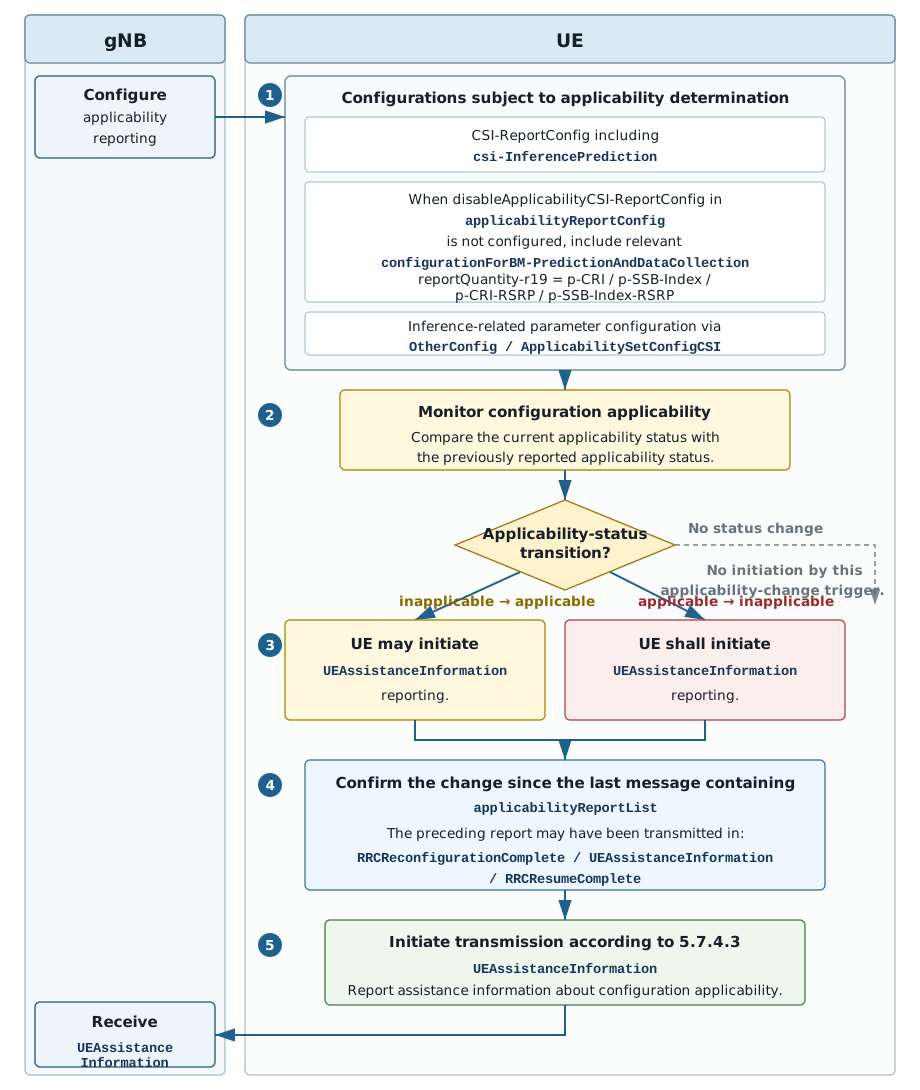
Followings are the direct quote of the specification just for confirm. Just refer to this part only when you want to check on the procedure described above directly with the specification.
A UE capable of applicability reporting based on inference configuration provided via CSI-ReportConfig or based on inference related parameter configuration provided via OtherConfig may initiate the procedure if it was configured with configurations subject to the applicability determination procedure (i.e. CSI report configurations including csi-InferencePrediction or, if disableApplicabilityCSI-ReportConfig in applicabilityReportConfig is not configured, including configurationForBM-PredictionAndDataCollection with reportQuantity-r19 set to p-CRI or p-SSB-Index or p-CRI-RSRP or p-SSB-Index-RSRP, or ApplicabilitySetConfigCSI configurations), upon determining that the applicability of a configuration subject to the applicability determination procedure changed from inapplicable to applicable. A UE capable of applicability reporting based on inference configuration provided via CSI-ReportConfig or based on inference related parameter configuration provided via OtherConfig shall initiate the procedure if it was configured with configurations subject to the applicability determination procedure, upon determining that the applicability of a configuration subject to the applicability determination procedure changed from applicable to inapplicable.
Upon initiating the procedure, the UE shall:
1> if configured with configurations subject to the applicability determination procedure (i.e. CSI report configurations including csi-InferencePrediction or, if disableApplicabilityCSI-ReportConfig in applicabilityReportConfig is not configured, including configurationForBM-PredictionAndDataCollection with reportQuantity-r19 set to p-CRI or p-SSB-Index or p-CRI-RSRP or p-SSB-Index-RSRP, or ApplicabilitySetConfigCSI configurations):
2> if the applicability status of configurations subject to the applicability determination procedure has changed since the last transmission of a message containing applicabilityReportList (in RRCReconfigurationComplete or in UEAssistanceInformation or in RRCResumeComplete):
3> initiate transmission of the UEAssistanceInformation message in accordance with 5.7.4.3 to report assistance information about the applicability of configurations subject to the applicability determination procedure;
5.7.4.3 Actions related to transmission of UEAssistanceInformation message
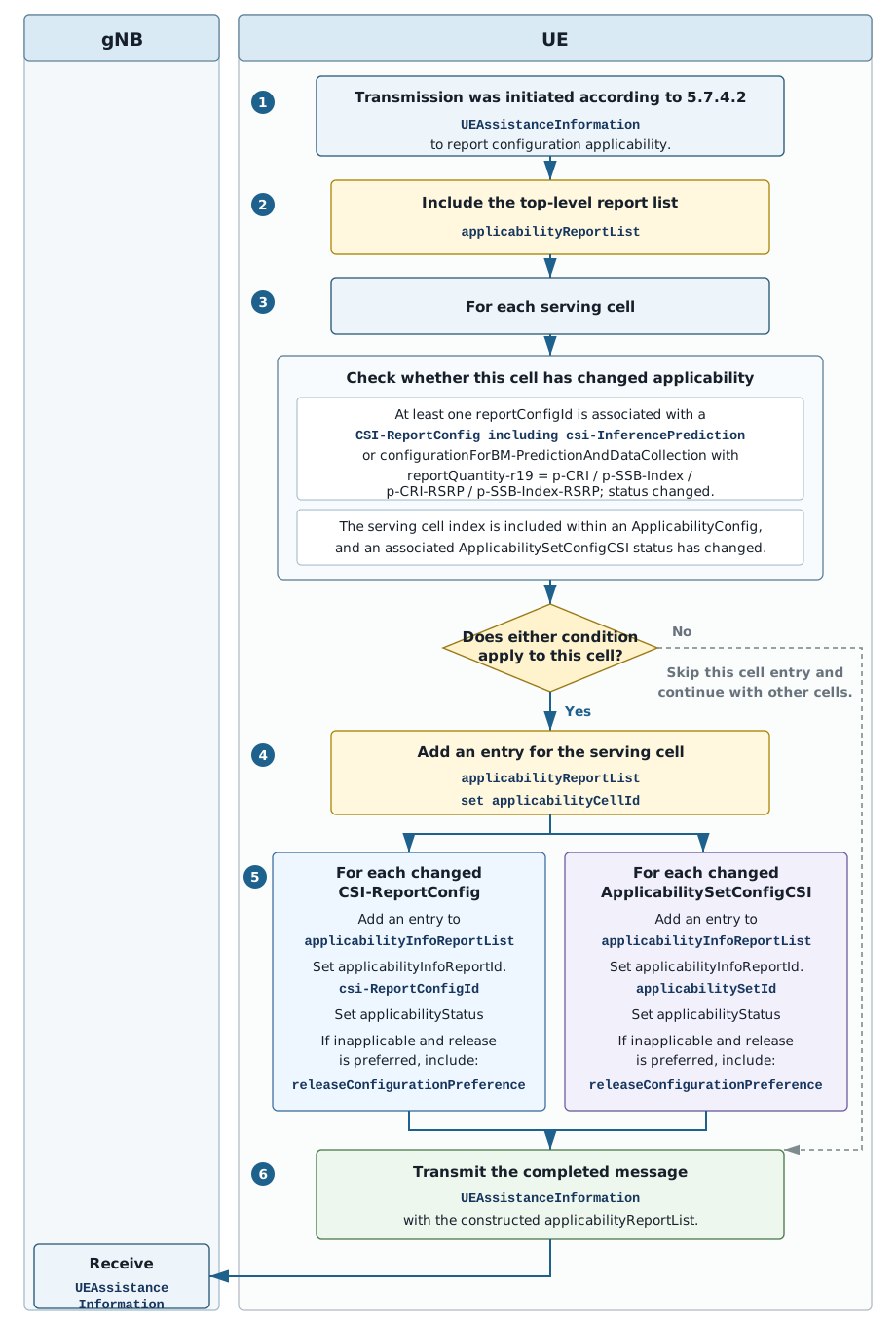
Followings are the direct quote of the specification just for confirm. Just refer to this part only when you want to check on the procedure described above directly with the specification.
The UE shall set the contents of the UEAssistanceInformation message as follows:
1> if transmission of the UEAssistanceInformation message is initiated to report assistance information about the applicability of configurations subject to applicability determination procedure according to 5.7.4.2:
2> include applicabilityReportList in this UEAssistanceInformation message;
2> for each serving cell:
3> if the cell is configured with at least one reportConfigId associated to a CSI-ReportConfig including csi-InferencePrediction, or, if disableApplicabilityCSI-ReportConfig in applicabilityReportConfig is not configured, including configurationForBM-PredictionAndDataCollection with reportQuantity-r19 set to p-CRI or p-SSB-Index or p-CRI-RSRP or p-SSB-Index-RSRP, for which the applicability status has changed; or
3> if the associated serving cell index is included within any ApplicabilityConfig stored at the UE and the applicability status for at least one of the associated ApplicabilitySetConfigCSI has changed:
4> include an entry in applicabilityReportList in the UEAssistanceInformation message, and set the content as follows:
5> set the applicabilityCellId to the serving cell index of the cell;
5> for each configured reportConfigId associated to a CSI-ReportConfig including csi-InferencePrediction, or, if disableApplicabilityCSI-ReportConfig in applicabilityReportConfig is not configured, including configurationForBM-PredictionAndDataCollection with reportQuantity-r19 set to p-CRI or p-SSB-Index or p-CRI-RSRP or p-SSB-Index-RSRP, for which the applicability status has changed:
6> include an entry in the applicabilityInfoReportList and set the content as follows:
7> set the csi-ReportConfigId within applicabilityInfoReportId to the corresponding reportConfigId;
7> set the applicabilityStatus to the applicability status of the configuration corresponding to the applicabilityInfoReportId;
7> if the applicabilityStatus is set to inapplicable:
8> if the UE prefers to release the concerned CSI-ReportConfig, include releaseConfigurationPreference;
5> for each ApplicabilitySetConfigCSI configuration stored at the UE, associated with the concerned serving cell and for which the applicability status has changed:
6> include an entry in the applicabilityInfoReportList and set the content as follows:
7> set the applicabilitySetId within applicabilityInfoReportId to the corresponding applicabilitySetConfigId;
7> set the applicabilityStatus to the applicability status of the configuration corresponding to the applicabilityInfoReportId;
7> if the applicabilityStatus is set to inapplicable:
8> if the UE prefers to release the concerned configuration, include releaseConfigurationPreference;
RRC Parameters
The listing below is the prediction half of CSI-ReportConfig, followed by the band and band-combination capabilities that go with it. Read the CHOICE first : it is what decides whether a report setting is an inference, a monitor, or neither.
Following is based on
predictionConfiguration-r19            CHOICE {
   csi-InferencePrediction-r19             NULL,
   configurationForBM-PredictionAndDataCollection-r19  SEQUENCE {
       resourcesForChannelPrediction-r19       CSI-ResourceConfigId,
       associatedIdForChannelPrediction-r19    AssociatedId-r19 OPTIONAL,   -- Need R
       associatedIdForChannelMeasurement-r19   AssociatedId-r19 OPTIONAL,   -- Need R
       nrofReportedPredictedRS-r19             ENUMERATED { n1, n2, n3, n4 } OPTIONAL,   -- Need R
       nrofTimeInstance-r19                    ENUMERATED { n1, n2, n4, n8 } OPTIONAL,   -- Need R
       timeGap-r19                             ENUMERATED { ms10, ms20, ms40, ms80, ms160,
                                                            spare3, spare2, spare1 } OPTIONAL,   -- Need R
       ...
   },
   configurationForBM-Monitoring-r19       SEQUENCE {
       refToPredictionConfig-r19               CSI-ReportConfigId,
       nrofBestBeamForMonitoring-r19           ENUMERATED { n1, n2 } OPTIONAL,   -- Need R
       nrofTransmissionOccasion-r19            ENUMERATED { n1, n3, n7, n15 } OPTIONAL,   -- Need R
       timeInstanceForRS-PAI-r19               ENUMERATED { n1, n2, n3, n4, n5, n6, n7, n8 } OPTIONAL,   -- Need R
       mappingToResourcesForChannelPrediction-r19
                                               BIT STRING (SIZE (1..maxNrofNZP-CSI-RS-ResourcesPerSet)) OPTIONAL,   -- Need R
       ...
   },
   configurationForCSI-Monitoring-r19      SEQUENCE {
       refToPredictionConfig-r19               CSI-ReportConfigId,
       timeInstanceForCSI-PAI-r19              ENUMERATED { n1, n2, n3, n4, n5, n6, n7, n8 } OPTIONAL,   -- Need R
       ...
   }
} OPTIONAL,   -- Need R

reportQuantity-r19                     CHOICE {
   noneBM-r19                              NULL,
   noneCSI-r19                             NULL,
   p-CRI-r19                               NULL,
   p-SSB-Index-r19                         NULL,
   p-CRI-RSRP-r19                          NULL,
   p-SSB-Index-RSRP-r19                    NULL,
   rs-PAI-r19                              NULL,
   csi-PAI-r19                             NULL,
   cjtc-Dd-r19                             NULL,
   cjtc-F-r19                              NULL,
   cjtc-P-r19                              NULL,
   cjtc-Dd-F-r19                           NULL,
   cli-RSSI-r19                            NULL,
   cli-SRS-RSRP-r19                        NULL
} OPTIONAL   -- Need R

CA-ParametersNR-v1900 ::= SEQUENCE {
    aiml-CSI-PredictionDopplerPerBC-r19              CodebookParametersCSI-PredictionDoppler-r19 OPTIONAL,

    -- R1 58-0-1: CSI report framework for UE-side inference
    aiml-CSI-ReportPerBC-r19                         SEQUENCE (SIZE (1..2)) OF CPU-PoolInfo-r19 OPTIONAL,

    -- R1 58-3-1: CSI prediction for UE-sided inference when N4=1
    aiml-CSI-PredictionPerBC-r19                     SEQUENCE {
        supportedCSI-RS-ResourceList-r19            SEQUENCE (SIZE (1..maxNrofCSI-RS-ResourcesExt-r16)) OF INTEGER
                                                        (0..maxNrofCSI-RS-ResourcesAlt-1-r16),
        scalingFactor-r19                           ENUMERATED { n1, n2, n4 },
        numberOfOccupiedCPU-r19                     INTEGER (0..8),
        numberOfOccupiedCPUx-r19                    INTEGER (0..8),
        relaxationTimelineT-r19                     SEQUENCE {
            scs15kHz-r19                            ENUMERATED { n14, n28, n56, n112 },
            scs30kHz-r19                            ENUMERATED { n28, n56, n112, n224 },
            scs60kHz-r19                            ENUMERATED { n56, n112, n224, n448 },
            scs120kHz-r19                           ENUMERATED { n112, n224, n448 },
            scs480kHz-r19                           ENUMERATED { n448, n896, n1792 },
            scs960kHz-r19                           ENUMERATED { n896, n1792 }
        },
        occupiedResourcePool-r19                    INTEGER (1..2),
        inferenceReportType-r19                     ENUMERATED { aperiodic, semiPersistent }
    } OPTIONAL,

    -- R1 58-3-1a-1: DD unit size when A-CSI-RS is configured for CMR N4>1 for UE side inference of CSI prediction
    aiml-CSI-PredictionUnitDurationDD-PerBC-r19     ENUMERATED { supported } OPTIONAL,

    -- R1 58-3-2: CSI prediction for UE-sided inference when N4>1
    aiml-CSI-PredictionN4PerBC-r19                  SEQUENCE {
        supportedCSI-RS-ReportSettingAcrossCC-r19   SEQUENCE (SIZE (1..maxNrofCSI-RS-ResourcesExt-r16)) OF
                                                        SupportedCSI-RS-ReportSetting-r18,
        supportedCSI-RS-ReportSettingOneReport-r19  SEQUENCE (SIZE (1..maxNrofCSI-RS-ResourcesExt-r16)) OF
                                                        SupportedCSI-RS-ReportSetting-r18,
        numOccupiedCPU-r19                          INTEGER (0..8),
        numOccupiedCPUx-r19                         INTEGER (0..8),
        occupiedPool-r19                            ENUMERATED { p1, p2 }
    } OPTIONAL,

    -- R1 58-3-4: UE side data collection for CSI prediction
    aiml-CSI-PredictionUE-DataCollectionPerBC-r19   ENUMERATED { supported } OPTIONAL,

    -- R1 58-3-5: Performance monitoring for CSI prediction model
    aiml-CSI-PredictionMonitoringPerBC-r19          SEQUENCE {
        suppportedCSI-RS-ResourceList-r19           SEQUENCE (SIZE (1..maxNrofCSI-RS-ResourcesExt-r16)) OF INTEGER
                                                        (0..maxNrofCSI-RS-ResourcesAlt-1-r16),
        numOccupiedCPU-r19                          INTEGER (1..2)
    } OPTIONAL
}

CodebookParametersCSI-PredictionDoppler-r19 ::= SEQUENCE {
    -- R1 58-3-1b: Maximum number of aperiodic CSI-RS resources that can be configured in the same CSI report setting for Rel-16-based
    -- doppler measurement for UE side inference of CSI prediction
    maxNumberOfAperiodic-CSI-RS-Resource-r19           ENUMERATED { n4, n8, n12 } OPTIONAL,

    -- R1 58-3-1-2: Support R=2 for Rel-16-based doppler codebook for UE side inference of CSI prediction
    eType2DopplerR2-r19                                SEQUENCE (SIZE (1..maxNrofCSI-RS-ResourcesExt-r16)) OF INTEGER
                                                           (0..maxNrofCSI-RS-ResourcesAlt-1-r16) OPTIONAL,

    -- R1 58-3-1-3: Support X=1 based on first and last slot of WCSI, for Rel-16-based doppler codebook for UE side inference of CSI prediction
    eType2DopplerX1-r19                                ENUMERATED { supported } OPTIONAL,

    -- R1 58-3-1-3a: Support X=2 CQI based on 2 slots for Rel-16-based doppler codebook for UE side inference of CSI prediction
    eType2DopplerX2-r19                                ENUMERATED { supported } OPTIONAL,

    -- R1 58-3-1-4: support of l = (n - nCSI,ref ) for CSI reference slot for Rel-16 based doppler codebook for UE side inference of CSI prediction
    eType2DopplerL-N4D1-r19                            ENUMERATED { supported } OPTIONAL,

    -- R1 58-3-1-5: Support of L=6 for Rel-16 based doppler codebook for UE side inference of CSI prediction
    eType2DopplerL6-r19                                ENUMERATED { supported } OPTIONAL,

    -- R1 58-3-1-6: Support of rank equals 3 and 4 for Rel-16 based doppler codebook for UE side inference of CSI prediction
    eType2DopplerR3R4-r19                              ENUMERATED { supported } OPTIONAL,

    -- R1 58-3-1-7: Active CSI-RS resources and ports for mixed R16 based doppler codebook for CSI prediction via UE side model with
    -- other codebooks in any slot
    codebookComboParameterMixedTypePrediction-r19      SEQUENCE {
        type1SP-Type1SP-N4-r19               SEQUENCE (SIZE (1..maxNrofCSI-RS-ResourcesExt-r16)) OF INTEGER
                                                           (0..maxNrofCSI-RS-ResourcesAlt-1-r16) OPTIONAL,
        type1SP-eType2SP-r19                 SEQUENCE (SIZE (1..maxNrofCSI-RS-ResourcesExt-r16)) OF INTEGER
                                                           (0..maxNrofCSI-RS-ResourcesAlt-1-r16) OPTIONAL,
        type1SP-eType2SP-N4-r19              SEQUENCE (SIZE (1..maxNrofCSI-RS-ResourcesExt-r16)) OF INTEGER
                                                           (0..maxNrofCSI-RS-ResourcesAlt-1-r16) OPTIONAL,
        type1SP-N4-eType2SP-r19              SEQUENCE (SIZE (1..maxNrofCSI-RS-ResourcesExt-r16)) OF INTEGER
                                                           (0..maxNrofCSI-RS-ResourcesAlt-1-r16) OPTIONAL,
        type1SP-N4-eType2SP-N4-r19           SEQUENCE (SIZE (1..maxNrofCSI-RS-ResourcesExt-r16)) OF INTEGER
                                                           (0..maxNrofCSI-RS-ResourcesAlt-1-r16) OPTIONAL,
        eType2SP-eType2SP-N4-r19             SEQUENCE (SIZE (1..maxNrofCSI-RS-ResourcesExt-r16)) OF INTEGER
                                                           (0..maxNrofCSI-RS-ResourcesAlt-1-r16) OPTIONAL
    } OPTIONAL
}

CPU-PoolInfo-r19 ::= SEQUENCE {
    maxNumCPU-PerCC-r19      INTEGER (1..8),
    maxNumCPU-AllCC-r19      INTEGER (1..32)
}
Followings are short descriptions on important parameters
-
predictionConfiguration-r19 defines how the UE and the network coordinate AI-based prediction activity. It is configured per CSI-ReportConfig and works together with reportQuantity-r19 : BM prediction or data collection requires reportQuantity-r19 set to p-CRI, p-SSB-Index, p-CRI-RSRP, p-SSB-Index-RSRP or noneBM, BM monitoring requires rs-PAI, and CSI prediction monitoring requires csi-PAI. -
csi-InferencePrediction-r19 represents an inference mode in which the UE runs a pre-trained AI model, predicts CSI, and reports the result back to the gNB. -
Monitoring configurations allow the network to compare predicted CSI with the actual channel condition, so it can evaluate prediction accuracy and monitor AI model performance over time. -
CPU-PoolInfo-r19 defines the amount of processing resource that the UE can dedicate to AI and ML tasks. -
maxNumCPU-AllCC-r19 indicates how much AI processing capacity the UE can share across multiple component carriers in carrier aggregation. -
relaxationTimelineT-r19 tells the gNB how much extra processing time, measured in slots, the UE may need to complete AI inference for different subcarrier spacings. -
CodebookParametersCSI-PredictionDoppler-r19 handles Doppler and high-mobility support for AI-based CSI prediction. -
eType2DopplerR3R4-r19 indicates support for higher-rank transmission cases, such as rank 3 and rank 4, even when AI-based prediction is used. -
X1 and X2 related parameters define the time window, in slots, that the AI model uses to analyze Doppler and frequency shift behavior. -
scalingFactor-r19 defines the complexity or size of the AI model. A larger value usually means a larger or more precise model. -
inferenceReportType-r19 defines how the UE reports AI-based results, such as by aperiodic or semi-persistent reporting. -
supportedCSI-RS-ResourceList indicates which CSI-RS resources the UE’s AI model is capable of processing. -
codebookComboParameter supports hybrid operation where some CSI reporting uses AI-based prediction while other parts still use legacy Type-I or Type-II codebook methods. -
resourcesForChannelPrediction-r19 indicates the CSI-ResourceConfig whose CSI-RS resources are used as the AI model input for channel prediction. -
associatedIdForChannelPrediction-r19 / associatedIdForChannelMeasurement-r19 link the prediction report to the associated resource configurations so that the network can correlate the predicted channel with the measured channel. -
nrofReportedPredictedRS-r19, nrofTimeInstance-r19 and timeGap-r19 define how many predicted reference signals are reported, how many future time instances are predicted and the time spacing between those instances. -
refToPredictionConfig-r19 indicates the linked CSI-ReportConfigId corresponding to a prediction report configuration, so that a monitoring report can be tied to the prediction it is evaluating. -
nrofBestBeamForMonitoring-r19, nrofTransmissionOccasion-r19 and timeInstanceForRS-PAI-r19 control how many best beams and transmission occasions are used for beam prediction accuracy monitoring, and which predicted time instance the RS prediction accuracy indicator (rs-PAI) refers to. -
timeInstanceForCSI-PAI-r19 indicates which predicted time instance the CSI prediction accuracy indicator (csi-PAI) refers to. -
reportQuantity-r19 introduces the AI/ML related report quantities : predicted CRI / SSB index and predicted RSRP (p-CRI, p-SSB-Index, p-CRI-RSRP, p-SSB-Index-RSRP), prediction accuracy indicators (rs-PAI, csi-PAI) and noneBM / noneCSI used for data collection without a regular report.
N4 Logic
N4 logic is the idea that the UE does not make an AI-based CSI prediction from only one instant of radio measurement. Instead, it can collect multiple CSI-RS observations over time and use them together as input to the AI model. In this sense, N4 represents the observation depth or the number of channel snapshots the UE buffers before running inference. When N4 is small, the model works with very limited history and the processing is simpler. When N4 is larger, the UE can observe channel evolution over multiple time points, which is especially useful for tracking Doppler behavior, fading trends, and other time-varying effects in high-mobility scenarios. At a high level, N4 defines how much past channel context the AI model uses in order to predict future channel behavior more accurately.
What is N4 for
- N4 means the number of CSI-RS observations or channel snapshots that the UE uses as input for one AI-based CSI prediction.
- It defines how much past channel history the UE buffers before running the AI inference.
- The main purpose of N4 is to give the AI model enough time-domain context to predict future channel behavior more accurately.
Why N4 is Needed
- If the UE uses only one observation, the model sees only the current channel condition.
- If the UE uses multiple observations, the model can track how the channel changes over time.
- This is especially important in high-mobility scenarios where Doppler and fading change quickly.
Small N4 vs Large N4
- If N4 is small, the processing is simpler and the memory requirement is lower.
- If N4 is large, the model has more historical context and can make a better time-series style prediction.
- A larger N4 usually increases processing load, memory usage, and inference complexity.
High-Level Meaning
- N4 is essentially the observation window size for AI-based CSI prediction.
- It tells the network that the UE can buffer and process multiple CSI-RS resources before generating a prediction.
- At a high level, N4 controls the tradeoff between prediction accuracy and implementation complexity.
Beam Management
While the previous section focused on predicting channel quality through CSI, this Beam Management section focuses on predicting the spatial direction of the signal. In Release 19, AI and ML are used to estimate which beam is likely to become the best beam in the near future, so the network can react before radio quality drops too much. This changes beam management from a reactive process into a more proactive one. Instead of waiting until beam quality degrades and then switching, the UE can use AI-based prediction to anticipate future beam behavior and help the gNB maintain more stable connectivity, especially in mobility scenarios where beam conditions can change very quickly.
RRC Procedure
The steps below are the same four procedures the CSI prediction section quotes, because one applicability framework covers both use cases. What changes is the configuration being judged, and the beam side adds the SCell and lower layer paths that CSI prediction does not need.
The following statements are copied directly from TS 38.331 and describe the RRC procedures related to AI/ML-based Beam management.
5.3.5.3 Reception of an RRCReconfiguration by the UE
1> set the content of the RRCReconfigurationComplete message as follows:
2> if, for at least one serving cell, the RRCReconfiguration message includes in csi-ReportConfigToAddModList at least one CSI-ReportConfig including csi-InferencePrediction, or, if disableApplicabilityCSI-ReportConfig in applicabilityReportConfig is not configured, including configurationForBM-PredictionAndDataCollection with reportQuantity-r19 set to p-CRI or p-SSB-Index or p-CRI-RSRP or p-SSB-Index-RSRP; or
2> if, for at least one serving cell, the UE is configured with at least one reportConfigId associated to a CSI-ReportConfig including csi-InferencePrediction, or, if disableApplicabilityCSI-ReportConfig in applicabilityReportConfig is not configured, including configurationForBM-PredictionAndDataCollection with reportQuantity-r19 set to p-CRI or p-SSB-Index or p-CRI-RSRP or p-SSB-Index-RSRP, for which the applicability status has changed since the last transmission of a message containing applicabilityReportList (in RRCReconfigurationComplete or in UEAssistanceInformation or in RRCResumeComplete); or
3> for each serving cell associated with any of the configurations above, include an entry in the applicabilityReportList and set the content as follows:
4> set the applicabilityCellId to the serving cell index of the cell;
4> for each configured reportConfigId associated to a CSI-ReportConfig including csi-InferencePrediction, or, if disableApplicabilityCSI-ReportConfig in applicabilityReportConfig is not configured, including configurationForBM-PredictionAndDataCollection with reportQuantity-r19 set to p-CRI or p-SSB-Index or p-CRI-RSRP or p-SSB-Index-RSRP, that is included in the RRCReconfiguration message or for which the applicability status has changed since the last transmission of a message containing applicabilityReportList (in RRCReconfigurationComplete or in UEAssistanceInformation or in RRCResumeComplete):
5> include an entry in the applicabilityInfoReportList and set the content as follows:
6> set the csi-ReportConfigId within applicabilityInfoReportId to the corresponding reportConfigId;
6> set the applicabilityStatus to the applicability status of the configuration corresponding to the applicabilityInfoReportId;
6> if the applicabilityStatus is set to inapplicable:
7> if the UE prefers to release the concerned CSI-ReportConfig, include releaseConfigurationPreference;
5.3.5.5.7 SpCell Configuration
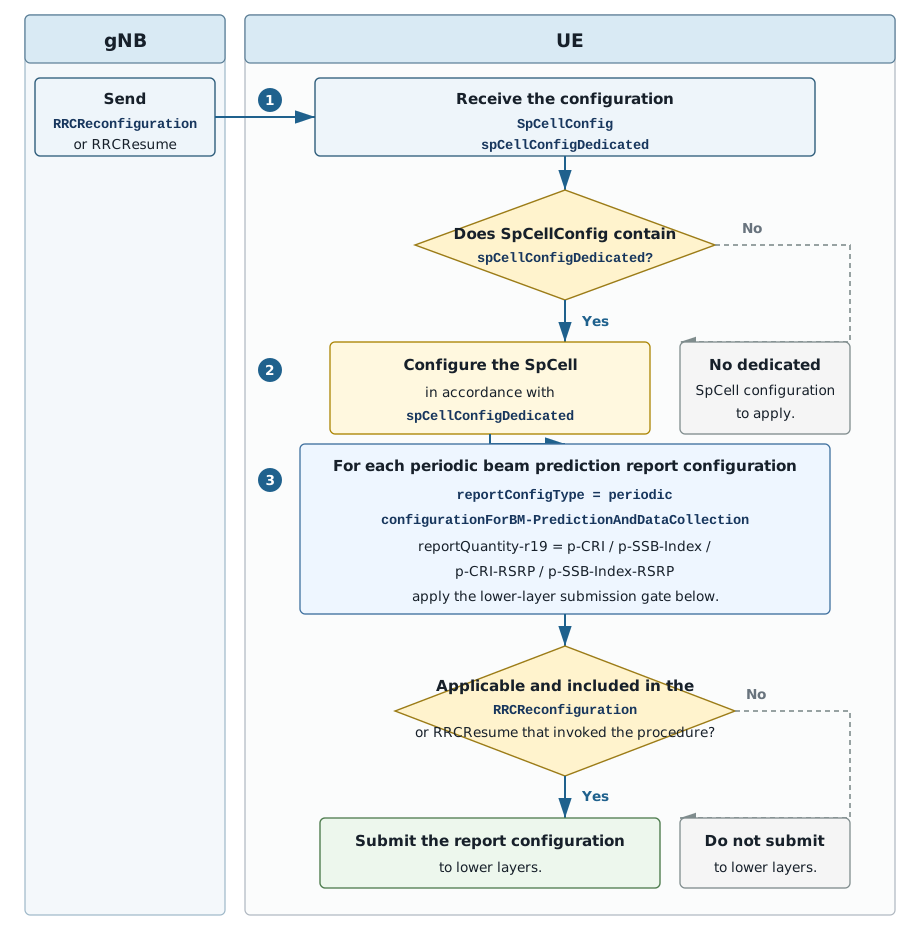
The UE shall:
2> if the SpCellConfig contains spCellConfigDedicated:
3> configure the SpCell in accordance with the spCellConfigDedicated;
NOTE: CSI report configurations including reportConfigType set to periodic and configurationForBM-PredictionAndDataCollection with reportQuantity-r19 set to p-CRI or p-SSB-Index or p-CRI-RSRP or p-SSB-Index-RSRP are submitted to lower layers only if they are applicable and included in the RRCReconfiguration message or RRCResume message that invoked the procedure.
5.3.5.5.9 SCell Addition/Modification
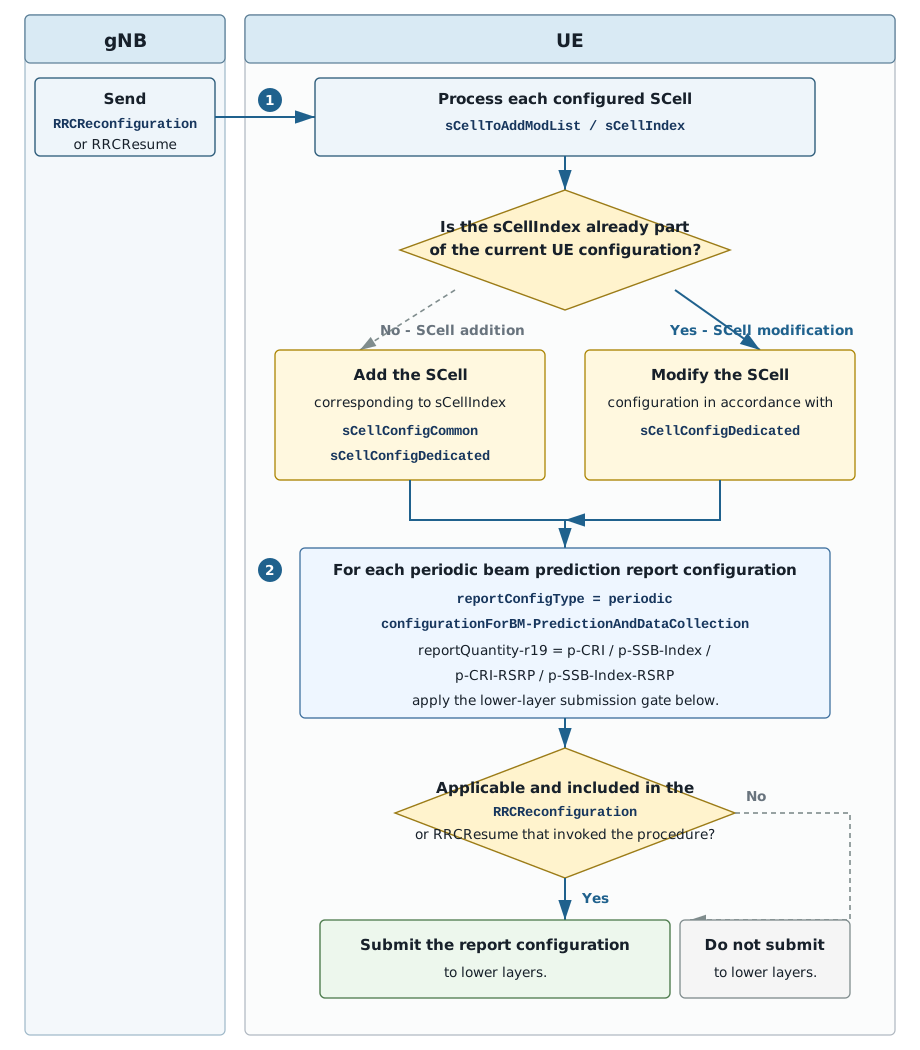
The UE shall:
1> for each sCellIndex value included in the sCellToAddModList that is not part of the current UE configuration (SCell addition):
2> add the SCell, corresponding to the sCellIndex, in accordance with the sCellConfigCommon and sCellConfigDedicated;
NOTE1: CSI report configurations including reportConfigType set to periodic and configurationForBM-PredictionAndDataCollection with reportQuantity-r19 set to p-CRI or p-SSB-Index or p-CRI-RSRP or p-SSB-Index-RSRP are submitted to lower layers only if they are applicable and included in the RRCReconfiguration message or RRCResume message that invoked the procedure.
1> for each sCellIndex value included in the sCellToAddModList that is part of the current UE configuration (SCell modification):
2> modify the SCell configuration in accordance with the sCellConfigDedicated;
NOTE 2: CSI report configurations including reportConfigType set to periodic and configurationForBM-PredictionAndDataCollection with reportQuantity-r19 set to p-CRI or p-SSB-Index or p-CRI-RSRP or p-SSB-Index-RSRP are submitted to lower layers only if they are applicable and included in the RRCReconfiguration message or RRCResume message that invoked the procedure.
5.3.13.4 Reception of the RRCResume by the UE
1> set the content of the of RRCResumeComplete message as follows:
2> if, for at least one serving cell, the UE is configured with at least one reportConfigId associated to a CSI-ReportConfig including csi-InferencePrediction, or including configurationForBM-PredictionAndDataCollection with reportQuantity-r19 set to p-CRI or p-SSB-Index or p-CRI-RSRP or p-SSB-Index-RSRP:
3> for each such serving cell, include an entry in the applicabilityReportList and set the content as follows:
4> set the applicabilityCellId to the serving cell index of the cell;
4> for each configured reportConfigId associated to a CSI-ReportConfig including csi-InferencePrediction, or including configurationForBM-PredictionAndDataCollection with reportQuantity-r19 set to p-CRI or p-SSB-Index or p-CRI-RSRP or p-SSB-Index-RSRP:
5> include an entry in the applicabilityInfoReportList and set the content as follows:
6> set the csi-ReportConfigId within applicabilityInfoReportId to the corresponding reportConfigId;
6> set the applicabilityStatus to the applicability status of the configuration corresponding to the applicabilityInfoReportId;
6> if the applicabilityStatus is set to inapplicable:
7> if the UE prefers to release the concerned CSI-ReportConfig, include releaseConfigurationPreference;
5.7.4 UE Assistance Information
5.7.4.1 General
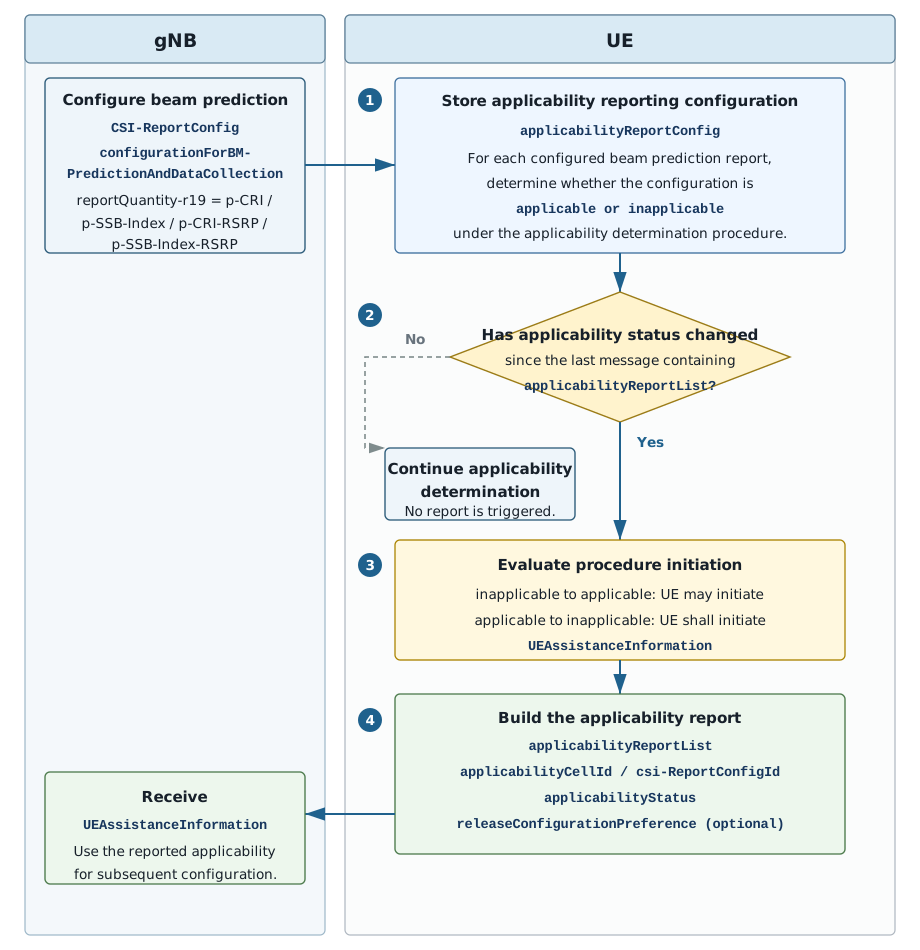
The purpose of this procedure is for the UE to inform the network of:
- applicability of configurations subject to the applicability determination procedure; or
5.7.4.2 Initiation
A UE capable of applicability reporting based on inference configuration provided via CSI-ReportConfig or based on inference related parameter configuration provided via OtherConfig may initiate the procedure if it was configured with configurations subject to the applicability determination procedure (i.e. CSI report configurations including csi-InferencePrediction or, if disableApplicabilityCSI-ReportConfig in applicabilityReportConfig is not configured, including configurationForBM-PredictionAndDataCollection with reportQuantity-r19 set to p-CRI or p-SSB-Index or p-CRI-RSRP or p-SSB-Index-RSRP, or ApplicabilitySetConfigCSI configurations), upon determining that the applicability of a configuration subject to the applicability determination procedure changed from inapplicable to applicable. A UE capable of applicability reporting based on inference configuration provided via CSI-ReportConfig or based on inference related parameter configuration provided via OtherConfig shall initiate the procedure if it was configured with configurations subject to the applicability determination procedure, upon determining that the applicability of a configuration subject to the applicability determination procedure changed from applicable to inapplicable.
Upon initiating the procedure, the UE shall:
1> if configured with configurations subject to the applicability determination procedure (i.e. CSI report configurations including csi-InferencePrediction or, if disableApplicabilityCSI-ReportConfig in applicabilityReportConfig is not configured, including configurationForBM-PredictionAndDataCollection with reportQuantity-r19 set to p-CRI or p-SSB-Index or p-CRI-RSRP or p-SSB-Index-RSRP, or ApplicabilitySetConfigCSI configurations):
2> if the applicability status of configurations subject to the applicability determination procedure has changed since the last transmission of a message containing applicabilityReportList (in RRCReconfigurationComplete or in UEAssistanceInformation or in RRCResumeComplete):
3> initiate transmission of the UEAssistanceInformation message in accordance with 5.7.4.3 to report assistance information about the applicability of configurations subject to the applicability determination procedure;
5.7.4.3 Actions related to transmission of UEAssistanceInformation message
The UE shall set the contents of the UEAssistanceInformation message as follows:
1> if transmission of the UEAssistanceInformation message is initiated to report assistance information about the applicability of configurations subject to applicability determination procedure according to 5.7.4.2:
2> include applicabilityReportList in this UEAssistanceInformation message;
2> for each serving cell:
3> if the cell is configured with at least one reportConfigId associated to a CSI-ReportConfig including csi-InferencePrediction, or, if disableApplicabilityCSI-ReportConfig in applicabilityReportConfig is not configured, including configurationForBM-PredictionAndDataCollection with reportQuantity-r19 set to p-CRI or p-SSB-Index or p-CRI-RSRP or p-SSB-Index-RSRP, for which the applicability status has changed; or
4> include an entry in applicabilityReportList in the UEAssistanceInformation message, and set the content as follows:
5> set the applicabilityCellId to the serving cell index of the cell;
5> for each configured reportConfigId associated to a CSI-ReportConfig including csi-InferencePrediction, or, if disableApplicabilityCSI-ReportConfig in applicabilityReportConfig is not configured, including configurationForBM-PredictionAndDataCollection with reportQuantity-r19 set to p-CRI or p-SSB-Index or p-CRI-RSRP or p-SSB-Index-RSRP, for which the applicability status has changed:
6> include an entry in the applicabilityInfoReportList and set the content as follows:
7> set the csi-ReportConfigId within applicabilityInfoReportId to the corresponding reportConfigId;
7> set the applicabilityStatus to the applicability status of the configuration corresponding to the applicabilityInfoReportId;
7> if the applicabilityStatus is set to inapplicable:
8> if the UE prefers to release the concerned CSI-ReportConfig, include releaseConfigurationPreference;
RRC Parameters
Beam prediction capabilities live in a different place from the CSI ones. They sit in MIMO-ParametersPerBand rather than in a band combination IE, because the capability is a property of the antenna panel and the band rather than of carrier aggregation.
Following is based on
MIMO-ParametersPerBand ::= SEQUENCE {
    aiml-CSI-PredictionDoppler-r19              CodebookParametersCSI-PredictionDoppler-r19 OPTIONAL,

    -- R1 58-0-1: CSI report framework for UE-side inference
    aiml-CSI-Report-r19                         SEQUENCE (SIZE (1..2)) OF CPU-PoolInfo-r19 OPTIONAL,

    -- R1 58-1-2: UE-side beam prediction for BM Case1 for inference
    aiml-BM-Case1-r19                           SEQUENCE {
        maxNumberOfInferenceReportPerBWP-r19    SEQUENCE {
            periodicReporting-r19               INTEGER (1..4),
            aperiodicReporting-r19              INTEGER (1..4),
            semiPersistentReporting-r19         INTEGER (1..4)
        },
        maxNumberOfInferenceReportAcrossAllCC-r19
                                               ENUMERATED { n1, n2, n3, n4, n8, n10, n12, n16 },
        maxNumberOfResourceSetB-r19            ENUMERATED { n4, n8, n16 },
        maxNumberOfResourceSetA-r19            ENUMERATED { n8, n16, n32, n64 },
        resourceTypeSetB-CSI-RS-r19            SEQUENCE {
            periodic-r19                       ENUMERATED { supported } OPTIONAL,
            aperiodic-r19                      ENUMERATED { supported } OPTIONAL,
            semiPersistent-r19                 ENUMERATED { supported } OPTIONAL
        },
        inferenceReportType-r19                SEQUENCE {
            periodic-r19                       ENUMERATED { supported } OPTIONAL,
            aperiodic-r19                      ENUMERATED { supported } OPTIONAL,
            semiPersistent-r19                 ENUMERATED { supported } OPTIONAL
        },
        subUseCases-r19                        ENUMERATED { subset, diffSet, both },
        maxNumberOfPredictedBeamPerReportingInstance-r19
                                               INTEGER (1..4),
        numberOfOccupiedCPU-r19                INTEGER (0..8),
        numberOfOccupiedCPUx-r19               INTEGER (0..8),
        relaxationTimelineD-r19                SEQUENCE {
            scs15kHz-r19                       ENUMERATED { n7, n14, n21, n28, n35, n42, n56 },
            scs30kHz-r19                       ENUMERATED { n14, n28, n42, n56, n70, n84, n112 },
            scs60kHz-r19                       ENUMERATED { n28, n56, n84, n112, n140, n168, n224 },
            scs120kHz-r19                      ENUMERATED { n56, n112, n168, n224, n280, n336, n448 },
            scs480kHz-r19                      ENUMERATED { n224, n448, n672, n896, n1120, n1344, n1792 },
            scs960kHz-r19                      ENUMERATED { n448, n896, n1344, n1792 }
        },
        relaxationTimelineD1-r19               SEQUENCE {
            scs15kHz-r19                       ENUMERATED { n7, n14, n21, n28, n35, n42, n56 },
            scs30kHz-r19                       ENUMERATED { n14, n28, n42, n56, n70, n84, n112 },
            scs60kHz-r19                       ENUMERATED { n28, n56, n84, n112, n140, n168, n224 },
            scs120kHz-r19                      ENUMERATED { n56, n112, n168, n224, n280, n336, n448 },
            scs480kHz-r19                      ENUMERATED { n224, n448, n672, n896, n1120, n1344, n1792 },
            scs960kHz-r19                      ENUMERATED { n448, n896, n1344, n1792 }
        },
        occupiedResourcePool-r19               INTEGER (1..2)
    } OPTIONAL,

    -- R1 58-1-3: UE-side beam prediction for BM Case1 with predicted RSRP for inference
    aiml-BM-Case1-PredictedRSRP-r19            INTEGER (1..4) OPTIONAL,

    -- R1 58-1-4: UE-side beam prediction for BM Case2 for inference
    aiml-BM-Case2-r19                          SEQUENCE {
        maxNumberOfInferenceReportPerBWP-r19   SEQUENCE {
            periodicReporting-r19              INTEGER (1..4),
            aperiodicReporting-r19             INTEGER (1..4),
            semiPersistentReporting-r19        INTEGER (1..4)
        },
        maxNumberOfInferenceReportAcrossAllCC-r19
                                               ENUMERATED { n1, n2, n3, n4, n8, n10, n12, n16 },
        maxNumberOfResourceSetB-r19            ENUMERATED { n4, n8, n16, n32, n64 },
        maxNumberOfResourceSetA-r19            ENUMERATED { n4, n8, n16, n32, n64 },
        minNumberOfKBM-SetB-r19                ENUMERATED { n2, n4, n8 },
        resourceTypeSetB-CSI-RS-r19            SEQUENCE {
            periodic-r19                       ENUMERATED { supported } OPTIONAL,
            semiPersistent-r19                 ENUMERATED { supported } OPTIONAL
        },
        inferenceReportType-r19                SEQUENCE {
            periodic-r19                       ENUMERATED { supported } OPTIONAL,
            aperiodic-r19                      ENUMERATED { supported } OPTIONAL,
            semiPersistent-r19                 ENUMERATED { supported } OPTIONAL
        },
        maxNumberOfPredictedBeamPerPerTimeInstance-r19
                                               INTEGER (1..4),
        maxNumberOfPredictedTimeInstance-r19   ENUMERATED { n1, n2, n4, n8 },
        maxTotalNumberOfPredictedBeamPerReport-r19
                                               ENUMERATED { n1, n2, n4, n6, n8, n12, n16, n32 },
        dummy-TimeGap-r19                      ENUMERATED { ms10, ms20, ms40, ms80, ms160 },
        numberOfOccupiedCPU-r19                INTEGER (0..8),
        numberOfOccupiedCPUx-r19               INTEGER (0..8),
        relaxationTimelineD-r19                SEQUENCE {
            scs15kHz-r19                       ENUMERATED { n14, n28, n42, n56, n70, n84, n98 },
            scs30kHz-r19                       ENUMERATED { n28, n56, n84, n112, n140, n168, n196 },
            scs60kHz-r19                       ENUMERATED { n56, n112, n168, n224, n280, n336, n392 },
            scs120kHz-r19                      ENUMERATED { n112, n224, n336, n448 },
            scs480kHz-r19                      ENUMERATED { n448, n896, n1344, n1792 },
            scs960kHz-r19                      ENUMERATED { n896, n1792 }
        },
        relaxationTimelineD1-r19               SEQUENCE {
            scs15kHz-r19                       ENUMERATED { n14, n28, n42, n56, n70, n84, n98 },
            scs30kHz-r19                       ENUMERATED { n28, n56, n84, n112, n140, n168, n196 },
            scs60kHz-r19                       ENUMERATED { n56, n112, n168, n224, n280, n336, n392 },
            scs120kHz-r19                      ENUMERATED { n112, n224, n336, n448 },
            scs480kHz-r19                      ENUMERATED { n448, n896, n1344, n1792 },
            scs960kHz-r19                      ENUMERATED { n896, n1792 }
        },
        occupiedResourcePool-r19               INTEGER (1..2)
    } OPTIONAL,

    -- R1 58-1-5: UE-side beam prediction for BM-Case2 with predicted RSRP for inference
    aiml-BM-Case2-PredictedRSRP-r19            SEQUENCE {
        maxNumPredictedBeamPerInstance-r19     INTEGER (1..4),
        maxNumPredictedTime-r19                ENUMERATED { n1, n2, n4, n8 },
        maxTotalNumPredictedBeamInOneReport-r19
                                               ENUMERATED { n1, n2, n3, n4, n6, n8, n12, n16, n24, n32 }
    } OPTIONAL,

    -- R1 58-1-6: Performance monitoring for UE-sided model
    aiml-BM-Monitoring-r19                     SEQUENCE {
        maxNumTotalResource-r19                ENUMERATED { n4, n8, n16, n32, n64 },
        maxNumReportPerBWP-Periodic-r19        INTEGER (1..4),
        maxNumReportPerBWP-Aperiodic-r19       INTEGER (1..4),
        maxNumReportPerBWP-SP-r19              INTEGER (1..4),
        maxNumReportAcrossAllCC-r19            ENUMERATED { n1, n2, n4, n8 },
        maxNumOccasion-r19                     ENUMERATED { n1, n3, n7, n15 },
        monitoringResourceType-r19             ENUMERATED { periodic, semipersistent },
        monitoringReportType-r19               ENUMERATED { periodic, aperiodic, semipersistent }
    } OPTIONAL,

    -- R1 58-1-7: Data collection for UE-side beam prediction
    aiml-BM-UE-DataCollection-r19              SEQUENCE {
        subCase-r19                            ENUMERATED { equal, subset, notSubset },
        maxNumResourceSetB-r19                 ENUMERATED { n4, n8, n16, n32, n64 },
        maxNumResourceSetA-r19                 ENUMERATED { n8, n16, n32, n64 }
    } OPTIONAL,

    -- R1 58-3-1: CSI prediction for UE-sided inference when N4=1
    aiml-CSI-Prediction-r19                    SEQUENCE {
        supportedCSI-RS-ResourceList-r19       SEQUENCE (SIZE (1..maxNrofCSI-RS-ResourcesExt-r16)) OF INTEGER
                                                   (0..maxNrofCSI-RS-ResourcesAlt-1-r16),
        scalingFactor-r19                      ENUMERATED { n1, n2, n4 },
        numberOfOccupiedCPU-r19                INTEGER (0..8),
        numberOfOccupiedCPUx-r19               INTEGER (0..8),
        relaxationTimelineT-r19                SEQUENCE {
            scs15kHz-r19                       ENUMERATED { n14, n28, n56, n112 },
            scs30kHz-r19                       ENUMERATED { n28, n56, n112, n224 },
            scs60kHz-r19                       ENUMERATED { n56, n112, n224, n448 },
            scs120kHz-r19                      ENUMERATED { n112, n224, n448 },
            scs480kHz-r19                      ENUMERATED { n448, n896, n1792 },
            scs960kHz-r19                      ENUMERATED { n896, n1792 }
        },
        occupiedResourcePool-r19               INTEGER (1..2),
        inferenceReportType-r19                SEQUENCE {
            aperiodic-r19                      ENUMERATED { supported },
            semiPersistent-r19                 ENUMERATED { supported }
        }
    } OPTIONAL,

    -- R1 58-3-1a-1: DD unit size when A-CSI-RS is configured for CMR N4>1 for UE side inference of CSI prediction
    aiml-CSI-PredictionUnitDurationDD-r19      ENUMERATED { supported } OPTIONAL,

    -- R1 58-3-2: CSI prediction for UE-sided inference when N4>1
    aiml-CSI-PredictionN4-r19                  SEQUENCE {
        supportedCSI-RS-ReportSettingAcrossAllCC-r19
                                               SEQUENCE (SIZE (1..maxNrofCSI-RS-ResourcesExt-r16)) OF
                                                   SupportedCSI-RS-ReportSetting-r18,
        supportedCSI-RS-ReportSettingAcrossOneReport-r19
                                               SEQUENCE (SIZE (1..maxNrofCSI-RS-ResourcesExt-r16)) OF
                                                   SupportedCSI-RS-ReportSetting-r18,
        numOccupiedCPU-r19                     INTEGER (0..8),
        numOccupiedCPUx-r19                    INTEGER (0..8),
        occupiedPool-r19                       INTEGER (1..2)
    } OPTIONAL,

    -- R1 58-3-4: UE side data collection for CSI prediction
    aiml-CSI-PredictionUE-DataCollection-r19   ENUMERATED { supported } OPTIONAL,

    -- R1 58-3-5: Performance monitoring for CSI prediction model
    aiml-CSI-PredictionMonitoring-r19          SEQUENCE {
        supportedCSI-RS-ResourceList-r19       SEQUENCE (SIZE (1..maxNrofCSI-RS-ResourcesExt-r16)) OF INTEGER
                                                   (0..maxNrofCSI-RS-ResourcesAlt-1-r16),
        numOccupiedCPU-r19                     INTEGER (1..2)
    } OPTIONAL,
    ...,
    [[
    -- Time gap for BM Case2: bitmap of supported time gaps (ms10, ms20, ms40, ms80, ms160)
    aiml-BM-Case2-v1920                        SEQUENCE {
        timeGap-r19                                BIT STRING (SIZE (5))
    } OPTIONAL
    ]]
}

CodebookParametersCSI-PredictionDoppler-r19 ::= SEQUENCE {
    -- R1 58-3-1b: Maximum number of aperiodic CSI-RS resources that can be configured in the same CSI report setting for Rel-16-based
    -- doppler measurement for UE side inference of CSI prediction
    maxNumberOfAperiodic-CSI-RS-Resource-r19      ENUMERATED { n4, n8, n12 } OPTIONAL,

    -- R1 58-3-1-2: Support R=2 for Rel-16-based doppler codebook for UE side inference of CSI prediction
    eType2DopplerR2-r19                           SEQUENCE (SIZE (1..maxNrofCSI-RS-ResourcesExt-r16)) OF INTEGER
                                                      (0..maxNrofCSI-RS-ResourcesAlt-1-r16) OPTIONAL,

    -- R1 58-3-1-3: Support X=1 based on first and last slot of WCSI, for Rel-16-based doppler codebook for UE side inference of CSI prediction
    eType2DopplerX1-r19                           ENUMERATED { supported } OPTIONAL,

    -- R1 58-3-1-3a: Support X=2 CQI based on 2 slots for Rel-16-based doppler codebook for UE side inference of CSI prediction
    eType2DopplerX2-r19                           ENUMERATED { supported } OPTIONAL,

    -- R1 58-3-1-4: Support of l = (n - nCSI,ref) for CSI reference slot for Rel-16 based doppler codebook for UE side inference of CSI prediction
    eType2DopplerL-N4D1-r19                       ENUMERATED { supported } OPTIONAL,

    -- R1 58-3-1-5: Support of L=6 for Rel-16 based doppler codebook for UE side inference of CSI prediction
    eType2DopplerL6-r19                           ENUMERATED { supported } OPTIONAL,

    -- R1 58-3-1-6: Support of rank equals 3 and 4 for Rel-16 based doppler codebook for UE side inference of CSI prediction
    eType2DopplerR3R4-r19                         ENUMERATED { supported } OPTIONAL,

    -- R1 58-3-1-7: Active CSI-RS resources and ports for mixed R16 based doppler codebook for CSI prediction via UE side model with
    -- other codebooks in any slot
    codebookComboParameterMixedTypePrediction-r19 SEQUENCE {
        type1SP-Type1SP-N4-r19                    SEQUENCE (SIZE (1..maxNrofCSI-RS-ResourcesExt-r16)) OF INTEGER
                                                      (0..maxNrofCSI-RS-ResourcesAlt-1-r16) OPTIONAL,
        type1SP-eType2SP-r19                      SEQUENCE (SIZE (1..maxNrofCSI-RS-ResourcesExt-r16)) OF INTEGER
                                                      (0..maxNrofCSI-RS-ResourcesAlt-1-r16) OPTIONAL,
        type1SP-eType2SP-N4-r19                   SEQUENCE (SIZE (1..maxNrofCSI-RS-ResourcesExt-r16)) OF INTEGER
                                                      (0..maxNrofCSI-RS-ResourcesAlt-1-r16) OPTIONAL,
        type1SP-N4-eType2SP-r19                   SEQUENCE (SIZE (1..maxNrofCSI-RS-ResourcesExt-r16)) OF INTEGER
                                                      (0..maxNrofCSI-RS-ResourcesAlt-1-r16) OPTIONAL,
        type1SP-N4-eType2SP-N4-r19                SEQUENCE (SIZE (1..maxNrofCSI-RS-ResourcesExt-r16)) OF INTEGER
                                                      (0..maxNrofCSI-RS-ResourcesAlt-1-r16) OPTIONAL,
        eType2SP-eType2SP-N4-r19                  SEQUENCE (SIZE (1..maxNrofCSI-RS-ResourcesExt-r16)) OF INTEGER
                                                      (0..maxNrofCSI-RS-ResourcesAlt-1-r16) OPTIONAL
    } OPTIONAL
}

CPU-PoolInfo-r19 ::= SEQUENCE {
    maxNumCPU-PerCC-r19      INTEGER (1..8),
    maxNumCPU-AllCC-r19      INTEGER (1..32)
}
In addition to MIMO-ParametersPerBand, Release 19 adds per-band RF capabilities in BandNR indicating support of beam prediction under the known Rx beam condition :
Following is based on
BandNR ::= SEQUENCE {
    ...
    -- R4 59-1: UE-side beam prediction for BM Case1
    aiml-BM-Case1-KnownRxBeam-r19              ENUMERATED { supported } OPTIONAL,
    -- R4 59-2: UE-side beam prediction for BM Case2
    aiml-BM-Case2-KnownRxBeam-r19              ENUMERATED { supported } OPTIONAL,
    ...
}
Followings are short descriptions on important parameters
maxNumPredictedBeam-r19 : Indicates how many future candidate beams the UE can predict and report in a single AI-based Beam Management report.maxNumberOfPredictedTimeInstance-r19 : Indicates how many future time points the UE can predict, especially for Case 2 temporal beam prediction.dummy-TimeGap-r19 / aiml-BM-Case2-v1920 : Defines the spacing between future prediction points. In the released ASN.1 the original enumerated timeGap field is frozen as dummy-TimeGap-r19 (not used by the network), and the time gap capability is instead reported in aiml-BM-Case2-v1920 as a 5-bit bitmap in which each bit indicates support of ms10, ms20, ms40, ms80 or ms160. This tells the network how far apart the predicted beam states are in time.maxNumberOfResourceSetA-r19 : Indicates how many measured beam resource sets the UE can use as observation input to the AI model.maxNumberOfResourceSetB-r19 : Indicates how many target beam resource sets the UE can predict as output of the AI model.aiml-BM-Case1-PredictedRSRP-r19 : Indicates support for reporting predicted RSRP rather than only measured RSRP for beam management.maxNumOccasion-r19 : Defines how many monitoring occasions can be used when the network evaluates prediction accuracy over time.relaxationTimelineD-r19 : Indicates the extra processing time the UE may need to complete beam prediction inference and prepare the report.relaxationTimelineD1-r19 : Indicates additional processing time needed for more complex operations such as concurrent data collection or advanced multi-beam handling.occupiedResourcePool-r19 : Identifies which internal UE processing or hardware resource pool is assigned to the beam management task.subset / diffSet related parameters : Indicate the relationship between the measured beam set and the predicted beam set, such as whether prediction is made within the same set or across different sets.aiml-BM-Case1-r19 : Represents support for AI-based beam prediction for the current or immediate next beam decision.aiml-BM-Case2-r19 : Represents support for more advanced temporal prediction where the UE predicts a sequence of future best beams over multiple time instances.aiml-BM-Case1-KnownRxBeam-r19 / aiml-BM-Case2-KnownRxBeam-r19 : Per-band RF capabilities signalled in BandNR, indicating that the UE supports beam prediction for Case 1 / Case 2 under the known Rx beam condition, i.e. the RAN4 measurement requirements assuming the UE already knows the suitable Rx beam.
AI-BM Case 1 vs. Case 2
Case 1 and Case 2 are the two main AI-based Beam Management approaches in Release 19, but they emphasize different dimensions of prediction. Case 1 is more of a spatial prediction problem. It focuses on identifying the best beam among candidate beams for the current moment or the immediate next moment based on the current observation. In other words, it is mainly about selecting the best direction in space. Case 2 extends this idea into the temporal domain. It predicts how the best beam will change over multiple future time instances, so the network can anticipate beam evolution ahead of time. In simple terms, Case 1 is mainly about spatial beam selection, while Case 2 is about time-evolving beam prediction.
Case 1 refers to intra-unit prediction(Spatial prediction). The UE predicts the best beam for the current time instance or the immediate next time instance based on current measurements.Case 2 refers to temporal prediction. The UE predicts a sequence of future best beams across multiple future time instances.maxNumberOfPredictedTimeInstance-r19 indicates how many future time points the UE can predict.timeGap-r19 (signalled via aiml-BM-Case2-v1920) defines the spacing between those future prediction points.- Case 1 is mainly about immediate refinement and accuracy, while Case 2 is about proactive beam tracking over time.
Resource Set A and Resource Set B
Resource Set A and Resource Set B define the basic input-output structure of AI-based Beam Management. One set represents what the UE actually measures from the radio environment, and the other set represents what the UE tries to predict with AI. In high-level terms, this allows the UE to observe a limited number of real reference signals and then use those observations to estimate the quality of a larger or different set of candidate beams. This structure is important because the UE cannot always measure every possible beam directly in real time. Instead, it measures a practical observation set and uses AI to infer the expected quality or best beam choice for the prediction set.
maxNumberOfResourceSetA-r19 indicates the number of measured resource sets that can be used as AI model input.maxNumberOfResourceSetB-r19 indicates the number of target resource sets whose beam quality the AI model can predict.Resource Set A is the observation set. These are the SSB or CSI-RS resources that the UE actually measures.Resource Set B is the prediction set. These are the beams or resources whose future quality the UE tries to predict.subset means the predicted beams in Set B are a smaller group within the measured beams in Set A.diffSet means the predicted beams are different from the measured beams, such as using measurements on one frequency to predict beams on another frequency.
In summary :
|
Feature |
Set B (Input) |
Set A (Output) |
|---|---|---|
|
Role |
Observation Set: What the UE actually measures in the physical world. |
Prediction Set: The full list of potential beams the network wants to evaluate. |
|
Quantity |
Small (e.g., 8 beams) |
Large (e.g., 64 beams) |
|
UE Task |
Performs L1-RSRP measurements on these resources. |
Runs AI inference to predict the RSRP or "Best Beam ID" for this set. |
Predicted RSRP
Predicted RSRP is one of the key ideas that makes AI-based Beam Management different from legacy beam reporting. In the legacy approach, the UE can only report the signal power that it has already measured. In the AI-based approach, the UE can go one step further and report the signal power it expects to see in the near future for a candidate beam. Through aiml-BM-Case1-PredictedRSRP-r19, the UE provides the gNB with a forward-looking estimate rather than only a backward-looking measurement. This allows the network to make proactive beam decisions before signal quality actually degrades, which can improve beam stability and reduce the risk of sudden beam failure.
- In legacy Beam Management, the UE reports the RSRP that it has already measured.
- In AI-based Beam Management, the UE can report
Predicted RSRP throughaiml-BM-Case1-PredictedRSRP-r19 . - This means the UE reports the expected beam power before actually reaching that beam condition.
- This allows the gNB to make proactive beam decisions instead of waiting for signal quality to drop.
Relaxation Timeline D and D1
Relaxation Timeline D and D1 define the extra processing time that the UE may need when performing AI-based Beam Management. Unlike conventional beam reporting, AI-based prediction requires additional computation for inference, report generation, and sometimes simultaneous data collection or more complex multi-beam processing. relaxationTimelineD represents the extra time needed for the basic inference and reporting procedure, while relaxationTimelineD1 represents additional time that may be required for more advanced or parallel operations. At a high level, these parameters allow the UE to inform the network that AI processing cannot always fit into the same timing budget as legacy beam management, especially when NPU or GPU based computation is involved.
relaxationTimelineD indicates the extra time the UE needs to run AI inference and prepare the Beam Management report.relaxationTimelineD1 indicates additional time that may be needed for more complex operations, such as concurrent data collection or multi-beam processing.- These parameters are important because AI-based Beam Management requires more processing time than conventional beam reporting.
- They allow the UE to signal that extra time is needed for NPU or GPU based processing.
Applicability Reporting
The procedure text quoted in the two sections above keeps naming IEs that the listings so far have not shown. The names applicabilityReportConfig, ApplicabilityConfig and ApplicabilitySetConfigCSI all appear in those steps, and this section is where they are defined.
The problem they solve is specific to a model rather than to a radio measurement. A trained model is valid for the conditions it was trained on, and a configuration the network hands out may fall outside those conditions. The UE is the only node that can tell.
So the network configures what it wants an opinion on, and the UE answers with an applicable or inapplicable verdict per configuration. Nothing in the exchange describes the model, and that is the point of the design.
What the network configures
Three IEs nest inside each other here, and reading them from the outside in makes the structure clear. The outer one is per UE, the middle one is per serving cell, and the inner one is the individual configuration the UE is asked to judge.
Following is based on
ApplicabilityReportConfig-r19 ::= SEQUENCE {
    applicabilityConfigToAddModList-r19    SEQUENCE (SIZE (1..maxNrofServingCells)) OF ApplicabilityConfig-r19       OPTIONAL, -- Need N
    applicabilityConfigToReleaseList-r19   SEQUENCE (SIZE (1..maxNrofServingCells)) OF ServCellIndex                 OPTIONAL, -- Need N
    disableApplicabilityCSI-ReportConfig-r19     ENUMERATED {true}                                                   OPTIONAL, -- Need R
    ...
}

ApplicabilityConfig-r19 ::=       SEQUENCE {
    applicabilityConfigCellId-r19    ServCellIndex,
    applicabilitySetConfigCSI-ToAddModList-r19   SEQUENCE (SIZE (1..maxNrofApplicabilitySetCSI-Configs-r19)) OF ApplicabilitySetConfigCSI-r19
                                                                                                                     OPTIONAL, -- Need N
    applicabilitySetConfigCSI-ToReleaseList-r19   SEQUENCE (SIZE (1..maxNrofApplicabilitySetCSI-Configs-r19)) OF ApplicabilitySetConfigId-r19
                                                                                                                     OPTIONAL, -- Need N
    ...
}

ApplicabilitySetConfigCSI-r19 ::=       SEQUENCE {
    applicabilitySetConfigId-r19            ApplicabilitySetConfigId-r19,
    resourcesForChannelMeasurement-r19      CSI-ResourceConfigId                                                     OPTIONAL, -- Need R
    resourcesForChannelPrediction-r19       CSI-ResourceConfigId                                                     OPTIONAL, -- Need R
    associatedIdForChannelMeasurement-r19   AssociatedId-r19                                                         OPTIONAL, -- Need R
    associatedIdForChannelPrediction-r19    AssociatedId-r19                                                         OPTIONAL, -- Need R
    reportQuantity-r19                      CHOICE {
                                                p-CRI-r19                   NULL,
                                                p-SSB-Index-r19             NULL,
                                                p-CRI-RSRP-r19              NULL,
                                                p-SSB-Index-RSRP-r19        NULL
    }                                                                                                                OPTIONAL, -- Need R
    reportConfigType-r19                    CHOICE {
        periodic                                SEQUENCE {
            reportSlotConfig-r19                    CSI-ReportPeriodicityAndOffset,
            pucch-CSI-ResourceList-r19              SEQUENCE (SIZE (1..maxNrofBWPs)) OF PUCCH-CSI-Resource
        },
        semiPersistentOnPUCCH                   SEQUENCE {
            reportSlotConfig-r19                    CSI-ReportPeriodicityAndOffset,
            pucch-CSI-ResourceList-r19              SEQUENCE (SIZE (1..maxNrofBWPs)) OF PUCCH-CSI-Resource
        },
        semiPersistentOnPUSCH                   SEQUENCE {
            reportSlotConfig-r19                    ENUMERATED {sl5, sl10, sl20, sl40, sl80, sl160, sl320},
            reportSlotOffsetList-r19                SEQUENCE (SIZE (1.. maxNrofUL-Allocations)) OF INTEGER(0..32),
            p0alpha-r19                             P0-PUSCH-AlphaSetId
        },
        aperiodic                               SEQUENCE {
            reportSlotOffsetList-r19                SEQUENCE (SIZE (1..maxNrofUL-Allocations)) OF INTEGER(0..32)
        }
    }                                                                                                                OPTIONAL, -- Need R
    nrofReportedPredictedRS-r19                 ENUMERATED {n1, n2, n3, n4}                                          OPTIONAL, -- Need R
    nrofTimeInstance-r19                        ENUMERATED {n1, n2, n4, n8}                                          OPTIONAL, -- Need R
    timeGap-r19                                 ENUMERATED {ms10, ms20, ms40, ms80, ms160, spare3, spare2, spare1}   OPTIONAL, -- Need R
    ...
}

ApplicabilitySetConfigId-r19 ::=            INTEGER (0..maxNrofApplicabilitySetCSI-Configs-1-r19)
Four points are worth pulling out of that listing.
disableApplicabilityCSI-ReportConfig-r19 switches off the implicit route. Without it the UE judges every CSI-ReportConfig that carries csi-InferencePrediction or a beam prediction configuration, and with it the UE judges only what ApplicabilitySetConfigCSI names explicitly.applicabilityConfigCellId-r19 is a ServCellIndex, so the whole framework is per serving cell. A model that is applicable on one carrier can be inapplicable on another.ApplicabilitySetConfigCSI-r19 carries the same resource and associated-id fields as a prediction configuration, plus its own reportConfigType. It is a configuration the UE can be asked about without ever being told to run it.reportQuantity-r19 here offers only the four predicted beam quantities, p-CRI, p-SSB-Index, p-CRI-RSRP and p-SSB-Index-RSRP. The CSI side of the framework reaches the UE through CSI-ReportConfig instead.
What the UE reports back
The answer travels in three nested IEs that mirror the configuration. One entry per serving cell, one entry per judged configuration inside it, and a verdict at the bottom.
Following is based on
ApplicabilityReportList-r19 ::=      SEQUENCE (SIZE (1..maxNrofServingCells)) OF ApplicabilityReport-r19

ApplicabilityReport-r19 ::=          SEQUENCE {
    applicabilityCellId-r19              ServCellIndex,
    applicabilityInfoReportList-r19      SEQUENCE (SIZE (1..maxNrofApplicabilityReports-r19)) OF ApplicabilityInfoReport-r19  OPTIONAL,
    ...
}

ApplicabilityInfoReport-r19 ::=      SEQUENCE {
    applicabilityInfoReportId-r19        CHOICE {
        csi-ReportConfigId-r19               CSI-ReportConfigId,
        applicabilitySetId-r19               ApplicabilitySetConfigId-r19
    }                                                                                                                         OPTIONAL,
    applicabilityStatus-r19              ENUMERATED {applicable, inapplicable},
    releaseConfigurationPreference-r19   ENUMERATED {true}                                                                    OPTIONAL,
    ...
}
applicabilityStatus-r19 is the whole payload, and it takes one of two values. The UE says applicable or inapplicable, and it never says why.
releaseConfigurationPreference-r19 is the one extra signal. When the UE marks a configuration inapplicable, it may add this flag to say it would rather the network released the configuration than left it standing unused.
Where the report travels is worth noting, because it is not one message. The procedure text above carries applicabilityReportList in RRCReconfigurationComplete, in RRCResumeComplete and in UEAssistanceInformation, so the UE can answer when asked and also volunteer a change later.
Data Collection
Three of the five bits in AIML-Parameters-r19 are about collecting data rather than about running a model. The bits loggedDataCollection-r19, eventBasedLoggedDataCollection-r19 and dataThresholdAvailabilityIndication-r19 all point at this framework, and the UE Capability section names them without showing what they configure.
The reason a framework is needed at all is that a model has to be trained before it can infer. Training needs labelled measurements from the real radio environment, and the UE is where those measurements exist.
Two mechanisms sit side by side in the specification. One lets the UE say which configurations it would like to collect against, and the other lets the UE warn the network about memory and power while it logs.
Candidate configurations
The network does not simply order the UE to collect. It offers a menu of candidate configurations first, and each candidate says which resources the collection would use and what it would be collecting for.
Following is based on
DataCollectionPreferenceConfig-r19 ::=  SEQUENCE {
    dataCollectionCandidateConfigToAddModList-r19   SEQUENCE (SIZE (1..maxNrofServingCells)) OF DataCollectionCandidateConfig-r19
                                                                                                                     OPTIONAL, -- Need N
    dataCollectionCandidateConfigToReleaseList-r19   SEQUENCE (SIZE (1..maxNrofServingCells)) OF ServCellIndex
                                                                                                                     OPTIONAL, -- Need N
    ...
}

DataCollectionCandidateConfig-r19 ::=           SEQUENCE {
    dataCollectionServCellIndex-r19                 ServCellIndex,
    dataCollectionCandidateConfigParameterToAddModList-r19  SEQUENCE (SIZE (1..maxNrofDataCollectionCandidateConfigs-r19))
                                                          OF DataCollectionCandidateConfigParameters-r19             OPTIONAL, -- Need N
    dataCollectionCandidateConfigParameterToReleaseList-r19  SEQUENCE (SIZE (1..maxNrofDataCollectionCandidateConfigs-r19))
                                                          OF DataCollectionCandidateConfigId-r19                     OPTIONAL, -- Need N
    ...
}

DataCollectionCandidateConfigParameters-r19 ::= SEQUENCE {
    dataCollectionCandidateConfigId-r19             DataCollectionCandidateConfigId-r19,
    parameters-r19                          CHOICE {
        parametersForBM-r19                     SEQUENCE {
            resourcesForChannelMeasurement-r19      CSI-ResourceConfigId                                             OPTIONAL, -- Need R
            resourcesForChannelPrediction-r19       CSI-ResourceConfigId                                             OPTIONAL, -- Need R
            associatedIdForChannelMeasurement-r19   AssociatedId-r19                                                 OPTIONAL, -- Need R
            associatedIdForChannelPrediction-r19    AssociatedId-r19                                                 OPTIONAL, -- Need R
            timeGap-r19                             ENUMERATED {ms10, ms20, ms40, ms80, ms160, spare3, spare2, spare1}  OPTIONAL, -- Need R
            nrofTimeInstance-r19                    ENUMERATED {n1, n2, n4, n8}                                      OPTIONAL  -- Need R
        },
        parametersForCSI-InferencePrediction-r19    SEQUENCE {
            resourcesForChannelMeasurement-r19          CSI-ResourceConfigId                                         OPTIONAL, -- Need R
            codebookConfig-r19                          CodebookConfig-r18                                           OPTIONAL  -- Need R
        },
        ...
    },
    ...
}
The CHOICE at the bottom is the useful part. Its first branch, parametersForBM-r19, describes a beam management collection, with a prediction resource, a measurement resource, a time gap and a number of time instances. The second branch, parametersForCSI-InferencePrediction-r19, describes a CSI collection instead, and it needs only a measurement resource and a codebook.
Those two sets are the same inputs the inference configurations use, which is deliberate. Training data collected under a configuration the UE will later infer under is worth more than data collected under any other.
Preference and assistance
The UE answers the menu, and it also reports on its own condition while collecting. Both directions travel in UEAssistanceInformation rather than in a dedicated message.
Following is based on
DataCollectionPreference-r19 ::= SEQUENCE {
    dataCollectionRequest-r19                     ENUMERATED {true}                                                            OPTIONAL,
    dataCollectionPreferredConfigurationList-r19  SEQUENCE (SIZE (1..maxNrofServingCells)) OF DataCollectionCandidateList-r19  OPTIONAL,
    dataCollectionStopConfigurationList-r19       SEQUENCE (SIZE (1..maxNrofServingCells)) OF DataCollectionList-r19           OPTIONAL,
    ...
}

DataCollectionCandidateList-r19 ::= SEQUENCE {
    dataCollectionServCellIndex-r19         ServCellIndex,
    dataCollectionCandidateIdList-r19       SEQUENCE (SIZE (1..maxNrofDataCollectionCandidateConfigs-r19)) OF DataCollectionCandidateConfigId-r19
                                                                                                                     OPTIONAL
}

DataCollectionList-r19 ::=                SEQUENCE {
    dataCollectionStopServCellIndex-r19       ServCellIndex,
    dataCollectionIdList-r19                  SEQUENCE (SIZE (1..maxNrofCSI-ReportConfigurations)) OF CSI-ReportConfigId    OPTIONAL
}

LoggedDataCollectionAssistanceConfig-r19 ::= SEQUENCE {
    loggedDataCollectionMemoryThreshold-r19      ENUMERATED {kB16, kB32, kB48, spare1}                               OPTIONAL, -- Need R
    ...
}

LoggedDataCollectionAssistance-r19 ::=    SEQUENCE {
    lowPowerState-r19                         ENUMERATED {true}                                                             OPTIONAL,
    memoryStatus-r19                          ENUMERATED {full, aboveThreshold}                                             OPTIONAL,
    ...
}
Read dataCollectionRequest-r19 as the UE asking to start. The two lists beside it then say which candidates the UE would prefer, by id and per serving cell, and which running collections it would like stopped.
LoggedDataCollectionAssistance-r19 covers the other direction. Its memoryStatus-r19 field reports full or aboveThreshold, where the threshold is the one the network set in loggedDataCollectionMemoryThreshold-r19, and the choices there are 16, 32 or 48 kilobytes.
Those numbers say something about the scale of the feature. A 48 kilobyte log is a handful of measurement records rather than a training set, so the UE is a sensor feeding a process that trains elsewhere.
lowPowerState-r19 is the last field and the bluntest. The UE raises it to tell the network that collecting further data now would cost more battery than the UE is willing to spend.
Positioning
In 3GPP TS 38.331 V19.3.0 (2026-08), AI/ML-based positioning is not standardized as an RRC-controlled functionality. The specification defines the AIML-Parameters-r19 capability IE for AI/ML-based beam management and AI/ML-based CSI prediction, but it defines no positioning-specific child IE, capability branch, configuration, report quantity, applicability procedure, or processing-budget parameter under that AI/ML framework.
This is an important scope boundary. TS 38.331 contains many conventional positioning-related RRC features, such as positioning system information and SRS for positioning, but their presence does not make them AI/ML features. The Release 19 RRC AI/ML framework and the RRC positioning framework remain separate.
RRC Scope
Before reading the listing, note what this section is arguing. The claim is negative : that Release 19 RRC carries no AI/ML positioning switch at all, and the evidence for it is the absence of a field rather than the presence of one.
The complete top-level AI/ML capability IE in TS 38.331 is shown below. None of its five fields identifies AI/ML positioning support.
Following is based on
AIML-Parameters-r19 ::= SEQUENCE {
    applicabilityReportingCSI-r19                  ENUMERATED {supported} OPTIONAL,
    applicabilityReportingOther-r19                ENUMERATED {supported} OPTIONAL,
    loggedDataCollection-r19                       ENUMERATED {supported} OPTIONAL,
    eventBasedLoggedDataCollection-r19               ENUMERATED {supported} OPTIONAL,
    dataThresholdAvailabilityIndication-r19          ENUMERATED {supported} OPTIONAL
}
The word Other in applicabilityReportingOther-r19 should not be interpreted as a hidden positioning flag. The parent IE is explicitly scoped to beam management and CSI prediction, and the detailed per-band and per-band-combination capabilities contain aiml-BM-* and aiml-CSI-* branches only. There is no corresponding aiml-Positioning-* branch in this version of the specification.
Evidence in TS 38.331 |
Release 19 Status |
Meaning for Positioning |
|---|---|---|
Definition of AIML-Parameters |
Explicitly covers AI/ML beam management and CSI prediction. |
AI/ML positioning is outside the stated scope of the IE. |
Per-band and per-band-combination UE capabilities |
Define aiml-BM-* and aiml-CSI-* capability branches. |
No positioning model capability or positioning inference budget is advertised through these branches. |
UE-NR-Capability-v1900 |
aiml-Parameters-r19 and onDemandPosSIB-ConnectedCtrlParam-r19 are separate sibling fields. |
A normal positioning capability located near an AI/ML capability is not an AI/ML positioning capability. |
AI/ML RRC configuration and reporting |
Prediction configuration and monitoring are defined for beam management and CSI prediction. |
There is no RRC configuration or report quantity for an AI/ML positioning model in TS 38.331 V19.3.0. |
Positioning IEs vs. AI/ML IEs
TS 38.331 still has an extensive positioning role. It provides radio-layer mechanisms needed by positioning procedures, but these mechanisms are independent of whether a positioning algorithm uses machine learning internally.
Positioning system information provides or requests positioning assistance data through positioning SIB mechanisms.SRS for positioning configures uplink reference-signal transmission used for position measurements, including Release 19 enhancements such as bandwidth aggregation and frequency hopping.UEPositioningAssistanceInfo reports radio-layer assistance information, including the association between positioning SRS resources and the UE transmit timing error group.Sidelink positioning configures NR sidelink positioning operation and SL-PRS resources.
These are measurement, reference-signal, assistance-data, and resource-control functions. TS 38.331 does not add AI model inputs, model outputs, model identifiers, training controls, inference timelines, or prediction-accuracy reports to them.
Practical Interpretation
Three consequences follow for anyone reading a capability exchange or a log. All three are about what may not be concluded, because the evidence in Release 19 RRC is an absence rather than a signal.
- During UE capability exchange, the gNB can discover Release 19 RRC AI/ML support for beam management and CSI prediction, but it cannot discover an AI/ML positioning model through AIML-Parameters-r19.
- The presence of applicabilityReportingOther-r19, logged-data-collection support, or an ordinary positioning capability must not be used to infer AI/ML positioning support.
- There is no Release 19 TS 38.331 procedure to activate, deactivate, monitor, or fall back from an AI/ML positioning model.
- Any AI/ML-specific positioning configuration belongs to the positioning protocol domain rather than to the RRC AI/ML parameter set; for NR positioning, the relevant protocol specification is TS 37.355 (LPP).
Model Specification
One of the most distinctive aspects of the Release 19 AI/ML framework is what 3GPP decided NOT to specify : the AI model itself. There is no IE in the RRC ASN.1 that describes, identifies, downloads or configures a specific neural network. The model remains a vendor proprietary black box inside the UE, and the specification only defines the interfaces around it : what the model takes as input (e.g. the CSI-RS observations of Set B), what it produces as output (e.g. predicted CSI or predicted beams of Set A), how much processing budget it consumes (CPU pools, relaxation timelines) and how its behavior is managed over time (applicability, monitoring, fallback). In fact, the word "model" appears in the AI/ML related ASN.1 of TS 38.331 only in comments and in a single field description.
The table below summarizes what goes into and what comes out of the model black box from the RRC point of view, i.e. which RRC IEs configure the model input and which IEs carry the model output :
|
Functionality |
Input to the Model (Black Box) |
Output from the Model (Black Box) |
|---|---|---|
|
BM Case 1 (spatial beam prediction) |
L1-RSRP measurements on the Set B resources (SSB or CSI-RS), taken from the CSI-ResourceConfig referenced by the CSI-ReportConfig that contains predictionConfiguration-r19 (configurationForBM-PredictionAndDataCollection-r19). associatedIdForChannelMeasurement-r19 identifies the deployment the measurements belong to. |
Predicted best beam(s) among Set A, optionally with predicted RSRP, reported as reportQuantity-r19 = p-CRI, p-SSB-Index, p-CRI-RSRP or p-SSB-Index-RSRP. The number of reported predicted beams is set by nrofReportedPredictedRS-r19, and associatedIdForChannelPrediction-r19 identifies the predicted beam set. |
|
BM Case 2 (temporal beam prediction) |
The same Set B L1-RSRP measurements, but observed over multiple past time instances (observation history buffered inside the UE). |
Predicted best beams / predicted RSRP for up to nrofTimeInstance-r19 future time instances spaced by timeGap-r19, reported with the same p-CRI / p-SSB-Index (-RSRP) report quantities. |
|
CSI Prediction |
N4 CSI-RS channel snapshots (CMR) from the resources referenced by the CSI-ReportConfig whose predictionConfiguration-r19 is set to csi-InferencePrediction-r19. The observation depth corresponds to the N4 / scalingFactor-r19 capability of the UE. |
Predicted CSI (RI / PMI / CQI) for a future reference slot, encoded with the Rel-16 eType-II Doppler based codebook configured by codebookConfig-r19 and carried in a legacy CSI report. |
|
Performance Monitoring |
Actual measurements of the previously predicted beams / channel, collected over nrofTransmissionOccasion-r19 occasions (BM) or at the configured time instance (CSI), linked to the prediction report via refToPredictionConfig-r19. |
Prediction accuracy indicators reported as reportQuantity-r19 = rs-PAI (beam prediction, for the instance set by timeInstanceForRS-PAI-r19) or csi-PAI (CSI prediction, timeInstanceForCSI-PAI-r19). |
|
UE side Data Collection (training) |
Set B (and Set A) measurements collected with reportQuantity-r19 = noneBM / noneCSI, or via logged data collection. |
Nothing over the air - the data is stored inside the UE as training data, and the model training itself takes place outside 3GPP signalling. |
Why the Model itself is not Standardized
The decision to leave the model out of the specification looks like an omission and is not. Three separate arguments push the same way, and each of them would be enough on its own.
Vendor innovation : chipset and device vendors compete on model architecture, model size and training quality. Standardizing the model itself would freeze the technology at the level of the first release.Testability : conformance testing can only be defined on observable input/output behavior (prediction accuracy, reporting timeline), not on internal weights of a neural network.IP protection : trained model weights are valuable trade secrets. Exchanging them over standardized interfaces raised strong inter-vendor concerns during the study phase.Upgradability : a UE vendor can retrain and replace its model at any time without any signalling impact, as long as the declared capability and the applicability status still hold.
Functionality based LCM vs Model-ID based LCM
The Release 18 study (TR 38.843) defined two candidate approaches for the Life Cycle Management (LCM) of AI/ML models, and the choice between them decides whether a model ever becomes visible on the air interface.
Functionality based LCM : the network sees and controls only functionalities (e.g. beam prediction Case 1, CSI prediction). Activation, deactivation, switching and fallback are applied to a configured functionality, and which physical model the UE runs underneath is invisible to the network. This is what Release 19 standardized for the UE-side (one-sided) models.Model-ID based LCM : each model (or model pairing) is identified by a model ID known to both the network and the UE, and LCM actions are applied per model ID. This approach was studied but NOT standardized in Release 19.Model identification Type A : the model is identified offline, through co-engineering between the UE vendor, the network vendor and the operator, without any over-the-air procedure. Only the resulting identifiers would ever appear in signalling.Model identification Type B : the model is identified via over-the-air signalling, either UE initiated (Type B1) or network initiated (Type B2). Even in the UE initiated case the network assigns or confirms the ID in order to guarantee uniqueness within its domain. Type B was deferred and produced no Release 19 signalling.
How the Network manages Models without a Model ID
Even though no model is identified explicitly, Release 19 gives the network a complete set of indirect handles, and together they emulate most of what a model ID would provide :
Configuration level control : "activating a model" is realized by configuring the corresponding report configuration (predictionConfiguration-r19 inside CSI-ReportConfig), and "deactivating" it by releasing the configuration. The functionality, not the model, is the unit of control.Applicability reporting : through ApplicabilityReportConfig-r19 / ApplicabilityReport-r19 the UE declares each configuration applicable or inapplicable, optionally with releaseConfigurationPreference-r19. The field description explicitly mentions model unavailability as a trigger - this is how a UE says "I do not have a working model for this" without ever naming a model.AssociatedId-r19 : a 24 bit, PLMN-unique identifier indicating that the UE may assume similar properties of a DL Tx beam or beam set associated with the same value. It acts as a deployment fingerprint, letting the UE recognize whether the current site matches what its model was trained on. It identifies the scenario, not the model.Performance monitoring : the prediction accuracy indicators (rs-PAI for beam prediction, csi-PAI for CSI prediction) let the network detect a degraded model and fall back to legacy operation by releasing the configuration.Data collection : logged and event based data collection provide training data, but the training itself and the delivery of the resulting model to the UE happen entirely outside 3GPP signalling.
Who would configure a Model ID
If and when a model ID (or model pairing ID) is introduced, the roles are expected to follow the pattern that is already visible in Release 19. In every variant that 3GPP has seriously discussed, the network side owns the ID space and the UE never invents its own model ID.
ID assignment : the ID value is created offline (model identification Type A), during co-engineering between the UE vendor, the network vendor and the operator. The expected scope is operator administered, PLMN-unique IDs - exactly the convention already frozen for AssociatedId-r19, which is defined as "unique within a PLMN".ID configuration : the gNB configures the applicable ID to the UE via dedicated RRC signalling, after the UE has declared the supported IDs or pairings in its UE capability - the same flow used today for associatedIdForChannelPrediction-r19 inside predictionConfiguration-r19.Runtime selection : fast selection among RRC configured candidates (activation, switching, fallback) is expected via MAC CE, following the usual NR pattern such as TCI state activation or semi-persistent CSI reporting.
Where Model related Parameters would live
If a model identifier is ever standardised, it will not arrive in one place. The table below maps each part of a model lifecycle to the layer that would carry it, and RRC owns fewer rows than most readers expect.
|
Aspect |
Layer / Mechanism |
|---|---|
|
Capability (supported functionalities, future model pairings) |
RRC UE capability (AIML-Parameters-r19, aiml-* fields in MIMO-ParametersPerBand / CA-ParametersNR / BandNR) |
|
Functionality configuration |
RRC dedicated signalling (predictionConfiguration-r19 in CSI-ReportConfig, ApplicabilityReportConfig-r19, DataCollectionPreferenceConfig-r19) |
|
Activation / switching / fallback |
RRC configuration and release in Release 19; MAC CE expected for fast LCM actions in later releases |
|
Model identification |
Offline co-engineering (Type A); over-the-air identification (Type B) deferred |
|
Model delivery (weights / binary) |
User plane / application layer and OAM, supported by the SA2 AI/ML cross-domain work - deliberately out of RRC scope |
|
Positioning use cases |
LPP (TS 37.355) rather than RRC carries the AI/ML positioning configuration |
Outlook
The first genuinely model related parameter on the air interface is expected to come from the two-sided model work on CSI compression, where the UE side encoder and the network side decoder must be trained as a pair : such an operation structurally requires some pairing identity in capability signalling and configuration, even if it identifies a pairing rather than a downloadable model. AI/ML for mobility, the other major normative candidate, is expected to reuse the functionality based framework without model IDs. Note that this section reflects the status as of the Release 19 ASN.1 freeze and the early Release 20 scoping discussions, and the details may still evolve.
Reference
- 3GPP TS 38.331 v19.3.0 : NR; Radio Resource Control (RRC); Protocol specification
- 3GPP TS 38.306 : NR; User Equipment (UE) radio access capabilities
- 3GPP TS 38.214 : NR; Physical layer procedures for data
- 3GPP TS 37.355 : LTE Positioning Protocol (LPP)
- 3GPP TR 38.843 : Study on Artificial Intelligence (AI)/Machine Learning (ML) for NR air interface
- 3GPP TR 38.744 : Study on Artificial Intelligence (AI)/Machine Learning (ML) for mobility in NR
- RP-234039 : New WID on Artificial Intelligence (AI)/Machine Learning (ML) for NR air interface (Release 19 Work Item Description)