CSI is one of the areas where 6G cannot simply extend 5G NR by adding more report types, larger codebooks, or more frequent measurements. In 5G, CSI already became a heavy part of PHY and MAC operation. In 6G, this burden becomes even larger because the system is expected to support larger antenna arrays, wider bandwidth, higher frequency bands, more dynamic beams, distributed MIMO, RIS-assisted links, NTN scenarios. And possibly sensing-assisted communication. In this environment, the question is not only how accurately the UE can measure the channel. The more important question is how much channel information should be reported, how often it should be updated, where it should be processed. And how much overhead the system can afford.
As antenna size, bandwidth. And beam dimension increase, full CSI reporting becomes less realistic. If the network asks the UE to report too much CSI, the uplink feedback overhead becomes too high and UE power consumption also increases. If the network receives too little CSI, beamforming, scheduling, MIMO layer selection, precoding, MCS selection. And interference control lose accuracy. So the main challenge of 6G CSI is not just to improve measurement accuracy. It is to find the right balance among accuracy, overhead, latency, UE complexity, energy consumption. And actual system-level gain. In other words, the target is not to report everything. The target is to report only the information that is useful for network decision making.
This is why AI/ML becomes an important topic in 6G CSI discussions. AI/ML may help compress CSI feedback, predict missing channel information, reconstruct a richer channel state from limited measurements, or infer future channel behavior from past observations. But AI/ML does not automatically solve the CSI problem. It creates another layer of design questions. For example, what kind of input should be given to the model, what output should be standardized, where the model should run, how large the model can be, how the model is trained, how robust it is under mobility or interference. And how different vendors can interoperate. So AI/ML-based CSI should not be viewed only as a performance enhancement technique. It should be viewed as a new CSI framework that needs clear boundaries between what is standardized and what is implementation-specific.
Another important change is that CSI timing may become more flexible. In 5G, CSI reporting is usually understood in terms of periodic, semi-persistent. And aperiodic reporting. In 6G, this may evolve into a more context-aware operation. Some CSI may be very short-term and tightly related to PHY-layer beamforming or link adaptation. Some CSI may be more long-term and may be better handled by higher-layer control or network-side prediction. Some CSI may not need to be reported again if the network can predict it with enough confidence.. This means CSI reporting may become more event-driven, demand-driven, or intelligence-assisted rather than being only timer-driven.
For this reason, CSI accuracy alone is not enough to judge a 6G CSI scheme. A method may look attractive if it improves channel reconstruction accuracy or reduces NMSE. But that is only one part of the story. The same method should also be evaluated in terms of feedback bits, processing delay, UE power, memory size, training cost, inference complexity, robustness. And actual throughput or coverage gain. A CSI scheme that gives slightly less accurate channel reconstruction may still be better if it gives the scheduler enough useful information with much lower overhead and lower UE burden.
Eventually, the network does not need CSI as raw information. It needs CSI to make better decisions. It needs to choose beams, layers, precoders, MCS, scheduling resources, interference strategies. And possibly sensing or positioning actions. So the best CSI design may not be the one that gives the most complete channel description. It may be the one that gives the most actionable channel knowledge with the least cost. In this sense, 6G CSI is moving from simple channel reporting toward channel intelligence, where the UE, gNB. And possibly AI/ML functions cooperate to build a useful and efficient view of the radio environment.
- Executive Summary
- Mind Map
- Agreed Items
- CSI-RS Design and Enhancements
- Expansion of maximum CSI-RS antenna ports up to 128, 256, 512
- Evaluation evidence on the maximum CSI-RS port count
- Enhancements to CSI-RS pattern designs and larger CDM group sizes
- Mitigation of CSI-RS PAPR and false PMI phenomena
- Flexible CSI-RS resource allocation and resource sharing for MRSS and network energy savings
- Cell-specific precoded and network-assisted beamformed CSI-RS frameworks
- Minimum reference signal bandwidth for fine time and frequency tracking
- Uplink-Based CSI Acquisition and SRS
- CSI Framework and Reporting Mechanisms
- Simplification of the CSI resource configuration framework
- Decoupling of CSI measurement triggering and CSI reporting to address out-of-order scheduling constraints
- Signaling container considerations for CSI reporting comparing L1-UCI and L2 MAC CE
- The agreed CSI container and triggering split
- Introduction of UE-initiated and event-triggered CSI reporting
- Asynchronous CSI reporting and dynamic parameter updating
- Decoupled RI and PMI/CQI computation and reporting
- Alternative CSI Acquisition and Feedback Strategies
- AI/ML, Prediction, and Compression
- Codebook Enhancements and Adaptation
- Update Note
- Reference
Executive Summary
|
Area |
Main Topics Covered |
Summary |
Design Implication for 6G CSI |
|---|---|---|---|
|
CSI-RS design and enhancements |
|
6G CSI-RS must support larger arrays while controlling overhead, measurement quality and UE processing. The working design assumes 256 ports; the final choice among 128, 256 and 512 is scheduled for RAN1 #127. RAN1 #126-bis supports PN sequences with QPSK and an RB-set mapping framework, while detailed CDM and sharing choices remain under study. |
CSI-RS should become more flexible, with larger multiplexing groups, better sequence separation, partial or shared sounding options, and beamformed/network-assisted designs that preserve measurement usefulness without always exposing every antenna-domain detail. |
Uplink-based CSI acquisition and SRS |
Resource sharing, sequences, combs, port multiplexing, wideband hopping, antenna switching and reconstruction |
RAN1 #126-bis confirms the resource-set hierarchy and specified cyclic-shift/comb multiplexing directions. Sequence families, sparse combs, hopping and detailed RF behavior remain under study. |
Count usable UE power, phase continuity, switching time and channel age when comparing sounding overhead with CSI quality. |
|
CSI framework and reporting mechanisms |
|
The reporting framework has to become less rigid than the 5G model. CSI measurement, CSI computation, and CSI transmission may need different timing, different payload containers, and different update rates depending on urgency, report size, and channel variation. |
6G should separate CSI preparation from report delivery, allow faster parameter updates than full RRC reconfiguration, and choose between UCI and MAC CE based on latency and payload needs. Decoupling RI from PMI/CQI can reduce unnecessary computation and feedback when rank changes more slowly. |
|
Alternative CSI acquisition and feedback |
|
Not all useful channel knowledge has to come from a conventional CSI-RS cycle. DMRS can give fresher link-specific information, early CSI can reduce blind scheduling after mobility or idle/inactive transitions, and channel-property feedback can guide density and granularity decisions without full CSI reports. |
The network should be able to combine conventional CSI-RS reports with lightweight, event-linked, or property-level feedback so that scheduling and link adaptation are based on timely information rather than only periodic measurements. |
|
AI/ML, prediction, and compression |
|
AI/ML and non-AI prediction are considered as ways to infer missing CSI when full measurement is too expensive or too slow. Compression and learned codebooks aim to preserve useful channel information while reducing uplink feedback size and UE search burden. |
Prediction and compression should be evaluated by system-level benefit, not only reconstruction accuracy. Delay, traffic burstiness, UE complexity, model coordination, and periodic full-port reference measurements all affect whether sparse CSI-RS or learned feedback improves real throughput. |
|
Codebook enhancements and adaptation |
|
6G codebooks need to match more diverse deployment geometry and less ideal hardware. Multi-panel and multi-TRP operation can create additional spatial degrees of freedom, while uncalibrated or passive radio chains can break assumptions used by standard DFT-based codebooks. |
Codebook design should support geometry-aware feedback for WSMP/M-TRP gains and include practical adaptations for polarization-dependent phase errors. Allowing a different oversampled beam in the second polarization can recover throughput without replacing the whole codebook family. |
|
Overall direction |
|
The page presents 6G downlink CSI acquisition as a tradeoff between richer channel knowledge and the cost of obtaining it. The central theme is not simply adding more CSI-RS ports or more report bits. But making CSI acquisition adaptive to antenna scale, channel dynamics, traffic timing, deployment type. And UE capability. |
6G CSI should move toward a modular framework where reference signals, triggering, feedback container, prediction, compression, and codebook behavior can be selected according to the actual measurement purpose and system condition. |
Mind Map
What channel knowledge does the network need, and what does it cost to obtain? The map separates downlink pilots, uplink sounding, reporting and tracking. Other branches cover alternative measurements, channel properties, prediction, compression and codebooks, because each solves a different part of the CSI problem.
Expand a branch with + to see its topics and descriptive comment leaves. Select a topic for its detailed section link. Drag the background or a comment leaf to pan. Hold the left mouse button and turn the wheel to zoom around the pointer. The toolbar provides expansion, collapse, zoom and reset controls. Keyboard users can Tab to controls and press Enter or Space.
The interactive map requires JavaScript. The text outline below provides the topics and section links.
NOTE: Lines group related design questions; they do not specify a processing sequence. Confirmed agreements, evaluation assumptions and candidate designs have different status. The map follows the source window recorded in this note. Reconstruction accuracy, pilot savings and system throughput are different results and should not be treated as interchangeable gains.
Text outline and section links
- Agreements and open study choices: Keep confirmed outcomes separate from evaluation baselines and proposals. The 256-port working assumption is not a final maximum, and the continued 6 dB boosting assumption is not approval of 9 dB.
- Downlink CSI-RS design: Larger arrays need useful channel measurements without excessive pilot resources or receiver cost. Port count, CDM, sequence design and beamforming interact.
- Port count and evaluation evidence: The cited study compares 128, 256 and 512 ports. Ports are measured channel dimensions, not physical antenna elements. Array geometry, power, load and feedback determine the useful gain.
- CDM and RB-set mapping: The agreed framework repeats a pattern within consecutive RB sets. Detailed CDM choices remain open. Larger FD/TD spreading must tolerate channel selectivity and measurement delay.
- PAPR, false PMI and power boosting: PN sequences with QPSK are supported. Scrambling, mapping and OCC remedies remain under study. Compare PA behavior and interference-induced PMI errors under realistic receiver assumptions.
- Resource sharing, MRSS and NES: Sharing port subsets, frequency densities or muted arrays needs clear measurement and feedback hypotheses. Partial reception must preserve CDM separability and distinguish actual pilots from the target channel grid.
- Beamformed CSI-RS and assistance: Known precoders can relate beam-domain measurements to the sounded subspace. They cannot reveal unsounded dimensions without further assumptions. Count assistance signaling and reconstruction complexity.
- Uplink acquisition and SRS: Network-side sounding is limited by UE power, multiplexing, RF switching and channel age. Resource savings must survive those physical constraints.
- Resource sets and dynamic updates: One SRS resource may belong to multiple sets. Parameter placement remains under study. Shared usages need consistent power, port associations and rules for the validity of stored estimates.
- Sequence comparisons: Compare PAPR, correlation, usable roots and channel estimation using the clarified oversampling and sequence-pool assumptions. A smaller candidate pool is not a free waveform gain.
- Sparse combs and port multiplexing: Supported cyclic-shift and comb multiplexing directions leave detailed TDM and TD-OCC choices open. Sparse combs change delay ambiguity, sequence length and usable transmit power.
- Hopping and RF switching: Aggregate sounded bandwidth can exceed one UE transmission. Combining frequency chunks requires valid port associations, phase assumptions and sufficiently fresh measurements, with retuning and displaced data counted.
- Precoded SRS and reconstruction: The network must know what channel the precoded sounding represents. Count any prior CSI-RS, calibration or precoder reporting. Early SRS also needs triggers and capabilities suited to its procedure.
- Configuration, timing and reporting: Separate measurement, computation and report delivery while preserving their shared context. Greater flexibility needs explicit readiness, lifetime and payload rules.
- Reusable measurement configuration: A simpler resource/task/report model can reduce repeated signaling. Two-level configuration remains a proposal. Reused measurements need explicit associations, processing assumptions and a lifetime.
- Measurement/report triggers: Separate triggers let computation begin before the reporting grant. Stored results must identify their measurement occasion, port subset and interference hypothesis, with expiration and buffer-release rules.
- L1 container and triggering baseline: The cited #126 decision uses L1 reporting with separate measurement and report triggering. It does not itself select PUSCH-only reporting. Network-triggered or configured reporting remains the baseline.
- UE events and report skipping: Event-triggered reporting remains under evaluation. Count monitoring, notification and update delay; silence or omitted report components must have a consistent meaning at the network.
- Asynchronous readiness and updates: Flexible completion windows and dynamic parameters are proposals. The scheduler still needs the result identity, payload size, readiness and bounded storage requirements.
- Separate RI and PMI/CQI updates: Different update rates can reduce rank search and signaling. Later PMI/CQI must retain a valid rank and layer mapping; stale RI can hide a channel change.
- Time and frequency tracking: The cited baseline adds a single-port tracking RS beyond SSB without selecting one bandwidth. Pilot frequency span and temporal spacing affect different estimation limits. DMRS reuse must provide the right observation before it is needed.
- DMRS and early acquisition: Reuse available observations or acquire CSI before a transition finishes. Evaluate whether the information arrives in time to help the first useful transmission.
- DMRS feedback for data and control: DMRS observes the effective scheduled channel and can support fresh CQI-like corrections. It does not expose arbitrary untransmitted layers. PDSCH and PDCCH have different interference and receiver assumptions.
- Early CSI for transitions: Initial access, mobility and SCell activation have different timelines. The study evaluates CSI-RS and DMRS against no early CSI; it does not select a mandatory Msg2/Msg3 mechanism.
- Channel properties and joint DL/UL: Channel statistics and UE-side interference can complement instantaneous channel estimates. Feedback resolution should follow the network decision it supports.
- TDCP, FDCP, SDCP and IPN: Time, frequency and spatial properties can guide pilot density and feedback configuration. Covariance needs a defined representation, normalization and lifetime; rank-truncated PMI does not recover a full covariance by itself.
- SRS-assisted downlink and calibration: SRS-derived channel knowledge does not supply UE-side interference automatically. SINR, non-PMI CSI or RSRP/IPN can assist rank and MCS selection. RF-path differences, feedback age and calibration remain relevant.
- Prediction and sparse measurements: Separate reconstruction of missing dimensions from prediction of a future channel. Compare AI and capable non-AI methods under the same information and compute budget.
- Spatial, frequency and time prediction: The time-prediction evaluation baseline uses N4=1. Target time, interference and CQI assumptions still matter. Reconstruction metrics alone cannot establish a throughput gain.
- Sparse pilots and dense refresh cost: Partial ports and partial PRBs create different reconstruction problems. Dense covariance or label refresh occasions consume resources and can delay burst traffic. Count them in the claimed overhead saving.
- Compression and explicit CSI: A compressed channel object must survive feedback transport and remain useful for link adaptation. Representation, RF distortion and reliability are part of the design.
- JSCM and projection encoders: Learned symbol mappings and reduced-parameter projections offer different encoder trade-offs. Count PAPR treatment, usable transmit power and decoder coordination. Option 0 without nonlinear PAPR reduction was deprioritized.
- Explicit channel representation: Channel matrices, covariance information and singular-vector representations retain different phase, scale and layer information. No single explicit format is selected; rank/MCS may need additional interference or receiver information.
- Codebooks, geometry and hardware: Match feedback resolution to the array, deployment and hardware. Detailed codebooks need enough useful spatial information to justify their search and reporting cost.
- S-TRP, M-TRP and WSMP: Widely separated panels can add spatial degrees of freedom. Compare low- and high-resolution feedback with actual geometry, traffic load and search cost; higher SINR alone does not guarantee higher rank.
- Phase errors and CJT calibration: Uncalibrated chains can violate common-beam assumptions across polarizations. CJT delay-offset reporting remains under study. Phase tracking and per-TXRU power limits still affect usable precoders.
- Low- and high-resolution baselines: The low-resolution study uses W1W2; high resolution uses W1W2Wf with competing basis selections. Evaluation ranks and basis sizes are study assumptions rather than final UE limits.
- Configurable and downloaded bases: A smaller tailored basis can reduce UE search. Count the CPI/SRS observations, download bits, update rate and buffers used to obtain it, including performance after the channel changes.
Agreed Items
This section records confirmed agreements separately from technical proposals. Meeting labels identify when an outcome was recorded; an agreement to evaluate an option does not select that option for the final 6GR design. Earlier origins remain explicit when a later summary carries them forward.
RAN1 #126-bis - Release 20 6GR study
The available #126-bis outcome records confirm the following DL and UL study directions. R1-2608773 supplies the latest accessible DL outcome list, R1-2608781 supplies the UL agreements, and R1-2608755 is the endorsed power-boosting liaison. Earlier baselines are identified separately below.
- DL sequence and mapping: support PN sequences with QPSK for CSI-RS and a repeating consecutive-RB-set framework with M2 occupied RBs within Y RBs. Detailed mapping and CDM choices remain under study. (R1-2608773.)
- Interference measurement: use NR CSI-IM patterns 0 (2-by-2) and 1 (4-by-1) as baselines. Wider coverage and multi-slot IMR remain study items. (R1-2608773.)
- Power boosting: send the LS to RAN4 and continue the 6 dB evaluation assumption pending its feedback. Draft R1-2608754 was followed by endorsed R1-2608755. This is not approval of 9 dB. (R1-2608773.)
- Prediction: use N4=1 as the UE-side time-prediction evaluation baseline; endorse the prediction-collection observations as starting points for continued evaluation. (R1-2608646; R1-2608773.)
- High-resolution codebook study: evaluate layer/group-specific L={1,2} and layer-common L={2,4,6}; the L=1-only Option 1 was not selected. Downloaded-basis sizes and update periods are evaluation assumptions. (R1-2608773.)
- Explicit CSI and CPI: study the defined channel/covariance/singular-vector representations and compression candidates. No single explicit-feedback format or mandatory full covariance report was chosen. (R1-2608773.)
- Events and early CSI: evaluate the defined event/report-component directions and early CSI-RS/DMRS acquisition against the corresponding baseline. Event thresholds and a specific Msg2-based mechanism were not selected. (R1-2608773.)
- CJT calibration: study delay-offset reporting linked to CJT CSI, with the identified spatial/frequency basis and trigger/report associations. The final report structure remains open. (R1-2608773.)
- JSCM RF study: deprioritize Option 0 without subsequent nonlinear PAPR reduction. An Option 0 design with that reduction is a separate case. (R1-2608773.)
- SRS configuration: support sets of one or more resources and association of one resource with multiple sets. Parameter placement at set or resource level remains under study. (R1-2608781.)
- SRS port multiplexing: support cyclic shifts without TDM for 2/3/4/8 ports and comb multiplexing without TDM for 3/4/8 ports. TDM combinations, TD-OCC details and sparse-comb feasibility remain study items. (R1-2608781.)
- SRS evaluation and switching: apply the clarified sequence-comparison assumptions and prioritize integer-ratio xTyR combinations, including at least the NR combinations. Hopping choices and RF switching feasibility remain under study. (R1-2608696; R1-2608781.)
CSI-RS Design and Enhancements
CSI-RS is the starting point of the downlink CSI story because the UE can only report useful channel information after it has measured the channel with enough quality. In 6G, this becomes harder than in 5G because the network wants much larger antenna arrays, wider deployment options. And better energy behavior at the same time. This section follows the design pressure from the physical reference signal itself: how many ports to expose, how to multiplex them, how to avoid waveform and interference problems. And how to make beamformed or shared CSI-RS practical.
Expansion of maximum CSI-RS antenna ports up to 128, 256, 512
The first question in 6G CSI-RS design is simply how large the measurement framework should become. More antenna ports can give the network more spatial resolution and more beamforming gain. But every extra port also consumes radio resources, spreads transmit power thinner. And makes the UE search problem harder. So this topic is not just about choosing a bigger number. It is about finding the point where massive antenna arrays become useful in practice without making CSI measurement and reporting too heavy for the system.
Large arrays are being studied for 6GR, including operation around 7 GHz. CSI-RS ports describe the channel dimensions exposed for measurement; they are not a count of physical antenna elements. RAN1 #126 used 256 ports as the working design assumption and scheduled the final choice among 128, 256 and 512 for #127. (R1-2608773.)
Below is a detailed breakdown of each alternative along with their respective pros and cons.
- Alt 1: 128 Ports (The Legacy Baseline) This option maintains the maximum number of CSI-RS ports established in 5G Rel-19.
- Pros:
- Requires the least amount of CSI-RS physical resource overhead among the alternatives
- It can reduce the UE PMI search burden; the actual complexity depends on the selected codebook and search method.
- Cons:
- Some proposals argue that 128 ports leave useful spatial resolution unexposed in particular arrays. Others retain 128 per resource or combine resources; physical array gain cannot be inferred from the port count alone.
- Alt 2: 256 Ports (The Balanced Approach) This option expands the maximum port count to 256, which multiple industry proposals actively advocate as the optimal limit for 6G.
- Pros:
- Evaluated MU-MIMO cases can obtain enough spatial benefit from 256 ports to offset their additional pilot overhead; the result depends on the array, feedback and load
- Some evaluated higher-load cases favor 256 over 512 ports; this is not a universal ordering
- Supporters see 256 as a useful compromise for their evaluated scenarios; it remains the working design assumption rather than the final maximum.
- Cons:
- Doubling the port count doubles pilot REs only if the per-port density and multiplexing assumptions remain the same
- Because transmit power must be distributed across more ports, it degrades Power Spectral Density (PSD) per port, necessitating new coverage-enhancing designs like larger CDM group sizes (e.g., CDM-16) or relying on AI/ML-based partial-port prediction to manage overhead.
- Alt 3: 512 Ports (The Extreme Scale) This option pushes the CSI-RS framework to support up to 512 simultaneous ports.
- Pros:
- Under low traffic load conditions, 512 ports demonstrate slightly better cell-center and cell-edge performance than both 128 and 256 ports.
- Cons:
- Some higher-load evaluations favor 256 ports once pilot and feedback costs are included; other array and deployment studies still seek 512. Supporting 512 ports increases the search and processing burden, but its scale depends on the codebook, basis selection and implementation. Those costs remain part of the comparison. It also introduces a massive physical resource overhead that would be difficult to mitigate.
Evaluation evidence on the maximum CSI-RS port count
RAN1 #126 set 256 CSI-RS ports as a design assumption, while leaving the final maximum to RAN1 #127. The alternatives remain 128, 256 and 512. RAN1 #126-bis contributions still disagree on that choice: the measured benefit depends on array geometry, deployment, power normalization, channel estimation and feedback overhead. The earlier comparison below is one evaluation case, not a final port ceiling. (R1-2608773; R1-2607068; R1-2607471; R1-2608535.)
The most direct evidence is also the most counterintuitive. In rank-1 single-user link level simulation, converged peak spectral efficiency falls as the port count rises.
| CSI-RS ports | Converged peak spectral efficiency, rank-1 SU-MIMO | Relative to 128 ports |
|---|---|---|
| 128 | 5.80 bps/Hz | baseline |
| 256 | 5.62 bps/Hz | -3.1% |
| 512 | 5.49 bps/Hz | -5.3% |
The reason is that a larger array does not add power. The same transmit power is split across more elements. And each added port costs further CSI-RS overhead. So peak efficiency at a single rank does not follow the port count upward. The same contribution is careful about how far this reaches: a three percent envelope between 128 and 256 cannot settle the question from one rank-1 operating point, because the case for more ports rests on multi-user spatial separation rather than on single-user peak rate.
The objection to 512 combines reference-signal overhead, lower power per sounded port and greater processing cost. Other #126-bis proposals still seek 512 for particular array and deployment conditions. Conversely, a proposal to limit one resource to 128 ports can combine resources to sound a larger array. A per-resource port count and the total array size therefore need separate comparisons. No universal throughput ordering follows from the rank-1 results above. (R1-2607471; R1-2608269; R1-2608535.)
The #126-bis inputs also examine intermediate port counts, hybrid-array TXRU exposure and multiple resources. A larger number is useful only when the physical array, feedback resolution and channel estimator can exploit it. Compare equal physical apertures and a stated total-power budget, then include actual CSI-RS REs and feedback bits in the throughput calculation. (R1-2607037; R1-2607291; R1-2607471; R1-2608269.)
Enhancements to CSI-RS pattern designs and larger CDM group sizes
Once the number of CSI-RS ports becomes very large, the next problem is how to place those ports on the time-frequency grid without losing coverage or wasting too many resource elements. Larger CDM groups are attractive because they allow more ports to be packed into a limited area. But the orthogonality must still survive the real channel. This section therefore looks at CSI-RS pattern design as a balance between compact multiplexing, cell-edge reliability. And the propagation behavior expected in FR3 bands.
The Need for Larger CDM Group Sizes
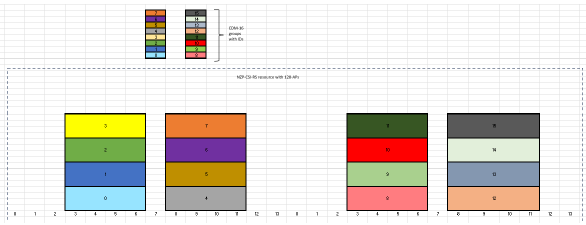
Configuring many CSI-RS ports, such as 128 or 256, can reduce coverage for cell-edge users. The base station must distribute its total transmit power across many ports. To recover this loss, 3GPP is evaluating larger Code Division Multiplexing (CDM) groups, such as CDM-16. These groups could complement or replace the legacy 5G NR maximum of CDM-8.
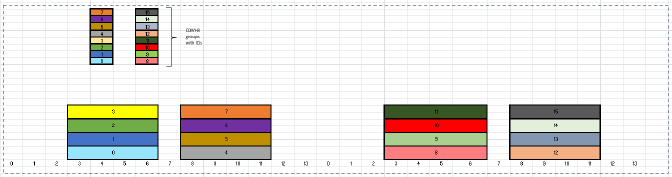
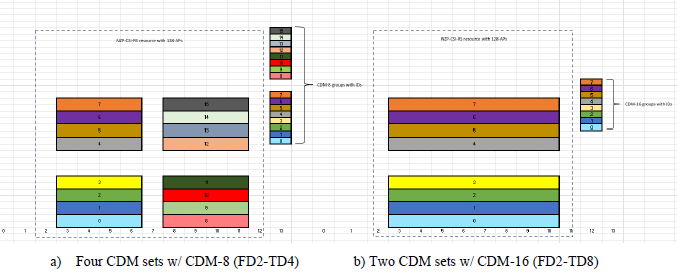
< R1-2604533 : Figure 5: Different 128-port CSI-RS resource configurations >
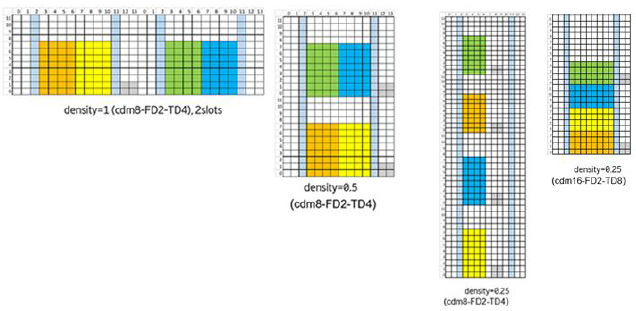
< R1-2603525 : Figure 2. Example of 128-AP single resource CSI-RS configuration, d=1, w/ 4 CDM sets w/ 4 CDM-8 (FD2-TD4) groups in each set. >
< R1-2603525 : Figure 3. Two examples of 128-AP single resource CSI-RS configuration, d=1/2>
< R1-2603525 : Figure 4. Example of 128-AP single resource CSI-RS configuration, d=1/4, w/ 4 CDM sets w/ 4 CDM-8 (FD2-TD4) groups in each set.>
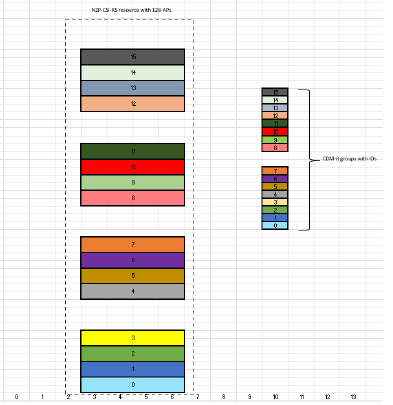
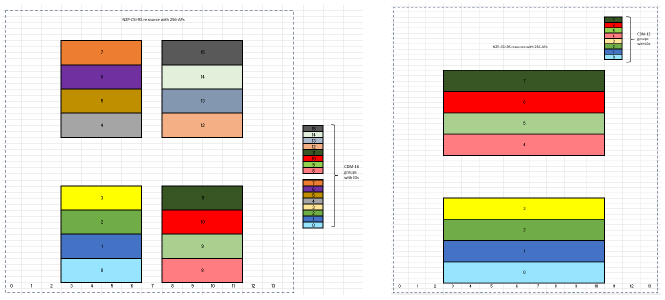
< R1-2603525 : Figure 5. Example of 256-AP single resource CSI-RS configuration, d=1, w/ 4 CDM sets w/ 4 CDM groups in each set, CDM-16 (FD4-TD4)>
< R1-2603525 : Figure 6. Two examples of 256-AP single resource CSI-RS configuration with d=1/2>
Multiplexing Efficiency and Processing Gains
Increasing the CDM size allows a greater number of antenna ports to be orthogonally multiplexed within a limited number of Resource Elements (REs). This structural enhancement provides two primary benefits:
- Enhanced Coverage: Larger CDM groups facilitate higher transmit power boosting levels across the multiplexed ports and yield greater processing gains, which significantly enhances the received SINR and overall channel estimation quality at the cell edge.
- Compact Resource Allocation: By utilizing new CDM-16 structures—such as FD4-TD4 or FD2-TD8 alongside density adaptations (e.g., density = 1 or 1/2)—a massive 256-port CSI-RS can be efficiently configured within just one or two consecutive time slots. This compact allocation helps reduce both transmission latency and physical resource overhead.
Enhancing Frequency-Domain OCC for FR3 Bands
A fundamental challenge of increasing the CDM size is that spreading Orthogonal Cover Code (OCC) sequences over a wider time and frequency range can degrade channel estimation accuracy, as long OCC sequences are traditionally sensitive to time and frequency variations in the channel. But this is mitigated by the specific propagation traits of the higher frequency bands targeted for 6G (e.g., FR3). The channel delay spread in FR3 is expected to be relatively small compared to legacy FR1 and FR2 bands. Because of this reduced delay spread, extending the OCC sequence length in the frequency domain becomes a feasible approach. Consequently, new CDM types featuring extended frequency-domain OCCs (e.g., FD-4 or FD-8) are proposed to successfully accommodate larger CDM sizes (like CDM-16) while effectively managing the impacts of frequency selectivity in FR3 environments.
The current frequency-domain framework uses consecutive RB sets. Each set spans Y consecutive RBs, CSI-RS occupies M2 RBs within it with M2 no greater than Y, and the RE pattern repeats in each set. The mapping granularity for all ports is one RB set. This agreement fixes the repeating allocation unit, while detailed RE locations, CDM mapping and parameter limits still need selection. (R1-2608773.)
Multi-slot sounding has a processing cost as well as a radio-resource cost. A long time-domain OCC becomes sensitive to channel variation; a wide frequency-domain OCC depends on channel coherence across its REs. The proposals therefore compare FD/TD splits, slot buffering, measurement latency and UE processing timelines together. Suggested port thresholds X include 32 and 128; neither value should be presented as the adopted threshold. (R1-2607008; R1-2607068; R1-2607259; R1-2607715; R1-2608619.)
Sharing between frequency densities also needs sequence consistency. One proposed approach generates the higher-density sequence first and extracts the lower-density REs from it. This lets two density configurations share actual transmitted symbols, provided sequence indexing and the mapping remain aligned. Uniform and non-uniform patterns still require separate evaluation; generating a sparse pattern independently need not preserve that relationship. (R1-2607044; R1-2607259; R1-2607471.)
Mitigation of CSI-RS PAPR and false PMI phenomena
CSI-RS is usually discussed as a measurement signal. But its sequence design can create very practical transmitter and receiver problems. A mapping that looks harmless in a small-port system can produce high PAPR when precoding is applied. And the same lack of port distinction can make a UE lock onto the wrong PMI under strong neighbor-cell interference. The key idea in this section is that a small change in how CSI-RS sequences are separated across ports can remove two different failure modes at once.
The High PAPR Problem with Precoded CSI-RS
Under the legacy 5G NR sequence-to-resource mapping, a high Peak-to-Average Power Ratio (PAPR) occurs when CSI-RS is precoded and more than two CSI-RS antenna ports from different Code Division Multiplexing (CDM) groups are configured within the exact same OFDM symbol. This significant PAPR increase at the tail of the transmitted signal distribution degrades the base station's Power Amplifier (PA) efficiency, degrades signal leakage properties. And complicates antenna virtualization. Ultimately, this issue has restricted the practical deployment of precoded CSI-RS in existing NR networks.
The False PMI Phenomenon at the Cell Edge
A secondary issue is the "false PMI" phenomenon, which appears when the network transmits many non-precoded CSI-RS ports. A UE with simple receiver processing at the cell edge experiences strong interference from neighboring base stations. Because of this interference, the UE calculates and reports an incorrect Precoding Matrix Indicator (PMI). The incorrect PMI can misdirect the network toward downlink directions that do not align with the UE's actual location.
Root Cause and Per-Port Sequence Mitigation
CSI-RS sequence correlation and resource mapping can contribute to both PAPR growth after precoding and false PMI under interference. OCC distinguishes ports within a CDM group, so the problem should not be reduced to every port transmitting an identical waveform. RAN1 #126-bis supported a PN sequence with QPSK modulation and retained several remedies for detailed study. (R1-2608668; R1-2608773.)
Port- or CDM-group-dependent scrambling, sequence initialization, OCC differentiation and time-domain randomization are candidate remedies. The design must preserve the intended intra-resource orthogonality while changing unwanted correlation. Their effectiveness depends on the mapping, channel and receiver; the meeting did not select a universal port-scrambling solution. (R1-2607044; R1-2608619; R1-2608773.)
Performance Benefits over Alternative Mitigations
- PAPR Mitigation: Port-dependent sequence processing can reduce PAPR in evaluated precoding cases; the RF benefit must be checked for each mapping and waveform.
- False PMI Mitigation: Changing unwanted CSI-RS correlation can improve channel estimation and PMI selection. Evaluation must retain realistic neighbor-cell interference, different scrambling IDs, receiver processing and load.
- Comparison to Rate Matching: Sequence differentiation and collision avoidance have different overhead and interference costs. Compare throughput after accounting for the resource reuse and PDSCH rate matching assumed in each evaluation.
False-PMI evaluations now explicitly include different cell scrambling IDs, wideband and subband channel estimation, and the signal-to-interference ratio. The study retains changes to time-domain behavior, global RE mapping, port/CDM scrambling and OCC initialization. Orthogonal-port designs remain an important comparison: a non-orthogonal alternative must count leakage and its effect on MU-MIMO interference, rather than only the saved pilot REs. (R1-2608645; R1-2608668; R1-2608773.)
RAN1 #126-bis endorsed an LS asking RAN4 whether the historical CSI-RS power-boosting limit needs an update. Until that feedback arrives, evaluations continue to assume 6 dB. The historical 9 dB case could require a more linear transmitter or output-power reduction; it is not an approved new boost level. A larger CDM group does not by itself remove these PA constraints. R1-2608755 is the endorsed LS following draft R1-2608754. (R1-2608732; R1-2608773.)
Flexible CSI-RS resource allocation and resource sharing for MRSS and network energy savings
Massive CSI-RS cannot be treated as a fixed block that is dropped into one narrow part of the slot. It has to coexist with DMRS, TRS, different UE capabilities, multi-RAT operation. And energy-saving modes where only part of the antenna array may be active. The common theme here is flexibility: the same reference-signal framework should allow dense full-array sounding when needed, partial sounding when sufficient. And shared resources when several UE classes must be supported together.
Flexible Resource Allocation to Avoid Collisions
Configuring a massive number of CSI-RS ports (e.g., up to 256) inherently leads to a dense occupation of Resource Elements (REs) within a single slot. This dense occupation creates a critical risk of resource collisions and potential severe interference with other essential reference signals, such as DMRS and Tracking Reference Signals (TRS).
To prevent these collisions, the documents propose relaxing the rigid legacy 5G NR allocation rules, which currently rely on restricted symbol locations and fixed Resource Block (RB)-level allocation patterns. Instead, a more flexible time and frequency resource allocation scheme should be adopted. This adaptable configuration would allow massive CSI-RS patterns to be defined flexibly across single or multiple slots and across multiple RBs, fundamentally distributing the dense resource footprint to coexist seamlessly with other channels.
Hierarchical CDM Designs for Resource Sharing (MRSS)
To further minimize the total CSI-RS overhead, the proposal shares one massive CSI-RS resource among User Equipment (UEs) with different measurement capabilities. In this scenario, the base station transmits a massive CSI-RS resource (e.g., 256 ports) for high-capability UEs or AI/ML-based predictors. A "partial port sounding" feature lets low-capability or legacy UEs measure only a specific subset of those ports.
But if the massive CSI-RS uses a large Code Division Multiplexing (CDM) size, low-capability UEs face a fundamental limitation: they cannot process the entire long Orthogonal Cover Code (OCC) sequence. This inability causes a severe loss of orthogonality, resulting in crippling intra-resource interference from the unmeasured ports within the same CDM group.
To resolve this, a hierarchical CDM design is proposed within the single CSI-RS resource. Under this design, the OCC sequences are structurally nested or partitioned. Advanced UEs can process the entire resource using the overarching large CDM sequence (e.g., length-8 OCC) to extract all ports, while low-capability UEs can safely measure a smaller CDM subset (e.g., using length-4 or length-2 OCC) to extract just their required port subset. This prevents OCC interference from the unmeasured ports and natively supports Multi-RAT Dual Connectivity (MRSS) and legacy UE coexistence.
Density Adaptations for Network Energy Savings (NES)
Network Energy Savings (NES) techniques allow the base station to dynamically adjust the number of active antenna ports for transmission depending on actual traffic conditions, which requires evaluating CSI for partial transmit arrays.
Both sparse reference signaling (used for general overhead reduction) and spatial-domain NES techniques require flexible and dynamic configuration mechanisms. These mechanisms allow the network to share CSI-RS resources on the same set of physical resources by adapting the density of the reference signal in both the spatial domain (e.g., transmitting/measuring only subsets of antenna ports) and the frequency domain. Striving for a common port subset handling framework for both NES port muting and general overhead reduction allows networks to effectively reduce energy consumption while maintaining reliable link adaptation
Resource sharing has several different meanings: different port capabilities, different frequency densities and spatial adaptation for NES. A common design can reuse a transmitted resource, but must identify the subset each UE measures and the port set its feedback describes. CDM-group sharing is simpler than arbitrary sharing inside one OCC; finer sharing must preserve the receiver processing needed to separate the ports. (R1-2607008; R1-2607346; R1-2607699; R1-2608640.)
The UE also needs to distinguish the actual sparse measurement pattern from the target channel grid. A network may transmit only selected ports or PRBs while asking for feedback on a larger target representation. Dynamic muting must preserve CDM integrity and make the requested hypothesis clear. Partial-array reports can reuse common components across NES configurations, but the usefulness of differential reporting depends on the changed port and power assumptions. (R1-2607665; R1-2608353; R1-2608619.)
For interference measurement, #126-bis keeps the NR CSI-IM 2-by-2 and 4-by-1 patterns as baselines. Wider RB coverage and multi-slot interference measurement remain study questions. Contributions disagree about adding NZP CSI-RS probing or merging measurement and rate-matching resources, so the CSI-IM baseline should not be read as adoption of either proposal. (R1-2607037; R1-2608353; R1-2608645; R1-2608773.)
Cell-specific precoded and network-assisted beamformed CSI-RS frameworks
Non-precoded CSI-RS is simple. But it becomes less attractive when a large array must cover users with limited per-port power. Beamformed CSI-RS can recover much of this coverage by focusing energy, yet it also hides part of the antenna-domain channel from the UE and can force the UE to choose from coarse beam directions. This section explains how 6G may keep the coverage benefit of beamformed CSI-RS while giving the UE enough information to make a more precise PMI decision.
The Coverage Challenge and Cell-Specific Precoded CSI-RS
In conventional 5G NR deployments, CSI-RS are typically non-precoded, meaning the base station transmits them isotropically and distributes its total transmit power across all configured antenna ports. As 6G scales up to massive arrays (e.g., 256 ports), this isotropic distribution causes a severe degradation in the Power Spectral Density (PSD) per port, severely limiting reliable CSI measurement accuracy for cell-edge users.
Configuring dedicated, precoded CSI-RS resources for every UE would create too much resource overhead. The proposal therefore uses a cell-specific precoded CSI-RS framework. The network applies beamforming weights to the CSI-RS transmission and combines the power from multiple antennas. This compensates for PSD loss while keeping the signal cell-specific. Multiple UEs can then measure the same physical resource, which improves coverage and limits overhead.
The Straddling Loss Problem in Beamformed CSI-RS
While beamforming the CSI-RS concentrates power and limits overhead, it introduces a new performance penalty known as "straddling loss". This occurs when a UE's optimal angle of departure does not perfectly align with the exact center of any of the transmitted CSI-RS beams. Because the UE is forced to report a Precoding Matrix Indicator (PMI) corresponding strictly to one of the available beam directions, the slight misalignment degrades performance compared to non-beamformed CSI-RS. Traditionally, networks would fix this by transmitting a denser, overlapping grid of beams. But this approach requires non-orthogonal precoders and defeats the purpose of reducing CSI-RS overhead.
Network-Assisted CSI Acquisition and Codebook Oversampling
Network assistance can reduce beam-grid straddling loss by exposing the mapping between the sounded beams and the channel representation used for feedback. The resulting accuracy still depends on the sounded subspace and any reconstruction assumptions. The proposed processing has three parts:
- Explicit Precoder Signaling: The network explicitly signals the exact CSI-RS precoder information (the spatial filtering weights used to form the beams) to the UE.
- Antenna Domain Reconstruction: A known precoder lets the UE relate measured beam-domain coefficients to the sounded antenna-domain subspace. A reduced-rank sounding matrix does not reveal unsounded channel components without additional assumptions or assistance. (R1-2608015.)
- Finer Granularity via Oversampling: The UE may evaluate finer candidate directions using the known mapping and its reconstruction model. Codebook oversampling can reduce quantization loss, but does not guarantee perfect alignment or recover dimensions absent from the measurements.
Network-assisted oversampling and enhanced port-selection feedback can improve the tested precoded CSI-RS cases. The comparison must identify the transmitted precoder, its signaled information, channel-estimation assumptions and reconstruction method. These determine whether the gain comes from better feedback resolution or additional channel knowledge. (R1-2608015; R1-2608353; R1-2608619.)
Port Decoupling Requirement
To implement this in standardization, the 6G framework must decouple Channel Measurement Resource (CMR) ports from CSI/PMI calculation ports
. In legacy non-precoded NR, these are tightly coupled (a one-to-one mapping between the measured port and the physical antenna)
. For a UE to apply standard Type-I or Type-II codebooks to a precoded CSI-RS, the specification must separate the observed precoded beams (CMR ports) from the full logical antenna dimensions required for PMI calculation
Two feedback paths remain useful comparisons. One reports in the measured port space using an enhanced port-selection basis. Another provides precoder information so that a model can relate the measurements to a different CSI calculation space. Each path must account for non-uniform received power, QCL assumptions and the UE search cost. Comparing them requires the same sounded information and antenna geometry. (R1-2607471; R1-2608015; R1-2608353; R1-2608619.)
Minimum reference signal bandwidth for fine time and frequency tracking
Tracking accuracy depends on how wide the reference signal is. And RAN1 #126 agreed to settle that width by evaluation rather than by assumption. The candidate values run from a full bandwidth part down to 24 resource blocks. And two of them reuse signals the UE already receives instead of adding a new one.
The candidates are the full bandwidth part, 52 resource blocks, and 24 resource blocks, together with the PDSCH bandwidth where DMRS carries the tracking function, and the SSB or another 6G synchronization signal where that is used for tracking instead. Other values remain open.
Frequency span and pilot spacing determine delay resolution and ambiguity, while time span and symbol spacing affect frequency-offset estimation and its unambiguous range. Wider bandwidth alone does not settle both questions. The receiver also needs a tracking channel representative of the scheduled transmission. (R1-2607164; R1-2607351; R1-2608355.)
Why 24 Resource Blocks Is Contested
A narrow dedicated RS must justify its overhead against SSB-based tracking, but connected-mode tracking has a separate agreed baseline: RAN1 #126 supported a single-port RS in addition to SSB for finer time/frequency tracking. A multi-port RS is not precluded. This baseline does not select 24 RBs, require idle-mode TRS, or settle whether DMRS can supply a particular refinement. (R1-2607650.)
Why the Definition Comes First
At 400 MHz of channel bandwidth, or where one cell spans several carriers, a tracking signal covering the whole bandwidth is expensive and largely wasted. Transmitting it per subband or per carrier is the alternative. And the effective bandwidth is then a multiple of the per-subband value. This makes the definition of the bandwidth the first thing to fix, because the candidate values mean different things under a cell-specific reading and a per-subband reading.
The #126-bis tracking contributions disagree on dedicated aperiodic TRS, PDSCH DMRS and PDCCH DMRS. A dedicated periodic signal offers a predictable observation before burst traffic; DMRS reuses an existing transmission but may arrive too late for that burst or carry a different spatial filter. Multi-port measurements may help derive a representative PDP, yet add processing and require a rule for selecting or combining the ports. These are competing designs, not a confirmed replacement for the single-port baseline. (R1-2607046; R1-2607070; R1-2607261; R1-2607576; R1-2608391; R1-2608648.)
A 400 MHz receiver can have frequency-dependent impairments across RF chains or subbands. One center-band tracking estimate may not represent the entire scheduled bandwidth. Conversely, transmitting full-bandwidth TRS every time can cost too much. The study must identify the relevant frequency region, the RS-to-PDSCH precoder relationship, and whether different chains need separate observations. A common-LO, single-CFO model alone cannot settle every implementation. (R1-2607216; R1-2607351; R1-2607526; R1-2607987.)
High-speed tracking also trades estimation range against resolution. Shorter symbol separation increases the unambiguous Doppler range; longer observation spans can improve resolution when the channel permits coherent use. Bursty PDSCH, beam changes and mismatched TRS/DMRS delay profiles belong in that evaluation. Extra RS for slot-boundary phase or amplitude discontinuities is a separate proposal, not an agreed new signal. (R1-2607164; R1-2607473; R1-2608137; R1-2608355; R1-2608650.)
Another tracking proposal uses a one-slot TRS pattern and seeks a common structure for aperiodic TRS and DMRS. Whether that structure can also serve CJT calibration or channel-property measurement depends on the observation and spatial-filter requirements of each use. It remains an alternative to the dedicated multi-slot and DMRS-based candidates. (R1-2607667.)
Uplink-Based CSI Acquisition and SRS
Uplink-based CSI acquisition adds a different set of design choices to the downlink framework. Here the network measures SRS, and the limiting factors include UE transmit power, sequence capacity, antenna switching and the time needed to sound a wide channel. The #126-bis study balances those physical costs against the CSI the scheduler can use.
SRS resource sets, usages and dynamic adaptation
SRS lets the network measure uplink channels and, where reciprocity is usable, derive information for downlink transmission. The same physical transmission may serve several purposes, but its resource configuration, power control and association with a CSI report must stay unambiguous.
RAN1 #126-bis supports SRS resource sets containing one or more resources and permits one resource to belong to multiple sets. Which parameters are common to a set and which belong to the resource remains under study, including time-domain behavior, number of ports, usage and power control. Sharing an SRS therefore does not imply that every usage can impose a different physical transmission on the same occasion. (R1-2608781.)
The configuration proposals range from keeping NR usage-based sets to separating physical signal properties from their intended uses. Both approaches try to avoid duplicated sounding while retaining clear spatial relations and power assumptions. Dynamic bandwidth, frequency position, slot offset, repetition and port count need evaluation against signaling cost and RF reconfiguration time. A resource update must also identify which measurements and stored channel estimates remain valid. (R1-2607009; R1-2607038; R1-2607575; R1-2608234; R1-2608354; R1-2608613.)
Periodic, semi-persistent and aperiodic SRS have different activation and scheduling costs. Some proposals retain semi-persistent SRS for repeated sounding with flexible beam updates; others seek the same function through fewer mechanisms. UE-initiated sounding likewise needs a demonstrated benefit against network-controlled triggering. None of those proposals follows automatically from the agreed resource-set hierarchy. (R1-2607069; R1-2607118; R1-2607282; R1-2607472; R1-2608354.)
Aperiodic sounding can also use a per-resource slot offset and a dynamically selected trigger-to-transmission offset. This proposal separates a resource definition from the scheduling opportunity that makes it usable. The network still needs enough time for the UE to prepare the requested port and frequency configuration. (R1-2607628.)
SRS sequence designs and fair comparison assumptions
A lower-PAPR sequence can improve usable transmit power, but sequence selection must also preserve channel-estimation quality and multiplexing capacity. The #126-bis inputs compare ZC root selection and extensions, enhanced chirp constructions, computer-generated sequences, time-domain designs and block-based sequence generation.
Different proposals optimize different constraints. Frequency-domain constant modulus need not imply a restricted PSK alphabet. Selecting only low-PAPR roots can reduce the root pool or worsen cross-length correlation; a sequence with favorable same-length correlation may still interfere when allocations differ. Compare PAPR or cubic metric together with autocorrelation, cross-correlation, available roots and realistic channel estimation. (R1-2607350; R1-2607758; R1-2607965; R1-2608425; R1-2608613.)
The updated evaluation rules exclude CP from sequence comparisons and use an IFFT size of eight times sequence length, including the comb effect, with comb 2 for that comparison. The NR baseline distinguishes all 60 sequences using v=0 and v=1 from the 30-sequence v=0-only case. Cross-correlation for the 60-sequence case excludes the paired v=0/v=1 sequences in the same group and includes all oversampled lags. These common assumptions prevent a smaller sequence pool from appearing to be a free waveform gain. (R1-2608696; R1-2608781.)
The sequence observations are information for the continuing study, not selection of a winning family. Multi-symbol schemes must count their longer observation resources, and short sequences created by a large comb may need new supported lengths or grouping rules. Root mapping, mixed allocation sizes and the transmitted waveform all affect the result. (R1-2607594; R1-2607758; R1-2607986; R1-2608234; R1-2608354.)
Sparse combs, port multiplexing and TD-OCC
A larger comb uses fewer subcarriers for one SRS port, leaving more REs for data or other sounding. The saving changes sequence length, delay ambiguity and the ways ports can be separated. Coverage therefore depends on both signal processing and the power the UE can actually transmit.
RAN1 #126-bis supports cyclic-shift multiplexing without TDM for 2, 3, 4 and 8 ports, and comb multiplexing without TDM for 3, 4 and 8 ports. Whether TDM combinations are necessary is still under study. These decisions identify supported multiplexing directions; they do not finalize a factorization of every port count or settle proposals for 5, 6, 7 or more than 8 ports. (R1-2608781.)
For combs no greater than 8, the study includes a 4-RB minimum bandwidth and maximum cyclic-shift candidates of 24, 12 and 6 for combs 2, 4 and 8 respectively. Comb 12 and 16 require additional feasibility checks involving minimum bandwidth, short-sequence availability and cyclic-shift capacity. Those numbers are study combinations, not final normative configuration limits. (R1-2608781.)
Sparse combs can narrow the unambiguous delay range or require a smaller cyclic-shift pool. They can also change MPR, so equal nominal transmit power does not guarantee equal radiated pilot power. Compare a larger comb against partial-band sounding with a smaller comb, under the same coverage, interference and RF assumptions. Candidate combs 12 and 16 are not automatically better than comb 8. (R1-2607013; R1-2607163; R1-2607260; R1-2607965; R1-2608613.)
TD-OCC spreads separation across repeated symbols. Hadamard and DFT codes, repetition factors and OCC hopping remain under study. Channel variation, a frequency hop inside the code window or partial symbol dropping can destroy orthogonality. The confirmed study direction retains only ports whose orthogonality survives the allowed partial dropping; proposals differ on whether to discard an entire window or configure a shorter one. (R1-2607260; R1-2607411; R1-2608036; R1-2608354; R1-2608781.)
Wideband sounding, frequency hopping and RF switching
A UE may need to sound a downlink bandwidth wider than its uplink transmission bandwidth. The network then has to combine measurements from several frequency chunks, while the UE retunes RF chains and still serves uplink traffic. The aggregate sounded bandwidth and the bandwidth of one actual transmission are different quantities.
The alternatives beyond the NR 272-PRB table include extended or scaled tables, parameter-based bandwidth and hopping definitions, and several normal-sized SRS resources. Proposals disagree on backward compatibility and signaling flexibility. A wide resource spanning multiple RF steps needs explicit transmission opportunities and port associations; naming a large aggregate resource does not remove the UE bandwidth limit. (R1-2607118; R1-2607609; R1-2607986; R1-2608354; R1-2608425; R1-2608613.)
Two-level hopping separates movement across a wide region from movement within a smaller region. RAN1 #126-bis agreed to study nested, network-provided and sequential choices, with NR partial-frequency sounding and intra-repetition hopping as relevant starting points. This is not a final choice of two-level hopping over single-level hopping. Coverage-oriented repetition and interference randomization may favor different traversal orders. (R1-2607009; R1-2607260; R1-2607758; R1-2608234; R1-2608781.)
Combining hopped estimates requires attention to channel age and phase continuity. A long sweep can make the first subband stale before the last arrives; retuning or antenna switching can introduce a phase discontinuity that breaks coherent reconstruction. State whether the network combines instantaneous coefficients or slower channel statistics, and include guard periods, repetitions, collisions and displaced PUSCH resources in the cost. (R1-2607687; R1-2607970; R1-2608020; R1-2608235.)
For antenna switching, the confirmed study prioritizes xTyR combinations with integer y/x and at least the NR combinations. Candidate support for more receive ports, guard-less switching and joint carrier/UL-Tx switching still depends on UE architecture and RAN4 feasibility. When different antenna paths carry different powers, the network needs either sufficiently accurate calibration or assistance before using reciprocity. (R1-2607215; R1-2607575; R1-2607758; R1-2608354; R1-2608425; R1-2608781.)
Precoded SRS, reconstruction and early acquisition
Precoding can concentrate sounding energy into a useful spatial direction, but it also changes the channel the network observes. A proposal must identify whether SRS supports uplink codebook selection, reciprocity-based uplink transmission or downlink acquisition, because those uses need different knowledge of the precoder.
The studied derivation methods let the network select or indicate a precoder, or let the UE derive it from downlink measurements. A network-selected beam can require an earlier unprecoded sounding step. A UE-derived beam can require CSI-RS, calibration and a precoder report before the network can interpret it. Count that additional signaling and sounding when claiming a coverage or overhead gain. (R1-2607069; R1-2607472; R1-2607688; R1-2608234; R1-2608354.)
Reduced-density SRS can feed a network-side AI or non-AI reconstruction model. Its evaluation needs realistic UE antenna layouts, blockage, phase continuity and calibration, plus the overhead of dense labels or covariance assistance. Check link adaptation and throughput as well as NMSE; a low reconstruction error alone does not establish reliable MCS or rank selection. Model monitoring and fallback are part of the operating cost. (R1-2607687; R1-2608118; R1-2608136; R1-2608643.)
UL DMRS can provide extra channel observations when data is already scheduled, but it only exposes the transmitted layers and precoding. It cannot replace full-rank sounding for unobserved dimensions without further information. Early SRS may help initial access, mobility, SCell activation or early CJT; its trigger, UE capability and switching requirements must fit the relevant procedure. Msg2-triggered sounding is a proposal rather than a selected RACH design. (R1-2607038; R1-2607282; R1-2607666; R1-2608036; R1-2608270; R1-2608425.)
Share sounding with clear context: resource reuse must preserve power, port and measurement associations.Count the RF cost: sparse pilots and wide sweeps need feasible power, retuning and phase assumptions.Separate support from study: resource-set and port-multiplexing agreements leave sequence, hopping and detailed configuration choices open.
CSI Framework and Reporting Mechanisms
After the UE measures the channel, the next question is how the network configures the measurement and how the UE reports the result. A powerful CSI-RS design is not enough if the control-plane structure is too heavy, if reporting is forced onto the wrong timing, or if the report container does not match the amount and urgency of the information. This section looks at CSI as a procedure, focusing on how 6G can make configuration, triggering. And reporting more flexible without losing scheduler control.
Simplification of the CSI resource configuration framework
As CSI-RS, CSI-IM, multi-TRP. And energy-saving configurations become more diverse, the control-plane structure itself can become a source of overhead. If the network needs many reports and many resource assumptions, a deeply nested RRC model makes every configuration heavier than the radio feature it is trying to support. This section focuses on simplifying the framework so that 6G can add richer CSI behavior without carrying an unnecessarily complex signaling structure.
The Legacy 3-Level RRC Structure and Signaling Overhead
In 5G NR, channel measurement and interference measurement resources are configured using parallel 3-level Radio Resource Control (RRC) structures. For channel measurements, a CSI-ReportConfig Information Element (IE) points to a CSI-ResourceConfig, which in turn points to an NZP-CSI-RS-ResourceSet containing individual NZP-CSI-RS-Resource configurations. An independent, parallel 3-level structure is used to configure Interference Measurement (CSI-IM) resources.
This 3-level framework is overly complex and results in very high RRC configuration overhead. Analysis shows that approximately 80% of the ASN.1 signaling is related to configuring this CSI framework. The overhead problem becomes particularly severe when the network needs to configure multiple CSI-ReportConfigs to a UE to receive different types of feedback simultaneously (e.g., configuring separate reports for Type I CSI, eType II CSI. And eType II Coherent Joint Transmission (CJT) for multi-TRP setups).
Proposed 2-Level Simplification
To streamline the framework for 6G and support the addition of multi-TRP nodes more efficiently, transitioning to a 2-level structure is proposed. In the legacy NR framework, the intermediate CSI-ResourceConfig IE only contains a few fields, such as lists of resource sets, Bandwidth Part ID (BWP-Id). And resource type. The proposed simplification eliminates this intermediate level by moving the lists of resource sets directly into the CSI-ReportConfig IE. And moving the BWP-Id and resource type fields directly into the resource set level.
Joint Configuration of NZP-CSI-RS and CSI-IM
Further simplification is proposed by removing the requirement to configure independent resource sets for channel and interference measurements. When a CSI report requires both channel and interference measurements, the framework should allow NZP-CSI-RS and CSI-IM resources to be jointly configured within a single combined resource set, avoiding the redundant parallel structures used in NR.
Addressing Complexities in NES Sub-Configurations
The cumbersome nature of the legacy configuration framework is also a major bottleneck for Network Energy Savings (NES). The Rel-18 NES feature utilizes sub-configurations within the CSI-ReportConfig framework to handle different spatial or power domain adaptation scenarios. Under this design, the UE is required to measure, calculate. And report CSI for each sub-configuration completely separately.
If the network wants to obtain CSI reports for a more diverse set of NES assumptions, the number of required sub-configurations grows. Maintaining multiple independent CSI measurement processes simultaneously imposes a substantial computational burden on the UE. And separately reporting them vastly increases signaling overhead. A streamlined CSI configuration framework is necessary to ensure these demanding NES use cases can be supported without unsustainable inefficiencies.
The #126-bis proposals distinguish the resource, the measurement/computation task and the report configuration. A reusable measurement context can serve several reports, but it needs an explicit association, processing assumptions and a lifetime. Configuration templates or reusable components can reduce RRC signaling; a new two-level structure is still a proposal rather than an adopted replacement for the NR hierarchy. (R1-2607008; R1-2607410; R1-2607652; R1-2608353.)
Adaptation also needs a bounded set of useful operating points. Acquisition method, spatial resolution, reported representation and the split of UE/network computation can change together. Supporting every combination creates configuration and testing cost, so a scalable framework should identify which combinations serve a deployment and how the scheduler changes between them. (R1-2607890; R1-2607964; R1-2608640.)
Decoupling of CSI measurement triggering and CSI reporting to address out-of-order scheduling constraints
In many cases, measuring the channel and sending the report do not need to happen as one tightly coupled action. The UE may need more time to compute CSI than ordinary uplink data needs. And forcing both onto the same scheduling timeline can block otherwise valid transmissions. The main idea here is to separate the moment when the UE starts CSI processing from the moment when the network asks for the completed report. So CSI can be prepared in the background and used when it is actually needed.
< R1-2604743 : Figure 5-2: OoO scheduling of DCI-to-PUSCH – A-CSI reporting case >

< R1-2604743 : Figure 5-3: Decoupling between A-CSI meas. trigger and PUSCH scheduling for the corresponding A-CSI report >

The Problem in 5G NR: Synchronous Triggering and Out-of-Order Restrictions
In legacy 5G NR, an Aperiodic CSI (A-CSI) report is triggered via a single UL DCI, which synchronously schedules the CSI report alongside potential uplink data on the PUSCH. But A-CSI computation requires a significantly longer and more relaxed processing timeline compared to standard PUSCH data transmissions.
That creates a major bottleneck due to strict "out-of-order". (OoO) scheduling restrictions mandated in the TS 38.214 specifications. Under these rules, once an A-CSI report is triggered, the network is strictly prohibited from providing any subsequent UL grant to schedule a PUSCH transmission that would occur *beforethe completion of the delayed A-CSI report. Because high-resolution CSI computation timelines (such as Type II CJT) can be extremely long, a substantial amount of intermediate uplink resources become blocked and unavailable to the UE.
Impact on Performance and Latency
The combination of synchronous A-CSI reporting and OoO restrictions severely limits PUSCH and PDSCH scheduling flexibility. This restriction forces increased delays for regular PUSCH scheduling and HARQ-ACK feedback reporting, as the UE is forced to deliver the A-CSI report before other uplink transmissions can clear. Consequently, this degrades peak data rates and notably increases uplink tail latency, particularly for cell-edge users.
The Proposed 6G Solution: Decoupled Triggering
To overcome these scheduling limitations, it is proposed to split the A-CSI reporting process into two decoupled steps, removing the strict time relation between measurement and reporting:
- Step 1 (Measurement Trigger): The base station issues a first trigger (e.g., via a DL DCI) that solely instructs the UE to measure the CSI-RS resource and compute the CSI, without scheduling the corresponding uplink reporting resource.
- Step 2 (Reporting Trigger): After the UE performs the measurement and computation, the base station sends a second, decoupled trigger (e.g., an UL DCI) that provides the UL grant to actually transmit the PUSCH carrying the CSI report.
Benefits of Decoupling
By removing the synchronous scheduling constraint at the moment of the initial trigger, the reporting resource is no longer scheduled well in advance. So the network is completely free to schedule regular UL-SCH data transmissions during the time the UE is busy computing the CSI. Furthermore, because the UE has already finished computing the CSI by the time the second UL grant arrives, the time gap between receiving the UL grant and transmitting the PUSCH carrying the CSI report can be significantly reduced. Ultimately, this framework alleviates PUSCH scheduling restrictions, avoids unnecessary data transmission delays. And substantially reduces uplink latency.
Separate triggers require a shared measurement context. The network needs to know which CSI-RS occasion, port subset, interference resource and calculation hypothesis produced a stored result. The UE needs a rule for readiness, replacement, expiration and buffer release. A later reporting grant cannot assume that an arbitrarily old result is still available or representative. (R1-2607044; R1-2607068; R1-2607652; R1-2608353.)
Signaling container considerations for CSI reporting comparing L1-UCI and L2 MAC CE
CSI reporting is not only about what information the UE sends. But also about where that information is carried. L1-UCI gives tight timing and direct scheduler control, while MAC CE can be more flexible for larger or less time-critical payloads. This section compares those containers from the viewpoint of latency, reliability, resource usage. And how much freedom 6G should give the network when different CSI report types have different urgency.
Signaling Container Options for CSI Reporting: L1-UCI vs. L2 MAC CE
The transition to 6G requires evaluating the optimal signaling medium for CSI reporting. The discussion centred on restricting CSI reporting to the PUSCH and choosing between Layer 1 UCI(L1-UCI) and Layer 2 MAC CE (L2 MAC CE). RAN1 #126 settled it in favour of L1. And the comparison below is the reasoning that led there.
Arguments Favoring L1-UCI (PUSCH)
Proposals supporting L1-UCI highlight its predictability, efficiency, and lack of cross-layer complexity:
- Controlled Latency and Reliability: L1-based reporting provides a strictly controlled timeline. Its latency remains unchanged when scheduled on PUSCH, whereas MAC CE reporting may suffer from additional MAC processing delays and HARQ retransmission delays if the initial transmission fails. L1-UCI also natively supports varying reliability levels using existing NR mechanisms.
- Efficiency and Fixed Overhead: L1-UCI maintains the same efficiency as legacy 5G NR, where payload size is determined exactly by the CSI content. In contrast, L2 MAC CE requires parsing CSI contents into octets, resulting in additional overhead from MAC sub-headers and potential padding or reserved bits.
- Simpler Cross-Layer Implementation: L1-UCI avoids the cross-layer processing complexity that occurs between L1 and L2 at both the UE and the network.
- Congestion Control: Because L1-UCI reporting instances are fully controlled and scheduled by the network, it avoids the congestion risks associated with asynchronous MAC CE reporting, especially in cells with a large number of UEs.
Arguments Favoring L2 MAC CE
Conversely, proposals advocating for L2 MAC CE argue that the synchronous, tailor-made channels in NR contribute to immense system complexity, which MAC CE naturally resolves.
- Handling Varying and Large Payloads: L2 MAC CE natively supports varying CSI payload sizes without requiring the network to know the exact payload beforehand, making it highly suitable for UE-initiated CSI reporting. For exceptionally large payloads—such as advanced AI/ML-based CSI or Joint Sensing and Communication (ISAC) reports—L2 can seamlessly handle segmentation via the transport protocol. Under L1-UCI, maximum payloads are strictly capped by the limits of Polar codes (e.g., 1706 bits), whereas L2 is limited only by the maximum Transport Block Size (TBS).
- Reduced Multiplexing and Priority Complexity: L2 MAC CE eliminates the need for complicated L1 UCI multiplexing rules, as multiple reports are easily concatenated as MAC CEs. It also removes the need to define strict CSI priority rules, as each report payload is self-contained.
- Flexible Timeline and Asynchronous Reporting: Utilizing L2 removes the need to standardize rigid, pessimistic, worst-case CSI processing timelines, allowing the UE to report CSI asynchronously whenever processing finishes.
- Simplified Cross-Carrier Operation: L2 reporting drastically simplifies sending CSI for higher-frequency downlinks (e.g., FR2) via lower-frequency uplinks (e.g., FR1) without painful UCI multiplexing rules, easily supporting carrier aggregation with non-ideal transport delays.
- Rebuttal to Overhead and Latency Concerns: Proponents of L2 argue that the overhead from MAC sub-headers is negligible (e.g., 1.7% to 3.7% efficiency loss) when the CSI is piggybacked onto a typical PUSCH data transmission, such as a TCP-ACK. Furthermore, the added MAC processing latency (roughly 1ms) and potential HARQ retransmission delays result in negligible downlink throughput degradation (less than 2%).
The agreed CSI container and triggering split
RAN1 #126 closed both halves of the question above. The CSI report is carried in L1. And the triggering of measurement is configured separately from the triggering of the report. The second half matters more than the first, because it is what makes the decoupling described earlier a property of the framework rather than an optimisation.
What Separate Triggering Means
Measurement and computation have their own triggering and configuration. And reporting has its own. The network can therefore start the UE computing without having committed to when the result comes back. And it can ask for the result without implying a fresh measurement. The two timelines stop being one timeline.
Why Collision Handling Drove It
The stated reason for the split is to minimise the number of collision cases. And to simplify the rules where more than one uplink channel is involved and at least one carries a CSI report. Coupling measurement to reporting multiplies those cases, because every measurement trigger also implies a future uplink transmission that may collide. Separating them removes a class of rules rather than adding one.
The detailed handling of multiple uplink transmissions is left to the agenda item that owns it, and no collision handling rules across carriers are assumed at this stage.
Where UE-Initiated Reporting Now Stands
Network triggered or configured reporting is supported as the baseline. UE-initiated and event-triggered reporting remain a study item rather than an agreed feature. And they are to be evaluated against network triggered reporting as the benchmark. The evaluation covers performance and complexity including signalling overhead, the reporting format and quantities. And the definition of the event itself.
The L1 container decision does not itself choose PUSCH-only reporting. #126-bis proposals still differ on using small periodic reports on PUCCH, larger aperiodic reports on PUSCH and the need for semi-persistent reporting. The comparison must include scheduling latency, feedback protection, collisions and whether the network knows the payload size before decoding it. (R1-2607117; R1-2607608; R1-2607781; R1-2608035; R1-2608076; R1-2608668.)
Introduction of UE-initiated and event-triggered CSI reporting
Periodic CSI reporting is easy to manage. But it can waste resources when the channel is stable and can still be too slow when the channel changes suddenly. UE-initiated and event-triggered reporting changes the viewpoint: the UE reports when it detects that the old CSI is no longer useful or when a meaningful channel event has occurred. The challenge is to get this responsiveness without letting the UE and network drift into different assumptions about what should be reported and when.
The Concept of UE-Initiated and Event-Triggered CSI Reporting
In legacy 5G NR systems, CSI is typically reported in a periodic manner with a fixed rate. But radio channels can vary rapidly for some users due to mobility or interference, while remaining relatively stable for others. Under fixed periodic reporting, the network receives excessive, redundant CSI reports when the channel is stable, which wastes uplink physical resources and drains the UE battery. Field data analysis indicates that up to 41% of periodic CSI reports can be entirely redundant because the channel does not change significantly between reporting intervals.
To address this inefficiency, UE-initiated (or event-triggered) CSI reporting is proposed. Under this framework, the UE monitors the channel autonomously and ties the transmission of a CSI report—or the selection of a new CSI reporting configuration—to specific channel conditions rather than a fixed time pattern.
Triggers and Event Conditions
The events that trigger a CSI report can be based on several metrics:
- CSI Quantities: Variations in metrics such as CQI, Rank Indicator (RI), or Precoding Matrix Indicator (PMI). For example, the UE may trigger a report only when it detects a sufficient variation between the currently calculated PMI (or the wideband part of the PMI) and the last reported PMI.
- Channel Property Metrics: Threshold crossings related to Time, Frequency, or Spatial Domain Channel Properties (TDCP, FDCP, SDCP).
- Network Instructions: Non-measurement events, such as the activation of a Secondary Cell (SCell).
Performance Benefits: Overhead Reduction
System-level simulations demonstrate that event-triggered CSI reporting provides significant efficiency gains. In urban macro scenarios, tying CSI reporting to variations in the PMI successfully reduced the uplink CSI feedback overhead by roughly 40%. Despite this massive reduction in feedback, the mean User Perceived Throughput (UPT) was maintained within approximately 2% of the legacy periodic CSI baseline across various network load levels. This confirms that event-triggered mechanisms can successfully suppress unnecessary reports while still reacting fast enough to channel variations to preserve link adaptation performance.
Debates and Concerns: Complexity and Network Misalignment
Despite the demonstrated overhead reductions, the necessity and feasibility of implementing UE-initiated CSI reporting are heavily debated due to several technical challenges:
- PMI Event Definition Challenges: While it is relatively straightforward to trigger reports based on beam quality or CQI/RI changes, extending this to the PMI is highly complex. The PMI relies on instantaneous channel states and is quantized by indices mapping to specific codebook matrices, making it technically difficult to define a stable, proper event trigger for PMI variations.
- Misalignment with Network Logic: Allowing the UE to autonomously decide when to report CSI may not always align with the base station's overarching scheduling, interference management, and resource allocation strategies.
- Increased UE Burden: Shifting the trigger decision to the UE requires the device to continuously maintain local channel estimation and evaluate complex trigger logic. This requirement fundamentally increases the UE's computational complexity and power consumption, potentially offsetting the battery savings gained from transmitting fewer uplink reports.
The #126-bis agreement defines evaluation directions for events, including CQI changes with unchanged PMI/RI, RI changes and other PMI, SINR or CPI conditions. The study also covers report-component skipping and UE selection or adaptation of a reporting configuration. It does not mandate one event threshold or make UE-initiated reporting a universal baseline. (R1-2608773.)
An event scheme has a cost even when it suppresses reports. State how often the UE checks the event, what notification it sends, how the network interprets silence and the delay before a changed channel reaches the scheduler. Compare throughput and total overhead against network-triggered/configured CSI using the same measurement resources. Sending only changed quantities also needs the network to retain the correct earlier components. (R1-2607068; R1-2607689; R1-2607781; R1-2608640.)
Asynchronous CSI reporting and dynamic parameter updating
CSI becomes less useful as it ages. And this aging problem becomes worse when the report must wait for a rigid uplink opportunity or when key reporting parameters can only be changed through slow RRC signaling. Asynchronous reporting and dynamic parameter updates try to make CSI handling more elastic. The goal is to let the UE send useful CSI closer to the time it is computed and let the network adjust important reporting assumptions without rebuilding the whole configuration.
The Problem with Legacy Synchronous CSI Timelines (Forced Aging)
In 5G NR, CSI triggering operates synchronously, so the network must provision a reporting offset that follows fixed CSI computation timelines, defined as Z and Z' values in the specifications. These timelines reflect the expected worst-case UE processing capability. Even when a capable UE finishes CSI early, or has spare processing capacity, the UE must wait until that worst-case timeline expires before reporting. That creates an artificial "CSI aging" component and makes the network use older channel state information. These timelines have also expanded across releases. For example, a 128-port Type I CSI may require 288 symbols, while a more complex Type II CJT CSI requires only 141 symbols. This variation creates scheduling challenges and capability fragmentation.
The Proposed Solution: Asynchronous CSI Reporting
To resolve this bottleneck in 6G, replacing these rigidly standardized, pessimistic timelines with an asynchronous reporting framework is proposed. Instead of a fixed point in time, the network would define an asynchronous time window. The UE can process the CSI at its own pace and report it dynamically whenever the computation finishes, taking advantage of the next available uplink transmission opportunity (such as an upcoming PUSCH grant) within that window.
Benefits of Asynchronous Reporting
- Reduced CSI Latency: Rather than a fixed worst-case delay, the CSI reporting delay becomes a statistical time distribution, allowing capable UEs to report much earlier than legacy timelines would permit.
- Future-Proofing Chipset Evolution: It removes the need for standardized worst-case specifications, allowing future, faster chipset generations to inherently reduce CSI latency without requiring specification updates.
- Efficient Resource Utilization: Because the UE can report whenever ready, the report can easily piggyback on existing PUSCH transmissions (e.g., those carrying TCP-ACKs), which are highly common, bypassing the need for the network to use dedicated control channels just to schedule the CSI report.
The Problem with Static RRC Parameter Configurations
In current networks, CSI report parameters are configured semi-statically via RRC signaling. Because RRC reconfigurations are slow and costly, they cannot adapt to short- or mid-term channel variations. To bypass this limitation, networks are currently forced to configure a UE with multiple, separate static CSI report configurations corresponding to different parameter combinations (e.g., four different parameter sets for an eType-II codebook). The network must then experiment by triggering these different reports to identify the optimal parameter combination, which generates excessive signaling overhead and forces the UE to juggle measurements and computations across multiple configurations.
Dynamic Parameter Updating
To streamline this process, 6G proposes supporting dynamic parameter updating. Instead of configuring multiple static reports, the network configures only a single CSI report. The specific parameter combinations within that report can then be dynamically updated by the network on the fly, guided by channel property information received from the UE (such as Spatial Domain Channel Property, or SDCP, feedback). This fully avoids the RRC signaling overhead of maintaining multiple configurations, makes tracking the active report simpler for the network. And significantly reduces the UE's computational burden, as the UE only needs to measure and compute for a single parameter combination at any given time.
Readiness, payload length and timing are coupled. Larger port counts, explicit CSI and AI processing can require different calculation times, so proposals examine flexible processing classes and configuration-dependent timelines. The scheduler must still identify the result and its size, bound storage requirements and avoid requesting a report before the associated computation is ready. (R1-2607699; R1-2607964; R1-2608076; R1-2608645.)
Decoupled RI and PMI/CQI computation and reporting
Rank, precoder. And CQI are related. But they do not always need the same update rate or the same measurement window. Rank often changes more slowly, while PMI and CQI may need to follow faster channel and interference variations. By decoupling these parts of CSI, 6G can reduce unnecessary reporting and computation. But it must also manage the risk that one part of the report becomes inconsistent with the others.
Decoupled RI and PMI/CQI Computation and Reporting
- The Problem of PMI Search Complexity : In 5G NR, CSI reports were expanded to support up to 128 ports. And 6G is expected to push this limit even higher to 256 ports. This massive number of ports drastically increases the number of candidate precoders, which raises the PMI search complexity at the UE to potentially unbearable levels. If the complexity is too high, the UE may be forced to perform sub-optimal PMI searches, ultimately degrading network performance.
- The Different Time-Scales of RI and PMI/CQI : The RI captures the preferred transmission rank, which typically remains stable over relatively long time intervals. In contrast, the CQI and PMI capture instantaneous channel quality and spatial structure, which fluctuate rapidly and require much more frequent updates.
- Issues with Coupled Reporting :When RI computation and reporting are strictly tied to the CSI-RS periodicity (and thus coupled directly with PMI/CQI), it creates inefficiencies. If the CSI-RS periodicity is short, the UE wastes processing power and battery life computing and reporting the RI more often than necessary. Conversely, if the periodicity is long, the RI updates may become too infrequent to properly align with the actual rank dynamics of the channel.
- Benefits of Decoupling : To resolve this, it is proposed to decouple the computation and reporting of RI from PMI/CQI:
- For the UE (Skipping Hypothesis Testing): The UE can report RI at a much larger periodicity (e.g., 2 to 5 times the PMI/CQI periodicity). For the frequent PMI/CQI reports in between, the UE simply conditions its calculations on the latest reported RI (or a specific RI requested by the network). This completely removes the need for the UE to perform exhaustive rank hypothesis testing during those intermediate PMI searches, saving significant computation and energy.
- For the Network (Simplified Decoding): Because the RI is not dynamically changing in every PMI/CQI report, the payload variation of those reports is significantly smaller. This simplifies network-side decoding by avoiding the complex "two-part decoding" typically required for highly variable CSI payloads.
- Performance Impact: System-level simulations in an Urban Macro (UMa) scenario at 4 GHz compare decoupled RI computation and reporting with conventional joint reporting. With a suitable periodicity, throughput loss is only about 2-5%. This makes the trade-off efficient.
Alternative CSI Acquisition and Feedback Strategies
- DMRS-based CSI acquisition and feedback for PDSCH and PDCCH
- PDSCH DMRS: Legacy NR relies on sparse CSI-RS transmissions (e.g., 20ms periodicity) for link adaptation, which is often too slow to track real-time channel conditions for bursty traffic, resulting in conservative and inaccurate MCS selections. Utilizing PDSCH DMRS allows the UE to assess the actual link quality of an ongoing data transmission and provide real-time CQI updates. This tracks CQI variations between the sparse CSI-RS occasions, improving average throughput by up to 11% while removing the need for dense periodic CSI-RS.
- PDCCH DMRS: Link adaptation for the PDCCH is traditionally performed by applying a fixed back-off (e.g., 3 dB) to the PDSCH SINR. But the control region experiences drastically different interference and loading than the data region—especially in uplink-heavy traffic where the control region is congested but the data region is sparse. Using PDCCH DMRS to compute and report CSI (such as L1-SINR) specifically for the control region significantly improves PDCCH link adaptation, keeping CCE usage efficient and preventing massive success rate drops under high traffic loads.
- Early CSI acquisition for mobility and state transitions
- When a UE transitions from IDLE/INACTIVE to CONNECTED, activates a Secondary Cell (SCell), or undergoes a cell switch, the network initially lacks prior channel knowledge. Consequently, the network is forced to rely on fallback transmission schemes with conservative MCS and no closed-loop precoding, degrading initial throughput.
- To mitigate this, early CSI acquisition mechanisms trigger reference signal measurement and reporting before or during the transition. This can be achieved by mandating simple early CQI reporting based on DMRS via Msg3 during initial access without requiring UE capability indication. Additionally, AI/ML-based temporal prediction can be utilized to predict and report the future CSI of a target cell before a cell switch actually occurs, allowing the network to apply optimal precoding immediately upon transition.
- UE-assisted Channel Property Information (TDCP, FDCP, SDCP) and IPN feedback
- Channel Property Information (CPI): Instead of just instantaneous CSI, the UE can report long-term channel statistics.
- Time Domain (TDCP):Tracks temporal correlation to help the network choose between low-overhead Type I or delay-sensitive Type II codebooks.
- Frequency Domain (FDCP):Tracks inter-subband correlation to optimize the frequency density of CSI-RS or subband reporting sizes, achieving ~60% overhead reduction with only minor throughput loss.
- Spatial Domain (SDCP):Tracks long-term spatial covariance and dominant beam indices. This assists the network in configuring precoded CSI-RS, determining the number of DFT beams, or performing interference-aware coordinated scheduling across multiple Transmission Reception Points (TRPs), which has shown to provide a 26% throughput gain.
- Interference Plus Noise (IPN) Feedback: In reciprocity-based TDD networks, the base station acquires the downlink channel via uplink SRS. But it still lacks accurate UE-side interference information required for proper MCS and rank selection. Legacy NR workarounds (like configuring a redundant Type I PMI/CQI report or relying on non-PMI reports) suffer from high overhead, excessive delay. And precoder mismatch. Introducing a standalone subband IPN report provides the exact scalar interference information needed, significantly improving reciprocity-based downlink transmissions and enabling highly accurate frequency-selective scheduling.
RI and PMI/CQI can be updated at different rates, but the later report must retain a valid rank and layer mapping. Reusing an earlier rank can reduce search and signaling cost when the channel is stable; stale RI can hide a rank change or make the PMI hypothesis inconsistent. Evaluate the savings with realistic scheduler use and feedback delay. (R1-2608619; R1-2608668.)
Alternative CSI Acquisition and Feedback Strategies
Not every useful CSI value has to come from a conventional CSI-RS report. Some information can be inferred from DMRS, some can be obtained early during mobility or state transitions. And some can be reported as channel properties rather than as a full channel estimate. This section collects these alternatives because they all address the same practical issue: the network often needs fresher or more targeted channel knowledge than a normal CSI-RS cycle can provide.
DMRS-based CSI acquisition and feedback for PDSCH and PDCCH
CSI-RS gives planned channel measurements. But it may not always reflect the exact channel condition seen by the scheduled data or control transmission. DMRS is already embedded in PDSCH and PDCCH. So it can provide a more immediate view of the link that the UE actually experienced. This section considers DMRS-based feedback as a way to refine link adaptation with fresh scalar information, especially when CSI-RS density is limited or the channel changes quickly.
The Limitation of Legacy Sparse CSI-RS
In 5G NR, link adaptation relies on periodic CSI-RS and CSI-IM resources to evaluate the downlink channel. In practical deployments, these reference signals are often configured sparsely in time, such as with a 20 ms periodicity, to avoid consuming excessive downlink resources. But this sparse transmission creates a slow control loop that struggles to track real-time channel fluctuations, especially for short, bursty traffic. Consequently, the network is often forced to make conservative and inaccurate MCS selections. While increasing the transmission frequency of CSI-RS would solve this, it would drastically increase signaling overhead, increase interference. And reduce the physical resources available for actual data transmission.
PDSCH DMRS for Real-Time Rate Adaptation
To bridge the gap between sparse CSI-RS occasions without increasing overhead, 6G proposes leveraging the DMRS inherently associated with PDSCH transmissions. Because DMRS is already transmitted alongside downlink data for basic demodulation, using it for intermediate channel estimation requires zero additional radio resource allocation.
By assessing the actual link quality of an ongoing PDSCH transmission via DMRS, the UE can provide real-time, intermediate CQI updates to the network. This gives the scheduler true, real-time insight into how close the current link adaptation is to the desired target, significantly improving MCS selection for bursty traffic. System-level evaluations demonstrate that complementing baseline CSI-RS with PDSCH DMRS-based CQI updates provides consistent gains of up to 11% in average user throughput and up to 14% in 5-percentile (cell-edge) throughput.
Focus on Scalar Metrics (CQI/L1-SINR)
DMRS configurations, including port mapping and density, are scheduled dynamically and can change between PDSCH transmissions. DMRS therefore lacks the stable spatial resolution and diversity of dedicated CSI-RS. DMRS-based CSI acquisition should focus on scalar, CQI-like metrics such as CQI or L1-SINR. These metrics indicate overall channel quality. Spatial metrics such as Rank Indicator (RI) or Precoding Matrix Indicator (PMI) cannot be estimated reliably from DMRS alone.
PDCCH DMRS for Control Region Link Adaptation
Link adaptation for the PDCCH such as choosing the correct aggregation level is traditionally performed using measurements taken from the data region (e.g., CSI-RS) by applying a fixed back-off (e.g., 3 dB) to the estimated PDSCH SINR.
But the interference and loading conditions in the control region often differ drastically from those in the data region. For example, when a network serves many UEs with small data packets or during uplink-heavy traffic, the data region remains sparsely loaded while the control region becomes highly congested. In these scenarios, relying on data-region CSI-RS leads to sub-optimal, statistically skewed PDCCH link adaptation. By utilizing PDCCH DMRS to measure and report a CSI quantity (like L1-SINR) specifically for the control region, the network can accurately track this unique interference loading. Simulations show that this dedicated PDCCH feedback achieves more efficient Control Channel Element (CCE) usage at medium loads and prevents massive drops in the PDCCH success rate (BLER) under high traffic loads.
DMRS-based feedback observes the effective scheduled channel, which makes CQI-like corrections a useful candidate for fast link adaptation. It does not directly expose arbitrary untransmitted layers or the complete antenna-domain channel. Joint feedback with HARQ-ACK may reduce signaling cost, but needs a clear measurement interval, trigger and interpretation. Unused DMRS ports added only for sounding would create extra overhead and remain a separate disputed proposal. (R1-2607471; R1-2607608; R1-2607715; R1-2608353; R1-2608619.)
Feedback should also identify receiver assumptions and per-layer imbalance. A CQI derived for one PDSCH receiver or interference covariance need not predict another receiver or PDCCH performance. Per-layer energy, SINR corrections and non-PMI feedback can assist the network, provided the associated precoder and interference conditions are understood. (R1-2607985; R1-2608271; R1-2608648.)
Early CSI acquisition for mobility and state transitions
When a UE moves between cells or returns from a low-activity state, the network often needs channel knowledge before the normal CSI process has caught up. Without early CSI, the scheduler may fall back to conservative settings, which protects reliability but costs throughput and delay. The purpose of this section is to show how 6G can obtain usable CSI earlier, either through procedure-linked reporting or prediction. So the first transmissions after a transition are not blind.
The Challenge: Fallback Degradation During Transitions
When a UE undergoes state transitions—such as moving from RRC_IDLE/RRC_INACTIVE to RRC_CONNECTED, transitioning a Secondary Cell (SCell) from a deactivated or dormant state to an active state, or performing a cell switch—the network initially lacks accurate prior channel knowledge. Because it does not know the optimal transmission parameters, the network is forced to rely on fallback transmission schemes immediately after the transition. This typically involves using highly conservative MCS selections and transmitting without closed-loop precoding (which is especially detrimental for large massive MIMO antenna arrays), resulting in severely degraded throughput during the initial transmission phase.
Mandatory Early CQI Reporting via Msg3
To mitigate this degradation and enable the network to apply closed-loop precoding and higher MCS immediately upon connection setup, early CSI acquisition mechanisms are required. But specifying multiple optional early CSI features may lead to low adoption in real deployments due to UE capability fragmentation.
To guarantee that early CSI is widely utilized in 6G, it is proposed to establish a minimum set of early CSI features that are mandatory for all 6G UEs to support. A primary candidate for this is simple, early CQI reporting based on DMRS or other available reference signals. Because early CQI calculation requires low computational complexity for the UE, it can be made mandatory without requiring any UE capability indication signaling. Under this framework, the UE could automatically compute and include this early CQI report directly within Msg3 during the initial access (RACH) procedure, providing the network with immediate channel insight.
AI/ML-Based Temporal Prediction for Cell Switching
For mobility scenarios (such as L1/L2-triggered mobility or L3 handovers), AI/ML-based temporal-domain CSI prediction offers an advanced mechanism for early CSI acquisition. Instead of waiting to measure the target cell after switching, the UE can utilize AI/ML predictors to forecast the future CSI of candidate cells before the cell switch actually occurs.
Specifically, predicting and reporting the future CQI or Interference Plus Noise (SINR) of candidate cells prior to the transition provides two major benefits:
- Target Cell Selection: It assists the network in evaluating and deciding which candidate cell is the optimal target for the mobility procedure.
- Immediate Link Adaptation: It enables the target cell to apply optimal link adaptation instantaneously after the switch.
Initial evaluations demonstrate that AI/ML-based temporal-domain predictors for cross-cell early CSI acquisition are highly accurate, achieving SINR prediction errors of only 0.5 to 0.6 dB.
Dependency on Transition Procedures
While recognized as a crucial feature, initiating the detailed design of 6G early CSI acquisition is currently challenging because the fundamental 6G procedural frameworks for Initial Access, RACH. And mobility have not yet been fully defined. Consequently, early CSI acquisition will be treated as a key use-case category that must be integrated once those general transition procedures are established.
RAN1 #126-bis agreed to evaluate CSI-RS and DMRS, including a Msg2 DMRS example, against operation without early CSI. Relevant results cover throughput, latency, interruption, packet loss and coverage during the early period. A steady-state CSI gain alone does not show that a measurement arrives soon enough to help initial access or mobility. Early SRS is handled with the uplink acquisition study. (R1-2608773.)
The contributions disagree on the first useful reporting opportunity and on how much UE capability is needed beforehand. Initial access, idle/inactive transitions, LTM and SCell activation should therefore retain their own timing assumptions. Predictions and CJT calibration may help particular cases, but need explicit observations, report triggers and inter-TRP assumptions rather than an assumed early perfect channel. (R1-2607214; R1-2607781; R1-2607975; R1-2608353; R1-2608619; R1-2608668.)
UE-assisted Channel Property Information (TDCP, FDCP, SDCP) and Interference Plus Noise (IPN) feedback
The network does not always need a full channel report to make a better scheduling or CSI configuration decision. Sometimes it only needs to know how fast the channel varies in time, how selective it is in frequency, how concentrated it is in space, or how interference changes across subbands. UE-assisted property feedback gives the network this higher-level view, allowing it to tune reference-signal density, reporting granularity. And interference handling without asking the UE to send a complete channel description every time.
UE-Assisted Channel Property Information (TDCP, FDCP, SDCP)
- Concept of Channel Property Information (CPI): Instead of only providing instantaneous channel state feedback tightly coupled to a specific data transmission, the UE can report long-term channel statistics and properties, collectively termed Channel Property Information (CPI). These metrics assist the network in optimizing reference signal densities, codebook parameters. And coordinated scheduling.
- Time Domain Channel Properties (TDCP): Originally introduced in 5G NR Rel-18 based on periodic Tracking Reference Signals (TRS), TDCP captures the temporal variability of the channel. The network utilizes this information to adapt DMRS configurations, switch between SU-MIMO and MU-MIMO operations. And decide whether to configure low-overhead (Type I) or delay-sensitive, high-resolution (Type II) CSI reporting. Additionally, TDCP can assist in time-domain CSI prediction by tracking the cyclic variation of channel prediction quality, allowing the network to target prediction occasions when the accuracy is highest.
- Frequency Domain Channel Properties (FDCP): FDCP captures the degree of frequency selectivity or inter-subband correlation across the reporting bandwidth. The network leverages FDCP to configure the optimal frequency density of CSI-RS resources, PRB bundling sizes, subband reporting sizes, or the compression ratio of frequency domain basis vectors in eType II codebooks. System-level evaluations demonstrate that utilizing FDCP reporting can reduce CSI feedback overhead by approximately 60% with only a minor average throughput loss of roughly 4%.
- Spatial Domain Channel Properties (SDCP): SDCP captures long-term spatial correlation characteristics, helping the network determine Line-of-Sight (LOS) versus Non-LOS conditions, angular spread, and the appropriate number of DFT beams to configure for CSI feedback. SDCP enables two major advanced operations:
- Interference-Aware Coordinated Scheduling: A UE can measure signals from non-serving (interfering) Transmission Reception Points (TRPs) and generate SDCP reports containing the strongest interfering directions and their associated power levels. The serving TRP uses this SDCP information to update its precoder, steering spatial nulls toward the reported interfering directions of UEs served by other TRPs. This approach has demonstrated a 26% average throughput gain in multi-TRP scenarios.
- Long-Term Covariance Reporting: The UE can report its long-term spatial covariance matrix (second-order channel statistics) via SDCP, potentially utilizing compressed transform-domain representations, such as beamspace projection. With this long-term prior, the network can configure cell-specific precoded CSI-RS resources shared among multiple UEs, bypassing the need for UE-specific CSI-RS transmissions. This achieves a CSI-RS overhead reduction of approximately 50% with a negligible throughput difference of about 1%.
Standalone Interference Plus Noise (IPN) Subband Report
- The Problem in Reciprocity-Based Downlink: In Time Division Duplex (TDD) networks leveraging channel reciprocity, the base station effectively acquires the downlink channel estimate by measuring uplink SRS. But the network still lacks reliable and accurate knowledge of the interference conditions experienced at the UE receiver, which is strictly required to perform optimal Rank and MCS selection.
- Limitations of Legacy Approaches: To obtain this interference data, legacy 5G NR networks must rely on inefficient workarounds. The network can configure a redundant Type I PMI/CQI report. But this introduces unnecessary overhead and suffers from a mismatch because the reported CQI is based on the reported PMI rather than the SRS-derived precoder. Alternatively, the network can rely on non-PMI reporting using UE-specific beamformed CSI-RS. But this procedure is impractical due to high complexity and excessive CSI acquisition delays.
- The Subband IPN Solution: To resolve this, a standalone IPN report with subband granularity is proposed. By directly providing scalar interference information, the IPN report facilitates highly accurate reciprocity-based downlink transmissions and enables frequency-selective scheduling, allowing the network to avoid allocating bad subbands to a UE. Simulations show that the IPN-based approach achieves up to a 19.5% average throughput gain over legacy CQI adjustment methods, whereas the legacy non-PMI approach suffers severe degradation due to latency.
CPI reports need a defined representation and a useful lifetime. Spatial and frequency covariance can be represented with basis indices, powers and selected off-diagonal terms; dropping all off-diagonal terms loses correlations that some reconstruction methods need. A normalized, rank-truncated PMI generally cannot recover a full covariance matrix by itself. Report quantization, normalization and update cost alongside any gain. (R1-2607162; R1-2607281; R1-2607471; R1-2608037; R1-2608117; R1-2608353.)
The #126-bis study includes orthogonal or non-orthogonal DFT bases with power and off-diagonal information, combined DFT representations and port-domain bases. These are candidate CPI representations, not a mandatory full covariance report. A compact long-term report may guide codebook selection or prediction; the preferred resolution depends on that use and the cost of obtaining the statistics. (R1-2607346; R1-2608640; R1-2608668; R1-2608773.)
Assistance information for joint DL/UL CSI acquisition
Reciprocity-based acquisition gives the network the channel but not the interference. RAN1 #126 agreed to study what the UE should report to close that gap. So that modulation, coding and rank can still be chosen when the channel estimate comes from SRS rather than from a CSI report.
The use case is narrow and worth stating exactly: selection of MCS and rank for downlink transmission, where CSI acquisition rests on SRS and is assisted by additional reporting from the UE.
Why Reciprocity Alone Is Not Enough
SRS gives the network the uplink channel. And reciprocity carries that estimate to the downlink. What reciprocity cannot carry is the interference and noise the UE actually sees. That quantity belongs to the UE's position among the neighbouring cells, not to the channel between the UE and its own cell. Rank and MCS both depend on it. So a reciprocity-based scheme can choose a precoder well and still choose a transport format badly.
The Three Candidate Reports
- SINR, which is compact and already close to the quantity the scheduler needs.
- Non-PMI CSI feedback, for example CRI-RI-CQI, which reuses reporting the framework already defines and leaves the precoder to the network.
- RSRP together with interference-plus-noise, which is the rawest of the three and requires the network to combine it with its own channel knowledge.
Each may be reported wideband or per subband. Subband granularity costs more uplink and tracks frequency-selective interference, which is the case where a single wideband value misleads the scheduler most. How each quantity is calculated, used and reported is left to the evaluations rather than fixed in the agreement.
The joint study separates channel reconstruction from link adaptation. For reconstruction, SRS and downlink feedback can carry complementary spatial information. For rank/MCS selection, non-PMI CSI, SINR, RSRP and interference-plus-noise may be sufficient. Benchmark the first case against both SRS-only and CSI-RS-only operation, with realistic Rel-19 UE antenna assumptions and the overhead of each assistance report. (R1-2607650; R1-2607070; R1-2607576; R1-2608355.)
Reciprocity does not remove UE RF-path differences. Contributions disagree on implementation-only insertion-loss compensation, static assistance and dynamic per-Rx power reports. Calibration, relative phase and port association determine whether fusion improves the downlink channel estimate. A joint model evaluated with ideal reciprocal ports cannot resolve that debate for a practical antenna-switching UE. (R1-2607010; R1-2607046; R1-2607283; R1-2608078; R1-2608271; R1-2608391; R1-2608648.)
One fusion proposal uses SRS to estimate a spatial subspace and downlink CSI to report lower-dimensional coefficients. The useful subspace dimension must balance sounding and feedback costs, and the network needs to associate both observations in time, frequency and port space. Unequal UL/DL bandwidths and irregular hopping add estimation-age and coverage questions. FDD studies may exploit related statistics; they do not establish instantaneous channel reciprocity across frequencies. (R1-2607119; R1-2607646; R1-2607882; R1-2607966; R1-2608235; R1-2608271.)
For rank and MCS assistance, subband RSRP plus interference-and-noise can expose frequency selectivity that one wideband value hides. SINR also depends on the assumed receiver, precoder and spatial interference structure. State those assumptions and the feedback granularity before comparing a compact assistance report with explicit channel feedback. (R1-2607216; R1-2607261; R1-2607629; R1-2608391; R1-2608648.)
AI/ML, Prediction, and Compression
AI/ML enters the CSI discussion mainly because 6G channel information can become too large, too frequent, or too slow to collect by direct measurement alone. Prediction tries to fill in missing CSI across space, frequency, or time, while compression tries to send the most useful part of the channel with fewer uplink resources. This section separates the promise from the practical constraints by looking at reconstruction accuracy, acquisition delay, UE complexity. And how much coordination is needed between UE and network vendors.
AI/ML and non-AI-based spatial, frequency, and time-domain CSI prediction
Prediction is one of the main ways to reduce CSI overhead. But it is useful only if the missing CSI can be estimated accurately enough for scheduling and precoding. AI/ML methods can learn complex spatial, frequency, or time-domain relationships, while non-AI methods may be simpler and easier to specify. This section compares these directions around the same practical question: when the network sends less reference information today, can the UE or network still infer the channel state needed for tomorrow's transmission decision?
The Concept of CSI Prediction for Overhead Reduction
As 6G networks scale to massive antenna arrays (e.g., 128 or 256 ports), transmitting CSI-RS across all ports continuously generates excessive physical resource overhead. To mitigate this, networks can transmit "sparse". CSI-RS by sounding only a subset of the antenna ports (spatial domain reduction) or a subset of subcarriers/resource blocks (frequency domain reduction). To recover the missing data, the UE utilizes spatial and frequency-domain CSI prediction algorithms to accurately restore the full-dimensional channel estimates from these partially sounded measurements.
Transformer-Based UE-Sided AI Predictors
For AI-based spatial and frequency CSI prediction, the UE deploys an AI/ML model—typically based on a Transformer architecture - that takes the sparse, noisy CSI-RS samples as input and acts as a non-linear interpolator, extrapolator, and denoiser.
- Performance Gains: Evaluations show that Transformer-based AI predictors achieve significant Mean Squared Error (MSE) reductions compared to traditional linear interpolation baselines based on Least Squares (LS) estimation. The AI model improves MSE by approximately 3 dB and outperforms classical baselines even when the CSI-RS density is halved or reduced to just 1/4 of the total ports.
- System-Level Impact: In terms of Spatial Generalized Cosine Similarity (SGCS), AI/ML predictors achieve a highly accurate SGCS of approximately 0.9 even when only 1/4 of the antenna ports are measured. Conversely, applying simple linear interpolation without AI severely degrades user perceived throughput, making it an unviable approach for highly sparse grids.
Non-AI Based Prediction Alternatives
While AI/ML shows superior performance, non-AI-based prediction techniques are also studied as reliable, lower-complexity alternatives that do not require advanced neural network processing. Because simple linear interpolation performs poorly, advanced non-AI methods utilize Linear Minimum Mean Square Error (LMMSE) estimation to exploit spatial and frequency correlation structures. For example, the network can transmit an infrequent full-port CSI-RS to allow the UE to calculate a long-term wideband spatial covariance matrix. The UE then uses this matrix alongside LMMSE to accurately predict and interpolate the missing ports during the frequent, sparse CSI-RS transmissions.
Time-Domain AI Prediction for Mobility and Early CSI
Time-domain CSI prediction focuses on forecasting future channel states to overcome scheduling delays and minimize throughput degradation during mobility procedures, such as cell switching.
- Cross-Cell SINR Prediction: For early CSI acquisition, the UE can utilize AI/ML temporal predictors to evaluate and predict the future SINR or CQI of candidate target cells prior to a handover.
- Accuracy vs. Baselines: AI/ML-based cross-cell prediction demonstrates high accuracy, achieving an average SINR prediction error of only 0.5 to 0.6 dB. This vastly outperforms the traditional Sample-and-Hold (SaH) baseline, whose prediction error increases rapidly over time. By predicting the target cell's channel accurately, the network can apply optimal closed-loop link adaptation immediately upon cell switching.
- Model Fine-Tuning: Because propagation environments change randomly, relying solely on static offline training can degrade prediction performance. To address this, online fine-tuning is evaluated as a Life Cycle Management (LCM) procedure, allowing the UE to fast-adapt its local time-domain AI model to the specific, real-time channel measurements using few-shot learning techniques.
Spatial/frequency reconstruction and time prediction answer different questions. The first fills unmeasured channel dimensions; the second forecasts a later channel from an observation window. For UE-side time prediction, #126-bis uses one prediction occasion, N4=1, as the evaluation baseline. The report must still identify its target time, and CQI or interference prediction cannot be assumed correct merely because the desired-channel predictor is accurate. (R1-2607975; R1-2608353; R1-2608773.)
Prediction comparisons need matched sampling ratios, antenna counts, channel estimators, feedback codebooks, assistance information and compute budgets. Per-layer SGCS and system throughput answer different questions. Compare each method with a full-density baseline under the same assumptions, and count dense refresh measurements and feedback. Raw gains from unlike cases do not establish an AI-versus-non-AI ranking. (R1-2607689; R1-2608646.)
A fair sparse-pilot comparison includes modern non-AI reconstruction, such as covariance-assisted LMMSE or sparse-domain methods, as well as the full-density baseline. A weak linear interpolation reference can exaggerate the apparent gain. Training labels, model architecture, quantized inputs, actual and target patterns, and generalization across densities should be stated. (R1-2607008; R1-2607044; R1-2607281; R1-2607627; R1-2608118; R1-2608668.)
Hybrid dense and sparse occasions can refresh statistics or labels, but their dense measurements are part of the overhead. Network-side, UE-side and two-sided models also have different capability, data-collection and coordination costs. Prediction should be tested after beam or port adaptation for NES and with realistic feedback delay, so the net throughput gain survives the conditions that trigger adaptation. (R1-2607037; R1-2607162; R1-2607259; R1-2607346; R1-2608117; R1-2608173.)
CSI-RS overhead reduction strategies for massive antenna arrays
For very large arrays, always sounding every port and every useful frequency location can consume too much of the downlink resource grid. Sparse CSI-RS is therefore attractive. But sparse measurement is only helpful if the missing channel can be reconstructed before the scheduling decision loses its value. This section highlights the important difference between reconstruction accuracy in an ideal sense and the actual user throughput after waiting time, traffic burstiness. And periodic full-port measurements are included.
The CSI-RS Overhead Challenge
As 6G networks scale to massive antenna arrays (e.g., up to 256 ports), transmitting CSI-RS on all active antenna ports continuously results in massive physical resource overhead, leaving very few time-frequency resources available for actual data transmission. To mitigate this, networks can employ sparse CSI-RS transmission strategies.
< R-2604533 : Figure 8: Combining full and sparse CSI-RS transmissions to reduce CSI-RS overhead >
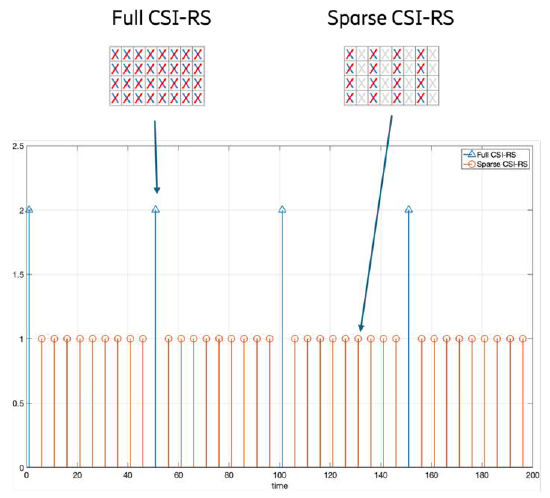
Spatial and Frequency Domain Sparsity
- Spatial Domain Reduction: The network transmits CSI-RS only on an active subset of the antenna array, effectively muting the remaining ports (e.g., sounding only half or a quarter of the total ports).
- Frequency Domain Reduction: The network transmits CSI-RS on only a subset of frequency resources, such as alternating PRBs or subcarriers. Densities can be reduced to 1/2, 1/4, or even down to 1/8 RE/RB/port.
Non-AI/ML Approaches for Channel Reconstruction
When CSI-RS is transmitted sparsely, the UE must reconstruct the missing channel information for the unmeasured ports. Two primary non-AI techniques are evaluated:
- Linear Interpolation: The UE applies simple linear interpolation, where the channel of an unmeasured port is estimated using the nearest measured ports based on CSI-RS port indexing. Alternatively, the UE can simply set the channel estimate to zero for the missing ports. But system-level simulations reveal that standard linear interpolation performs very poorly on highly sparse, vectorized antenna grids, resulting in extremely low throughput.
- Combining Partial and Full-Port Transmissions: To recover the spatial resolution lost by port muting, networks can combine frequent sparse CSI-RS transmissions (e.g., with a 10ms periodicity) with infrequent full-port CSI-RS transmissions (e.g., with a 50ms periodicity). The UE utilizes the infrequent full-port transmission to estimate the wideband spatial covariance between every CSI-RS port pair. The UE then uses this estimated spatial covariance to apply Linear Minimum Mean Square Error (LMMSE)-based interpolation to accurately reconstruct the channel for the muted ports during the frequent sparse transmissions.
The Trade-off: User Throughput vs. Acquisition Delays
While the combined partial and full-port sounding method achieves very high actual channel reconstruction accuracy, it suffers from a severe CSI acquisition delay.
If a UE arrives and receives a partial-port CSI-RS first, it must wait for the next periodic full-port transmission to obtain the spatial covariance matrix required to predict the full-port CSI. This waiting period introduces a significant delay before the start of the downlink transmission, which is particularly detrimental for bursty traffic (such as FTP1 models) where a UE may only have a single packet to transmit.
Because of this delay, the actual User Perceived Throughput (UPT) severely degrades. When accounting for these scheduling and acquisition delays, the overall throughput performance of the combined scheme drops to levels similar to a baseline where all ports are transmitted continuously, effectively nullifying the benefits of the highly accurate LMMSE channel reconstruction.
Low density can mean missing ports, missing PRBs or both. Their geometry matters: a structured port group and isolated missing ports do not create the same reconstruction problem. Define which dimensions are actually measured, which output grid is requested and how a UE learns the active pattern. Sparse signaling is useful only if its additional assistance, dense refresh occasions and feedback leave a net system saving. (R1-2607008; R1-2607044; R1-2607259; R1-2607627; R1-2607665; R1-2608619.)
AI/ML-based CSI compression utilizing JSCM (Joint Source, Channel Coding, and Modulation) and downloadable codebooks
CSI feedback can become too large when the channel dimension grows. So 6G has to look beyond simply adding more report bits. One direction is to learn a compact representation that survives the uplink channel itself. And another is to let the network download a better basis so the UE can search a smaller and more relevant codebook. The common purpose is to preserve useful channel information while reducing UE complexity, feedback overhead. And the amount of cross-vendor AI coordination required.
The JSCM Framework and Cliff Effect Mitigation
Traditional 5G NR networks utilize Separated Source and Channel Coding (SSCC), which involves a sequential chain of compression, quantization, coding. And modulation. Joint Source, Channel Coding. And Modulation (JSCM) replaces this chain by treating CSI feedback as a single learned transmit-receive mapping. Under JSCM, the UE compresses the target CSI directly into a low-dimensional latent vector of modulated symbols, which are then mapped directly to the uplink physical resource blocks.
JSCM can soften the feedback cliff observed when SSCC operates below its configured rate, but the gain depends on feedback SNR, adaptation, reconstruction and RF assumptions. Mapping latent symbols to structured constellations is one PAPR-control approach. Its cost depends on waveform and output distribution; the #126-bis evaluations do not establish a uniformly minor loss for all mappings. (R1-2607019; R1-2607595; R1-2608773.)
Kronecker-Based Learnable Projection Matrix
JSCM can be implemented using a linear projection matrix at the UE, which is a lower-complexity alternative to deploying a full neural network encoder. But a standard fully learnable linear projection matrix requires an immense number of parameters (e.g., 119,808 parameters for a configuration of 32 ports, 13 subbands. And 72 allocated Resource Elements).
To drastically reduce this parameter footprint, a Kronecker-based model is proposed, which replaces the large original matrix with the Kronecker product of two smaller matrices.
- Parameter Reduction: A fully learnable Kronecker model shares learnable parameters between the real and imaginary parts of complex-valued CSI. It reduces the parameter count to 462. The Spatial Generalized Cosine Similarity (SGCS) drops by only about 0.02 compared with the 119,808-parameter matrix.
- Further Simplification: Employing a partially learnable model (where one matrix is learned and the other is fixed) reduces the count to just 78 parameters.
- Quantization: Because these parameters must be downloaded from the network to the UE, they can be further compressed using 4-bit or 8-bit scalar quantization, maintaining performance that consistently outperforms fixed baselines.
Downloadable Codebooks and Bypassing Inter-Vendor Collaboration
Deploying full two-sided AI/ML models (an encoder at the UE and a decoder at the network) introduces severe inter-vendor collaboration complexities regarding model training, performance monitoring, and RAN4 conformance testing.
To bypass these complexities, the proposal prioritizes a one-sided "downloadable codebook" framework. The network uses cell-, site-, or UE-specific channel characteristics to learn an optimized Spatial Domain (SD) and/or Frequency Domain (FD) basis. The network then downloads these optimized bases to the UE.
Simplifying the UE's PMI Search
Once the UE receives the downloaded basis, it computes the Precoding Matrix Indicator (PMI) using the exact same operations used for fixed DFT-basis PMI calculations. Because the downloaded basis is highly optimized and much smaller than a massive generic codebook, it significantly reduces the UE's computational complexity. The UE no longer has to perform an exhaustive search evaluating complex sum-power combinations across numerous oversampled DFT beams. Initial link-level simulations under idealized scenarios indicate that a downloadable codebook can provide a 3% to 12% User Perceived Throughput (UPT) gain compared to the standard NR Rel-19 Type I Mode B codebook.
JSCM comparisons now need the transmitted waveform and RF treatment, not only latent-vector reconstruction error. Structured constellations, annular distributions, clipping or nonlinear PAPR reduction can change both usable transmit power and distortion. RAN1 #126-bis deprioritized Option 0 without subsequent nonlinear PAPR reduction; Option 0 followed by such reduction remains a different case. Earlier proposals favoring Option 0 alone should not be read as the latest outcome. (R1-2607019; R1-2607387; R1-2607781; R1-2608640; R1-2608773.)
Projection-matrix compression is a separate way to simplify the UE encoder. A specified matrix, a network-downloaded matrix and a UE-designed encoder impose different interoperability and training requirements. PCA can derive a projection from an agreed dataset and report dimension, while a network-side nonlinear decoder improves reconstruction. Its linear MSE property depends on the dataset distribution; it does not guarantee the same performance after a deployment shift. (R1-2607044; R1-2608113; R1-2608353; R1-2608668.)
For example, R1-2608113 reports a length-16 latent representation. In its CDL-C case, a PCA projection with ML decoder gives -6.10 dB NMSE and 0.89 cosine similarity, versus -3.54 dB and 0.79 for linear PCA reconstruction, and -7.56 dB and 0.92 for the two-sided ML model. These are reconstruction results for the stated experiment, not a system throughput result or an adopted projection matrix.
Reconstruction accuracy also needs a reliability interface to the scheduler. The UE may need RI/CQI without access to the network decoder, while the network needs to detect a poor reconstruction before choosing a precoder. Proposals consider side information and reliability signatures, alongside receiver assumptions, feedback errors and RF distortion. Compare end-to-end throughput, coverage and complexity with SSCC and fixed-codebook feedback. (R1-2607948; R1-2608173; R1-2608535; R1-2608637; R1-2608645.)
Explicit CSI representation and link adaptation
Explicit feedback aims to let the network reconstruct a channel object rather than only recover an index into a precoder codebook. The representation determines which information survives compression and what extra assistance the scheduler needs for rank and MCS selection.
The #126-bis study includes the channel matrix H, diagonal and off-diagonal information of HHH, transmit-side singular vectors with eigenvalues, and paired transmit/receive singular vectors with relative phase or eigenvalues. Candidate compression includes high-resolution-codebook-like structures, AI methods, QR/Givens rotations and DFT-basis projection powers. Frequency granularity finer than wideband is part of the study, not a selected report format. (R1-2608773.)
A channel representation alone may omit interference or receiver behavior needed for CQI. The evaluation therefore separates reconstruction from link adaptation, using RI/CQI, SINR/RSRP/IPN assistance or a suitably pre-whitened object. Compare the feedback and testability cost with implicit feedback, and state whether phase, scale and layer information needed by the network survives normalization. (R1-2607117; R1-2607410; R1-2607689; R1-2608037; R1-2608173; R1-2608645; R1-2608668.)
Codebook Enhancements and Adaptation
A codebook connects the measured channel information to the precoder that the network may actually use. The useful representation depends on deployment geometry and on the calibration errors that remain in the radio hardware.
In 6G, this connection becomes more difficult. Networks may use multi-panel sites, coordinated TRPs, and different types of radio hardware. Because of this, one fixed codebook may not work well in every situation.
Codebook design needs to adapt to two main changes.
First, the deployment geometry is changing. Wider antenna apertures and multiple panels can create new chances to use higher-rank transmission.
Second, the hardware may not be perfect. Calibration errors between panels or radios can reduce the gain, even when the channel measurement itself looks accurate.
This section explains how codebook design should evolve to handle both new deployment structures and real hardware limitations.
Codebook enhancements for S-TRP, M-TRP, and widely-spaced multi-panel (WSMP) scenarios
A codebook that works well for one compact transmission point may not work well in every deployment. Panel spacing and coordination can change the available spatial dimensions, so compare feedback cost against the gain in the actual deployment.
In 6G, the network may use multiple panels or multiple TRPs. In some cases, these panels or TRPs may also be widely separated. So they can create a much larger virtual antenna aperture.
Because of this larger aperture, the channel can gain more spatial degrees of freedom. This is especially useful for users in a strong LoS path. In a compact antenna setup, this kind of LoS channel may be strong. But it may still support only limited rank. But with widely spaced panels, the same user may see more spatial separation. So higher-rank transmission may become possible.
For this reason, 6G codebooks need to follow the deployment geometry.
For WSMP scenarios, the codebook may need enough resolution to capture the extra spatial gain created by the wide panel spacing. But high-resolution feedback should not always be used. If the channel does not have enough spatial structure, detailed feedback only increases overhead without giving much benefit.
So this section explains how codebook design can adapt to S-TRP, M-TRP, and WSMP deployments. The goal is to use more detailed codebooks when the geometry can provide real gain, while avoiding unnecessary feedback when the channel does not justify it.
Baseline Codebooks for S-TRP and M-TRP Scenarios
To support the massive MIMO deployments expected in 6G, existing 5G NR codebooks can be used as the starting point. These codebooks already provide a useful baseline for different levels of CSI feedback.
- For Single-TRP, or S-TRP, the Rel-19 Type-I Single Panel Mode A/B codebooks can be used as the baseline for low-resolution CSI feedback. In this case, the feedback is relatively simple and has lower overhead. On the other hand, when more detailed channel information is needed, the Rel-19 eType-II codebook can be used as the baseline for high-resolution CSI feedback.
- For Multi-TRP, or M-TRP, and multi-panel deployments, the situation is more complex. Transmission may be coordinated across separated panels, so the codebook needs to support feedback across multiple transmission points or panels. The Rel-19 Type-I Multi-Panel codebook can serve as the baseline for low-resolution feedback. For high-resolution feedback and more advanced joint transmission, the Rel-18 eType-II Codebook Joint Transmission codebook can serve as the baseline.
In this way, 6G codebook design does not need to start from zero. Instead, it can build on existing 5G NR codebooks and extend them according to the deployment scenario and CSI resolution requirement.
WSMP Codebook Design for LoS-Dominant High-SINR UEs
WSMP codebook design is motivated by a practical limitation of conventional centralized antenna deployments. In many hotspot or cell-center scenarios, the UE may have very high SINR because the channel is dominated by a strong LoS path. But this strong LoS channel often concentrates most of its power into one dominant spatial direction. So the channel becomes rank-limited even though the signal quality is high. WSMP addresses this problem by placing multiple panels several meters apart and creating a larger virtual aperture. This changes the spatial structure of the channel, balances the eigenvalue distribution. And makes higher-rank transmission more feasible. So the WSMP codebook should exploit the additional spatial degrees of freedom created by the wide panel spacing, while still avoiding unnecessary high-resolution feedback when a simpler low-resolution CJT structure is enough.
Overall, high level logic of WSMP codebook design goes as follows :
- In legacy centralized antenna deployments, UEs located near the cell center or in hotspot areas often experience very high SINR. This is mainly because their channels are dominated by a strong Line-of-Sight path.
- But high SINR does not always mean high spatial multiplexing gain. In many LoS-dominant channels, most of the channel power is concentrated in the strongest spatial direction. So the first eigenvalue (i.e, the largest eigenvalue of the channel covariance-like matrix (Diagonal Matrix of SVD) of the channel matrix H)) becomes dominant, while the remaining eigenvalues are much weaker. That creates a strong eigenvalue imbalance.
- Because of this imbalance, the channel becomes rank-limited. So even though the UE has good signal quality, it may not fully benefit from multi-layer transmission. This limits spatial multiplexing and reduces the possible spectral efficiency gain.
- To address this problem, Widely-Spaced Multi-Panel, or WSMP, intra-site deployment can be used. In this deployment, multiple antenna panels are placed several meters apart. For example, this can be applied in upper mid-band deployments around 7 GHz. By separating the panels in this way, the base station can create a much larger virtual antenna aperture.
- This larger virtual aperture changes the spatial structure of the channel. Instead of seeing only one dominant spatial direction, the UE can see more spatially distinguishable paths from the separated panels. So the channel can gain more spatial degrees of freedom.
- Because of these additional spatial degrees of freedom, the eigenvalue distribution becomes more balanced. In other words, the channel no longer depends mainly on only the first eigenvalue. So hotspot and cell-center UEs can support higher-rank transmission more effectively.
- This is the main benefit of WSMP. It can enable full-rank transmission for many LoS-dominant high-SINR UEs, which is difficult to achieve with conventional centralized antenna deployments. So WSMP can improve peak spectral efficiency, especially in hotspot scenarios where many UEs already have strong signal quality but are limited by channel rank.
- But this does not mean that the UE always needs a very high-resolution codebook. In WSMP scenarios, the LoS component may still carry most of the channel capacity. So applying a complex high-resolution codebook, such as a full legacy eType-II CJT codebook, may be unnecessarily expensive in terms of UE processing complexity and CSI feedback overhead.
- For this reason, WSMP is well suited for low-resolution Codebook Joint Transmission, or CJT. A low-resolution CJT codebook can still capture the main spatial structure created by the widely spaced panels. At the same time, it can reduce UE complexity and CSI feedback overhead.
- One possible approach is to extend the Rel-19 Type-I Multi-Panel codebook for WSMP operation. Another approach is to restrict the legacy CJT codebook so that only one spatial beam is used per layer. This keeps the codebook simple while still preserving the main benefit of the WSMP geometry.
- To further reduce feedback overhead, the WSMP codebook can also allow a panel-specific Spatial Domain basis to be reused across multiple layers. But when multiple layers share the same spatial basis, they need to be separated properly to avoid interference. This can be done by applying wideband multiplexing codes within the subband co-phasing coefficients.
In this way, the WSMP codebook design follows the actual deployment geometry. It uses enough codebook structure to exploit the larger virtual aperture, but it avoids unnecessary high-resolution feedback when the channel is mainly LoS-dominant and can be represented with a simpler structure.
The #126-bis high-resolution study retains layer/group-specific L values of 1 and 2, and layer-common L values of 2, 4 and 6. The L=1-only Option 1 was not down-selected. The meaning of L depends on whether the basis uses DFT beams, a non-DFT construction or port selection, so equal L does not by itself imply equal feedback cost or search complexity. (R1-2608773.)
The competing designs share components to different degrees across layers, polarizations, panels and frequency. A common W1 can simplify the framework, while layer-specific bases or SD-specific frequency compression can better follow some channels. Compare the actual PMI payload and search, not just the number of named factors. Low-resolution CJT and high-resolution CJT also need separate overhead comparisons against a loaded single-TRP MU-MIMO baseline. (R1-2607281; R1-2607410; R1-2607471; R1-2608053; R1-2608353; R1-2608640; R1-2608668.)
Near-field evaluation needs a defined array geometry, propagation model and fraction of affected UEs. A larger DFT expansion, combined basis or downloaded basis may approximate a spherical wavefront without a wholly separate codebook. Report gains for matched UE drops and include the extra basis signaling and search. A near-field percentage or gain from one array cannot be transferred to every deployment. (R1-2607387; R1-2607471; R1-2607715; R1-2608353.)
Codebook adaptations for uncalibrated radios and phase errors
Not every 6G network will be built only from perfectly calibrated active antenna systems. Many practical deployments still include passive or classical radio chains where random phase offsets break assumptions that standard DFT codebooks quietly depend on. The adaptation discussed here is important because it protects codebook performance in those real deployments by giving the UE more freedom to handle polarization-dependent phase behavior without replacing the whole codebook family.
The Calibration Problem in Classical Radios
Classical radios equipped with passive antenna arrays (such as traditional 4 Tx configurations) are still widely deployed in real-world networks. Unlike modern integrated radios (such as Active Antenna Systems, or AAS), these classical setups utilize feeder cables of varying lengths and lack dedicated circuitry for closed-loop calibration. Consequently, the antenna ports are not calibrated, leading to random phase offsets between the different ports.
Failure of Legacy DFT Codebooks
This physical limitation breaks a fundamental assumption of legacy 5G NR codebooks. Standard NR DFT-based codebooks assume that a common DFT beam can be applied simultaneously across both polarizations. Because of the random phase errors inherent to uncalibrated passive arrays, this assumption fails. And applying current standard DFT codebooks directly to these classical radios introduces a notable performance loss.
Codebook Adaptation: Independent Oversampled Beams
To resolve this and ensure 6G codebooks perform optimally on passive arrays, an adaptation is proposed to allow the use of a different oversampled beam in the second polarization.
- Alternative 1 (Different Beam in Second Polarization): By employing an independent oversampled beam (e.g., using a 4X oversampling factor) for the second polarization, the codebook can effectively correct for the phase offsets. This solution requires minimal changes to the underlying codebook specifications but provides significant benefits: system-level simulations show it yields a 4% to 10% gain in average throughput and a substantial 13% to 25% gain in cell-edge throughput across different network loads. These gains remain consistent for both wideband and subband CSI reporting scenarios.
Further Enhancements via Increased Oversampling
- Alternative 2 (Higher Oversampling Factor):To push performance even further, a second alternative proposes combining the independent second-polarization beam with a significantly increased codebook oversampling factor (e.g., increasing the factor by four, effectively reaching $O_1 = 16$). This finer spatial granularity provides an additional 1% to 4% gain in average throughput and an extra 2% to 7% gain at the cell edge on top of the Alternative 1 improvements.
Ultimately, evaluations confirm that adopting a DFT codebook with a different oversampled beam in the second polarization can deliver up to a 14% improvement in average User Perceived Throughput (UPT) and up to a 32% improvement in cell-edge UPT for uncalibrated radios.
CJT calibration is coupled to the CSI report. RAN1 #126-bis agreed to study delay-offset reporting with TRP/panel-specific spatial bases and a common frequency basis, including separate or joint triggers and same or different reporting occasions. Network indication of the assumed delay offset and combined reporting remain options. The agreement does not finalize a calibration report format or remove frequency/phase tracking errors. (R1-2607975; R1-2608619; R1-2608640; R1-2608773.)
Non-constant-modulus precoders also meet per-TXRU PA limits. A sum-power constraint alone can hide power backoff on a heavily loaded branch, changing the effective SINR assumed for CQI. One proposal provides per-port power-headroom offsets for the UE calculation, so it can account for local power constraints. This is a proposed configuration enhancement, not adopted ASN.1 or a requirement for one PA architecture. (R1-2608122.)
Agreed evaluation baselines for the 6G codebook
RAN1 #126 fixed the reference points the codebook study is measured against. Until this point proposals were compared against whichever NR codebook each company chose, which made the numbers hard to read across contributions. The baselines below give one set.
Resolution and Rank
The earlier evaluation baselines use maximum RI=8 for low resolution and RI=4 for high resolution; these are study assumptions rather than final UE rank limits. The later #126 agreement specifies a W1W2-only low-resolution study, with eType-I Scheme-B-like unrestricted orthogonal 2D-DFT selection as its baseline. It precludes eType-I Scheme-A and eType-II with L=1 from that low-resolution discussion. The high-resolution study uses W1W2Wf and continues to compare layer/group-specific and layer-common SD basis selection. (R1-2607689; R1-2608773.)
Basis Selection
For non-precoded CSI-RS the NR fixed DFT basis is the evaluation baseline for the spatial and frequency components. For cell-specific precoded CSI-RS, a port-selection basis or the NR DFT basis may be used instead. Other bases stay open. And near-field operation is named as the case most likely to need one, since a DFT basis assumes a plane wavefront that near-field geometry does not provide.
Scope of Scenarios
The codebook has to beat 5G for single-user and multi-user MIMO, across single TRP and multi-TRP including coherent joint transmission. Three harder cases are named alongside them: high Doppler and high speed train, near-field propagation. And spatially non-stationary channels. Companies supply a complexity analysis with any proposal. So a gain that costs more than it returns is visible in the same comparison.
For the low-resolution W1W2 study, spatial selection may be layer-specific or layer-group-specific, and inter-polarization co-phasing uses BPSK/QPSK as candidate alphabets. Basis ordering, amplitude, RI above 4 and other detailed choices still need study. The earlier rank-8 evaluation assumption does not mean that all those higher-rank details have been resolved. (R1-2607689; R1-2608773.)
Configurable and downloadable codebooks
A codebook fixed in the specification serves the average deployment. A configurable or downloadable one can be matched to the array and the environment, and RAN1 #126 agreed what such a study has to account for before that flexibility can be assessed.
What the Network Needs to Choose One
The network must first know enough to select the codebook or basis. The named sources are reported channel property information, SRS. And previously reported CSI. Each of these is a measurement the network already has or can ask for. So the question is not whether the information exists but what it costs to collect at the rate the selection needs.
What the Evaluation Must Include
The additional signalling overhead for collecting that information is counted as part of the scheme, not treated as free. Companies also state their assumptions explicitly, including the SRS assumptions and the reporting assumptions behind any channel property information. A downloadable codebook that ignores the cost of the information used to pick it would show a gain that a deployment could not reproduce.
The #126-bis evaluation distinguishes UE-specific basis updates from a cell-specific basis held fixed through a simulation. UE-specific update periods include 40, 100, 200, 400 and 800 ms. These are evaluation points, not prescribed network update periods. The assumed SD/FD basis sizes, quantization, orthogonality, buffer cost and any further PMI selection must be reported. (R1-2608773.)
The network can choose a basis using CPI, SRS or past CSI, but the acquisition and download cost belongs in the result. A small downloaded basis may reduce search, while updating it too frequently can consume the saved feedback resources. Compare mean and cell-edge throughput at the same load and report how the basis performs after channel or beam changes. (R1-2607044; R1-2607471; R1-2607948; R1-2608353; R1-2608637.)
Update Note
- 2026-10-16 - Consolidated individual contributions and available summaries from RAN1 #126-bis into CSI-RS Design and Enhancements, Uplink-Based CSI Acquisition and SRS, CSI Framework and Reporting Mechanisms, Alternative CSI Acquisition and Feedback Strategies, AI/ML, Prediction, and Compression and Codebook Enhancements and Adaptation; updated Executive Summary, added Agreed Items, corrected superseded study status and appended individual Reference entries.
- 2026-08-30 - Subsections added under CSI Framework and Reporting Mechanisms and Codebook Enhancements and Adaptation, from the RAN1 #126 DL-based CSI feature lead summaries and the contributions of the nine tracked companies.
- 2026-08-29 - Subsections added under CSI-RS Design and Enhancements, Alternative CSI Acquisition and Feedback Strategies and Reference, from the RAN1 #126 documents.
Reference
The points summarized in this page cover downlink-based CSI, uplink-based sounding, joint DL/UL acquisition and channel tracking for 6GR. Individual contributions explain the competing designs; moderator summaries and endorsed liaison statements identify the confirmed study outcomes.
- R1-2603525 : 3GPP TSG RAN WG1 Meeting #125 - On downlink-based CSI acquisition in 6GR
- R1-2604533 : 3GPP TSG RAN WG1 Meeting #125 - Views on aspects of downlink-based CSI Acquisition
- R1-2604743 : 3GPP TSG RAN WG1 Meeting #125 - Discussion on Aspects of downlink-based CSI acquisition
- R1-2605298 : 3GPP TSG RAN WG1 Meeting #126 - Aspects of downlink-based CSI acquisition (Huawei, HiSilicon)
- R1-2605299 : 3GPP TSG RAN WG1 Meeting #126 - Aspects of uplink-based CSI acquisition (Huawei, HiSilicon)
- R1-2605300 : 3GPP TSG RAN WG1 Meeting #126 - Other aspects for MIMO operation (Huawei, HiSilicon)
- R1-2605320 : 3GPP TSG RAN WG1 Meeting #126 - Aspects of downlink-based CSI acquisition (MediaTek Inc.)
- R1-2605321 : 3GPP TSG RAN WG1 Meeting #126 - Aspects of uplink-based CSI acquisition (MediaTek Inc.)
- R1-2605322 : 3GPP TSG RAN WG1 Meeting #126 - Time/frequency tracking and joint DL/UL CSI acquisition (MediaTek Inc.)
- R1-2605334 : 3GPP TSG RAN WG1 Meeting #126 - Discussion on aspects of downlink-based CSI acquisition (ZTE Corporation, Sanechips)
- R1-2605335 : 3GPP TSG RAN WG1 Meeting #126 - Discussion on aspects of uplink-based CSI acquisition (ZTE Corporation, Sanechips)
- R1-2605336 : 3GPP TSG RAN WG1 Meeting #126 - Discussion on other aspects of CSI acquisition and channel tracking (ZTE Corporation, Sanechips)
- R1-2605352 : 3GPP TSG RAN WG1 Meeting #126 - Some aspects of Downlink-based CSI Acquisition (Kyocera Corporation)
- R1-2605388 : 3GPP TSG RAN WG1 Meeting #126 - On downlink-based CSI acquisition in 6GR (Nokia)
- R1-2605389 : 3GPP TSG RAN WG1 Meeting #126 - On uplink-based CSI acquisition in 6GR (Nokia)
- R1-2605390 : 3GPP TSG RAN WG1 Meeting #126 - Other aspects of 6GR physical layer operation (Nokia)
- R1-2605466 : 3GPP TSG RAN WG1 Meeting #126 - Feature lead summary #2 on DL-based CSI acquisition (Moderator (Samsung), Moderator (vivo))
- R1-2605467 : 3GPP TSG RAN WG1 Meeting #126 - Feature lead summary #4 on DL-based CSI acquisition (Moderator (Samsung), Moderator (vivo))
- R1-2605468 : 3GPP TSG RAN WG1 Meeting #126 - Feature lead summary #6 on DL-based CSI acquisition (Moderator (Samsung), Moderator (vivo))
- R1-2605540 : 3GPP TSG RAN WG1 Meeting #126 - Discussion on DL CSI acquisition for 6GR (Xiaomi)
- R1-2605569 : 3GPP TSG RAN WG1 Meeting #126 - Discussion on DL CSI acquisition for 6GR (Xiaomi)
- R1-2605570 : 3GPP TSG RAN WG1 Meeting #126 - Discussion on UL CSI acquisition for 6GR (Xiaomi)
- R1-2605694 : 3GPP TSG RAN WG1 Meeting #126 - Discussion on other aspects of CSI acquisition for 6GR (Lenovo)
- R1-2605695 : 3GPP TSG RAN WG1 Meeting #126 - FL summary #1 on other aspects of CSI acquisition and report (Moderator (Lenovo))
- R1-2605696 : 3GPP TSG RAN WG1 Meeting #126 - FL summary #2 on other aspects of CSI acquisition and report (Moderator (Lenovo))
- R1-2605697 : 3GPP TSG RAN WG1 Meeting #126 - FL summary #3 on other aspects of CSI acquisition and report (Moderator (Lenovo))
- R1-2605698 : 3GPP TSG RAN WG1 Meeting #126 - FL summary #4 on other aspects of CSI acquisition and report (Moderator (Lenovo))
- R1-2605834 : 3GPP TSG RAN WG1 Meeting #126 - Discussion on downlink-based CSI acquisition (Samsung)
- R1-2605835 : 3GPP TSG RAN WG1 Meeting #126 - Feature lead summary #1 on DL-based CSI acquisition (Moderator (Samsung), Moderator (vivo))
- R1-2605836 : 3GPP TSG RAN WG1 Meeting #126 - Feature lead summary #3 on DL-based CSI acquisition (Moderator (Samsung), Moderator (vivo))
- R1-2605837 : 3GPP TSG RAN WG1 Meeting #126 - Feature lead summary #5 on DL-based CSI acquisition (Moderator (Samsung), Moderator (vivo))
- R1-2605838 : 3GPP TSG RAN WG1 Meeting #126 - Discussion on UL-based CSI acquisition and SRS design (Samsung)
- R1-2605839 : 3GPP TSG RAN WG1 Meeting #126 - Discussion on other aspects on CSI acquisition and report (Samsung)
- R1-2605856 : 3GPP TSG RAN WG1 Meeting #126 - Views on uplink-based CSI acquisition (Ericsson)
- R1-2605870 : 3GPP TSG RAN WG1 Meeting #126 - Discussion on downlink-based CSI acquisition (NEC)
- R1-2605871 : 3GPP TSG RAN WG1 Meeting #126 - Discussion on uplink-based CSI acquisition (NEC)
- R1-2605872 : 3GPP TSG RAN WG1 Meeting #126 - Discussion on other aspects for CSI and reference signals (NEC)
- R1-2605913 : 3GPP TSG RAN WG1 Meeting #126 - Discussion on downlink based CSI acquisition (OPPO)
- R1-2605914 : 3GPP TSG RAN WG1 Meeting #126 - Discussion on uplink based CSI acquisition (OPPO)
- R1-2605915 : 3GPP TSG RAN WG1 Meeting #126 - Discussion on TRS and Joint DL/UL CSI (OPPO)
- R1-2605995 : 3GPP TSG RAN WG1 Meeting #126 - Discussion on aspects of uplink-based CSI acquisition (Ofinno)
- R1-2605996 : 3GPP TSG RAN WG1 Meeting #126 - Discussion on other aspects of CSI acquisition and report (Ofinno)
- R1-2606028 : 3GPP TSG RAN WG1 Meeting #126 - On downlink-based CSI acquisition (Apple)
- R1-2606029 : 3GPP TSG RAN WG1 Meeting #126 - On UL based CSI acquisition for 6GR (Apple)
- R1-2606030 : 3GPP TSG RAN WG1 Meeting #126 - On other aspects of CSI acquisition (Apple)
- R1-2606188 : 3GPP TSG RAN WG1 Meeting #126 - Discussion on downlink-based CSI acquisition (HONOR)
- R1-2606313 : 3GPP TSG RAN WG1 Meeting #126 - Interference Coordination / Management for 6G Fixed Wireless Access (T-Mobile USA Inc., Ericsson, MediaTek, Verizon)
- R1-2606325 : 3GPP TSG RAN WG1 Meeting #126 - Downlink-based CSI acquisition for 6GR air interface (NVIDIA)
- R1-2606381 : 3GPP TSG RAN WG1 Meeting #126 - Aspects of downlink-based CSI acquisition (Qualcomm Incorporated)
- R1-2606382 : 3GPP TSG RAN WG1 Meeting #126 - Aspects of uplink-based CSI acquisition (Qualcomm Incorporated)
- R1-2606383 : 3GPP TSG RAN WG1 Meeting #126 - Other aspects of CSI acquisition and reporting (Qualcomm Incorporated)
- R1-2606431 : 3GPP TSG RAN WG1 Meeting #126 - Aspects of DL-based 6GR Channel Acquisition (AT&T)
- R1-2606432 : 3GPP TSG RAN WG1 Meeting #126 - Aspects of UL-based 6GR Channel Acquisition (AT&T)
- R1-2606433 : 3GPP TSG RAN WG1 Meeting #126 - Other Aspects of 6GR CSI Acquisition (AT&T)
- R1-2606507 : 3GPP TSG RAN WG1 Meeting #126 - Discussion on Aspects of downlink-based CSI acquisition (NTT DOCOMO, INC.)
- R1-2606508 : 3GPP TSG RAN WG1 Meeting #126 - Discussion on Aspects of uplink-based CSI acquisition (NTT DOCOMO, INC.)
- R1-2606509 : 3GPP TSG RAN WG1 Meeting #126 - Discussion on Other aspects of CSI acquisition and report (NTT DOCOMO, INC.)
- R1-2606530 : 3GPP TSG RAN WG1 Meeting #126 - Views on aspects of downlink-based CSI Acquisition (Ericsson)
- R1-2606532 : 3GPP TSG RAN WG1 Meeting #126 - On RS for fine T/F synchronization and other CSI-related aspects (Ericsson)
- R1-2606649 : 3GPP TSG RAN WG1 Meeting #126 - Views on DL based CSI acquisition (CEWiT)
- R1-2606791 : 3GPP TSG RAN WG1 Meeting #126 - Aspects of downlink-based CSI acquisition (Qualcomm Incorporated)
- R1-2606792 : 3GPP TSG RAN WG1 Meeting #126 - Other aspects of CSI acquisition and reporting (Qualcomm Incorporated)
- R1-2606820 : 3GPP TSG RAN WG1 Meeting #126 - Views on aspects of downlink-based CSI Acquisition (Ericsson)
- R1-2607008 : 3GPP TSG RAN WG1 Meeting #126-bis - Discussion on aspects of downlink-based CSI acquisition (ZTE Corporation, Sanechips)
- R1-2607009 : 3GPP TSG RAN WG1 Meeting #126-bis - Discussion on aspects of uplink-based CSI acquisition (ZTE Corporation, Sanechips)
- R1-2607010 : 3GPP TSG RAN WG1 Meeting #126-bis - Discussion on other aspects of CSI acquisition and channel tracking (ZTE Corporation, Sanechips)
- R1-2607013 : 3GPP TSG RAN WG1 Meeting #126-bis - Discussion on 6G SRS coverage, capacity and overhead aspects (PML)
- R1-2607019 : 3GPP TSG RAN WG1 Meeting #126-bis - Discussion on downlink based CSI acquisition (BJTU)
- R1-2607037 : 3GPP TSG RAN WG1 Meeting #126-bis - Discussion on aspects of downlink-based CSI acquisition for 6GR air interface (FUTUREWEI)
- R1-2607038 : 3GPP TSG RAN WG1 Meeting #126-bis - Aspects of uplink-based CSI acquisition (FUTUREWEI)
- R1-2607039 : 3GPP TSG RAN WG1 Meeting #126-bis - Other Aspects for CSI acquisition (FUTUREWEI)
- R1-2607044 : 3GPP TSG RAN WG1 Meeting #126-bis - Aspects of downlink-based CSI acquisition (MediaTek Inc.)
- R1-2607046 : 3GPP TSG RAN WG1 Meeting #126-bis - Time/frequency tracking and joint DL/UL CSI acquisition (MediaTek Inc.)
- R1-2607068 : 3GPP TSG RAN WG1 Meeting #126-bis - On downlink-based CSI acquisition in 6GR (Nokia)
- R1-2607069 : 3GPP TSG RAN WG1 Meeting #126-bis - On uplink-based CSI acquisition in 6GR (Nokia)
- R1-2607070 : 3GPP TSG RAN WG1 Meeting #126-bis - Other aspects of CSI acquisition and report in 6GR (Nokia)
- R1-2607117 : 3GPP TSG RAN WG1 Meeting #126-bis - Discussion on aspects of downlink-based CSI acquisition for 6GR (Spreadtrum, UNISOC)
- R1-2607118 : 3GPP TSG RAN WG1 Meeting #126-bis - Discussion on aspects of uplink-based CSI acquisition for 6GR (Spreadtrum, UNISOC)
- R1-2607119 : 3GPP TSG RAN WG1 Meeting #126-bis - Discussion on other aspects of CSI acquisition and report for 6GR (Spreadtrum, UNISOC)
- R1-2607162 : 3GPP TSG RAN WG1 Meeting #126-bis - Discussion on downlink-based CSI acquisition (CMCC)
- R1-2607163 : 3GPP TSG RAN WG1 Meeting #126-bis - Discussion on uplink-based CSI acquisition (CMCC)
- R1-2607164 : 3GPP TSG RAN WG1 Meeting #126-bis - Discussion on other aspects of CSI acquisition and report (CMCC)
- R1-2607214 : 3GPP TSG RAN WG1 Meeting #126-bis - Discussion on DL CSI acquisition for 6GR (Xiaomi)
- R1-2607215 : 3GPP TSG RAN WG1 Meeting #126-bis - Discussion on UL CSI acquisition for 6GR (Xiaomi)
- R1-2607216 : 3GPP TSG RAN WG1 Meeting #126-bis - Discussion on other aspects of CSI acquisition (Xiaomi)
- R1-2607259 : 3GPP TSG RAN WG1 Meeting #126-bis - Discussion on downlink based CSI acquisition (OPPO)
- R1-2607260 : 3GPP TSG RAN WG1 Meeting #126-bis - Discussion on uplink based CSI acquisition (OPPO)
- R1-2607261 : 3GPP TSG RAN WG1 Meeting #126-bis - Discussion on RS for tracking and joint DLUL CSI acquisition (OPPO)
- R1-2607281 : 3GPP TSG RAN WG1 Meeting #126-bis - 6GR CSI: Aspects of Downlink-based CSI Acquisition (InterDigital, Inc.)
- R1-2607282 : 3GPP TSG RAN WG1 Meeting #126-bis - 6GR CSI: Aspects of Uplink-based CSI Acquisition (InterDigital, Inc.)
- R1-2607283 : 3GPP TSG RAN WG1 Meeting #126-bis - 6GR CSI: Other Aspects (InterDigital, Inc.)
- R1-2607291 : 3GPP TSG RAN WG1 Meeting #126-bis - Some aspects of Downlink-based CSI Acquisition (Kyocera Corporation)
- R1-2607346 : 3GPP TSG RAN WG1 Meeting #126-bis - Discussion on aspects of downlink-based CSI acquisition for 6GR (vivo)
- R1-2607348 : 3GPP TSG RAN WG1 Meeting #126-bis - Feature lead summary #4 on DL-based CSI acquisition (Moderator (Samsung), Moderator (vivo))
- R1-2607349 : 3GPP TSG RAN WG1 Meeting #126-bis - Feature lead summary #6 on DL-based CSI acquisition (Moderator (Samsung), Moderator (vivo))
- R1-2607350 : 3GPP TSG RAN WG1 Meeting #126-bis - Discussion on aspects of uplink-based CSI acquisition for 6GR (vivo)
- R1-2607351 : 3GPP TSG RAN WG1 Meeting #126-bis - Discussion on other aspects of CSI acquisition for 6GR (vivo)
- R1-2607387 : 3GPP TSG RAN WG1 Meeting #126-bis - Discussion on Aspects of Downlink-Based CSI Acquisition for 6GR (BUPT)
- R1-2607410 : 3GPP TSG RAN WG1 Meeting #126-bis - Discussion on aspects of downlink-based CSI acquisition (CATT)
- R1-2607411 : 3GPP TSG RAN WG1 Meeting #126-bis - Uplink-based CSI acquisition for 6GR (CATT)
- R1-2607412 : 3GPP TSG RAN WG1 Meeting #126-bis - Moderator summary#1 on uplink-based CSI acquisition (Moderator (CATT))
- R1-2607413 : 3GPP TSG RAN WG1 Meeting #126-bis - Moderator summary#2 on uplink-based CSI acquisition (Moderator (CATT))
- R1-2607414 : 3GPP TSG RAN WG1 Meeting #126-bis - Moderator summary#3 on uplink-based CSI acquisition (Moderator (CATT))
- R1-2607415 : 3GPP TSG RAN WG1 Meeting #126-bis - Moderator summary#4 on uplink-based CSI acquisition (Moderator (CATT))
- R1-2607471 : 3GPP TSG RAN WG1 Meeting #126-bis - Aspects of downlink-based CSI acquisition (Huawei, HiSilicon)
- R1-2607472 : 3GPP TSG RAN WG1 Meeting #126-bis - Aspects of uplink-based CSI acquisition (Huawei, HiSilicon)
- R1-2607473 : 3GPP TSG RAN WG1 Meeting #126-bis - Other aspects for MIMO operation (Huawei, HiSilicon)
- R1-2607526 : 3GPP TSG RAN WG1 Meeting #126-bis - Other aspects of CSI acquisition (TCL)
- R1-2607571 : 3GPP TSG RAN WG1 Meeting #126-bis - Discussion on downlink-based CSI acquisition (Samsung)
- R1-2607573 : 3GPP TSG RAN WG1 Meeting #126-bis - Feature lead summary #3 on DL-based CSI acquisition (Moderator (Samsung), Moderator (vivo))
- R1-2607574 : 3GPP TSG RAN WG1 Meeting #126-bis - Feature lead summary #5 on DL-based CSI acquisition (Moderator (Samsung), Moderator (vivo))
- R1-2607575 : 3GPP TSG RAN WG1 Meeting #126-bis - Discussion on UL-based CSI acquisition and SRS design (Samsung)
- R1-2607576 : 3GPP TSG RAN WG1 Meeting #126-bis - Discussion on other aspects on CSI acquisition and report (Samsung)
- R1-2607594 : 3GPP TSG RAN WG1 Meeting #126-bis - Discussion on uplink-based CSI acquisition (Beijing University of Posts and Telecommunications (BUPT))
- R1-2607595 : 3GPP TSG RAN WG1 Meeting #126-bis - Discussion on AI-based downlink CSI acquisition (Beijing University of Posts and Telecommunications (BUPT))
- R1-2607608 : 3GPP TSG RAN WG1 Meeting #126-bis - Discussion on aspects of downlink-based CSI acquisition (China Telecom)
- R1-2607609 : 3GPP TSG RAN WG1 Meeting #126-bis - Discussion on aspects of uplink-based CSI acquisition (China Telecom)
- R1-2607627 : 3GPP TSG RAN WG1 Meeting #126-bis - Discussion on downlink-based CSI acquisition (1Finity)
- R1-2607628 : 3GPP TSG RAN WG1 Meeting #126-bis - Discussion on uplink-based CSI acquisition (1Finity)
- R1-2607629 : 3GPP TSG RAN WG1 Meeting #126-bis - Discussion on other aspects related to CSI (1Finity)
- R1-2607646 : 3GPP TSG RAN WG1 Meeting #126-bis - Discussion on other aspects of CSI acquisition for 6GR (Lenovo)
- R1-2607647 : 3GPP TSG RAN WG1 Meeting #126-bis - FL summary #1 on other aspects of CSI acquisition and report (Moderator (Lenovo))
- R1-2607648 : 3GPP TSG RAN WG1 Meeting #126-bis - FL summary #2 on other aspects of CSI acquisition and report (Moderator (Lenovo))
- R1-2607649 : 3GPP TSG RAN WG1 Meeting #126-bis - FL summary #3 on other aspects of CSI acquisition and report (Moderator (Lenovo))
- R1-2607650 : 3GPP TSG RAN WG1 Meeting #126-bis - FL summary #4 on other aspects of CSI acquisition and report (Moderator (Lenovo))
- R1-2607652 : 3GPP TSG RAN WG1 Meeting #126-bis - Discussion on enhancing DL CSI acquisition (TCL)
- R1-2607665 : 3GPP TSG RAN WG1 Meeting #126-bis - Discussion on downlink-based CSI acquisition (NEC)
- R1-2607666 : 3GPP TSG RAN WG1 Meeting #126-bis - Discussion on uplink-based CSI acquisition (NEC)
- R1-2607667 : 3GPP TSG RAN WG1 Meeting #126-bis - Discussion on other aspects for CSI and reference signals (NEC)
- R1-2607687 : 3GPP TSG RAN WG1 Meeting #126-bis - Aspects of uplink-based CSI acquisition (Lenovo)
- R1-2607688 : 3GPP TSG RAN WG1 Meeting #126-bis - Discussion on 6G uplink based CSI acquisition (Pengcheng Laboratory)
- R1-2607689 : 3GPP TSG RAN WG1 Meeting #126-bis - Summary of email discussion on templates and results for use cases for DL CSI (Moderator (Samsung), Moderator (vivo))
- R1-2607699 : 3GPP TSG RAN WG1 Meeting #126-bis - Discussion on downlink-based CSI acquisition (HONOR)
- R1-2607715 : 3GPP TSG RAN WG1 Meeting #126-bis - Aspects of downlink-based CSI acquisition (Tejas Networks Limited)
- R1-2607758 : 3GPP TSG RAN WG1 Meeting #126-bis - Views on uplink-based CSI acquisition (Ericsson)
- R1-2607781 : 3GPP TSG RAN WG1 Meeting #126-bis - Discussion on aspects of the DL-based CSI acquisition (Quectel)
- R1-2607882 : 3GPP TSG RAN WG1 Meeting #126-bis - SRS and CSI feedback fusion for improved CSI reconstruction (Pengcheng Laboratory)
- R1-2607890 : 3GPP TSG RAN WG1 Meeting #126-bis - Discussion on Scalable CSI Acquisition Frameworks for 6GR (Rakuten Symphony)
- R1-2607948 : 3GPP TSG RAN WG1 Meeting #126-bis - Aspects of downlink-based CSI acquisition for 6GR study (Intel Corporation)
- R1-2607964 : 3GPP TSG RAN WG1 Meeting #126-bis - Discussion on aspects of downlink-based CSI acquisition (LG Electronics)
- R1-2607965 : 3GPP TSG RAN WG1 Meeting #126-bis - Discussion on aspects of uplink-based CSI acquisition (LG Electronics)
- R1-2607966 : 3GPP TSG RAN WG1 Meeting #126-bis - Discussion on TRS and joint DL/UL based CSI (LG Electronics)
- R1-2607970 : 3GPP TSG RAN WG1 Meeting #126-bis - Discussion on aspects of uplink-based CSI acquisition (Panasonic)
- R1-2607975 : 3GPP TSG RAN WG1 Meeting #126-bis - Discussion on aspects of downlink-based CSI acquisition for 6GR (NICT)
- R1-2607985 : 3GPP TSG RAN WG1 Meeting #126-bis - Discussion on Aspects of Downlink-based CSI Acquisition (Google)
- R1-2607986 : 3GPP TSG RAN WG1 Meeting #126-bis - Discussion on Aspects of Uplink-based CSI Acquisition (Google)
- R1-2607987 : 3GPP TSG RAN WG1 Meeting #126-bis - Discussion on Other Aspects of CSI Acquisition (Google)
- R1-2608015 : 3GPP TSG RAN WG1 Meeting #126-bis - Aspects of downlink-based CSI acquisition (Lenovo)
- R1-2608020 : 3GPP TSG RAN WG1 Meeting #126-bis - Discussion on aspects of uplink-based CSI acquisition (Rakuten Mobile, Inc)
- R1-2608035 : 3GPP TSG RAN WG1 Meeting #126-bis - Discussion of aspects of downlink-based CSI acquisition (Sony)
- R1-2608036 : 3GPP TSG RAN WG1 Meeting #126-bis - Discussion of aspects of uplink-based CSI acquisition (Sony)
- R1-2608037 : 3GPP TSG RAN WG1 Meeting #126-bis - Discussion of other aspects of CSI acquisition (Sony)
- R1-2608053 : 3GPP TSG RAN WG1 Meeting #126-bis - Downlink CSI acquisition for 6G (Fraunhofer IIS, Fraunhofer HHI)
- R1-2608076 : 3GPP TSG RAN WG1 Meeting #126-bis - Discussion on downlink-based CSI acquisition (ETRI)
- R1-2608077 : 3GPP TSG RAN WG1 Meeting #126-bis - Discussion on uplink-based CSI acquisition (ETRI)
- R1-2608078 : 3GPP TSG RAN WG1 Meeting #126-bis - Discussion on other aspects of CSI acquisition (ETRI)
- R1-2608113 : 3GPP TSG RAN WG1 Meeting #126-bis - PCA-Based Projection Matrix Design for JSCM/SSCC CSI compression (NTU)
- R1-2608117 : 3GPP TSG RAN WG1 Meeting #126-bis - Discussions on DL-based CSI acquisition design (CAICT, BJTU)
- R1-2608118 : 3GPP TSG RAN WG1 Meeting #126-bis - Aspects of uplink-based CSI acquisition (CAICT, BJTU)
- R1-2608122 : 3GPP TSG RAN WG1 Meeting #126-bis - CSI Acquisition improvement for non-constant modulus codebook (Orange, Deutsche Telekom)
- R1-2608136 : 3GPP TSG RAN WG1 Meeting #126-bis - Discussion on aspects of uplink-based CSI acquisition (Ofinno)
- R1-2608137 : 3GPP TSG RAN WG1 Meeting #126-bis - Discussion on other aspects of CSI acquisition and report (Ofinno)
- R1-2608173 : 3GPP TSG RAN WG1 Meeting #126-bis - Downlink-based CSI acquisition for 6GR air interface (NVIDIA)
- R1-2608233 : 3GPP TSG RAN WG1 Meeting #126-bis - On downlink-based CSI acquisition (Apple)
- R1-2608234 : 3GPP TSG RAN WG1 Meeting #126-bis - On UL based CSI acquisition for 6GR (Apple)
- R1-2608235 : 3GPP TSG RAN WG1 Meeting #126-bis - On other aspects of CSI acquisition (Apple)
- R1-2608269 : 3GPP TSG RAN WG1 Meeting #126-bis - Aspects of DL-based 6GR Channel Acquisition (AT&T)
- R1-2608270 : 3GPP TSG RAN WG1 Meeting #126-bis - Aspects of UL-based 6GR Channel Acquisition (AT&T)
- R1-2608271 : 3GPP TSG RAN WG1 Meeting #126-bis - Other Aspects of 6GR CSI Acquisition (AT&T)
- R1-2608353 : 3GPP TSG RAN WG1 Meeting #126-bis - Discussion on Aspects of downlink-based CSI acquisition (NTT DOCOMO, INC.)
- R1-2608354 : 3GPP TSG RAN WG1 Meeting #126-bis - Discussion on Aspects of uplink-based CSI acquisition (NTT DOCOMO, INC.)
- R1-2608355 : 3GPP TSG RAN WG1 Meeting #126-bis - Discussion on Other aspects of CSI acquisition and report (NTT DOCOMO, INC.)
- R1-2608388 : 3GPP TSG RAN WG1 Meeting #126-bis - Views on aspects of downlink-based CSI Acquisition (Ericsson)
- R1-2608391 : 3GPP TSG RAN WG1 Meeting #126-bis - On RS for fine T/F synchronization and other CSI-related aspects (Ericsson)
- R1-2608424 : 3GPP TSG RAN WG1 Meeting #126-bis - Aspects of downlink-based CSI acquisition (Qualcomm Incorporated)
- R1-2608425 : 3GPP TSG RAN WG1 Meeting #126-bis - Aspects of uplink-based CSI acquisition (Qualcomm Incorporated)
- R1-2608426 : 3GPP TSG RAN WG1 Meeting #126-bis - Other aspects of CSI acquisition and reporting (Qualcomm Incorporated)
- R1-2608535 : 3GPP TSG RAN WG1 Meeting #126-bis - Views on DL CSI (CEWiT)
- R1-2608613 : 3GPP TSG RAN WG1 Meeting #126-bis - Aspects of uplink-based CSI acquisition (MediaTek Inc.)
- R1-2608619 : 3GPP TSG RAN WG1 Meeting #126-bis - On downlink-based CSI acquisition (Apple)
- R1-2608637 : 3GPP TSG RAN WG1 Meeting #126-bis - Aspects of downlink-based CSI acquisition for 6GR study (Intel Corporation)
- R1-2608640 : 3GPP TSG RAN WG1 Meeting #126-bis - Discussion on downlink-based CSI acquisition (Samsung)
- R1-2608643 : 3GPP TSG RAN WG1 Meeting #126-bis - Discussion on uplink-based CSI acquisition (ETRI)
- R1-2608645 : 3GPP TSG RAN WG1 Meeting #126-bis - Aspects of downlink-based CSI acquisition (Qualcomm Incorporated)
- R1-2608646 : 3GPP TSG RAN WG1 Meeting #126-bis - Summary of [Post-126-6GR-For CSI prediction] (Moderator (vivo))
- R1-2608648 : 3GPP TSG RAN WG1 Meeting #126-bis - Other aspects of CSI acquisition and reporting (Qualcomm Incorporated)
- R1-2608650 : 3GPP TSG RAN WG1 Meeting #126-bis - Other Aspects for CSI acquisition (FUTUREWEI)
- R1-2608668 : 3GPP TSG RAN WG1 Meeting #126-bis - Views on aspects of downlink-based CSI Acquisition (Ericsson)
- R1-2608696 : 3GPP TSG RAN WG1 Meeting #126-bis - Observations on evaluation results of SRS sequence designs (Moderator (CATT))
- R1-2608729 : 3GPP TSG RAN WG1 Meeting #126-bis - Feature lead summary #7 on DL-based CSI acquisition (Moderator (Samsung), Moderator (vivo))
- R1-2608730 : 3GPP TSG RAN WG1 Meeting #126-bis - Feature lead summary #8 on DL-based CSI acquisition (Moderator (Samsung), Moderator (vivo))
- R1-2608731 : 3GPP TSG RAN WG1 Meeting #126-bis - Feature lead summary #9 on DL-based CSI acquisition (Moderator (Samsung), Moderator (vivo))
- R1-2608732 : 3GPP TSG RAN WG1 Meeting #126-bis - Feature lead summary #10 on DL-based CSI acquisition (Moderator (Samsung), Moderator (vivo))
- R1-2608754 : 3GPP TSG RAN WG1 Meeting #126-bis - Draft LS on CSI-RS power boosting (Moderator (vivo))
- R1-2608755 : 3GPP TSG RAN WG1 Meeting #126-bis - LS on CSI-RS power boosting (RAN1)
- R1-2608772 : 3GPP TSG RAN WG1 Meeting #126-bis - Feature lead summary #11 on DL-based CSI acquisition (Moderator (Samsung), Moderator (vivo))
- R1-2608773 : 3GPP TSG RAN WG1 Meeting #126-bis - Feature lead summary #12 on DL-based CSI acquisition (Moderator (Samsung), Moderator (vivo))
- R1-2608781 : 3GPP TSG RAN WG1 Meeting #126-bis - Moderator summary#5 on uplink-based CSI acquisition (Moderator (CATT))