Let's look at synchronization as a central design problem in 6G initial access. It shapes overall system efficiency as well as preparing the UE for communication. In previous generations, synchronization signal design mainly targeted robust detection and wide-area coverage. That starting point no longer fits 6G. Highly directional transmission, wider bandwidth variation and stronger energy constraints require a more adaptive design that responds to operating conditions.
Start with beam-based operation. At higher frequencies, especially mmWave and beyond, reliable communication depends on precise beam alignment. We can no longer assume omni-directional synchronization, because the UE also needs to discover the right beam. We must therefore design synchronization and beam management together. Synchronization signals become part of a dynamic search and prediction process, rather than just always-on references, as before.
Next, consider the balance between coverage and efficiency. Traditional designs transmitted synchronization signals frequently to ensure accessibility. In 6G, however, continuous transmission creates excessive energy consumption and unnecessary overhead. The design therefore moves toward sparse, event-driven or adaptive synchronization. We need mechanisms that remain reliable when signals are intermittent. The system must still let the UE detect the network and align with it under those conditions.
We also need consistency across system components. Synchronization must align with frame structure, numerology and bandwidth part configuration. Using consistent subcarrier spacing and timing structures across synchronization and data channels simplifies UE processing and avoids unnecessary switching overhead. This follows a broader 6G design principle: reducing fragmentation across layers improves performance and implementation efficiency.
Finally, we need to consider how intelligence can assist synchronization in 6G. The UE and network can use prediction, historical context and environmental awareness instead of blindly scanning every possibility. This changes synchronization from reacting to signals to anticipating them. The system begins to guide the UE toward the correct timing and spatial alignment. Initial access then becomes faster, more reliable and more energy efficient.
Together, these requirements show why we need more than signal detection for 6G initial access. We need one coordinated synchronization mechanism that integrates beam management, energy efficiency, system consistency and intelligence.
- Executive Summary
- Mind Map
- Agreed Items
- What is the overall objective of 6G initial access design?
- What is the role of synchronization signals and channels?
- How should time-frequency resources for synchronization be designed?
- How should synchronization signals (PSS/SSS) be designed?
- How should PSS be designed?
- How should SSS be designed?
- How should synchronization coexist with NR (MRSS scenarios)?
- What information should be delivered via PBCH/MIB?
- How should PBCH be designed for performance?
- How should synchronization periodicity and patterns be designed?
- How does beam-based operation impact synchronization?
- How should broadcast channels be delivered?
- How can coverage be extended for broadcast channels?
- What additional signals are needed for synchronization?
- How should mobility measurements be supported?
- How can AI/ML be integrated into 6GR initial access?
- Update Note
- Reference
Executive Summary
|
Area |
Main Topics Covered |
Summary |
Design Implication for 6G Synchronization |
|---|---|---|---|
|
Overall initial access and synchronization philosophy |
|
We need to treat 6G synchronization as a system-level initial access problem. Less frequent always-on transmission can save network energy, but the UE spends longer searching and processing, increasing access latency. The preferred balance also depends on the deployment type and device capability. |
Use a common, economical baseline, with scenario-specific flexibility only where required. We must evaluate network energy saving together with UE power, search complexity, latency and coverage. Otherwise, a network saving may simply increase the device's energy cost. |
|
Time-frequency resources and synchronization-signal structure |
|
More occupied bandwidth can carry more energy under a PSD limit. A shorter OFDM symbol instead requires higher SCS. But the UE needs greater sampling, processing and frequency-search capability. A fixed PSD limit allows total signal power to grow with occupied bandwidth until a separate total-power limit is reached. Supporting multiple bandwidths also risks separate UE implementations. |
6G should favor one synchronization structure across bandwidth capabilities, for example through puncturing with repetition or power compensation where needed. We should choose bandwidth and numerology together with raster design, low-tier UE capability, detection performance and beam-sweep latency. |
|
PSS and SSS sequence design |
|
The UE detects PSS and SSS under large timing and frequency uncertainty. Sequence behavior therefore directly affects blind-search complexity and UE power. PSS must provide reliable timing and coarse identification with manageable CFO hypotheses. SSS must expand cell identity while preserving low cross-correlation, frequency-offset tolerance and useful RSRP measurement behavior. |
Early synchronization signals should carry only what the UE needs for detection and basic identification. Leave additional information to PBCH or later signaling. When choosing sequences, prioritize robust correlation, low false-alarm probability, limited CFO hypotheses, cell-edge performance and measurement consistency over unnecessary signaling capacity. |
|
NR coexistence and MRSS operation |
|
If we align NR and 6G synchronization structures, the UE can reuse processing and reduce its search effort. But overlapping or nearby signals increase interference and RAT-misdetection risk. Frequency proximity within the CFO range can make NR and 6G signals harder to distinguish. |
MRSS should reuse NR timing or raster structure only when the search-complexity benefit exceeds the ambiguity cost. We must keep 6G sequences and resource placement distinguishable from NR under realistic CFO, interference and detection thresholds. That assessment must include legacy NR UE behavior. |
|
PBCH/MIB content and performance |
|
PBCH/MIB must give the UE enough bootstrap information to refine alignment and acquire further system information. We also need to avoid payload growth and blind decoding. Coverage depends on resource allocation and effective combining. Combining becomes easier when repeated PBCH payload and scrambling remain stable across occasions. |
The MIB should contain the minimum information needed to locate and decode later control and system information. Add optional feature indicators only when they remove a greater cost in later processing. PBCH occasions should support practical combining and configurable repetition without unnecessary latency or resource overhead. |
|
Periodicity, SSB patterns, and beam-based operation |
|
Long periodicity reduces always-on energy and overhead, but increases discovery latency and can leave measurements less current. Clustering improves combining and concentrates wake periods, but consumes contiguous resources. Higher frequencies require more broadcast beams. With analog beamforming, the network usually cannot freely multiplex those beams with data. |
6G should support adaptive periodicity and a small set of predictable SSB patterns, avoiding many fragmented cases. Use clustering where coverage and wake-time benefits justify concentrating resources. We must optimize beam count, SCS, sweep duration and data-resource loss together, especially around 7 GHz and in FR2. |
|
System information delivery, coverage extension, and auxiliary synchronization |
|
Continuous broadcast makes access simple but limits deep network sleep. On-demand or fixed allocation can reduce energy consumption and UE blind decoding. Coverage-limited LPWA and NTN cases may need repetition of both control and data. With very long periodicity, one-shot detection, accurate wake timing and auxiliary synchronization before paging or random access become more important. |
Keep a minimal bootstrap path universally available. Use on-demand delivery where the UE can reliably request or predict additional information. Tailor coverage enhancements and auxiliary synchronization to the scenario, coordinating them with WUS, paging, RACH and carrier aggregation. This avoids circular access dependencies while saving energy. |
|
Mobility measurement and AI/ML assistance |
|
Reusing synchronization signals for mobility measurements limits overhead and keeps procedures consistent across idle, inactive and connected states. CSI-RS can provide early channel knowledge where needed. AI/ML can predict likely beams and transmission timing from context and history, reducing exhaustive beam scanning and SI waiting. |
Synchronization and mobility measurement should share signal definitions and filtering behavior wherever practical. Add CSI-RS for targeted accuracy or early handover preparation. AI/ML should complement a fully functional conventional baseline and reuse mature beam-management frameworks. It should also provide fallback behavior when prediction confidence is low. |
The #126-bis discussion builds on a 20-RB SSB and a 12-RB PSS envelope. Four through seven SSB symbols remain the working assumption. Sequence selection, repetition signaling and default periodicity remain under study. The comparisons must include cold-search hypotheses, complete access failure and the resources left for control and uplink (R1-2608790).
Mind Map
How do the synchronization choices fit together? Start with the access target, then follow the signal design, radio resources and broadcast branches. The final branches connect these choices to network sleep, beam operation and the procedures that follow discovery.
Open a branch with + to see its topics and descriptive comment leaves. Select a topic for its section link. Drag the background or a comment leaf with the left mouse button to pan. Hold the left mouse button and turn the mouse wheel to zoom around the pointer. Use the zoom controls for scale, or Reset view to return to the main branches. Keyboard users can Tab to controls and press Enter or Space.
The interactive map requires JavaScript. The text outline below provides the same topics and section links.
NOTE: The connecting lines group related design questions. They do not specify a message sequence or a finalized 6G design. An agreement to study an option does not select that option. The linked sections retain the assumptions, contribution dates and proposal status behind each comparison.
Text outline and section links
- Access goals and study status: Balance network energy, UE search effort, latency and coverage. Keep confirmed baseline choices separate from agreements to study alternatives.
- Agreed baseline and open choices: The reproduced baseline includes a 20-RB SSB, a 12-RB PSS envelope and 1008 PCIs. Four through seven symbols remain a working assumption; sequence and default-periodicity choices remain open.
- Deployment and device needs: Standalone access needs a self-contained discovery path. Assisted multi-cell access and NTN introduce different timing, beam and configuration requirements. A common baseline must also work for lower-tier devices.
- Timing, frequency and bootstrap: The UE first detects the cell and aligns timing and frequency. PSS/SSS provide identification; PBCH provides the bootstrap configuration needed to continue system-information acquisition.
- PSS, SSS and identity: Signal design must work before the UE has accurate timing or frequency alignment. Sequence comparisons must count the complete detection chain.
- Hierarchical PCI acquisition: PSS and SSS together provide the full PCI in the study baseline. Reducing PSS hypotheses moves more identity discrimination to SSS; it does not automatically reduce the PCI space.
- PSS sequences and receivers: Compare m-sequence, ZC-based and other candidates with their actual receivers. CFO robustness, false alarms, memory and search-window processing all affect the claimed complexity gain.
- Single shot versus combining: Extra observations and unknown repetition patterns add receiver work. Compare timing accuracy, missed detections and global false alarms under matching CFO and interference assumptions.
- SSS detection and measurement: Gold sequences are the benchmark. Residual CFO, interference and fading affect identity detection and mobility measurements. Using SSS for PBCH estimation also changes DMRS and timing-information requirements.
- Time-frequency resources and raster: Bandwidth, SCS and slot placement define the signal resources. Raster choices and narrowband capability determine what an unconfigured UE can search.
- Bandwidth, SCS and block length: Distinguish channel bandwidth from occupied SSB resources. Higher SCS shortens symbols; wider bandwidth at fixed SCS does not. Longer blocks must still leave resources for control and uplink.
- Raster and blind-search cost: A coarser raster can reduce visited frequencies while adding PBCH-position hypotheses. A cold-search UE needs a bounded search rule before it has decoded carrier configuration.
- Narrowband and lower-tier UEs: A common design needs an explicit narrowband mapping and feasible initial uplink. Puncturing, retuning and RF power limits must be evaluated with their energy and timing costs.
- NR sharing and legacy detection: NR and 6GR must remain distinguishable under CFO and interference. Raster reuse, RB alignment, uplink frequency shift and timing advance solve different coexistence problems.
- PBCH contents and coverage: Bootstrap contents, resource allocation and combining determine whether a detected cell can be accessed. Keep payload compatibility and receiver assumptions explicit.
- MIB contents and information split: Keep the bootstrap information sufficient but small. Moving timing or indices from PBCH to SSS or DMRS can reduce payload while adding sequence or decoding hypotheses.
- Resources and narrowband mapping: More coded resources can improve decoding but consume a larger block. Narrowband puncturing, rate matching and retuning have different energy budgets; their reported gains cannot simply be added.
- Payload stability and combining: Repeated observations need compatible coded information. Soft combining can use separate channel estimates; coherent sample combining also needs phase alignment. Sleep transitions and mobility affect those assumptions.
- Coverage extension: Evaluate both control and data coverage under matching link-budget assumptions. Repetition, power boosting, fixed allocation and DMRS bundling have resource and delay costs, including for LPWA and NTN.
- Periodicity and transmission patterns: Longer periods, clustering and adjustable repetitions trade network sleep against UE waiting and search effort. Traffic and TDD constraints affect the outcome.
- Periodicity and network load: The cited study compares several periodicity-and-combining arrangements without selecting a default. Energy savings depend on traffic, scheduling, sleep transitions and additional synchronization transmissions.
- Clustering and empty-frequency wait: A cluster helps collect multiple receptions after discovery. It does not eliminate the wait needed to reject an empty raster point. Include random arrival and complete PBCH acquisition latency.
- Repetition discovery and TDD: A searching UE needs predictable or detectable repetition rules before SIB1. Candidate positions must fit usable TDD symbols and distinguish beam sweeps from repetitions of the same beam.
- Beams and multi-TRP operation: Distinct beams extend angular coverage; repeated beams add observations. Physical TRP identity is a separate question from choosing an SSB or access resource.
- Beam count and multiplexing: More distinct beams increase angular coverage and sweep overhead. Repeating an existing beam adds observations instead. Analog beamforming can restrict simultaneous SSB and data transmission.
- Transparent or explicit TRPs: Selecting an SSB or RACH resource does not always require physical-TRP identity. Explicit identification needs a demonstrated benefit over transparent network-side association.
- Periodic or on-demand SI: On-demand SIB1 can reduce unnecessary broadcast. Standalone UEs must already know how to request it and receive the response; the request cannot depend solely on the missing SIB1.
- Additional synchronization: RACH, paging, WUS and SSB-less secondary carriers may need extra timing support. Coordinate trigger and reception rules, and count the added network transmissions and UE monitoring.
- Mobility and measurement metrics: SSS and RSRP are supported in the reproduced idle-mobility baseline. Additional metrics remain open. Reselection, beam failure and radio-link recovery need separate timing and performance evaluations.
- AI/ML assistance and fallback: Prediction can prioritize beams or reception times. Count failed predictions, signaling and reference-signal overhead. Model applicability and a conventional fallback are necessary for reliable access.
Agreed Items
This section collects confirmed agreements by RAN1 meeting, starting with the baseline available at #126-bis. It separates agreed design choices from agreements to study alternatives. A study agreement does not mean that one candidate has been selected.
RAN1 #126-bis
The confirmed baseline below is reproduced in R1-2608790, the #126-bis FL summary. Several items were agreed before #126-bis, including the bandwidth decisions from #126. They are recorded here as the available baseline, rather than new #126-bis decisions.
Block composition: The basic 6GR SSB contains primary synchronization signal(s), secondary synchronization signal(s) and physical broadcast channel(s). Other synchronization or reference-signal structures remain for further study. This defines the block contents without fixing the number of symbols assigned to each component.SSB bandwidth: One 6GR SSB occupies 20 RBs. The PSS occupies a 12-RB envelope within that block. Both are #126 agreements reproduced at #126-bis.Cell identity: The baseline provides 1008 physical cell IDs. PSS and SSS together carry the full PCI. Changes to the identity space or information split require further justification.Idle mobility: At least the SSS of the 6GR SSB is supported for measurement, with RSRP as a supported metric. Additional resources and the choice between RSRQ and SINR remain open.PSS study scope: Compare m-sequences, ZC-based sequences and other sequences. Study length 127 or a length above 127 and no greater than 144. The sequence count and PSS symbol count remain study variables.SSS study scope: Use Gold sequences as the benchmark and study lengths of 127 or above 127. Other sequences, the sequence count and the SSS symbol count remain open.Repetition study scope: Compare fixed and network-adjustable repetition counts under predefined per-band limits. Restrictions and the adjustment method remain open. Neither policy is the selected baseline.Periodicity study scope: Evaluate five configurations: 160 or 80 ms with within-period combining; 40 ms with cross-period combining; 40 ms with both combining modes; and 20 ms with cross-period combining. This agreement does not select a default periodicity.Multi-TRP study scope: Compare UE-transparent and non-transparent operation during initial access. Evaluate coverage, energy, signaling, latency, UE complexity and compatibility with single-TRP deployments.Coverage evaluation: Derive the coverage-gap trimmed mean after removing the lowest and highest samples. The agreed link-budget assumptions for around 7 GHz use receiver noise figures of 9 dB for DL and 5 dB for UL. These are evaluation assumptions, rather than new receiver requirements.
Source: R1-2608790, including its reproduced agreements and the separately labeled #126 working assumption.
Confirmed design baseline: Keep the bandwidth, identity and idle-measurement agreements distinct from unresolved sequence and periodicity choices.Meeting attribution: The #126-bis heading records the baseline available there; it does not move earlier agreements to a later meeting.
What is the overall objective of 6G initial access design?
Let's start with what 6G initial access needs to achieve: reliable, efficient and scalable network entry across devices and deployment scenarios. We need to optimize the system, not just detect a signal. The design must balance network energy efficiency, UE computational complexity, latency and coverage. These requirements interact closely, so improving one often degrades another. Our goal is a balance that works across different environments and device capabilities.
Why is initial access important in 6G systems?
Initial access is the UE's first interaction with the network. It determines how quickly and reliably the UE connects, directly affecting user experience, power consumption and system efficiency. In 6GR, the focus on energy saving and flexibility makes this step even more important. Every subsequent communication procedure depends on it.
To lower network power consumption in 6GR, we need to reduce always-on transmissions. But fewer transmissions mean more search effort for the UE. Initial access must therefore minimize transmission overhead while maintaining detection reliability. We need to balance the network energy saving against the added UE complexity.
UE complexity affects device cost, power consumption and whether an implementation is practical. When we reduce signaling, the UE must do more of the work. It searches across time and frequency using multiple hypotheses, increasing processing load and energy use. We must limit those hypotheses so that even low-tier devices can detect signals efficiently.
What are the limitations of NR initial access that motivate 6G improvements?
NR improved initial access over LTE, but it still has limitations against 6GR requirements. Energy efficiency, UE complexity and flexibility across deployment scenarios remain areas for improvement. These limitations explain why we need to revisit the design for 6GR.
Always-on signals provide reliable detection, but the network must transmit them even when no UE is present. This continuous energy cost limits deep sleep. In dense deployments, continuous transmission also increases interference. Always-on signaling therefore becomes inefficient in both energy use and performance.
If we increase periodicity, the network transmits less often and saves energy. But the UE may wait longer for the next signal, increasing access latency. The larger detection window also requires more timing and frequency hypotheses, increasing UE complexity. We therefore need to balance energy saving, latency and UE processing effort.
How do different deployment scenarios (standalone vs multi-cell vs NTN) change initial access requirements?
6GR must support standalone, multi-cell and NTN deployments. Each places different demands on synchronization, signaling and UE behavior, so we need a flexible, adaptable initial access design.
Let's compare the priorities across deployments. In standalone operation, the UE must connect quickly while detecting the cell reliably, so both latency and coverage matter. Multi-cell operation can tolerate some latency because cells can assist each other. In NTN, coverage dominates: signals must reach very large areas, and longer latency may be acceptable. We need to adapt the design to these different priorities.
In NTN, large Doppler shifts and long propagation delays increase the UE's frequency and timing uncertainty. The UE must handle wider detection windows and more frequency hypotheses. Long periodicity may also make it rely on one-shot detection. These conditions differ substantially from terrestrial networks, so we must adapt UE behavior and detection strategies accordingly.
How do economy-of-scale considerations influence initial access design choices?
6GR must support both low-cost and high-performance devices within a large, diverse ecosystem. We therefore need design choices that scale economically. The goal is widespread adoption without excessive implementation complexity.
Compare the capabilities at each end of the device range. Low-tier devices have limited processing power and bandwidth, so they need simple detection mechanisms. High-end devices can support more advanced features and optimizations. We must scale the design across these classes, using a common framework with optional enhancements for more capable devices.
Every design choice affects cost and performance. Reducing complexity lowers device cost and supports large-scale deployment, while better performance often needs more processing. During standardization, we must balance these factors to achieve acceptable performance with practical implementations. That balance is essential for a successful ecosystem.
Which parts of the RAN1 #126 discussion are already settled?
The Rel-20 study already has a starting point for PCI acquisition and mobility measurements. But the #126 feature-lead drafts also contain competing proposals, revised wording and unresolved company comments. A proposed agreement is therefore not sufficient evidence of a final decision.
The earlier agreements reproduced in the contributions use 1008 PCIs and full PCI acquisition from PSS/SSS as the baseline. They also support SSS-based idle mobility measurements and RSRP. Changes to identity capacity, additional measurement metrics and the final SSB structure still need justification.
The official #126 meeting list marks the five available FL summaries as noted. It marks R1-2606726 and R1-2606727 as withdrawn, and their archives are unavailable. The technical discussion here therefore uses the accessible summaries and individual contributions, including MediaTek revision R1-2606847.
The endorsed draft liaison R1-2606890 describes an October target for the basic SSB time-frequency structure. It also leaves time for subsequent RAN4 work. This is a coordination target, rather than confirmation that a particular structure or periodicity was selected.
The #126-bis summaries reproduce the earlier agreements separately from new proposed wording. The later draft narrows some comparisons toward four, five or six symbols. That draft narrowing does not establish a final symbol count. Likewise, an item marked closed in the discussion does not prove adoption of every proposed sentence (R1-2608445 through R1-2608450, R1-2608790).
Does two-stage initial access always mean TRP selection?
Two-stage access can solve different problems, so the two stages need an explicit purpose. A common discovery stage can precede either finer spatial acquisition or a procedure adapted to the device capability. These choices have different signaling requirements.
MediaTek separates wide-area discovery from finer acquisition on the target carrier. CEWiT instead separates a minimal common access phase from device-specific or service-specific enhancements. A low-cost UE could use the common phase without supporting every later enhancement (R1-2606847, R1-2606646).
KT proposes reducing repeated broadcast across carriers aggregated as one Gothia cell. An anchor carrier could provide discovery and system information, while access uses another carrier. However, the UE must receive the target-carrier configuration and establish usable synchronization before transmitting there (R1-2605761).
NTN adds propagation and beam-hopping constraints to the same access problem. CSCN proposes a shared TN/NTN design, more distinguishable SSBs per cell and essential NTN access information in minimum SI. Its 160 ms NTN default remains a proposal. A common PCI across several beams does not require exposing every physical transmitter to the UE (R1-2607850).
What is the role of synchronization signals and channels?
Synchronization signals and channels let the UE detect a cell, align in time and frequency, and acquire essential system information. Their design also controls UE complexity, directly affecting processing effort, detection reliability and system efficiency. We therefore need to balance robustness and complexity when designing these initial access signals.
What does synchronization mean at the physical layer?
At the physical layer, synchronization means aligning the UE with the network in time and frequency. The UE detects signal timing, corrects frequency offset and establishes symbol alignment. Without that alignment, it cannot correctly decode OFDM signals, so synchronization must precede data communication.
The UE searches across time for known signal patterns such as PSS, typically using correlation. Once it identifies the correct timing, it aligns its internal clock with the received signal. This lets the UE detect symbol boundaries correctly. Accurate timing is essential for OFDM demodulation.
The UE estimates and corrects the frequency offset between itself and the network. Oscillator mismatch and Doppler effects cause this offset. The UE estimates it from synchronization signals, then compensates for it to align subcarriers correctly. Without frequency synchronization, inter-carrier interference degrades signal quality and decoding performance.
What roles do PSS, SSS, and PBCH play in NR?
Let's separate the roles of PSS, SSS and PBCH, the core NR initial access components. Each handles a specific part of detection or configuration. Together, they give the UE a structured, hierarchical path through synchronization and system information acquisition.
The UE detects PSS first through blind search over time and frequency. PSS must support robust detection under uncertainty. Detection gives the UE coarse timing alignment and partial cell identification, reducing the search space for later steps. PSS therefore determines where the whole initial access process starts.
After detecting PSS, the UE processes SSS to refine timing and frequency synchronization and determine the full physical cell ID. Because the UE already has partial synchronization, it needs fewer hypotheses for SSS than for PSS. PSS and SSS together therefore provide reliable cell identification with a less complex second detection stage.
PBCH carries the Master Information Block (MIB), including timing configuration, control channel information and system bandwidth details. After decoding PBCH, the UE knows where to find further system information such as SIB1. PBCH therefore connects synchronization to higher layer procedures. Without it, the UE cannot proceed to full access.
What additional information (e.g., cell type such as TN vs NTN) should be embedded in synchronization signals?
One suggestion is to include additional information in synchronization signals for new scenarios. For example, the signals may identify terrestrial (TN) or non-terrestrial (NTN) cell types. We need to assess this carefully: the added functionality may also increase detection complexity.
At initial detection, we should provide only essential information: a timing reference, coarse cell identification and basic configuration indicators. More information increases complexity. We should therefore defer non-essential information until later stages, such as PBCH decoding, to keep initial detection efficient.
Adding information to synchronization signals makes the UE decode more bits during initial detection. This may require more complex algorithms and can increase the number of hypotheses. The added processing raises UE complexity and power consumption, so we need to balance functionality against simplicity.
How should time-frequency resources for synchronization be designed?
Let's consider bandwidth, signal placement and transmission structure together. These choices affect UE capability, detection performance and system efficiency. Wider bandwidth can improve detection, but also increases UE complexity. We must support different device capabilities and deployments while balancing performance, complexity and flexibility in the time-frequency resource design.
What are the candidate bandwidth options for 6G initial access?
The candidate initial access bandwidths include 3 MHz and 5 MHz. Each offers a different balance between UE capability and detection performance. The choice directly affects how easily the UE can detect synchronization signals.
Compare 3 MHz with 5 MHz from the UE's perspective. A smaller bandwidth such as 3 MHz allows simpler RF design and less processing. But lower signal energy may reduce detection performance. A larger bandwidth such as 5 MHz captures more signal energy and provides more robust detection. We therefore need to choose based on the target device capability and deployment scenario.
Wider bandwidth requires the UE to sample faster and perform more processing, increasing hardware complexity and power consumption. Low-tier devices may struggle to support it efficiently. Narrow bandwidth reduces these requirements. To maintain broad compatibility, we must consider the system's least capable devices when choosing bandwidth.
How does synchronization signal bandwidth affect complexity?
Synchronization signal bandwidth determines how much frequency space the UE must process. Larger bandwidth improves detection but increases complexity; smaller bandwidth reduces complexity but may reduce robustness. This is the basic balance we need to assess.
With a wider synchronization signal, the search must cover more frequency space across the band. Coverage may therefore require more raster points. Each point adds a candidate frequency location for the UE to search, increasing overall search complexity.
The UE must process every candidate frequency location within the bandwidth. A larger bandwidth adds both data and hypotheses to that processing. The UE therefore performs more correlations and takes longer to detect the signal, increasing its processing load.
What techniques can unify designs across bandwidths?
We need to support multiple bandwidth options without building a completely different implementation for each one. A unified design avoids that duplication, and puncturing is one technique that can help.
Puncturing removes selected subcarriers from a wider signal to emulate a narrower bandwidth. We can then reuse the same base design across bandwidth configurations. The UE processes only a subset of the signal, reducing complexity while maintaining compatibility.
Removing subcarriers reduces signal energy and may degrade detection. We can compensate through repetition or power boosting, or optimize sequence properties for better robustness. These methods help preserve detection reliability at reduced bandwidth.
How does fixed power spectral density (PSD) influence the trade-off between bandwidth and detection performance?
Let's consider scenarios where transmit power is limited by PSD constraints. At fixed PSD, increasing occupied bandwidth permits more total transmitted power until another power limit is reached. This affects detection performance and design flexibility.
At the same PSD and observation duration, more occupied bandwidth can provide more signal energy. Noise bandwidth also increases, so detection gain depends on the waveform and receiver. At fixed total power instead, spreading that power across more subcarriers reduces power per subcarrier. These two constraints must be evaluated separately.
A PSD limit caps power per unit bandwidth, while a total-power or EIRP limit can cap the whole transmission. Whichever limit is reached first determines the available power. Wider SSB candidates must therefore report both occupied resources and feasible power, rather than assuming an unrestricted energy gain.
How does synchronization signal bandwidth impact beam sweep duration?
In beam-based systems, the network transmits synchronization signals across multiple beams. Signal bandwidth affects the duration of each transmission and therefore the overall beam sweep duration.
Higher SCS shortens OFDM symbols; wider occupied bandwidth at a fixed SCS does not. But we also need to consider the overall synchronization block structure. To assess the time footprint, we must examine both frequency and time domain parameters.
The network sweeps synchronization signals across multiple directions. Longer individual transmissions extend the total sweep and increase access latency; shorter transmissions allow a faster sweep. Bandwidth and signal design therefore directly affect beam sweeping latency and overall access time.
Which subcarrier spacing applies around 7 GHz?
For the new mid-band around 7 GHz, the baseline SCS is now 30 kHz. The study no longer includes 60 kHz. We can therefore narrow the SS/PBCH design choices, because subcarrier spacing directly determines symbol duration and burst length.
The study assumes the same SCS for SS/PBCH and other channels, except PRACH, in a given band. FR2-1 retains a separate same-SCS versus different-SCS study question. The UE therefore avoids changing numerology between initial access and normal operation. This simplifies implementation and keeps the frame structure consistent across procedures.
Around 7 GHz, the network assumes channel bandwidth up to 400 MHz. Don't confuse that with a requirement for every UE to support the full width; that remains a separate question. Synchronization must work across a band much wider than the SS/PBCH block itself.
How is the synchronization raster itself constructed?
The raster tells the UE where to search, so it also determines cold-search duration. We can inherit the NR principle of at least one raster point within each channel bandwidth. The remaining discussion concerns what should determine the spacing and how many hypotheses the UE must carry during search.
Consider why we might derive raster spacing from PSS bandwidth rather than the full SSB bandwidth. The UE detects PSS first, so only PSS must fall inside the searched band to start detection. Using the wider SSB bandwidth creates a tighter raster than detection requires. A PSS-based raster therefore allows wider spacing.
Each additional low channel bandwidth adds raster points, giving the UE more frequencies to try. Restricting narrow bandwidth options directly reduces the search space. But we lose deployment flexibility, especially in bands where spectrum is already scarce.
One proposal uses separate raster locations for NTN. A terrestrial UE would then avoid searching satellite cells it will not select. With one shared raster, every terrestrial cold search must include the NTN hypotheses too.
Which SSB structures are the companies actually comparing?
The resource discussion includes both compact NR-like blocks and longer blocks with more synchronization energy. The useful comparison is the complete access procedure, including beam sweep duration and the number of receptions needed. A larger block alone does not establish an efficiency gain.
The #126 agreements reproduced at #126-bis establish a 20-RB SSB and a 12-RB PSS envelope. The symbol-count working assumption is four through seven. OPPO now proposes five symbols; LG and Ericsson propose six. CEWiT also proposes six, replacing its earlier eight-symbol design. These proposals refine the agreed resource framework (R1-2607263, R1-2607451, R1-2607871, R1-2608532, R1-2608790).
A longer block can improve one-shot detection and reduce the repetitions needed by a weak UE. But it also lengthens a multi-beam sweep and reserves more symbols when coverage enhancement is unnecessary. Nokia and NTT DOCOMO therefore favor structures that can accommodate two SSBs within a slot, with room for control.
Jio proposes comparing the candidates at equal EPRE, equal total SSB energy and equal time-frequency resources. These comparisons answer different questions. They should identify the limiting PSS/SSS or PBCH stage and also measure failure of the complete detection-and-decoding chain (R1-2605419).
The remaining design freedom includes PSS and SSS symbol allocation inside the block. OPPO proposes two PSS symbols, two PBCH symbols and one SSS symbol. Ericsson uses two PSS, three PBCH and one SSS. CEWiT uses two PSS and two SSS in a six-symbol block. Equal block lengths therefore need not provide equal energy to each acquisition stage (R1-2607263, R1-2607871, R1-2608532).
LG studies a six-symbol block with dedicated DMRS and two-port diversity. Jio compares longer blocks under explicit resource assumptions. With one PSS, one SSS and quarter-density DMRS, its four- and seven-symbol examples provide 432 and 972 PBCH data REs. The ratio is 2.25, or about 3.52 dB more data-symbol energy at fixed EPRE. That is not an intrinsic coding gain (R1-2607451, R1-2608461).
NTT DOCOMO relates block length to the complete reception window. It considers four symbols at 40 ms and longer blocks at 80 or 160 ms. A larger one-shot block can reduce later receptions, but the comparison must still include latency and the number of raster points searched (R1-2608347).
Can a sparse raster introduce more PBCH search hypotheses?
A wider raster step reduces the number of frequencies visited during cell search. But that saving can require more candidate PBCH positions after PSS detection. The receiver cost depends on both stages, especially when the UE has not decoded any configuration yet.
Apple proposes raster steps associated with channel bandwidth, allowing wider deployments to use a coarser search set. Ericsson proposes prioritizing frequently used raster points. Neither approach means that a cold-search UE already knows the actual carrier bandwidth or may permanently ignore narrow deployments (R1-2606022, R1-2605521).
Nokia and Qualcomm consider locating PBCH at several possible offsets from detected PSS. OPPO warns that moving PBCH outside the searched synchronization bandwidth can create several SSB hypotheses. A bounded offset set must therefore be available before PBCH decoding, or the search saving can become extra blind decoding (R1-2605382, R1-2606375, R1-2605917).
OPPO also evaluates reducing SSB bandwidth from 20 to 18 RBs. Its raster model gives about 23% fewer raster points below 3 GHz and 33% fewer from 3 to 24.25 GHz. The associated average UE energy reduction is about 28% in that evaluation; it is not a universal narrowband gain.
A PSS-based raster can also retain several placements inside the full SSB. ETRI studies two or three frequency patterns while keeping the PSS/SSS relationship predictable. Nokia studies configurable PBCH offsets. Xiaomi, OPPO, Samsung, China Telecom and Jio emphasize avoiding an uncontrolled increase in full-SSB hypotheses. The offset set must be searchable before configuration is decoded (R1-2608070, R1-2607062, R1-2607208, R1-2607263, R1-2607560, R1-2607603, R1-2608461).
The earlier OPPO 18-RB result remains a historical bandwidth comparison. Its #126-bis discussion proceeds within the agreed 20-RB SSB framework. ASUSTeK still studies a longer default combined with a coarser raster, or a design without a default. Neither approach removes the need to bound unsuccessful search time (R1-2607263, R1-2608479).
Can two SSBs fit while retaining control and uplink symbols?
Two blocks can fit numerically yet leave different resources for the rest of the slot. The comparison must reserve downlink control, switching time and uplink control consistently. Otherwise, two evaluations can report different capacities for the same block length.
For consecutive starts at symbols 2 and 2+X, two four-symbol blocks end at symbol 9. Five-symbol blocks end at 11; six-symbol blocks end at 13. The six-symbol case leaves no trailing symbols for switching or uplink control. Ericsson permits two six-symbol blocks under its assumptions. ETRI reserves other slot functions and therefore allows only one six- or seven-symbol block (R1-2607871, R1-2608070).
Which RF constraints matter for a lower-tier UE?
A common synchronization structure must also fit the receiver and transmitter capabilities of smaller devices. Initial downlink reception alone does not establish feasible access. The UE must later transmit PRACH and the first scheduled uplink with an acceptable power reduction.
Nordic proposes studying a lower-tier initial FDD uplink limited to about 25 PRBs per symbol. It also considers LO retuning to reduce uplink MPR. Retuning can require a gap, whose duration depends on RF requirements. These are proposals for evaluation, rather than settled capabilities or a standardized retuning time (R1-2608109).
Nordic distinguishes low-band coverage-layer discovery from assisted access on higher bands. It favors 20 ms below 3 GHz while allowing longer intervals for assisted deployments. Sony separately studies puncturing, retiming or restructuring a common block for 3 MHz operation. A common waveform still needs a usable narrowband access procedure (R1-2608109, R1-2608029).
How should synchronization signals (PSS/SSS) be designed?
Let's examine PSS and SSS with the UE's initial uncertainty in mind. The UE processes these signals without accurate timing or frequency alignment. Their design must provide reliable detection with limited hypotheses and manageable UE complexity. We also need scalability and future extensibility, so we must balance several requirements rather than optimize detection alone.
What information should synchronization signals carry?
Synchronization signals give the UE its first network information. We must provide enough for detection and basic identification, but extra information increases complexity. At this stage, we should therefore include only what is essential.
In NR, PSS and SSS together provide the full PCI through hierarchical detection. This lets the UE uniquely identify the cell early, but also increases the number of hypotheses. We must balance early identification against detection complexity. The 6GR study baseline retains full PCI acquisition from PSS/SSS; moving part of the identity to another signal still needs justification.
The system needs enough ID space for many cells, especially in dense deployments. But more IDs increase detection complexity. We must optimize ID space and complexity together, using a sequence design that scales without degrading performance.
Why use multiple synchronization signals?
With separate signals such as PSS and SSS, we can divide detection into stages. The UE then avoids detecting everything at once. This hierarchical approach reduces complexity and helps control its processing load.
PSS starts with coarse detection and a limited set of hypotheses. SSS then refines the result. By dividing detection into these smaller steps, the UE avoids testing every combination at once. That reduces the total hypothesis count and substantially lowers processing complexity.
When we split information across signals, each detection stage handles only part of the search space. For example, PSS may identify a cell group, while SSS identifies the exact cell. The UE processes fewer hypotheses at a time, improving efficiency and reducing power consumption.
What is the minimum necessary information that must be available at the earliest stage of cell detection?
The UE faces high uncertainty at initial detection, so we should include only essential information then. We can provide additional information later through PBCH. This keeps complexity low while preserving functionality.
We can defer non-critical configuration to PBCH, including detailed system parameters and higher layer configuration. Synchronization signals then remain simpler, reducing detection complexity and improving robustness under uncertainty.
Key information provided early can reduce search steps. Partial identification, for example, narrows the candidate cells and reduces repeated searches. But too much information increases early detection complexity. We should therefore include only the information with the greatest effect on the search.
Should synchronization signals support extensibility for future features?
6GR must accommodate future features, so we should allow for extensibility in synchronization signal design. That flexibility must not significantly increase complexity or break compatibility.
We can include reserved bits or flexible structures for future extensions. These allow new features without redesigning the signal. But we must design these additions carefully so they do not harm current performance.
New features should be optional and backward compatible. Legacy devices should still detect and process the signals. We must control how we add extensions so that we preserve compatibility and long-term system stability.
Which identity information is part of the study baseline?
The UE needs a cell identity before it can interpret later cell-specific signals reliably. The study baseline therefore keeps full PCI acquisition in PSS/SSS and provides 1008 identities. Reducing PSS hypotheses does not, by itself, reduce the total PCI space.
With one PSS sequence, SSS must distinguish more identities than the NR arrangement with three PSS sequences. Nokia continues studying this division. Ericsson now proposes two length-139 ZC sequences on consecutive PSS symbols. Its earlier single m-sequence proposal no longer represents its current design (R1-2607062, R1-2607871).
MediaTek considers reusing some identity capacity for repetition information in deployments that need fewer PCIs. ZTE considers TRP-related indications. Both change the baseline information split and need an explicit benefit. The number of physical TRPs alone does not determine the required PCI count.
CSCN and ZTE seek additional distinguishable beams or TRP-related information. CATT tests why that distinction matters. In its equal-power CDM edge case, the detected TRP differs from the nominally strongest TRP in 73.4% of bursts. Fading can change which TRP is strongest on each burst. Cell acquisition can still succeed, while the physical-TRP association becomes unstable. A PCI success rate therefore cannot establish reliable physical-TRP identification (R1-2607850, R1-2607302, R1-2607404).
How should PSS be designed?
PSS detection dominates UE complexity because the UE still lacks accurate timing and frequency alignment. Keep that uncertainty in mind when comparing sequence designs. PSS must support robust detection while minimizing computation. We want fewer hypotheses and correlation operations during blind search, which makes PSS design critical to 6GR initial access.
What are the key requirements for PSS sequences?
PSS sequences must remain reliable under noise, interference and frequency offset. They must also support efficient correlation-based detection. We need to assess both requirements together because they directly affect UE complexity and detection performance.
Before PSS detection, the UE has no frequency synchronization, so the received signal may have a large frequency offset. The PSS sequence must retain good correlation properties under that offset. If it is sensitive to CFO, the UE must test more frequency hypotheses, increasing complexity. CFO robustness is therefore a key PSS requirement.
The UE typically detects PSS through time-domain correlation, sliding a known sequence across the received signal to find a match. It repeats this operation many times, so the process must be efficient. Strong correlation properties support reliable detection with fewer operations. Poor properties increase false or missed detection, so we must design sequences for efficient time-domain correlation.
What are the trade-offs between sequence types?
Let's compare Zadoff-Chu sequences and m-sequences. They offer different correlation performance, CFO robustness and implementation complexity. We need to consider all three when choosing a PSS sequence.
Zadoff-Chu sequences have ideal correlation properties under perfect synchronization, but they are sensitive to frequency offset. NR adopted m-sequences for better CFO robustness, making them more suitable for practical conditions. Their correlation properties are not perfect, however. We therefore need to choose sequences based on the operating conditions.
m-sequences tolerate CFO better than Zadoff-Chu, but they still degrade under frequency offset. Their correlation peaks may spread or weaken, making detection less reliable in extreme conditions. The UE may still need additional processing or hypotheses. We therefore need careful sequence design even with m-sequences.
What PSS sequence options are being considered?
The baseline option keeps the NR-style m-sequence. It avoids the correlation peak shift that LTE Zadoff-Chu based PSS can experience under CFO, giving stable timing detection. But large residual CFO can still weaken the peak. The UE may therefore need several frequency hypotheses during initial search.
The main benefit is timing stability: the correlation peak tends to stay at the same position even with frequency offset. This improves timing acquisition, especially while the UE is still performing blind search. But reliable detection may require enough CFO hypotheses, increasing UE processing.
Another option shortens PSS to about one third of an OFDM symbol. Concentrating the sequence in less time can improve frequency-error tolerance and may reduce the density of CFO hypotheses. The UE may then need less initial search processing. But check whether the design uses multiple PSS locations or sequences. Those choices may transfer some complexity to SSS detection or symbol-position hypotheses.
< R1-2603518 : Figure 3. PSS Design with 1/3 Symbol Duration >
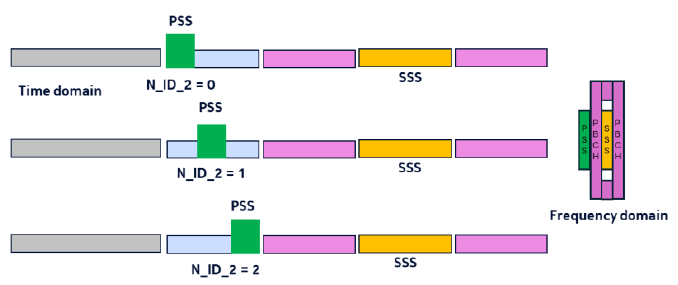
Compare PSS detection complexity with the work needed in later synchronization steps. A full-symbol NR-style design is simple and timing-stable, but may require more CFO searching. A shorter PSS can improve frequency-error tolerance. However, we must avoid adding ambiguity to SSS detection and cell identification.
Should the number of PSS sequences be reduced?
Reducing the number of PSS sequences can significantly reduce UE complexity, because each sequence adds a search dimension. We therefore benefit from fewer sequences, but must retain enough information for cell identification.
With fewer sequences, the UE tests fewer candidates and performs fewer correlations. This reduces processing load, detection time and power consumption. Limiting sequence count therefore gives us an effective way to reduce complexity.
Fewer sequences may make cells harder to distinguish, increasing ambiguity or collision risk. We may then need additional mechanisms to resolve that ambiguity. We must therefore balance sequence-count reduction against sufficient cell identification capability.
How does PSS design influence the number of required CFO hypotheses?
CFO uncertainty contributes substantially to detection complexity. The PSS sequence's sensitivity to frequency offset determines how many frequency hypotheses the UE needs. Sequence design therefore directly affects hypothesis count.
If the PSS sequence keeps strong correlation under frequency offset, the UE can detect it despite imperfect alignment. The UE then tests fewer CFO values, substantially reducing complexity.
Reducing CFO hypotheses directly reduces the UE's correlation operations. The UE processes less data, detects the signal sooner and consumes less power. Sequence robustness therefore directly improves UE efficiency.
How does PSS design affect UE power consumption during blind search?
Blind search is one of the UE's most power-intensive operations. PSS design determines how much processing the UE needs during that search, strongly affecting power consumption.
Count three factors when assessing correlation complexity: time samples, frequency hypotheses and sequence candidates. Increasing any one adds processing effort. Efficient sequence design can reduce one or more of these factors and control overall complexity.
During a longer search, the UE stays active longer and its processing units consume power continuously. Slow detection therefore affects battery life. Reducing search duration improves energy efficiency, and PSS design plays a key role in achieving that reduction.
Can low-complexity PSS detection use something other than an NR-style correlator?
The receiver may spend most of its cold-search effort detecting PSS before it knows the timing. Several proposals therefore change the sequence and detector together. Their reported complexity gains apply to the evaluated receiver, rather than every implementation of that waveform.
Apple evaluates a low-root ZC-based PSS and reports about 80% lower complexity for frequency offsets up to plus or minus 60 kHz. Qualcomm studies X-FMCW using two correlators. It forms different CFO hypotheses by shifting and combining their outputs, rather than running a separate full correlator for every hypothesis (R1-2606022, R1-2606375).
MediaTek evaluates frequency-domain OOK with energy detection and a TDM conjugate-ZC pair. Its analysis reports reductions of about 96.8% and 74.2%, respectively, against its NR correlation receiver. These values need the accompanying detection-performance and receiver assumptions (R1-2606847).
Ericsson now proposes a ZC root pair, u and -u, across two PSS symbols. Its six-symbol SSB also includes three PBCH symbols and one SSS symbol. Huawei continues evaluating m-sequence-based detection and challenges the residual-CFO behavior of single-root alternatives. Compare the complete receiver under matching assumptions (R1-2607871, R1-2607464).
Apple reports about 0.45 dB improvement for its ZC sequence design. Its three-PSS, 20 ppm comparison requires 7.8% of the NR reference complexity. The one-PSS case requires 9.1%. Its receiver resolves remaining frequency ambiguity through later processing. MediaTek retains frequency-domain OOK and conjugate-ZC comparisons. ETRI studies segmented m-sequences with roughly half the nonzero operations. Apple also counts sliding windows over the same search interval. Under that normalization, it finds a smaller OOK complexity saving than the earlier single-FFT comparison. These results describe different algorithms and comparison points (R1-2608215, R1-2607900, R1-2608070).
Huawei finds residual frequency errors above 1 kHz for one single-root receiver and poorer performance for a two-root alternative. Nokia identifies interference cases where X-FMCW misses the 1% misdetection target. Qualcomm develops X-FMCW and a two-symbol V-FMCW alternative. These results require common interference, CFO and receiver assumptions before ranking sequence families (R1-2607464, R1-2607062, R1-2608418).
How should single-shot detection and combining be compared?
A receiver can improve detection by processing more occasions, more hypotheses or more candidate peaks. A fair comparison must count that additional work. It must also separate single-shot performance from the coverage achieved after combining several observations.
The #126-bis draft evaluates both PSS and SSS acquisition, with timing inside half a CP of the strongest path. It discusses 1% and 10% single-shot misdetection targets, and 1% after combining. Applying the 1% false-alarm target at PSS alone or jointly after PSS/SSS remains a choice. That choice changes the detection threshold (R1-2608790).
Qualcomm illustrates the cost of unknown repetition patterns. Its global-false-alarm analysis raises the threshold by about 0.3 dB for two patterns. Searching all 128 patterns for eight repetitions raises it by about 1.02 dB. Adjustable repetition can therefore reduce the expected combining gain when the UE must first identify the pattern (R1-2608418).
Count real-valued multiplications, memory and candidate peaks passed to SSS over the complete attempt. Include sampling-frequency offset and residual timing/CFO, rather than only initial detection probability. CATT finds that reducing PSS work can transfer effort to SSS; its complete-chain comparison differs by about 0.3 dB under the evaluated conditions (R1-2607404, R1-2608790).
How should SSS be designed?
Now consider SSS after the UE has detected PSS and gained partial synchronization. SSS must provide reliable cell identification with good correlation properties, scalability and measurement support. Compared with PSS, the design focuses more on reliability and stability than on reducing blind-search complexity.
Why are Gold sequences used for SSS?
Gold sequences combine good correlation properties with flexibility, which explains their widespread use. For SSS, we need many IDs without sacrificing detection performance. Gold sequences offer a practical balance between performance and implementation complexity.
Good autocorrelation helps the UE identify the correct timing position. Gold sequences also have low cross-correlation between different sequences, reducing interference between cells with different IDs. Together, these properties improve multi-cell detection reliability and suit large-scale deployments.
What are the limitations of SSS under frequency offset?
The UE processes SSS after PSS detection, but residual frequency offset still affects it. SSS detection assumes some synchronization already exists. If frequency correction remains imperfect, performance can degrade.
Residual CFO can distort SSS, weakening the correlation peak and increasing detection noise. Detection probability then falls, and severe distortion may cause incorrect cell identification. SSS performance therefore depends on how accurately the UE corrects frequency during PSS processing.
What assumptions are needed for reliable SSS detection?
For SSS detection, we assume the UE already has coarse timing and frequency alignment. Without that partial synchronization, the UE would need more hypotheses, making SSS detection more complex.
The UE must align timing well enough to locate SSS in the correct symbol. It must also reduce frequency offset to a manageable level. With those conditions met, the UE can detect SSS efficiently using limited hypotheses. PSS performance therefore directly affects SSS reliability.
How does SSS design impact mobility measurements (e.g., RSRP accuracy)?
The UE uses SSS for measurement as well as detection. Synchronization signals may support mobility functions, so we must consider measurement accuracy when designing SSS.
Good sequence properties produce stable correlation results and more consistent signal strength measurements such as RSRP. Mobility decisions depend on that stability. Poor sequence quality may cause measurement fluctuations and degrade handover performance.
Residual CFO changes the received signal's amplitude and phase, introducing measurement errors. The UE may then underestimate or overestimate signal strength. Accurate frequency correction improves measurement reliability, so synchronization quality directly affects measurement performance.
How does SSS robustness affect cell-edge performance?
At the cell edge, low signal strength and high interference make SSS detection harder. This points to the importance of robust sequence design for maintaining cell-edge performance.
Neighboring-cell interference can distort SSS and make its correlation peak less clear, reducing detection reliability. Strong cross-correlation properties help limit that effect. Sequence design therefore plays an important role in interference resilience.
Fading changes signal amplitude and phase, affecting correlation results. In deep fading, the UE may struggle to detect the signal. Robust sequence design and possible repetition can help, so we must design SSS for realistic channel conditions.
Could SSS also provide the channel estimate for PBCH?
The NR PBCH reserves a substantial fraction of its REs for dedicated DMRS. Reusing SSS for channel estimation could release those resources for coded data. But the SSS placement and sequence would then need to support both cell identification and PBCH demodulation.
MediaTek studies a comb-like SSS/PBCH arrangement. Qualcomm studies distributing SSS over PBCH resources, and NTT DOCOMO proposes evaluating whether SSS can replace dedicated PBCH DMRS. Wider or more distributed SSS resources may improve channel estimation, but they also change the SSB structure and measurement assumptions.
Huawei and ZTE retain dedicated PBCH DMRS in their baselines. ZTE points out that DMRS also conveys timing or candidate-index information. Removing it can move that information into the payload or add decoding hypotheses. Jio therefore keeps dedicated DMRS as the evaluation reference and compares alternatives under matching assumptions (R1-2606847, R1-2606375, R1-2606501, R1-2605291, R1-2605431, R1-2605419).
Gold sequences remain the SSS benchmark, rather than the only candidate already selected. The later draft compares lengths such as 127, 144 and 240. Ericsson proposes truncating a length-255 Gold sequence to 240. NTT DOCOMO and MediaTek continue studying SSS-assisted PBCH estimation. These choices jointly affect measurement quality, DMRS overhead and decoding hypotheses (R1-2607871, R1-2608347, R1-2607900, R1-2608790).
How should synchronization coexist with NR (MRSS scenarios)?
In MRSS, NR and 6GR share the same or nearby spectrum. Their synchronization signals may overlap in time and frequency, so we must let UEs distinguish the RATs reliably. We also need to avoid interference and excessive UE complexity. Reusing existing structures may improve efficiency, but we must balance compatibility, complexity and performance.
Should 6G reuse NR synchronization raster?
Reusing the NR synchronization raster lets the UE search NR and 6GR through a common structure. This can simplify implementation, but the UE must still distinguish the two systems.
If NR and 6GR share raster locations, the UE can reuse search results and reduce scanning effort. That simplifies implementation. But signals from the two RATs may overlap, increasing misdetection risk. We therefore need additional mechanisms to distinguish them.
How can interference with NR devices be avoided?
To maintain reliable detection, we need to minimize interference between NR and 6GR signals. Signal design and resource allocation must provide separation or orthogonality where possible.
6GR synchronization sequences should have low cross-correlation with NR sequences to reduce detection interference. Through careful sequence design, we can achieve orthogonality and let the UE distinguish signals from different RATs. This improves detection performance.
What is the impact of alignment on UE complexity?
Alignment changes how the UE searches NR and 6GR. It can reduce or increase complexity depending on the implementation, so we must design the alignment carefully.
If both systems use similar timing and frequency structures, the UE can reuse detection results. Fewer independent searches then reduce processing load and improve efficiency.
With overlapping signals, the UE may mistake one RAT for the other, increasing false detection risk. It may need extra processing to resolve the ambiguity. That processing can offset the complexity saving from alignment.
What mechanisms prevent false detection of 6GR signals by legacy NR UEs?
Legacy NR UEs should not mistake 6GR synchronization signals for valid NR signals. We need mechanisms that preserve backward compatibility and prevent interference. The comparison must use existing NR receiver behavior, because deployed devices cannot be assumed to change their detection algorithms.
We can design 6GR sequences with low correlation to NR sequences, reducing false detection by an NR UE. Careful sequence-set selection is necessary to maintain compatibility between the systems.
Detection thresholds affect false alarms, but deployed NR UEs cannot be assumed to change their algorithms for 6GR. The 6GR waveform and placement must remain distinguishable under existing NR receiver behavior. Candidate receivers should be compared at the same global false-alarm target.
How does partial frequency proximity (within CFO range) affect coexistence?
If NR and 6GR signals are close in frequency, CFO can make them harder to distinguish and separate. We therefore need to account for frequency proximity in the design.
Frequency offset spreads signal energy across subcarriers. If two signals are close in frequency, that spreading can make them overlap. The UE may then struggle to distinguish them, making detection harder.
Overlap and interference make correlation peaks less clear, increasing missed or false detection probability. Detection algorithms must account for this. We therefore need to consider CFO in both sequence design and frequency planning.
Should resource block boundaries align between NR and 6GR?
On a shared NR and 6GR carrier, we need to align more than the synchronization raster. Both systems must also agree on resource block boundaries. Aligning those boundaries has broad support, but the discussion has not settled the point yet.
Misaligned grids create partial overlaps between NR and 6GR resource blocks. The network must then protect fractional resources rather than whole blocks. Scheduling and rate matching become harder, and more shared blocks mean more wasted edge resources.
A large group of companies jointly asked for a specification guarantee of alignment instead of leaving it to implementation. They view shared-carrier coexistence as a deployment requirement. A specification guarantee would make that requirement predictable.
We still have two open questions. Does alignment apply only to downlink, or to both directions? Also, how would it work with a half-subcarrier shift of the uplink centre frequency? That shift moves the uplink grid away from the NR grid.
Why are RB alignment and the uplink half-subcarrier shift separate questions?
The joint operator and vendor proposal addresses dynamic sharing in both time and frequency. If sharing were restricted to time, a small transmission for one RAT could prevent the other RAT from using otherwise free bandwidth. Aligned RB boundaries make finer sharing practical.
The joint contribution also identifies CORESET sharing and control-resource granularity as reasons for alignment. LTE downlink has a punctured DC subcarrier, so LTE/NR subcarrier alignment did not provide the same RB alignment. That earlier limitation motivates an explicit NR/6GR design requirement (R1-2606427).
The configurable 7.5 kHz uplink shift applies to a 15 kHz subcarrier grid. It supports coexistence with LTE, eMTC and NB-IoT and addresses DC-related impairments. It is a frequency shift, not a proposed 7.5 kHz SCS. The FL draft treats support for RB alignment and the need for this uplink shift as separate decisions (R1-2606723, R1-2606725).
Nokia distinguishes a common subcarrier grid from alignment of every RB boundary. One 6GR carrier can overlap several NR component carriers whose RB grids differ. A shared FFT or aligned subcarriers therefore do not guarantee one common RB grid across all those carriers. MRSS resource mapping must identify which alignment is required (R1-2607062).
Huawei additionally proposes configurable timing-advance offsets of 0, 25600 or 39936 Tc for coexistence. Quectel supports studying the configurable uplink half-subcarrier shift. Timing advance, frequency shift and RB-grid alignment solve separate coexistence problems; none substitutes for the others (R1-2607464, R1-2607777).
What information should be delivered via PBCH/MIB?
PBCH/MIB gives the UE its first system information after synchronization. We need enough information for timing alignment, frequency alignment and further system information acquisition. But a larger MIB increases decoding complexity and latency. We must therefore keep PBCH/MIB minimal while giving the UE enough information to continue access.
What essential information must UE obtain during initial access?
During initial access, the UE needs a small set of critical parameters to align with the network and prepare for further decoding. We should include only essential information at this stage.
Timing information lets the UE align its frame and symbol boundaries with the network. Parameters such as frame timing and subframe structure tell it how to interpret subsequent transmissions. Without accurate timing, the UE cannot continue decoding. Timing information is therefore one of the most critical MIB elements.
The UE first gains frequency alignment through synchronization signals. PBCH then provides configuration that refines the alignment, possibly including subcarrier spacing and frequency-resource information. The UE uses this information for correct demodulation. Reliable decoding requires accurate frequency alignment.
What configuration is needed for system information acquisition?
After decoding MIB, the UE must locate and decode further system information such as SIB1. It needs configuration parameters that tell it where and how to find that information.
MIB tells the UE about SIB1 location and scheduling, possibly including its time and frequency resources. The UE can then monitor the correct resources. Without that guidance, it would need blind search, so this information is essential for efficient access.
The UE needs basic PDCCH configuration to decode control channels and interpret scheduling grants. Without it, the UE cannot receive further system information. We must therefore include the basic control channel configuration needed for that step.
Should additional features be supported?
We also need to consider whether MIB should support additional features. They may improve energy efficiency or coverage, but increase MIB size and complexity. We must justify each addition carefully.
Energy saving may need extra configuration, such as parameters for reduced monitoring or on-demand signaling. These can help the UE operate more efficiently, but also enlarge MIB. We should therefore include only essential parameters.
Coverage extension may need repetition or configuration parameters that help the UE detect weak signals. Including them can improve cell-edge performance, but also increases complexity. We must weigh those costs against the coverage benefit.
How should information be split between SS, PBCH, and DMRS?
We should distribute information across signals and channels to balance complexity and performance. Keep early signals simple, then provide more detailed information later. Moving information between these components can also move the cost into extra sequence or decoding hypotheses.
Let's separate the functions. Synchronization signals provide timing and coarse identification, while PBCH carries essential configuration. DMRS supports channel estimation for decoding. Each component then handles a specific task, simplifying processing at each stage.
With information split across stages, the UE must finish one step before starting the next. This sequential processing can increase latency, although each step becomes simpler. We must therefore balance latency against processing efficiency.
What information enables new delivery methods (e.g., on-demand SI, fixed PDSCH)?
New system information delivery methods need additional configuration. The UE must know how to use those methods before it can obtain the information. The request and response resources must be available before the UE obtains the information it is requesting.
The UE must know the scheduling patterns and resource locations for system information channels. For on-demand delivery, it may also need trigger conditions. Without these parameters, it cannot use the new delivery methods, so we must include the key parameters in MIB.
Each new parameter enlarges MIB, requiring more resources for transmission and decoding. That increases latency and complexity. We should keep only critical parameters in MIB and deliver other information later to preserve efficiency.
Which PBCH fields obstruct combining across time?
The UE cannot directly add coded-bit likelihoods if those bits describe different payloads. Even a small time-dependent field can change many encoded bits. Payload splitting, scrambling and the interval of payload stability therefore matter as much as the number of repeated PBCH occasions.
Nokia proposes keeping the PBCH payload stable and conveying timing through other mechanisms. Qualcomm considers separately encoding SFN, while ZTE studies splitting MIB information. NEC asks for payload and index designs that facilitate combining. Ericsson favors carrying as much timing as practical through PBCH DMRS (R1-2605382, R1-2606375, R1-2605874, R1-2605431, R1-2605521).
Xiaomi retains the NR starting point of 32 information bits plus a 24-bit CRC in its proposal. This 56-bit figure includes the CRC; it is not a 56-bit MIB. Any new SSB repetition indicator or SIB1 version indicator must be assessed against the resulting coding and blind-decoding cost (R1-2605563).
A self-decodable PBCH occurrence and useful combining can coexist. Jio proposes preserving both, with a deterministic transformation where changing fields can be compensated. A fixed payload is one solution, but it is not the only way to make repeated coded information compatible (R1-2605419).
InterDigital proposes a 640 ms PBCH transmission interval, spanning four 160 ms periods, to support longer accumulation. It compares payload sizes of 42, 46 and 56 bits including CRC. Transsion separates stable PBCH information from changing indices. Quectel likewise asks to remove time-varying information from the combined portion. All require an explicit timing-recovery method (R1-2607914, R1-2607444, R1-2607777).
1Finity compares carrying timing through SSS or a larger DMRS sequence pool. Increasing that pool can complicate detection even when the payload shrinks. Ericsson instead favors SSB and burst indices through DMRS with a stable PBCH payload. The saving must include every resulting search hypothesis (R1-2607622, R1-2607871).
How should PBCH be designed for performance?
PBCH must remain decodable under difficult conditions, especially at the cell edge. But it must also avoid excessive delay and UE complexity. We therefore need to balance payload size, repetition and combining efficiency. The goal is high decoding probability with manageable latency and processing, supporting coverage and reliable initial access.
How does PBCH allocation size affect coverage?
Consider what happens when we give PBCH more symbols or bandwidth. The transmitter can spread coded information across more resources, improving the SNR required for one-shot decoding. But the larger allocation consumes more SSB resources. The UE may also need to test more allocation hypotheses.
< R1-2603518 : Figure 9. Illustration of considered PBCH allocation options >
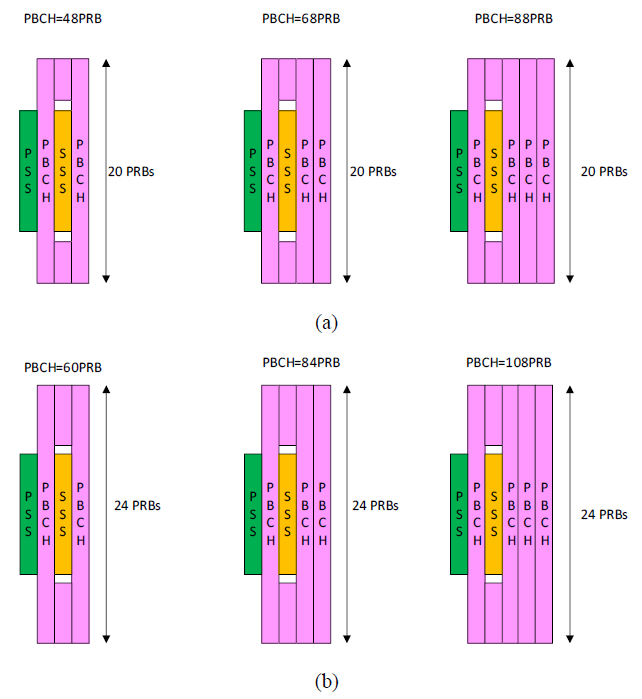
Adding one or two OFDM symbols to PBCH gives a clear coverage benefit. For the 20 PRB case, compare the NR-like 48 PRB allocation with 68 PRBs. The required SNR improves by about 1.5 dB. At 88 PRBs, the improvement reaches about 2.4 to 2.5 dB. Symbol extension therefore gives us an effective way to improve one-shot PBCH reliability.
With the symbol count unchanged, increasing PBCH bandwidth from 20 PRBs to 24 PRBs gives roughly 0.9 dB SNR improvement. Adding symbols as well gives a larger gain. The 108 PRB case combines 24 PRBs with two additional symbols. Its required SNR improves by about 3 dB against the NR-like baseline.
Larger PBCH allocations improve coverage but enlarge the SSB structure. Consider a 24 PRB PBCH with small channel bandwidth and blind detection: the UE may need many allocation hypotheses. We must therefore assess UE search complexity and SSB size as well as SNR. We also need to check whether PSS/SSS lets the UE derive PBCH location without excessive hypotheses.
What is the role of PBCH payload size?
PBCH payload size determines how much information the Master Information Block delivers. A larger payload adds functionality but makes decoding harder. A smaller payload improves robustness but limits flexibility, so we must choose the size carefully.
A larger payload means the network transmits more bits, increasing the SNR needed for successful decoding. Coverage may then decrease, especially at the cell edge. Reducing payload size improves decoding probability under weak signals and can therefore improve coverage.
What is PBCH combining and why is it important?
With PBCH combining, the UE combines multiple receptions of the same signal to improve decoding reliability. This is a key coverage technique, especially at low SNR.
The UE combines multiple transmissions to increase effective signal energy and improve the signal-to-noise ratio. Decoding then becomes more reliable, especially at the cell edge where signal strength is low.
Efficient combining needs sufficiently similar transmissions, including consistent channel conditions and timing alignment. Large channel variation reduces combining efficiency. We must therefore account for channel stability and coherence time when designing the transmission.
How much does combining actually recover at 7 GHz?
Let's compare PBCH link budgets at 7.0 GHz and 5G mid-band. For urban macro outdoor-to-indoor, the gap is about 8.3 dB without combining. When the UE combines four transmissions, that gap falls to about 3.1 dB.
Combining recovers roughly 5 dB for PBCH and about 3 dB for PSS/SSS. Most other candidate techniques currently offer less margin. We therefore need to treat combining as a basic coverage design assumption, rather than a later refinement.
Should PBCH payload be time-invariant?
Consider keeping the PBCH payload constant over time. That would simplify combining and reduce UE complexity, but may limit flexibility when updating system information. Changing timing fields need separate treatment before the UE can combine coded information across occasions.
If repeated payloads stay identical, the UE can combine signals without extra processing to track content changes. This reduces complexity and improves decoding efficiency. A time-invariant payload therefore supports a simpler UE implementation.
How does PBCH repetition pattern affect latency vs coverage trade-off?
More repetitions improve PBCH decoding reliability and coverage, but extend transmission time and delay access. We need to choose the repetition pattern carefully to balance coverage and latency.
Each repetition gives the UE another chance to receive the signal. The UE can combine these receptions to improve SNR and decoding probability. Repetition therefore provides an effective coverage enhancement.
Repetition extends transmission over a longer period. The UE may need to wait for several repetitions before it can decode, increasing access latency. We therefore gain reliability at the cost of access delay.
How does clustering of PBCH occasions impact combining efficiency?
Now consider the timing between PBCH transmissions. Clustering places several transmissions close together, which can improve combining efficiency under suitable conditions. The receiver still needs compatible payloads and an appropriate channel-estimation method; temporal proximity alone does not establish phase coherence.
Closely spaced transmissions see similar channel conditions, allowing coherent combining. But the small channel variation may limit diversity gain. Spreading transmissions over time increases diversity while making combining more complex. We therefore need to balance coherence against diversity when choosing transmission timing.
The UE must buffer received signals before combining them. Widely spaced transmissions require longer buffering and more memory. Clustering reduces that requirement and can therefore simplify UE implementation.
How can PBCH support a 3 MHz allocation without losing the wider-band design?
A 3 MHz spectrum allocation cannot simply carry the complete NR-like 20-RB SSB at 15 kHz SCS. Removing outer resources also removes coded energy. The narrowband solution must therefore specify where the payload is mapped and which receptions the UE may combine.
Xiaomi compares puncturing, rate matching and transmission retuning while retaining the NR-like structure. Its 12-RB cases lose about 2.3 to 4.4 dB against the 20-RB reference. Rate matching and retuning recover about 1.3 dB and 2.3 dB, respectively, relative to its puncturing reference (R1-2605563).
ZTE maps the MIB across two SSBs and reports about 1.5 dB improvement over its punctured two-transmission case. Qualcomm instead studies two PBCH parts: the central 12 RBs support the narrow allocation, and a wider allocation can use both parts. HONOR similarly studies repetition or incremental redundancy between the central and outer parts (R1-2605431, R1-2606375, R1-2606186).
These approaches use different mappings and energy allocations, so their gains cannot be added. The receiver must also know the applicable mapping before it can combine. Narrowband compatibility needs an explicit design, rather than an assumption that all wider PBCH resources remain observable.
When is coherent combining a valid assumption?
Repeated PBCH occasions need not share an unchanged propagation channel for useful soft combining. The UE can estimate each channel and combine compatible coded-bit likelihoods. Coherent sample-level combining has stronger requirements because it depends on phase alignment across the observations.
Xiaomi finds that intra-burst repetition can favor coherent cell-ID detection at low speed. With higher mobility, separated receptions can instead offer time diversity through non-coherent processing. MediaTek also identifies sampling-time drift as a limit on combining PSS over long intervals (R1-2605563, R1-2606847).
A network sleep transition may interrupt the transmitter phase reference even when the channel varies slowly. Jio therefore proposes evaluating an explicit phase-coherence window. Combining across different beams additionally needs compatible QCL, channel estimation and payload relations. It cannot be justified only by counting repetitions (R1-2605419).
InterDigital separates optimized reception of a complete block from a second receiver class that accumulates over longer intervals. This makes receiver capability part of the evaluation. A long PBCH interval does not itself ensure coherent phase across occasions. Report channel estimation, payload stability and the combining rule separately (R1-2607914).
Jio also distinguishes payload-to-coded-bit ratios from the polar mother-code rate. Its example with 56 information-plus-CRC bits should use the actual rate-matched length E when reporting 56/E. Changes in data RE count, repetition and DMRS density must remain visible in the comparison (R1-2608461).
How should synchronization periodicity and patterns be designed?
Synchronization periodicity and transmission patterns directly affect energy efficiency, access latency, and UE complexity. The key point is that increasing periodicity is a key method to reduce always-on signaling. But this introduces trade-offs in detection delay and processing effort. In addition, the structure of transmission patterns, such as clustering, affects combining efficiency and resource usage. So periodicity and pattern design must balance energy saving, performance, and resource efficiency.
What are the benefits of increasing SS/PBCH periodicity?
Increasing periodicity reduces how often synchronization signals are transmitted. This lowers network activity and improves energy efficiency. This is a key 6GR design goal. Actual savings also depend on whether traffic and other common channels allow the network to remain asleep.
When synchronization signals are transmitted less frequently, the network can remain idle for longer periods. That reduces transmit power usage. It also enables deeper sleep modes. Over time, this leads to significant energy savings. This is especially important in large-scale deployments.
How much energy does a longer period actually save?
Evaluations from a large group of companies now quantify the saving against a 20 ms baseline. On an unloaded carrier, moving to 80 ms or 160 ms saves a large fraction of network energy. The largest reported gains run from about 40 to 87 per cent, and they vary with the sleep state assumed.
The gains fall steeply once traffic is present. Evaluations that report more than 50 per cent at zero load report under 10 per cent at 15 per cent load. Sleep opportunities come from the gaps between transmissions, and traffic fills those gaps whatever the synchronization period.
No. Some evaluations show clustering roughly doubling the saving, and others show it reducing the saving and even turning it negative under light and medium load. The benefit depends on whether the clustered occasions fall inside sleep opportunities that the traffic leaves free.
What are the drawbacks?
Although increasing periodicity improves energy efficiency, it introduces several challenges. These include increased latency and higher UE complexity. So we must carefully consider these trade-offs.
With longer periodicity, the UE may need to wait longer for the next synchronization signal. If the UE arrives just after a transmission, it must wait until the next one. That increases access delay. Waiting for the first occasion can approach one full period. Successful acquisition can take longer when several periods are needed. So latency becomes less predictable.
Longer periodicity increases uncertainty in timing. The UE needs to search over a wider time window. That increases the number of time hypotheses. Combined with frequency hypotheses, the search space grows. So processing complexity increases. This also increases power consumption.
What is clustered transmission?
Clustered transmission refers to grouping multiple synchronization signal transmissions within a short time interval. Instead of spreading transmissions evenly, they are concentrated in a cluster. This structure can improve combining efficiency and reduce UE complexity in some cases.
Multiple transmissions within a short interval allow the UE to combine signals effectively. Since channel conditions are similar, combining is more efficient. That improves detection probability. It also reduces the need for long-term buffering. So clustering can enhance reliability.
Clustering reduces time diversity because transmissions occur close together. If channel conditions are poor, all repetitions may be affected. Spreading transmissions increases diversity but reduces combining efficiency. Clustering also increases short-term resource usage. So there is a trade-off between diversity and overhead.
How does synchronization periodicity affect measurement accuracy?
Synchronization signals are also used for measurements such as RSRP. So periodicity affects how often the UE can update measurements. The key point is that sparse signaling may impact measurement accuracy.
With less frequent signals, the UE has fewer opportunities to update measurements. This makes tracking of channel conditions less accurate. Rapid changes in the channel may not be captured. This can affect link adaptation and synchronization maintenance. So measurement accuracy decreases with sparse signaling.
Mobility decisions rely on measurement reports. If measurements are infrequent or inaccurate, decisions may be delayed or incorrect. This can lead to suboptimal handovers. In extreme cases, connection quality may degrade. So periodicity must support reliable mobility performance.
How does clustering impact resource availability for data transmission?
Synchronization signals occupy time-frequency resources that could otherwise be used for data. Clustering affects how these resources are distributed over time. The key point is that this has implications for system throughput.
When transmissions are clustered, a larger portion of resources is occupied in a short time. That creates a temporary reduction in available resources for data. Outside the cluster, resources are free. So resource usage becomes uneven over time.
Short-term clustering may reduce instantaneous throughput during transmission periods. But longer idle periods allow efficient scheduling of data. Overall throughput impact depends on how resources are managed. So clustering must be designed to minimize negative impact on data transmission.
How should SSB candidate locations be patterned?
SSB candidate locations are important because the UE must know where synchronization opportunities may appear before it can search efficiently. In NR, these locations are fixed within a slot and help the UE establish timing. For 6GR, fixed candidate locations can still be useful, especially if PBCH combining or SSB beam-sweep combining is expected. Without predictable candidate locations, the UE may need to test more timing hypotheses, which increases complexity.
Fixed locations reduce uncertainty. They allow the UE to search only a limited set of symbol and slot positions instead of scanning a wider time window. This is useful when SSB periodicity is extended, because fewer SSB occasions are available and each missed opportunity has a larger latency impact. So fixed candidate locations can help preserve detection reliability while keeping UE processing manageable.
How should symbol-level SSB locations be simplified?
NR symbol-level SSB locations were selected with several constraints in mind, including DL control at the start of a slot, UL control near the end of a slot, mixed numerology, mini-slot operation, and different TDD cases. For 6GR, some of these constraints may be relaxed. For example, if mixed numerology is not a prerequisite in FR1, the reserved symbols for DL control and SSB placement can be reconsidered.
< R1-2603518 : Figure 10. Illustration of NR SSB candidate locations within a slots for μ={0,1,2,3,4} >
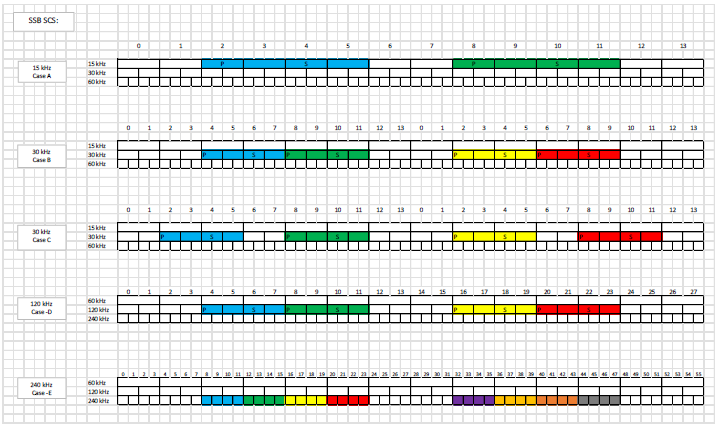
Using two SSB candidate locations in a slot can reduce beam sweep duration. This is useful when many beams must be transmitted and when the system wants to limit the total synchronization sweep time. Reserving a small number of symbols for DL control can still help multiplex SSB with other transmissions, but reserving UL control symbols at the end of every slot may not be needed in most slots.
A gap between SSB candidates does not appear necessary for many FR1 and FR2-1 cases. Avoiding unnecessary gaps can simplify the symbol pattern and make the candidate locations more compact. Special slots still need separate handling, because UL symbols and guard periods can reduce the number of usable SSB locations.
How should slot-level SSB patterns handle TDD constraints?
Slot-level SSB patterns must be aligned with the actual UL/DL slot structure. A pattern that works for one TDD configuration may collide with special slots or UL symbols in another configuration. So the relationship between SSB slot pattern and TDD UL/DL slot pattern needs to be considered explicitly in 6GR.
< R1-2603518 : Figure 11. Illustration of NR slot level SSB pattern for μ={0,1,2,3,4} >
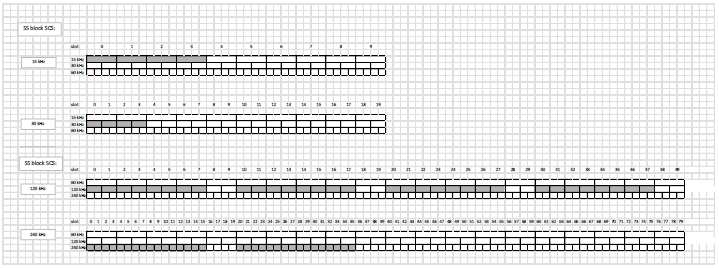
< R1-2603518 : Figure 12. Illustration of required number of slots to reach actual number of possible SSB candidate locations, Lactual, equal to {16,32} with two alternative TDD patterns >
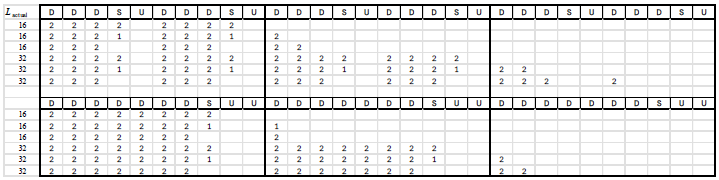
In NR, SSBs can be placed across a set of continuous slots. This is simple, but it may not align well with practical TDD patterns such as slots reserved for UL or special-slot operation. If some candidate locations cannot be used, the effective number of SSB occasions is reduced. This can limit the number of beams supported within a target time window such as 5 ms.
A TDD-agnostic SSB pattern is simpler from a specification perspective, but it may require more candidate locations to guarantee enough actually usable SSB occasions. A TDD-aware pattern can reduce unused candidates, but it depends on the configured UL/DL pattern and special-slot assumptions. So there is a trade-off between common design and efficient use of usable slots.
How do SSB repetitions affect combining and beam sweep duration?
If repetitions are transmitted before completing a beam sweep, the UE may be able to combine repeated SSBs more easily. But this can extend the time required to cover all beams. If the beam sweep is completed first and then repeated, the measurement gap may be shorter, but the UE may need additional assumptions about repetition timing and candidate locations.
Inter-frequency measurements are sensitive to the total duration of the synchronization sweep. If SSB repetitions cause the sweep to exceed the available measurement gap, the UE may not be able to measure all beams efficiently. So the mapping between repetitions and SSB candidate locations must consider both combining gain and measurement feasibility.
How should clustered SSB transmissions be used?
Clustered SSB transmission is a way to support long SSB periodicity while still giving the UE multiple synchronization opportunities within a shorter interval. Instead of spreading individual SSB occasions uniformly over time, the network can transmit a cluster at the start of a longer period. This can reduce the average latency for acquiring enough SSB occasions for measurements or PBCH decoding.
< R1-2603518 : Examples of Clustered SSB Transmission >
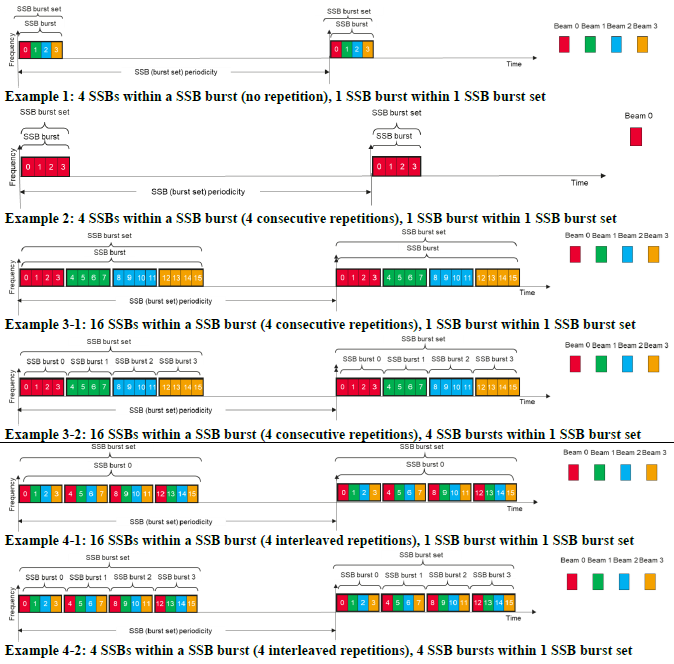
< R1-2603518 : Figure 14. Illustration of (a) legacy NR SSB transmission pattern and (b) clustered SSB transmission pattern >
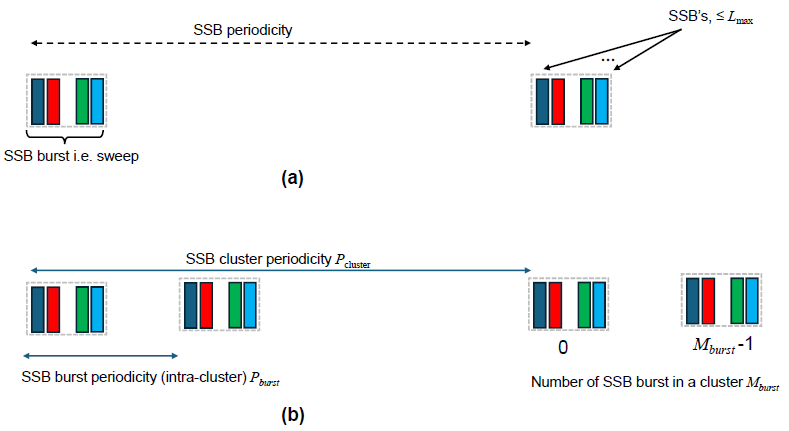
< R1-2603518 : Figure 15. Illustration of possible combining over clusters and within a cluster based on Pcluster and Pburst >
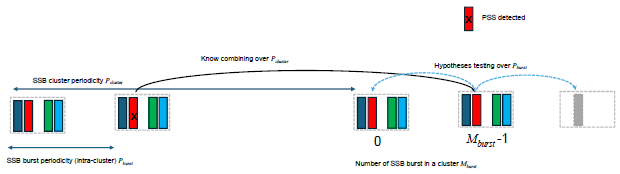
The useful distinction is between an SSB burst, an SSB burst set, and repetitions within the burst set. A 6GR SSB burst can contain multiple 6GR SSBs, while a burst set can contain one or more bursts. Repetitions may occur consecutively or with time separation inside the cluster. These definitions help describe whether the UE is seeing different beams, repeated transmissions, or multiple burst groups.
When the SSB periodicity is extended to values such as 80 ms or 160 ms, a UE may otherwise wait a long time to collect enough SSB occasions. Clustering can place multiple occasions near the beginning of the period. This can reduce average acquisition latency, especially when the UE needs several SSB occasions for measurement, tracking, or PBCH combining.
What UE assumptions are needed for clustered SSB operation?
Clustered operation should minimize the amount of prior information required by the UE. For PSS detection, the UE can still perform blind search without strict assumptions about the cluster. For SSS detection, the UE may use the detected PSS timing and then try SSS detection based on the expected SSB structure. For PBCH combining, more information is useful because the UE needs to know which SSBs can be combined.
The UE benefits from knowing the SSB cluster periodicity and the repetition periodicity within the cluster. With this information, it can combine PBCH over likely repetition candidates. Without it, the UE may need to test more hypotheses across SSB burst locations, which increases complexity. So clustered SSB operation should define enough timing structure to make combining practical.
Repeated synchronization signals and channels can help create self-detectable or decodable SS/PBCH occasions within a cluster. This is useful because the UE may not need full prior knowledge of every repetition if the repeated occasions can be detected from the signal structure itself. The design still needs to define how many repetitions are used, whether all repetitions are identical, and how far apart they are placed.
Is the periodicity gain real in deployment?
The evaluations above are simulations, and one line of argument at RAN1 #126 asks whether they survive contact with a network. The objection is not that the model is wrong. It is that the gain depends on the base station implementation, that it shrinks under load, and that no operator has yet deployed the periodicities being proposed.
No known commercial deployment uses an SSB periodicity longer than 20 ms, apart from one regional deployment at 40 ms. The proposals under study reach 80 ms and 160 ms. They are therefore four to eight times beyond anything currently in service.
Around 8 per cent, and about 3.5 per cent for the shallower sleep state, once the cell carries 15 per cent load. Those values sit at the low end of the reported range, and they are the ones a loaded network would see.
Qualcomm questions whether existing field experience establishes mobility performance beyond 40 ms and identifies connected-UE throughput costs. Ericsson separately provides simulations with adapted L3 filtering at 160 ms. These results address different conditions; neither establishes every mobility procedure under long periodicity.
What periodicity choices remain in the FL draft?
The #126 agreement and #126-bis drafts compare several complete periodicity-and-combining arrangements. It does not establish 160 ms as the selected default. The UE assumptions are part of each option because they determine how long a weak UE must wait before decoding succeeds.
The reproduced #126 agreement includes five study configurations. Two use 160 ms or 80 ms with within-period combining. Two use 40 ms, with either cross-period combining alone or both combining modes. The fifth retains 20 ms with cross-period combining. None establishes a selected default (R1-2608790).
Huawei and Samsung favor 160 ms together with additional design changes. Qualcomm prefers 20 ms and considers 40 ms; Apple, OPPO and MediaTek emphasize shorter search windows. NTT DOCOMO supports evaluating 40, 80 and 160 ms as a package with reduced search complexity. These positions do not reduce to a single agreed period.
ASUSTeK also examines omitting a standardized default altogether. That gives the network flexibility, but removes an important assumption for bounded search and combining. Its alternative is a longer default with a coarser raster, rather than an unrestricted search with no acquisition procedure (R1-2606439).
The #126-bis FL #5 draft splits the 80 ms case into two test points. One uses two within-period repetitions and combining over two periods. Another uses four within-period repetitions without cross-period combining. This yields six draft test points while preserving the five-configuration #126 baseline. The later summaries still discuss six options without establishing a final default (R1-2608449, R1-2608450, R1-2608790).
MediaTek favors a 40 ms baseline and compares two repetitions across sixteen beams with four repetitions across eight beams. CEWiT reports that its evaluated 32-beam case can meet coverage without repetition. Those results depend on the block structure and beam gain. They cannot establish one repetition count for every deployment (R1-2607900, R1-2608532).
Does clustering solve the wait on an empty raster point?
A cluster can help a UE collect several useful receptions after the first SSB arrives. It does not automatically shorten the observation needed to reject a frequency where no cell exists. Cold search therefore needs a separate latency assessment from combining on a known carrier.
OPPO identifies this remaining dwell-time cost, and Apple finds higher processing cost for cross-period acquisition. Jio proposes reporting the 95th-percentile latency from a random arrival time through successful PBCH decoding. The physical burst locations and early-stop rule must accompany that result (R1-2605917, R1-2606022, R1-2605419).
Qualcomm also measures a separate recovery cost after RLF. Its laboratory results show approximately 75% and 177% longer re-establishment latency for 80 ms and 160 ms SSB periods. These are results from its tested procedure, not universal percentages. They explain why a good idle-search result does not establish good recovery behavior (R1-2606375).
Why do the loaded-network energy evaluations disagree?
A longer common-signal period creates a potential sleep interval, but the scheduler decides whether traffic occupies it. The BS sleep model and extra synchronization transmissions also consume energy. Results with different scheduling assumptions therefore need to remain separate.
NTT DOCOMO clusters data occasions as well as common signals. Its evaluation reports substantial savings with limited QoS degradation at 40 and 80 ms for the evaluated eMBB traffic. Huawei likewise uses an energy-aware scheduler and includes separate cases with additional synchronization signals (R1-2606501, R1-2605291).
MediaTek revision R1-2606847 gives a different outcome under its Category 2, light-load assumptions. At 160 ms, unclustered SSB/SIB1/RO operation saves 5.0%, while clustered scheduling gives a negative 6.3% gain against its baseline. Apple also notes that omitting OD-SSB and tracking signals makes loaded-network savings optimistic.
CEWiT obtains much larger gains when it clusters the other common channels along with SSB. These findings establish a condition: compare the complete scheduler, common-channel pattern, BS state transitions and UE delay. They do not establish that clustering always helps or always fails (R1-2606646).
How can a searching UE discover an adjustable repetition pattern?
An adjustable repetition count saves transmissions when coverage is good, but a searching UE needs a rule before decoding system information. SIB1 can configure later reception. It cannot be the sole source of information required to acquire SIB1 in the first place.
Futurewei, Xiaomi, Google, Sony and Qualcomm favor predictable fixed repetition in their baseline discussions. Nokia, CMCC, OPPO, ZTE, Samsung and NEC support network adjustment under predefined limits. Spreadtrum starts from a 40 ms pattern and also specifies restrictions if adjustment is supported. These are competing design positions (R1-2607028, R1-2607208, R1-2607929, R1-2608029, R1-2608418, R1-2607062, R1-2607156, R1-2607263, R1-2607302, R1-2607560, R1-2607661, R1-2607111).
A restricted pattern set can make adjustment searchable. Vivo considers fixed behavior for two repetitions and restricted alternatives above two. ETRI favors the first consecutive repetitions. Tejas proposes complete beam rounds. Jio studies a small count set such as 1, 2, 4 and 8. Each approach needs a known acquisition fallback (R1-2607340, R1-2608070, R1-2607716, R1-2608461).
1Finity, Panasonic, Quectel, TCL, KT and NTT DOCOMO also support adjustment. The indication could use a detectable SSB property or later explicit signaling after bootstrap. Define the slot positions, burst placement and beam/repetition ordering separately. Knowing the maximum M alone does not tell the UE which observations share a beam (R1-2607622, R1-2607737, R1-2607777, R1-2607949, R1-2608294, R1-2608347).
How does beam-based operation impact synchronization?
Beam-based operation is a fundamental feature of 6GR, especially at higher frequencies. The key point is that synchronization must now be performed across multiple spatial directions. This significantly impacts how synchronization signals are transmitted and detected. Instead of omnidirectional transmission, signals are beamformed and swept across directions. That increases both transmission overhead and UE search complexity. So synchronization design must consider beam management as a core factor.
Why are more beams needed at higher frequencies?
At higher frequencies, signal propagation characteristics change. Path loss increases and signals become more directional. So beamforming is required to maintain coverage. This leads to an increase in the number of beams that must be supported.
Higher frequencies allow more antenna elements to be packed into the same physical area. This enables narrow beamforming. Narrow beams provide higher gain but cover smaller spatial regions. So more beams are required to cover the entire cell. That increases the number of beam directions that must be scanned during synchronization.
How many SS/PBCH beams should be supported?
The number of SS/PBCH beams determines how many directions synchronization signals are transmitted. The proposal is that increasing beam count improves coverage but increases overhead. So the number of beams must be carefully chosen.
NR already supports beam sweeping for synchronization, especially in FR2. But 6GR may require even more beams due to higher frequencies and narrower beams. That increases both transmission and detection complexity. So scaling beyond NR requires new optimizations.
How many broadcast beams may be needed around 7 GHz?
For new frequency ranges around 7 GHz, one objective is to keep a similar site grid to existing FR1 deployments. That requires enough antenna gain to compensate for the higher path loss compared with lower FR1 frequencies. If the physical array size remains similar, the number of antenna elements can increase, which narrows the beamwidth and increases the number of beams needed to cover the same area.
If the number of antenna elements is doubled in both horizontal and vertical dimensions, the number of possible beams can increase by about four times. So if FR1 supports up to eight SS/PBCH beams, a similar coverage target around 7 GHz may require support for 16 or 32 SS/PBCH beams. That improves coverage but also increases synchronization overhead and UE search effort.
How does subcarrier spacing affect beam transmission?
Subcarrier spacing affects symbol duration and transmission timing. This has implications for beam sweeping and synchronization overhead. The key point is that higher SCS can reduce time-domain overhead.
Higher SCS results in shorter symbol duration. That allows faster transmission of synchronization signals. In beam sweeping, this reduces the total time required to cover all beams. So higher SCS improves efficiency in high-frequency scenarios.
Shorter symbols mean that each beam transmission occupies less time. When multiple beams are transmitted sequentially, total duration decreases. That reduces synchronization overhead. So access latency can be improved.
Why consider 240 kHz SCS for SS/PBCH in FR2-1?
For FR2-1 operation, especially when 120 kHz SCS would otherwise be used, 240 kHz SCS can reduce the time-domain footprint of SS/PBCH. This is useful for analog beamforming, where many SSB beams may need to be swept. If 64 SSB beams are transmitted, using 240 kHz SCS can reduce the burst duration compared with 120 kHz SCS.
< R1-2603518 : Figure 16. Mapping of SSBs with 120 and 240 kHz SCSs, respectively, in a 14-symbol slot defined by 120 kHz SCS >

< R1-2603518 : Figure 17. NR mapping of SSBs into 14 symbol slots with 120 and 240 kHz SCSs within 5 ms half-frame >

With 120 kHz SCS, fewer SSBs fit into a 14-symbol slot. With 240 kHz SCS, more SSBs can be mapped into the same slot duration because each symbol is shorter. So the number of affected slots within a given time window can be reduced. That creates more opportunities for scheduling PDSCH and other downlink transmissions.
How does SS/PBCH SCS affect downlink resource overhead?
SSB transmissions are usually broadcast and periodic. They are intended to cover the cell even when there may not be active UEs under every beam. In analog beamforming, this can limit data multiplexing because the beam direction used for SSB may not match the beam direction needed for PDSCH. So the time-domain footprint of SSB directly affects available downlink resources.
FDM between SSB and PDSCH is not always practical with analog beamforming. The gNB may only be able to transmit data toward a beam direction aligned with one of the SSBs in the slot. For other SSB beams, the same symbols may effectively be unavailable for PDSCH scheduling. This makes the SSB footprint a real cell-level overhead, not only a physical resource mapping issue.
The numerical examples show that 240 kHz SCS can reduce the percentage of downlink resources affected by SSB compared with 120 kHz SCS. For a 64-beam, 20 ms SSB burst case, 120 kHz SCS affects about 32 out of 160 slots, while 240 kHz SCS affects about 16 out of 160 slots. That reduces SSB-related overhead and improves the amount of resource available for PDSCH.
| BW | Case 1 gain | Case 2 gain | Case 3 gain |
|---|---|---|---|
| 100 MHz | 3.16% | 5.34% | 11.9% |
| 200 MHz | 2.54% | 4.66% | 11.9% |
| 400 MHz | 2.23% | 4.33% | 11.9% |
For FR2-1 and possibly upper bands around 15 GHz, 240 kHz SCS for SS/PBCH can improve spectral efficiency by reducing the SSB time-domain footprint. The trade-off is that we must still align with the SCS assumptions for other channels and signals in the band. So SS/PBCH SCS should be selected together with beam count, analog beamforming constraints, and downlink multiplexing assumptions.
How does analog beamforming limit multiplexing of SSB and data?
In analog beamforming, a single beam direction is typically used at a time. This limits the ability to transmit multiple signals simultaneously in different directions. The key point is that this constraint affects how synchronization and data transmissions are scheduled.
Frequency division multiplexing assumes that different signals can be transmitted simultaneously in the same time slot. But with analog beamforming, the antenna can only focus in one direction at a time. So transmitting synchronization and data simultaneously in different beams is not straightforward. This limits multiplexing flexibility.
Since only one beam direction can be active at a time, transmissions must be scheduled sequentially. This affects both synchronization and data transmission. The network must decide when to transmit synchronization signals versus data. This introduces scheduling constraints and potential inefficiencies.
How does beam count scaling affect synchronization overhead?
As the number of beams increases, synchronization overhead also increases. Each beam requires its own transmission opportunity. This affects both network resource usage and UE search effort.
Each beam requires a separate transmission of synchronization signals. As the number of beams increases, total transmission time increases. This consumes more time-frequency resources. So less resource is available for data transmission.
The UE needs to search across all possible beam directions. That increases the number of hypotheses. Detection time increases as more beams are scanned. This also increases UE power consumption. So beam count directly impacts UE complexity and energy usage.
Is another beam equivalent to another repetition?
A new beam changes the angular coverage, while a repeated beam supplies another observation of an existing direction. The same total SSB count can therefore produce different coverage and latency. Comparisons must identify distinct beam indices separately from their repeated transmissions.
Huawei points out that a larger array does not automatically increase common-channel gain if broadcast beamwidth stays unchanged. Qualcomm finds limited benefit from simply increasing beam count in its channel model. OPPO and Xiaomi also compare fewer beams with repetition against larger beam sweeps (R1-2605291, R1-2606375, R1-2605917, R1-2605563).
CSCN identifies another scaling issue for NTN: one PCI can cover many satellite beams, and beam hopping can increase the needed number of distinguishable SSBs. Its proposal for a 160 ms NTN default therefore has a different motivation from terrestrial BS sleep. The common design must retain those different constraints (R1-2606479).
Must the UE know which physical TRP transmitted an SSB?
The UE can select a beam or RACH resource without knowing the physical network topology. Explicit TRP knowledge becomes relevant only when it changes a required UE action. This distinction separates resource selection from introducing a new TRP identity.
Ericsson, Nokia, Qualcomm and NTT DOCOMO favor keeping physical TRP associations within the network for baseline discovery. A common PCI, SSB groups and SSB-to-RO associations can support selection while the physical TRP mapping remains transparent (R1-2605521, R1-2605382, R1-2606375, R1-2606501).
MediaTek and ZTE study explicit differentiation before or during random access. KT identifies propagation-delay and RACH ambiguity in transparent SFN operation. Xiaomi therefore proposes comparing non-transparent access against transparent SSB-group operation, rather than assuming that a new identity is necessary (R1-2606847, R1-2605431, R1-2605761, R1-2605563).
The comparison needs relative arrival delays, usable CP, per-TRP power and phase assumptions. SFN gains from one deployment cannot be transferred unchanged to another. Resource partitioning may also reduce available preambles and increase collisions even when it simplifies preferred-TRP selection.
ZTE proposes a cell-cluster design with explicit or resource-pool-derived TRP information. Google instead proposes bounded early reporting, including two SSB indices, without requiring physical-TRP identity during discovery. These mechanisms should be compared against transparent network-side association. Extra identity information needs a demonstrated access or early-data benefit (R1-2607302, R1-2607929).
How should broadcast channels be delivered?
Broadcast channel delivery is a key part of initial access and system operation. The key point is that traditional always-on broadcast mechanisms may not be efficient for 6GR. Instead, more flexible delivery methods are needed. These include periodic and on-demand approaches. We must balance energy efficiency, latency, and UE complexity. It must also support different deployment scenarios and scalable system information delivery.
What are the options for system information delivery?
System information can be delivered using different methods depending on system requirements. The discussion covers both periodic and on-demand approaches. Each method has its own advantages and trade-offs.
On-demand SIB1 is transmitted only when needed. The UE may request system information or receive it based on network triggers. That reduces unnecessary transmissions. So network energy consumption decreases. But it requires additional signaling and coordination. This may introduce additional latency.
Periodic SIB1 is transmitted at regular intervals regardless of UE demand. This lets the UE that the UE can access system information without requesting it. It simplifies UE operation. But it leads to continuous transmission even when no UE is present. That reduces energy efficiency.
How does on-demand delivery improve energy efficiency?
On-demand delivery reduces unnecessary broadcast transmissions. The network transmits system information only when required. This aligns with 6GR goals of reducing always-on signaling. But it introduces trade-offs in latency and complexity.
With on-demand delivery, the UE may need to wait for system information to be transmitted after a request. That increases access delay compared to periodic transmission. The delay depends on scheduling and signaling procedures. So energy efficiency is improved at the cost of increased latency.
What deployment scenarios must be supported?
Broadcast delivery must work across different deployment scenarios. The key point is that standalone and multi-cell environments have different requirements. So we must be flexible.
In standalone scenarios, the UE relies entirely on a single cell for system information. So broadcast delivery must be self-contained. In multi-cell scenarios, system information may be distributed across cells. One cell may provide synchronization, while another provides system information. That allows more flexible and efficient delivery. But it requires coordination between cells.
How can area-specific system information be supported?
The proposal is that system information may vary across geographic areas. So mechanisms are needed to deliver area-specific information efficiently. This avoids unnecessary transmission of irrelevant information.
The network can divide coverage into smaller regions. Each region may have different system information. The UE needs to identify which region it belongs to. That allows it to receive only relevant information. That reduces overhead and improves efficiency.
The UE may use identifiers or indicators provided during initial access. These indicators point to the correct system information. The UE then monitors specific resources for relevant data. This avoids unnecessary decoding of unrelated information. So UE processing load is reduced.
What mechanisms allow UE to request system information without anchor cells?
In flexible architectures, the UE may not rely on a fixed anchor cell. Instead, it may need to request system information dynamically. We therefore need mechanisms that support this operation.
The UE may send a request signal indicating its need for system information. This signal must be simple and efficient. The network then schedules the delivery of requested information. This enables on-demand operation without continuous broadcasting.
Initial configuration must be provided through synchronization signals or minimal broadcast information. That allows the UE to know how to request further information. Without this, the UE cannot initiate the request process. So a minimal bootstrap mechanism is required.
How should repeated SSBs map to SIB1 monitoring occasions?
Repeating the same beam should not force the UE to treat every copy as a separate SIB1 scheduling opportunity. Otherwise, improved SSB coverage can produce unnecessary PDCCH monitoring. The mapping must distinguish a beam identity from a repeated candidate transmission.
NEC identifies this issue in the NR monitoring-occasion formula. It also asks how the reference frame is determined when a burst set spans several radio frames. Ericsson proposes revisiting the strict SSB-index mapping and studying one-to-many or many-to-many SIB1 associations (R1-2605874, R1-2605521).
HONOR proposes relating the SIB1 PDCCH monitoring period to one or more SSB periods. Xiaomi studies clustered Type0-PDCCH occasions and narrowband CORESET#0 options. The FL draft retains both TDM with nearby SIB1 transmissions and FDM as study candidates for FR1 (R1-2606186, R1-2605563, R1-2606725).
NEC shows that repeating beams can multiply Type0 monitoring occasions unless the mapping avoids redundant decoding. A burst spanning several frames also needs a clear reference frame. TCL separates synchronization and broadcast functions, but still needs a bounded rule to find the broadcast part. A smaller always-on block does not remove this search (R1-2607661, R1-2607949).
Tejas proposes a deterministic broadcast indication before PBCH and a fallback to normal PBCH when that indication is invalid. A UE with valid stored SI may use a lighter synchronization path. A UE without that information still needs the complete bootstrap procedure (R1-2607716).
What must be available before standalone on-demand SIB1 can work?
The UE needs enough configuration to send a valid request before it receives the requested SIB1. It also needs to know whether access is allowed and where to receive the response. Moving SIB1 on demand does not remove these bootstrap dependencies.
Apple questions fitting the required standalone UL-WUS configuration into MIB/PBCH and opposes standalone OD-SIB1 with SSB periods above 40 ms. Nokia supports studying MIB-based or other physical-channel delivery. NTT DOCOMO considers preconfigured request information, while OPPO studies a low-power network receiver to avoid frequent main-radio wake-ups (R1-2606022, R1-2605382, R1-2606501, R1-2605917).
A dense UL-WUS schedule can reduce request latency but consume the sleep opportunities that motivated on-demand delivery. The comparison must include UE transmit energy, configuration overhead, request collisions and response delay. Assisted operation with another cell should be evaluated separately from an isolated cold-start cell.
Futurewei studies a light synchronization signal with sequence-based indication and an optional SSS. A UE request still needs known uplink resources and sufficient timing, while the network must listen for it. Transsion and NEC extend on-demand ideas toward the PCell and additional RRC states. Stored configuration and cold initial access require separate procedures (R1-2607028, R1-2607444, R1-2607661).
How can paging fit inside a short common-channel active interval?
A short SSB and SIB1 cluster leaves fewer time positions for paging. Packing paging into that interval therefore creates a capacity problem as well as a synchronization problem. Frequency or spatial multiplexing can reduce the number of separate transmission occasions.
NEC studies FDMed occasions and multi-beam paging PDCCH. ZTE considers paging capacity across time and frequency, while MediaTek seeks one framework for operation with and without WUS. Huawei also studies finer paging subgroups to reduce unnecessary UE wake-ups (R1-2605874, R1-2605431, R1-2606847, R1-2605291).
The RAN2 agreement reproduced in the FL summary supports both clustered and evenly distributed PF/PO designs. Clustering is therefore an option, not a requirement for every deployment. A synchronization resource near the PO is useful only when the last usable SSB leaves too much tracking uncertainty (R1-2606725, R1-2605419).
Vivo and NEC relate paging order to the SSB multiplexing method. TDM can place repeated receptions of one beam close together. FDM changes the simultaneous bandwidth and capacity assumptions. China Telecom cautions against treating clustered paging as universally beneficial. The UE wake interval depends on which beam and repetitions it must actually receive (R1-2607340, R1-2607661, R1-2607603).
Transsion studies paging repetition and early indication, while Panasonic considers common adaptation signaling. An indication that changes the common transmission pattern must be available to the affected idle UEs. Changes cannot rely only on dedicated configuration held by connected devices (R1-2607444, R1-2607737).
How can coverage be extended for broadcast channels?
Coverage extension is a key requirement for 6GR, especially for scenarios such as LPWA and NTN. The key point is that broadcast channels must be decodable even under very low signal conditions. That requires techniques that improve detection probability without excessive complexity. At the same time, these techniques must not significantly increase latency or resource usage. So coverage extension design involves trade-offs between robustness, efficiency, and delay.
How large is the coverage gap at 7 GHz?
Coverage extension needs a target, and link budget work now supplies one. The initial-access comparison uses 7.0 GHz against 5G mid-band at 3.5 GHz. The trimmed means below are the gaps identified at #126, reproduced in the #126-bis material. They are study inputs, rather than final specification limits (R1-2608790).
The size of the gap depends on whether the UE is indoors, and the difference is large.
| Signal | Urban macro, outdoor-to-indoor | Urban macro, outdoor |
|---|---|---|
| PSS/SSS, no combining | -7.24 dB | -2.81 dB |
| PBCH, no combining | -8.32 dB | -1.51 dB |
| PSS/SSS, 4 combined | -4.08 dB | +1.13 dB |
| PBCH, 4 combined | -3.09 dB | +1.69 dB |
| SIB1 PDCCH | -5.56 dB | -1.28 dB |
| SIB1 PDSCH | -6.91 dB | -2.92 dB |
A negative value means worse coverage at 7 GHz. Outdoors the gap almost disappears, and combining turns it positive. Indoors it remains several decibels even after combining. Building penetration, rather than the carrier frequency alone, drives the requirement.
The uplink does. Msg3 PUSCH sits about 8.7 dB behind mid-band for urban macro outdoor-to-indoor, and Msg5 PUSCH about 13 dB. Downlink broadcast is therefore not the binding constraint, although it must still close its own gap.
What techniques enable coverage extension?
Several techniques can be used to improve coverage. These include repetition, power boosting, and simplified transmission structures. The discussion focuses on repetition as a primary method. But the choice of technique depends on system constraints.
Repetition increases the probability that the UE successfully receives the signal. Multiple transmissions allow combining, which improves effective SNR. This is particularly useful at the cell edge. But repetition increases transmission time and resource usage. So it improves coverage at the cost of latency and efficiency.
Both control and data channels may require repetition to ensure reliable decoding. Repeating only one may not be sufficient. For example, if PDCCH is not reliably decoded, the UE cannot access PDSCH. So both may need to be repeated in coverage-limited scenarios. That increases overhead but ensures end-to-end reliability.
When is fixed allocation preferable?
Fixed allocation refers to predefined resource locations for broadcast channels. This simplifies UE operation because it eliminates the need for dynamic scheduling. The proposal is that this can be beneficial in coverage-limited scenarios.
With fixed allocation, the UE knows exactly where to look for broadcast channels. This eliminates the need to decode control information first. It reduces the number of search steps. So UE complexity and power consumption decrease. This is especially useful for low-power devices.
How does coverage extension differ between LPWA and NTN scenarios?
LPWA and NTN scenarios have different characteristics. So coverage extension techniques must be adapted accordingly. Their propagation conditions and delay constraints differ. The evaluation must distinguish device capability limits from the propagation delay and Doppler constraints of satellite access.
In LPWA scenarios, coverage extension is needed for indoor or deep coverage. Signal attenuation is moderate but persistent. In NTN scenarios, signals travel very long distances. Path loss and Doppler effects are significant. So NTN requires more robust techniques such as higher repetition or stronger signals. LPWA may rely more on simplified processing.
LPWA applications may tolerate higher latency due to low data rate requirements. NTN scenarios also tolerate delay due to long propagation time. But the reasons differ. In NTN, delay is inherent to the system. In LPWA, delay is a design choice. So periodicity and repetition can be adjusted differently for each case.
How does extremely long periodicity (e.g., 160 ms) impact synchronization strategy?
The discussion considers very long periodicity as a way to reduce energy consumption. But this introduces new challenges for synchronization and detection. The UE needs to adapt its behavior to handle such conditions.
A long period does not require one-shot detection if the network transmits repetitions within that period. A stronger one-shot structure, within-period combining and cross-period combining are separate study choices. Their trade-off depends on coverage, burst placement, access delay and UE processing.
The UE needs to carefully schedule its wake-up time to coincide with signal transmission. If it misses the transmission, it must wait for the next period. That increases latency. Accurate timing knowledge is required to avoid unnecessary wake-ups. So synchronization and scheduling become more critical.
Which assumptions make the coverage-gap numbers comparable?
The 7 GHz site-grid comparison and the absolute MaxCL requirement answer different questions. The first compares deployment coverage against the mid-band reference. The second tests an absolute coupling-loss target. A design may satisfy one case while still needing enhancement for another.
The reproduced Rel-20 requirements use 143 dB for basic coverage and 153 dB for extended coverage. Xiaomi, Ericsson and NTT DOCOMO evaluate one- and two-receive-antenna UEs separately. A result for two receive antennas cannot establish coverage for a lower-tier one-antenna device (R1-2605563, R1-2605521, R1-2606501).
Huawei identifies receiver-noise-figure assumptions that differ between the RAN1 evaluation and RAN4 references. Ericsson asks for consistent cell-area reliability across initial-access channels. Both changes affect the inferred gap without changing the waveform. The FL drafts discuss these assumptions before aggregating company results (R1-2605291, R1-2605521, R1-2606725).
The coverage table above gives the gaps identified at #126, rather than final specification limits. Its 7 GHz comparison is referenced to the mid-band Msg3 bottleneck. The earlier evaluation also gives about 4.5 dB additional difference for a 2.6 GHz reference in UMa O2I. State the reference, antenna configuration, combining and reliability before comparing a new number.
The #126-bis summary also reproduces a 13 dB UL Msg5 gap for UMa O2I. Extended-coverage studies consider relaxing latency before changing the error target. Draft single-transmission error assumptions remain discussion inputs; they do not automatically become RAN4 receiver requirements. Keep the 143/153 dB targets separate from measured channel-specific gaps (R1-2608790).
Power normalization can change the inferred benefit. Nokia scales a 46 dBm-per-20-MHz reference with occupied bandwidth. Qualcomm identifies possible SSB boosting relative to wider-carrier power. Actual headroom remains constrained by total power, PSD, EIRP and the amplifier. Huawei also identifies different UE and BS noise-figure assumptions. These margins cannot be added without checking their common reference (R1-2607062, R1-2608418, R1-2607464).
Why might repetition need DMRS bundling or a smaller control payload?
Repeating a weak control channel adds observations, but it also repeats channel-estimation and decoding costs. More resources can instead reduce the coding rate or improve the channel estimate. The useful choice depends on the starting code rate and the available transmitter power.
MediaTek compares code-rate reduction, repetition with DMRS bundling, PSD boosting and repetition without bundling. Its analysis favors reducing the code rate first, then using repetition with bundling at very low code rates. The approximate 0.04 threshold belongs to that evaluation, rather than a selected 6GR rule (R1-2606847).
Huawei studies compact SIB1 control/data payloads, shared or enhanced DMRS, cross-beam combining and multi-slot PDSCH. OPPO studies longer CORESETs and higher aggregation levels. The open FL proposal includes these approaches alongside ordinary PDCCH/PDSCH repetition, so coverage work is broader than repetition count alone (R1-2605291, R1-2605917, R1-2606725).
What additional signals are needed for synchronization?
The key point is that relying only on SS/PBCH may not be sufficient for all scenarios in 6GR. As periodicity increases and energy efficiency becomes a priority, additional synchronization signals may be needed. These signals can support specific functions such as paging, system information acquisition, and RACH. They can also enable more flexible and efficient operation. So we must consider when and how to introduce additional signals without increasing unnecessary complexity.
When are on-demand synchronization signals useful?
On-demand synchronization signals are transmitted only when needed. That reduces continuous transmission and improves energy efficiency. The proposal is that such signals can be useful in specific procedures where synchronization must be refreshed.
Before paging, the UE may need to re-align with the network. On-demand synchronization signals can be transmitted just before paging occasions. That allows the UE to wake up and synchronize only when needed. So UE power consumption is reduced. It also reduces the need for continuous monitoring of SS/PBCH.
When the UE needs to acquire system information, synchronization may need to be refreshed. On-demand signals can provide this support. That allows the UE to avoid continuous scanning. It also improves efficiency in idle or inactive states. So on-demand synchronization supports flexible system information delivery.
Are additional signals needed for RACH?
Random access requires accurate timing alignment. The discussion considers whether additional synchronization support is needed for this procedure. This depends on the limitations of existing mechanisms.
Msg1 is transmitted without full timing alignment. This can lead to timing uncertainty. In challenging conditions, this may reduce success probability. Additional synchronization signals can help refine timing before RACH. That improves reliability of initial access attempts.
How can synchronization be maintained in carrier aggregation?
In carrier aggregation, multiple carriers may be used simultaneously. Not all carriers may transmit SS/PBCH. So synchronization must be maintained across carriers using alternative methods.
In some cases, secondary cells may not transmit SS/PBCH. The UE relies on synchronization from the primary cell. Additional signals such as CSI-RS may be used to maintain synchronization. That reduces overhead on secondary carriers. But it requires coordination between cells.
What is the trade-off between UE-triggered and network-triggered synchronization signals?
Synchronization signals can be triggered either by the UE or by the network. Each approach has advantages and disadvantages. The key point is that the choice depends on system requirements.
UE-triggered signals are useful when synchronization is needed on demand. That reduces unnecessary transmissions. Network-triggered signals are useful for scheduled operations such as paging. They provide predictable timing. So each approach is suitable for different scenarios.
UE-triggered signals require additional signaling for request and response. That increases control overhead. Network-triggered signals avoid this overhead but may result in unnecessary transmissions. So there is a trade-off between flexibility and efficiency.
How does wake-up signal (WUS) interaction affect synchronization design?
Wake-up signals are used to reduce UE power consumption. They allow the UE to wake up only when needed. The proposal is that WUS must be coordinated with synchronization signals.
WUS allows the UE to remain in low-power mode most of the time. It wakes up only when necessary. That reduces continuous monitoring of synchronization signals. So battery life is improved. This is especially important for low-power devices.
WUS timing must align with synchronization signal transmission. If SS periodicity is long, WUS must ensure that the UE wakes up at the correct time. That requires accurate scheduling. Proper coordination ensures that the UE does not miss synchronization opportunities. So WUS and SS design must be integrated.
Should additional synchronization reuse the complete SSB?
A connected UE may need tracking or a fresh beam measurement without needing another MIB. A complete SSB can provide it, but may carry unnecessary resources. The additional-signal design therefore depends on which information the UE already has and which procedure needs synchronization.
Apple proposes reusing the always-on SSB pattern for OD-SSB and starting transmission after RAR. Ericsson studies additional signals from the SSB structure. MediaTek instead favors a flexible Type B SS with independently designed bandwidth, density and optional ports. ZTE and NEC study PBCH-less synchronization for selected use cases (R1-2606022, R1-2605521, R1-2606847, R1-2605431, R1-2605874).
The proposals also differ before Msg1. Nokia questions a new on-demand signal for an ordinary cold-start PRACH procedure. MediaTek identifies a different case: PRACH on a carrier other than the one that supplied synchronization. That target carrier may need its own additional RS. The trigger, configuration source and timing relation must be explicit.
1Finity distinguishes an on-demand synchronization signal from a complete SSB. Google considers a periodic PBCH-less signal when always-on SSB intervals are long. Tejas bounds the interval from synchronization to early reference signals through a joint reference occasion. These proposals serve different receivers and must specify the configuration already available (R1-2607622, R1-2607929, R1-2607716).
Samsung relates early CSI availability to paging and scheduling. TCL distinguishes preparation within an aNB from preparation toward another aNB. The reproduced RAN2 discussion supports studying early synchronization with and without preconfiguration. RAN1 still needs to establish the useful signals, timing and cost for each case (R1-2607560, R1-2607949, R1-2608790).
How should mobility measurements be supported?
Mobility measurements are essential for cell selection, reselection, and handover. We must ensure accurate, stable, and low-latency measurements across different UE states. It must also balance measurement accuracy with UE complexity and power consumption. So the system should reuse existing signals where possible and introduce new mechanisms only when necessary.
What signals are used for measurements in NR?
SSS provides cell identity information. It is robust and always transmitted as part of SS/PBCH. It allows reliable detection even in low SNR conditions. So it is well suited for initial detection and mobility measurements. It also simplifies UE implementation since it is always available.
CSI-RS is more flexible but also more complex. It may not always be present or configured. It requires additional signaling and processing. So it is less suitable for basic mobility. It is mainly used when more accurate channel information is needed, such as for beam management.
Should synchronization signals be reused for mobility?
Reusing an acquisition signal can reduce additional transmissions, but the measurement procedure still needs suitable sampling and filtering. The chosen resources must support the mobility decision being evaluated.
Reusing synchronization signals simplifies the design. It avoids introducing additional measurement signals. That reduces overhead and UE complexity. The UE does not need to track multiple signal types. Measurement procedures become more consistent across states. So implementation becomes simpler and more power efficient.
What measurement quantities are important?
Received power alone does not describe interference. Comparing candidate cells therefore requires clear definitions of the measured quantity and its time-frequency resources, especially when common signals are sparse.
SS-RSRP measures received signal power. It reflects coverage level. SS-RSRQ combines signal strength and interference. It reflects quality. SS-SINR measures signal-to-interference-plus-noise ratio. It reflects link reliability. Together, they provide a complete picture of radio conditions for mobility decisions.
How should measurements be consistent across RRC states?
Measurements should behave similarly in idle, inactive, and connected states. This avoids abrupt changes in behavior. It also improves prediction accuracy. So consistent measurement definitions and procedures are important.
How can early CSI acquisition be integrated into mobility procedures?
Preparing channel information before a change of serving cell can reduce later uncertainty. The receiver still needs configured measurement resources and sufficiently recent observations for the target link.
Early CSI acquisition allows the UE to gather channel information before handover. This can be done using pre-configured CSI-RS. The UE already has channel knowledge when the handover starts. That reduces uncertainty and improves link setup speed. So handover success probability increases.
Without early CSI acquisition, the UE must measure the target cell after handover. This adds delay before stable communication can begin. With early acquisition, measurements are already available. So the UE can adapt more quickly and overall handover latency is reduced.
How does measurement design impact handover stability across RRC states?
A shared reference signal does not ensure identical measurement behavior across RRC states. Sampling, filtering and reporting must support the timescale of the cell-selection or handover decision.
Ping-pong occurs when measurements fluctuate around mobility thresholds. Consistent filtering, reporting, and decision logic reduce rapid changes in the measured result. This stabilizes handover decisions. So unnecessary back-and-forth handovers can be avoided.
In idle state, reselection depends on measured signal strength and quality. Stable and accurate measurements help the UE choose the most suitable cell. That improves user experience and reduces unnecessary reselection attempts. It also lowers signaling overhead.
Why is the choice between RSRQ and SINR still open?
RSRP gives received signal power but does not by itself identify an interference-limited candidate. A second metric can improve cell ranking. The study must also define the samples used by that metric so different UEs measure comparable radio conditions.
Huawei, Nokia, OPPO and MediaTek favor RSRQ in their contributions. NTT DOCOMO and Jio identify ambiguity in the default RSSI time resources and study SINR as an alternative. ZTE also supports SINR, while Samsung asks for coordination with RAN2 on the additional idle-mobility metric.
NTT DOCOMO notes that an RSSI window dominated by the measured SSB may poorly represent traffic load or other interference. Jio also asks for estimator-bias and equal RF-active-time comparisons. The reproduced baseline supports RSRP, with RSRQ or SINR still under study; it does not select all three as mandatory (R1-2606501, R1-2605419, R1-2605823, R1-2606725).
The joint T-Mobile USA/Ericsson contribution asks for network-configured time-frequency resources for interference measurement. Implementation-dependent sampling can otherwise give different RSRQ or SINR values for the same radio conditions. NTT DOCOMO raises the related RSSI-resource problem. RSRP remains the baseline; these concerns do not establish selection of one additional metric (R1-2608283, R1-2608347).
Sony proposes signaling how many beams the UE actually needs to measure. That number may be below its maximum capability. Vivo separately distinguishes L1 beam functions from L3 mobility and examines CDRX misalignment. A shared signal does not require identical measurement timing for every procedure (R1-2608029, R1-2607340).
Does a longer SSB period affect every mobility procedure in the same way?
Idle cell reselection and connected radio-link recovery operate on different timescales. Their filters and reference signals also differ. A satisfactory reselection result therefore does not settle beam-failure detection, handover preparation or recovery after RLF.
Ericsson obtains similar intra-frequency L3 mobility performance at 20 and 160 ms after adapting the L3 filter to measurement periodicity. Qualcomm presents field measurement dynamics and recovery results that motivate caution with longer periods. These are different evaluated procedures, not interchangeable claims about all mobility (R1-2605521, R1-2606375).
HONOR asks for tracking, BFD/RLF latency, recovery and handover or LTM evaluation. Nokia distinguishes beam failure from radio link failure and proposes hypothetical PDCCH BLER as an RLM starting point. Additional RS can support connected measurements, but its transmission and UE monitoring costs must be included (R1-2606186, R1-2605382).
Unifying reference-signal configuration does not eliminate L1 beam selection and L3 cell filtering. KT proposes wide- and narrow-beam prediction across TRPs, while Samsung studies two-level measurement resources for early mobility. The resulting report must still identify its measurement level and the action it supports.
How can AI/ML be integrated into 6GR initial access?
AI/ML can enhance initial access by improving efficiency, reducing latency, and lowering UE complexity. It enables predictive and adaptive behavior instead of exhaustive search. We must ensure that AI/ML integration does not increase signaling overhead or implementation complexity. So AI/ML should complement existing mechanisms rather than replace them.
How can AI/ML improve beam selection during initial access?
A predicted beam can reduce the set of directions tested during access. The comparison must also count incorrect predictions and preserve a search procedure for UEs without applicable models.
AI/ML can predict the most likely beam directions based on context such as location, history, and environment. That reduces the need for exhaustive beam sweeping. The UE can focus on a subset of candidate beams. So search complexity and power consumption are reduced.
How can prediction models improve synchronization timing?
Prediction can guide where and when the UE listens, but it does not replace received timing evidence. Deployment changes and stale observations can invalidate the expected beam or occasion.
Spatial prediction allows the UE to estimate the best beam direction before receiving synchronization signals. That reduces the number of beams that need to be monitored. So synchronization overhead is reduced.
The UE or network can store past beam selections and mobility patterns. These patterns can be used to predict future beam directions. This is especially useful in repetitive environments such as daily commute routes. So beam acquisition becomes faster and more reliable.
Instead of scanning all beams, the UE scans only predicted beams. That reduces the number of measurements required. It also reduces latency during initial access. So prediction directly improves efficiency.
How can temporal prediction reduce latency in system information acquisition?
Predicting an available reception occasion can reduce unnecessary monitoring. It cannot create an earlier transmission, so latency claims must distinguish reduced UE listening time from actual network waiting time.
AI/ML can learn periodic patterns of system information transmission. The UE can predict when SI will be transmitted. That allows the UE to wake up only at the expected time. So waiting time is reduced.
Without prediction, the UE may wait for the next SI window. This can introduce delay. With prediction, the UE aligns its reception with the expected transmission time. So system information can be acquired faster.
Which Rel-19 AI/ML beam management techniques can be reused in 6GR?
Reusing measurement and monitoring support differs from standardizing a prediction model. Initial access also needs usable configuration before prediction can guide reception, together with behavior for nonparticipating UEs.
Rel-19 provides support for AI/ML-assisted beam management, including measurement resources, applicability and monitoring procedures. The prediction models themselves are implementation-specific. Reusing that support in initial access still needs study of configuration, reports and coexistence with UEs that do not use prediction.
These models can be extended to the initial access phase. Instead of using them only for connected mode beam management, they can guide synchronization and access procedures. That allows reuse of existing frameworks. So standardization effort is reduced and interoperability is improved.
How could a predicted narrow beam be used during random access?
A prediction is useful only if the network can associate the selected access resource with the predicted beam. The UE also needs a way to check whether its model applies. These protocol details matter before assuming that a narrower predicted beam improves access.
Apple gives an example with model association information in SIB1 and RACH occasions associated with fine beams. A UE that cannot apply the model uses groups associated with the wide SSB beam. This keeps access possible for non-AI UEs while permitting finer beam selection (R1-2606022).
Qualcomm studies reporting a preferred SSB in Msg3, CSI-RS triggered by Msg2, and early CSI or SRS during access. Huawei also considers reusing SIB1 DMRS for finer beam measurements. ZTE proposes early reporting through MsgA or Msg3. These alternatives place refinement at different points in the access procedure (R1-2606375, R1-2605291, R1-2605431).
OPPO cautions that extra reports can enlarge an already coverage-limited uplink message. Additional CSI-RS also consumes network resources. Prediction should therefore be compared with conventional refinement and repetition under the same access-coverage target, including UE capability and fallback behavior (R1-2605917).
Vivo compares cross-frequency beam prediction with a simple linear mapping as well as a DNN. Its favorable results depend on colocated sites and antenna orientation; non-colocated cases perform differently. A prediction study should therefore include a conventional baseline and deployment mismatch. A successful trained model is not yet a standardized access dependency (R1-2607340).
KT studies UE-side and network-side prediction across TRPs and carriers. Google favors a bounded early beam report and known fallback behavior. Jio asks whether shared observations can deliver the benefit without an extra reference signal. Count failed predictions, reference-signal overhead and total access energy, rather than only top-beam accuracy (R1-2608294, R1-2607929, R1-2608461).
Update Note
- 2026-10-16 - Added Agreed Items after the Executive Summary. Recorded the confirmed baseline available at RAN1 #126-bis, with earlier agreement origins and open study choices distinguished.
- 2026-10-16 - Consolidated 36 individual #126-bis contributions and seven FL revisions. Updated Executive Summary, initial access, time-frequency resources, synchronization signals, PSS, SSS, MRSS coexistence. Expanded PBCH/MIB content, PBCH performance, periodicity, beam operation, broadcast delivery, coverage. Updated additional synchronization, mobility measurements, AI/ML access, Reference.
- 2026-10-16 - Consolidated the RAN1 #126 individual contributions and available FL summaries into initial access, time-frequency resources, synchronization signals, PSS, SSS, MRSS coexistence, PBCH/MIB content, PBCH performance, periodicity, beam operation, broadcast delivery, coverage, additional synchronization, mobility measurements, AI/ML access; included MediaTek revision R1-2606847 and corrected the PSD, symbol-duration and combining explanations.
- 2026-08-30 - Subsections added under time-frequency resources and synchronization periodicity, from the RAN1 #126 contributions of the nine tracked companies.
- 2026-08-29 - Sections on time-frequency resources, MRSS coexistence, PBCH performance, synchronization periodicity and broadcast coverage updated from the RAN1 #126 documents.
- 2026-08-29 - New subsection added under Reference, listing the RAN1 #126 contributions on synchronization acquisition and beam measurement.
Reference
- R1-2600032 : TSG RAN WG1 #124 - On Synchronization Acquisition and Beam Measurement
- R1-2600051 : TSG RAN WG1 #124 - 6G Synchronization Acquisition and Beam Measurement
- R1-2603518 : TSG RAN WG1 #125 - On Synchronization Acquisition and Beam Measurement
- R1-2605291 : TSG RAN WG1 #126 - Synchronization acquisition and beam measurement for 6GR (Huawei, HiSilicon)
- R1-2605382 : TSG RAN WG1 #126 - On synchronization acquisition and beam measurement (Nokia)
- R1-2605419 : TSG RAN WG1 #126 - Discussion on Synchronization acquisition and beam measurement (Jio Platforms)
- R1-2605431 : TSG RAN WG1 #126 - Discussion on Synchronization acquisition and beam measurement (ZTE Corporation, Sanechips)
- R1-2605521 : TSG RAN WG1 #126 - Synchronization acquisition and beam measurement (Ericsson Inc.)
- R1-2605563 : TSG RAN WG1 #126 - Discussion on synchronization acquisition and beam measurement for 6GR (Xiaomi)
- R1-2605761 : TSG RAN WG1 #126 - Discussion on synchronization acquisition and beam measurement (KT Corp.)
- R1-2605823 : TSG RAN WG1 #126 - Discussion on synchronization acquisition and beam measurement for 6GR (Samsung)
- R1-2605874 : TSG RAN WG1 #126 - Discussion on synchronization acquisition and beam measurement during initial access (NEC)
- R1-2605917 : TSG RAN WG1 #126 - Discussion on Synchronization acquisition and beam measurement for 6GR (OPPO)
- R1-2606022 : TSG RAN WG1 #126 - Synchronization acquisition and beam measurement (Apple)
- R1-2606143 : TSG RAN WG1 #126 - Views on synchronization acquisition and beam measurement (MediaTek Inc.)
- R1-2606186 : TSG RAN WG1 #126 - Discussion on synchronization acquisition and beam measurement (HONOR)
- R1-2606375 : TSG RAN WG1 #126 - Synchronization acquisition and beam measurement (Qualcomm Incorporated)
- R1-2606427 : TSG RAN WG1 #126 - On resource block alignment between LTE, NR, and 6GR (AT&T, Bouygues Telecom, BT, Deutsche Telecom, Ericsson, FirstNet, KT Corp., Nokia, Orange, Spark NZ, Telecom Italia, Verizon, Vodafone)
- R1-2606439 : TSG RAN WG1 #126 - Discussion of synchronization of 6GR (ASUSTeK)
- R1-2606479 : TSG RAN WG1 #126 - Discussion on synchronization acquisition and beam measurement (CSCN)
- R1-2606501 : TSG RAN WG1 #126 - Discussion on synchronization acquisition and beam measurement (NTT DOCOMO, INC.)
- R1-2606646 : TSG RAN WG1 #126 - Synchronization acquisition and beam measurement (CEWiT)
- R1-2606721 : TSG RAN WG1 #126 - FL summary #1 of Synchronization acquisition and beam measurement (Huawei) (Moderator, Huawei)
- R1-2606722 : TSG RAN WG1 #126 - FL summary #2 of Synchronization acquisition and beam measurement (Huawei) (Moderator, Huawei)
- R1-2606723 : TSG RAN WG1 #126 - FL summary #3 of Synchronization acquisition and beam measurement (Moderator, Huawei)
- R1-2606724 : TSG RAN WG1 #126 - FL summary #4 of Synchronization acquisition and beam measurement (Moderator, Huawei)
- R1-2606725 : TSG RAN WG1 #126 - FL summary #5 of Synchronization acquisition and beam measurement (Moderator, Huawei)
- R1-2606726 : TSG RAN WG1 #126 - FL summary #6 of Synchronization acquisition and beam measurement (Moderator, Huawei)
- R1-2606727 : TSG RAN WG1 #126 - FL summary of [Post-125-R20-6GR-Coverage] (Moderator, Huawei)
- R1-2606847 : TSG RAN WG1 #126 - Views on synchronization acquisition and beam measurement (MediaTek Inc.; revision of R1-2606143)
- R1-2606890 : TSG RAN WG1 #126 - Draft LS on Time plan for SSB design in RAN1&RAN4 (Rapporteur, NTT DOCOMO)
- R1-2607028 : TSG RAN WG1 #126-bis - 6G Synchronization Acquisition and Beam Measurement (FUTUREWEI)
- R1-2607062 : TSG RAN WG1 #126-bis - On synchronization acquisition and beam measurement (Nokia)
- R1-2607111 : TSG RAN WG1 #126-bis - Discussion on synchronization acquisition and beam measurement (Spreadtrum, UNISOC)
- R1-2607156 : TSG RAN WG1 #126-bis - Discussion on synchronization acquisition and beam measurement (CMCC)
- R1-2607208 : TSG RAN WG1 #126-bis - Discussion on synchronization acquisition and beam measurement for 6GR (Xiaomi)
- R1-2607263 : TSG RAN WG1 #126-bis - Discussion on Synchronization acquisition and beam measurement for 6GR (OPPO)
- R1-2607302 : TSG RAN WG1 #126-bis - Discussion on Synchronization acquisition and beam measurement (ZTE Corporation, Sanechips)
- R1-2607340 : TSG RAN WG1 #126-bis - Discussions on 6GR synchronization acquisition and beam measurement (vivo)
- R1-2607404 : TSG RAN WG1 #126-bis - Discussion on synchronization acquisition and beam measurement (CATT, CICTCI)
- R1-2607444 : TSG RAN WG1 #126-bis - Discussion on design of the synchronization (Transsion Holdings)
- R1-2607451 : TSG RAN WG1 #126-bis - Discussion on Synchronization acquisition and beam measurement for 6GR (LG Electronics)
- R1-2607464 : TSG RAN WG1 #126-bis - Synchronization acquisition and beam measurement for 6GR (Huawei, HiSilicon)
- R1-2607560 : TSG RAN WG1 #126-bis - Discussion on synchronization acquisition and beam measurement for 6GR (Samsung)
- R1-2607603 : TSG RAN WG1 #126-bis - Discussion on synchronization acquisition and beam measurement (China Telecom)
- R1-2607622 : TSG RAN WG1 #126-bis - Discussion on synchronization acquisition and beam measurement (1Finity)
- R1-2607661 : TSG RAN WG1 #126-bis - Discussion on synchronization acquisition and beam measurement during initial access (NEC)
- R1-2607716 : TSG RAN WG1 #126-bis - Synchronization acquisition and beam measurement (Tejas Networks Limited)
- R1-2607737 : TSG RAN WG1 #126-bis - Initial access design for 6GR (Panasonic)
- R1-2607777 : TSG RAN WG1 #126-bis - Discussion on synchronization acquisition and beam measurement (Quectel)
- R1-2607850 : TSG RAN WG1 #126-bis - Discussion on synchronization acquisition and beam measurement (CSCN)
- R1-2607871 : TSG RAN WG1 #126-bis - Synchronization acquisition and beam measurement (Ericsson)
- R1-2607900 : TSG RAN WG1 #126-bis - Views on synchronization acquisition and beam measurement (MediaTek Inc.)
- R1-2607914 : TSG RAN WG1 #126-bis - Synchronization acquisition and beam measurement (InterDigital, Inc.)
- R1-2607929 : TSG RAN WG1 #126-bis - Discussion on synchronization acquisition and beam measurement (Google)
- R1-2607949 : TSG RAN WG1 #126-bis - Discussion on synchronization acquisition and beam measurement (TCL)
- R1-2608029 : TSG RAN WG1 #126-bis - 6GR Synchronisation and Beam Management (Sony)
- R1-2608070 : TSG RAN WG1 #126-bis - Discussion on synchronization acquisition and beam measurement (ETRI)
- R1-2608109 : TSG RAN WG1 #126-bis - Synchronization, Frame structure and coverage (Nordic Semiconductor ASA)
- R1-2608215 : TSG RAN WG1 #126-bis - Synchronization acquisition and beam measurement (Apple)
- R1-2608283 : TSG RAN WG1 #126-bis - 6G measurements (T-Mobile USA, Ericsson)
- R1-2608294 : TSG RAN WG1 #126-bis - Discussion on synchronization acquisition and beam measurement (KT Corp.)
- R1-2608347 : TSG RAN WG1 #126-bis - Discussion on synchronization acquisition and beam measurement (NTT DOCOMO INC.)
- R1-2608418 : TSG RAN WG1 #126-bis - Synchronization acquisition and beam measurement (Qualcomm Incorporated)
- R1-2608445 : TSG RAN WG1 #126-bis - FL summary #1 of Synchronization acquisition and beam measurement (Moderator (Huawei))
- R1-2608446 : TSG RAN WG1 #126-bis - FL summary #2 of Synchronization acquisition and beam measurement (Moderator (Huawei))
- R1-2608447 : TSG RAN WG1 #126-bis - FL summary #3 of Synchronization acquisition and beam measurement (Moderator (Huawei))
- R1-2608448 : TSG RAN WG1 #126-bis - FL summary #4 of Synchronization acquisition and beam measurement (Moderator (Huawei))
- R1-2608449 : TSG RAN WG1 #126-bis - FL summary #5 of Synchronization acquisition and beam measurement (Moderator (Huawei))
- R1-2608450 : TSG RAN WG1 #126-bis - FL summary #6 of Synchronization acquisition and beam measurement (Moderator (Huawei))
- R1-2608461 : TSG RAN WG1 #126-bis - Discussion on synchronization acquisition and beam measurement for 6GR (Jio Platforms)
- R1-2608479 : TSG RAN WG1 #126-bis - Discussion of synchronization of 6GR (ASUSTeK)
- R1-2608532 : TSG RAN WG1 #126-bis - Discussion on Synchronization acquisition and beam measurement (CEWiT)
- R1-2608790 : TSG RAN WG1 #126-bis - FL Summary #7 of synchronization acquisition and beam measurement (Moderator (Huawei))