The literal meaning of Indeterminate is 'something that cannot determined'. Why it cannot be determined ? Does it simply because I am not knowledgeable enough ? (i.e, due to lack of knowledge ?). No. it is not because of lack of knowledge nor because you didn't study enough. It is because it cannot be specified mathematically.
Like most of other mathematical concept, the definition of Indeterminate look short, but understanding real meaning of the definition is not easy (actually very difficult). If you don't understand the exact meaning of this just by reading the definition here, don't get frustrated. It is not only you who has the same problem.
If you are really interested in understanding the exact meaning of 'Indeterminate', search in the web around 10 different definitions from 10 different persons (or text books). I put some of the sources that I have found useful to me in the Reference section. Even if you do that, it is not guaranteed that you will have very clear understanding and describe the definition in your own words, but at least you will have some intuitive understanding in your brain.
- What expressions are Indeterminate ?
- What is an Indeterminate Form ?
- How do you recognize an Indeterminate Form ?
- Reference
What expressions are Indeterminate ?
If you don't want to spend such a time and effort to do this. It is OK.. for most of practical situation, it would be good enough to know that it usually mean following expression when we talk of 'Indeterminate (or Indeterminate expression)''.
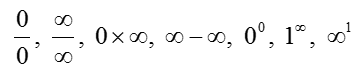
The last item in that list is printed as ∞1, but the standard seventh form is ∞0. A quantity that grows without limit stays infinite when you raise it to the power 1, so ∞1 is not indeterminate.
So why can none of the seven be given a value? Each one hides a competition between two parts, and the symbol alone does not say which part wins. Let's take 0/0. As x goes to 0, the limits of x/x, x2/x and x/x2 all start as 0/0. But the first limit is 1, the second is 0, and the third has no finite value at all. So the symbol 0/0 fits any answer, and mathematics does not assign it one.
The other forms behave the same way. For ∞ - ∞, the limit of (x + c) - x as x grows is c, for any number c. For 1∞, the limit of (1 + 1/x)x as x grows is e, although 1 raised to any fixed power is 1. For 00, the limit of xx as x goes to 0 from the right is 1, while the limit of 0x is 0.
Compare this with 1/0, which is not in the list. Near 0, the size of 1/x always grows without limit, and only its sign depends on the side you come from. So 1/0 is called undefined rather than indeterminate.
Indeterminate means the symbol does not fix a value : The same form can come from limits that equal 0, 1, any number c, or infinity.There are seven standard forms : 0/0, ∞/∞, 0 x ∞, ∞ - ∞, 00, 1∞ and ∞0.Undefined is a different thing : 1/0 has no value, but it is not uncertain, because its size always grows without limit.
What is an Indeterminate Form ?
Similary, you may heard people (or textbook) talk about 'Indeterminate Form'. In some cases, 'Indeterminate Form' would refer to the expressions listed above, but in many case 'Indeterminate Form' is mentioned in the context of 'Limit' operation.
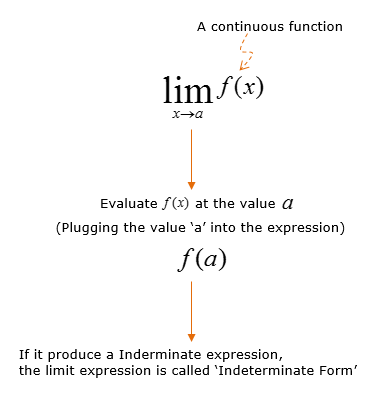
The flow above is the usual first step in evaluating a limit. You plug the value a into the expression. If f is continuous at a, the result f(a) is the limit, and you are done. The note 'A continuous function' at the top of the flow is that condition. If the result is one of the seven expressions, f is not continuous at a and plugging in has failed. The limit is then called an Indeterminate Form, and it still has to be worked out by another method.
An Indeterminate Form does not mean that the limit does not exist. It only means that the form alone does not tell you. The limit can turn out to be a finite number, infinity, or no value at all.
Three methods settle most cases. The first is to factor the expression and cancel the common factor that makes both parts zero. The second is L'Hopital's rule, which replaces f/g with f'/g' for the 0/0 and ∞/∞ forms. The third is to rewrite the other five forms into one of those two. For example, f x g with f going to 0 and g growing becomes f/(1/g), which is 0/0. The three power forms become a product after you take the logarithm, because ln(fg) = g ln f.
An Indeterminate Form is a limit, not a value : It is a limit whose plug-in result is one of the seven indeterminate expressions.The form says that more work is needed : It does not say that the limit fails to exist.Every form can be reduced to 0/0 or ∞/∞ : After that, factoring or L'Hopital's rule usually finishes the job.
How do you recognize an Indeterminate Form ?
The two examples below apply the plug-in test to two limits, and each one produces a different indeterminate expression. Recognizing the form is only half of the work. So each example then finishes the job and finds the actual limit.
Example 1
Example 1 is a rational function at a point where the denominator is zero. The test is whether the numerator is zero there too, because that decides between 0/0 and a plain division by zero.
Is following an Indeterminate Expression ?
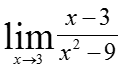
Yes. it is an indeterminate expression as shown below.
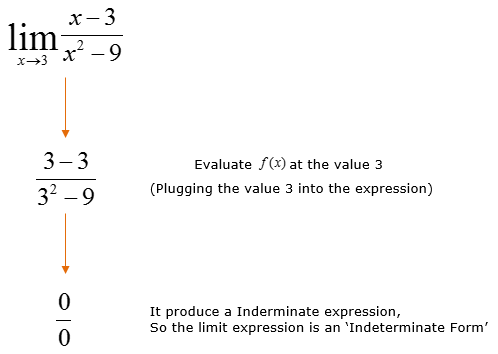
The form tells you that more work is needed, so let's do it. The denominator factors as x2 - 9 = (x - 3)(x + 3). The common factor x - 3 cancels, which leaves 1/(x + 3) for every x other than 3. Plugging in 3 now works and gives the limit 1/6. L'Hopital's rule gives the same answer, because the derivatives are 1 and 2x, and 1/(2 * 3) = 1/6.
Example 2
Example 2 is a limit at infinity instead of at a point. The numerator and the denominator both grow without limit, so the question is which of the two grows faster.
Is following an Indeterminate Expression ?

Yes. it is an indeterminate expression as shown below.
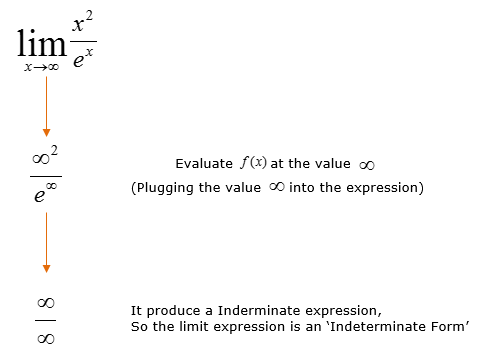
Plugging in ∞ is shorthand, because ∞ is not a number. It means looking at what each part does as x grows. The form ∞/∞ does not show which part grows faster, and L'Hopital's rule answers that. One step gives 2x/ex, which is still ∞/∞. A second step gives 2/ex, and this goes to 0. So the limit is 0, because ex grows faster than any power of x.
Plug in first : The plug-in result tells you whether the limit is already finished or is an Indeterminate Form.A common factor causes 0/0 at a point : In Example 1 the factor x - 3 makes both parts zero, and cancelling it gives the limit 1/6.A growth race causes ∞/∞ : In Example 2 the exponential wins, so the limit is 0.
Reference
[1] Undefined vs Indeterminate in Mathematics
[3] Indeterminate (Wolfram Mathworld)
[4] Indeterminate forms(Roberto’s Notes on Differential Calculus)