CBRS stands for Citizens Broadband Radio Service. It is a block of spectrum in 3.5 Ghz with the range of 150 Mhz (3550 MHz to 3700 MHz) for shared wireless access. This used to be used by US Navy and other DoD members, but freed up for shared wireless application like LTE (Refer to What is CBRS? - LTE in 3.5 GHz Shared Spectrum and What it Means for IoT ) for the details.
As mentioned above, this is shared spectrum meaning that you don't have to pay the cost for the spectrum. You can think of this as similar to ISM band, but how you can get a spectrum in the block. In case of ISM, you can just turn on your device working in the spectrum without any special procedure as long as the device meets the regional transmission requirement (e.g, FCC). However, you need to go through a special procedure to get a section of the frequency band as described in What is CBRS? - LTE in 3.5 GHz Shared Spectrum and What it Means for IoT
- How is the band shared between three tiers?
- CBRS band in FCC
- What is the common CBRS band in 3GPP ?
- Do we need any special protocols for CBRS ?
- Reference :
- YouTube
How is the band shared between three tiers?
The sentence above needs one qualification, because CBRS is not a single kind of access. The FCC divides the band into three tiers, and they do not cost the same. Spectrum in the lowest tier is free, which is what makes CBRS feel like an unlicensed band. The middle tier is a real licence, awarded by auction, and it is not free at all.
The three tiers rank by priority rather than by frequency. Incumbents come first, and everyone else has to move out of their way. Priority Access Licence holders come second, and they get protection from the tier below them. General Authorized Access comes third, takes whatever is left, and is protected from nobody.
GAA is where the phrase "licensed by rule" belongs. A GAA user pays nothing for the spectrum and holds no licence. But they cannot simply switch a radio on, the way an ISM device can. That is the distinction the paragraph above leaves out, and the reason for it is the coordinator in the middle of Figure 1.
Figure 1. What sits between a CBRS base station and the air. The SAS grants a channel and can withdraw it, and the ESC tells the SAS when an incumbent is present. None of this reaches the UE, which is why the same handset works on Band 48 whether the network holds a PAL or is running on GAA.
CBSD : Citizens Broadband Radio Service Device, which is the base station. It is an ordinary Band 48 or n48 radio, and the CBRS rules govern when it may transmit rather than how.SAS : the Spectrum Access System. A CBSD registers with it, asks for a channel, and transmits only on the grant it receives. The SAS can withdraw that grant later.ESC : the Environmental Sensing Capability, a network of sensors along the coast that listens for incumbent radar. When it hears one it tells the SAS, and the SAS moves the CBSDs that would interfere.The arrows on the left are priority, not signalling : they show which tier the SAS protects first when two requests collide.Nothing here reaches the UE : the whole coordination happens between the CBSD and the SAS over the internet. That is why the last section on this page finds no special modem protocol.
Free and unlicensed are not the same thing : GAA costs nothing and still requires a grant from a SAS before any transmission. PAL costs money and is won at auction.Priority is enforced by a database, not by the radio : a GAA CBSD does not detect a PAL holder and stop transmitting. The SAS simply never grants it that channel.The band can be taken back : an ESC detection moves GAA and PAL users off a channel within minutes. A deployment has to survive that, which is a planning constraint rather than a protocol one.
CBRS band in FCC
The exact CBRS band may vary depending on countries since each country may have different regulations. In case of North America, the band is allowed as specified by FCC as shown below.
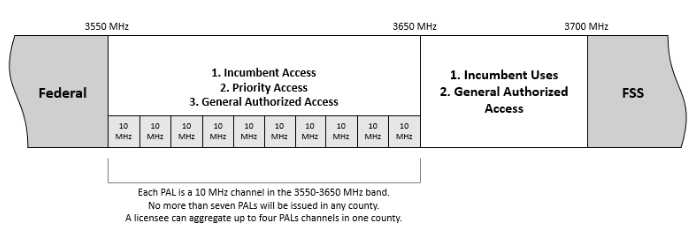
The FCC 3.5 GHz band plan. The band splits at 3650 MHz, and the two halves do not carry the same tiers: Priority Access exists only below that line. So a deployment that needs a licence has half the band to work in, while a deployment that does not can use all of it.
3550 to 3650 MHz carries all three tiers : Incumbent Access, Priority Access and General Authorized Access, numbered 1 to 3 in the drawing.3650 to 3700 MHz carries only two : Incumbent Uses and General Authorized Access. There is no Priority Access in this half, which the numbering makes explicit.The ten boxes are the PAL channels : each one is 10 MHz wide, and they cover exactly the 3550 to 3650 MHz half.The note under them sets the limits : no more than seven PALs are issued in any county. One licensee may aggregate up to four of them there.The blocks at each end are not CBRS : Federal use sits below 3550 MHz and Fixed Satellite Service above 3700 MHz. They are drawn to show what the 150 MHz is bounded by.
* FSS stands for Fixed Satellite Service * PAL stands for Priority Access License
source : 3.5 GHz Band Overview (FCC)
The split at 3650 MHz decides your options : a licence is only possible below it. A PAL deployment and a GAA deployment therefore do not see the same 150 MHz.PAL is counted in channels, not megahertz : ten 10 MHz channels exist, seven at most go to one county, and one licensee may hold four of them there.Other countries divide it differently : this plan is the FCC's. The 3GPP band in the next section is the same 150 MHz everywhere, but who may use it is a national question.
What is the common CBRS band in 3GPP ?
Now the CBRS band is defined in 3GPP as Band 48 (See Why CBRS frequency bands are perfect for private LTE and private 5G networks for further details). NOTE that B48 is TDD based.

Band 48 as the E-UTRA operating band table defines it. Uplink and downlink carry the same two numbers because the band is TDD, so the whole 150 MHz is one shared block rather than a paired allocation.
The uplink and downlink columns are identical : 3550 MHz to 3700 MHz on both sides. That is what TDD looks like in this table, and it is why there is no duplex spacing to quote.The range matches the FCC plan exactly : 3550 to 3700 MHz is the same 150 MHz the picture above divides into tiers. 3GPP defines the radio, and the FCC decides who may use which part of it.One row is one band, not one channel : a deployment occupies a channel inside this range, and the PAL grid above is 10 MHz per channel.
Now this band is open for 5G/NR as well (Ref [4])
Band 48 is not the only entry for this spectrum, and the second one answers a question the last section on this page leaves open. 36.101 defines Band 49 over exactly the same 3550 to 3700 MHz, also TDD, but with a note attached that Band 48 does not carry.
Band |
Specification |
Uplink and Downlink |
Duplex |
Note in the Specification |
36.101 (LTE) |
3550 MHz – 3700 MHz |
TDD |
None. Ordinary TDD operation. |
|
36.101 (LTE) |
3550 MHz – 3700 MHz |
TDD |
NOTE 16 : restricted to licensed-assisted operation using Frame Structure Type 3. |
|
38.101-1 (NR) |
3550 MHz – 3700 MHz |
TDD |
None. There is no n49. |
NOTE 16 against Band 49 reads: restricted to licensed-assisted operation using Frame Structure Type 3. Frame Structure Type 3 is the LAA frame structure, so a Band 49 carrier runs listen before talk and must be anchored to a licensed primary cell. Band 48 carries no such note and is ordinary standalone TDD. On the NR side 38.101-1 defines n48 over the same range, and there is no n49.
Band 48 is the one almost everyone means : standalone TDD over 3550 to 3700 MHz, with no special frame structure and no anchor carrier.Band 49 is the same spectrum with LAA rules : Frame Structure Type 3 and licensed-assisted operation only. Picking it is a different design, not a different frequency.NR has n48 and nothing else here : the licensed-assisted variant was not carried over, so a 5G deployment in this band is standalone by construction.The band tells you nothing about the tier : Band 48 is the same radio whether the operator holds a PAL or runs on GAA. The tier is settled with the SAS, not on the air.
Do we need any special protocols for CBRS ?
Since CBRS is mainly for spectrum regulation, it wouldn't require any specific protocol in terms of modem protocol. When you use test equipment (network simulator) and try your UE in CBRS band (e.g, LTE B48), it would work and UE would attach to the equipment which does not use any specific protocols for CBRS.
But in real deployment, the service provider may require some additional feature since the band may be used by other service provider as well (e.g, something similar to LBT(Listen Before Talk) or additional protocols as specified in CBRS WInnForum Standards)
Two things sharpen that. The listen before talk guess is right, but only for Band 49, where 36.101 mandates Frame Structure Type 3. On Band 48 there is no LBT at all, because the SAS has already decided that this CBSD owns this channel.
The WInnForum protocols are real, and they sit exactly where Figure 1 puts them. They run between the CBSD and the SAS, over the internet, in the base station rather than the modem. So the test equipment observation above holds. A UE attaches on Band 48 without knowing any of it exists.
The modem needs nothing special on Band 48 : it is plain TDD LTE or NR, which is why a network simulator works with no CBRS support at all.The base station needs a SAS client : registration, spectrum inquiry, grant and heartbeat are the CBSD's job, and they are specified by WInnForum rather than by 3GPP.Listen before talk applies only to Band 49 : that is the one place where the air interface itself changes, through Frame Structure Type 3.
Reference :
[1] What is CBRS? - LTE in 3.5 GHz Shared Spectrum and What it Means for IoT
[2] CBRS - Private LTE Networks for IoT Applications
[3] 3.5 GHz Band Overview (FCC)
[4] WInnForum Approves 5G NR as a Supported Air Interface for CBRS Band
[5] What is Private LTE (Band 48 CBRS) and Why is it Important?
[6] Why CBRS frequency bands are perfect for private LTE and private 5G networks
[8] Spectrum Sharing at 3.5 GHz
YouTube