MTC stands for Machine Type Communication. This is mainly designed to use LTE for M2M (Machine to Machine) or IoT (Internet of Things). Usually these application requires not that much throughput (in most case it needs very low throughput).
The page first explains why ordinary LTE is a poor fit for these devices, although it already handles low data rates. It then lists the objectives that RP-141865 set for Release 13, and compares them with what the Release 13 specifications finally defined for UE Category M1.
Followings are the topics to be covered in this page.
Why MTC Needs Its Own Design
An LTE modem can already send a few hundred bits per second, so low throughput alone does not justify a new design. The real problem is that a Category 1 modem costs too much and uses too much power for a sensor that runs for years on one battery.
Why do you need this kind of special technique ? Does this mean that current LTE cannot achieve such a low throughput ?
Of course there is no problem with the current LTE to work for such a low throughput application. But the issue is not with the low throughput, but with some other constraints. In practical point of view, this kind of application would need following characterstics.
- Low Throughput (usually just a couple of hundreds of bps in DL and less than 100 bps in UL)
- Low Cost (As low as an EGPRS modem)
- Low Energy Consumption
As I said there is no problem with achieving Low Throughput with the current LTE implementation, but there would be limitation to achieve Low Cost, Low Energy Consumption as required in this area (Actually Low Throughput itself is not a goal of the design. It is more like a result of design/implementation that meets MTC criteria illustrated below.
The diagram below groups the MTC requirements into three targets around one centre.
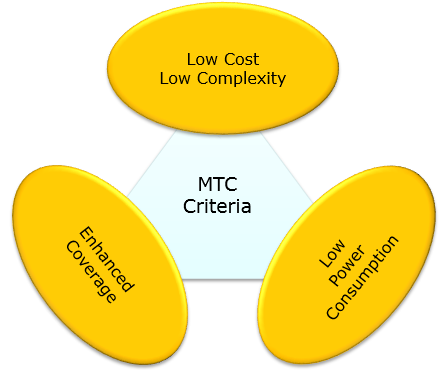
The three MTC criteria: low cost and low complexity, enhanced coverage, and low power consumption.
Two of the three targets are not about throughput at all. Enhanced coverage matters because many MTC devices sit in basements or inside meters, where the signal is far weaker than at street level. Low power consumption matters because the device must sleep for most of its life and wake only to report.
Then how to achieve these critical requirement. The easies way we can think of is to reduce the complexity of LTE and this is the main motivation of MTC and it is one of major topics in Rel 13. I think this would be more important feature/topic in 5G than in 4G (Current LTE).
In LTE, the main idea to achieve the low cost solution is
- i) Use the narrowest BW 1.4
- ii) Use Single Antenna (SISO)
- iii) Make some changes on Physical layer processing to reduce (simplify) baseband processing
You may say 'item i) and ii) has been supported from the day 1 of LTE. So we don't have to do anything (effort /changes) on network side ?'
Only in terms of throughput in a good signal condition, you may say like it. But with BW 1.4 and single antenna, it is very difficult to apply techniques to improve the reliable data connection (e.g, Spatial Diversity, Frequency Diversity etc). So we may need to change some specification to compensate this restriction.
Also, we may need to change some lower layer specification due to item iii) as well.
The restriction to 1.4 MHz and one antenna removes the usual ways of fighting a weak signal. Receive diversity and wide frequency allocations are gone, so the design must get its robustness elsewhere. Release 13 gets it mainly from repetition in time, as the section on Release 13 below shows.
Low throughput is a result : not the goal of the design.Three criteria : low cost, enhanced coverage and low power consumption.1.4 MHz and one antenna : cheaper, but without the usual diversity.
Objectives of the Rel-13 Work Item
Before Release 13, the design goals existed only in a study and a work item. The list below comes from the work item RP-141865, and each line names a cost or power saving that the later specifications had to turn into a concrete limit.
As of now (Apr 2015), no TS document yet, but you can get pretty details information from following documents.
- RP-141865
- TR 36.888
Followings are some of the Objective of MTC discussed in RP-141865
- Reduced Complexity in Category and Channel Bandwidth
- Reduced UE bandwidth of 1.4 Mhz in downlink and uplink
- Bandwidth reduced UEs should be able to operate within any System Bandwidth
- Frquency Multiplexing of bandwidth reduced UEs and non-MTC UEs should be supported
- The UE only needs to support 1.4 Mhz RF bandwidth in downlink and uplink
- Reduced maximum transmission power
- Reduced support for downlink transmission mode
- Reduced maximum transport block size for unicast and/or broadcast signaling
- Reduced support for simultaneous reception of multiple transmissions
- Relaxed transmit/receive EVM requirement
- Reduced physical control channel processing (e.g, reduced number of blind coding attempts)
- Reduced physical data channel processing (e.g, relaxed downlink HARQ time line or reduced number of HARQ processes
- Reduced support for CQI/CSI reporting modes
- Relative LTE Coverage Improvement (around 15 dB improvement for FDD) - Refer to RP-141865 for details
- Reduced power consumption/Ultra-long battery life - Refer to RP-141865 for possible techniques
- Half Duplex FDD, full Duplex FDD and TDD should be supported
Most objectives are reductions: a narrower bandwidth, a lower maximum power, a smaller transport block, fewer transmission modes and simpler control channel processing. Each one removes hardware or processing from the modem. The coverage objective works in the other direction, because it asks for about 15 dB more than normal LTE coverage for FDD. The bandwidth objective also keeps MTC inside a normal LTE carrier, so the operator does not need a separate carrier for these devices.
RP-141865 is the Release 13 work item : TR 36.888 is the study behind it.Most objectives remove cost : bandwidth, power, TBS, transmission modes.Coverage target of about 15 dB : the one objective that asks for more.
What Release 13 Specified
How did the objectives turn out in the final specifications? Release 13 defined UE Category M1 and a set of coverage enhancement features. The table below maps each objective to the parameter that now implements it, with the values from the current specifications.
Objective in RP-141865 | Release 13 result | Specification |
1.4 MHz UE bandwidth | A narrowband of 6 consecutive PRBs, placed anywhere in the LTE carrier | 36.211 v19.3.0 clause 6.2.7 |
Reduced maximum transport block size | Category M1: 1000 bits per TTI in DL and UL, one layer | 36.306 v19.3.0 Tables 4.1A-1 and 4.1A-2 |
Reduced maximum transmission power | Power class 5 at 20 dBm, next to class 3 at 23 dBm | 36.101 v20.0.0 Table 6.2.2E-1 |
Reduced control channel processing | MPDCCH confined to one narrowband instead of the full-band PDCCH, repeated up to 256 times | 36.331 v19.3.0 mpdcch-NumRepetition-r13 |
About 15 dB coverage improvement | CE mode A and CE mode B, with PDSCH and PUSCH repetition up to 2048 in CE mode B | 36.331 v19.3.0 pdsch/pusch-maxNumRepetitionCEmodeB-r13 |
Ultra-long battery life | Power Saving Mode and extended idle mode DRX | 23.401 v20.0.0 clauses 4.3.22 and 5.13a |
CE mode A is for moderate coverage loss, and it allows up to 32 repetitions of the PDSCH and the PUSCH. CE mode B is for deep coverage, and it allows up to 2048 repetitions. Every repetition costs time on the air, so a UE deep in CE mode B pays for its coverage with a much lower data rate.
Category M1 has also grown since Release 13. In the current 36.306, the DL transport block of Category M1 can reach 1736 bits and the UL block 2984 bits when the UE signals the later optional features. Category M2 raises the DL block to 4008 bits and the UL block to 6968 bits on a wider bandwidth.
Now (as of Rel 13) we can see the real implementation of these criteria because LTE MTC specification is released. See how these general criteria turns into reality in LTE : LTE BL/CE (M1) and LTE NB pages.
Category M1 : 1000 bit transport blocks, 6 PRB narrowband, one layer.CE mode A and B : up to 32 and up to 2048 repetitions.PSM and eDRX : the power saving tools for long battery life.
Reference
[1] 22.368 - Service requirements for Machine-Type Communications (MTC) Stage 1
[2] TR 36.888 - Study on provision of low-cost Machine-Type Communications (MTC) User Equipments (UEs) based on LTE
[3] 3GPP TS 36.211 v19.3.0 - clause 6.2.7, Narrowbands and widebands
[4] 3GPP TS 36.306 v19.3.0 - clause 4.1A, ue-CategoryDL and ue-CategoryUL
[5] 3GPP TS 36.331 v19.3.0 - MPDCCH and PDSCH/PUSCH repetition configuration
[6] 3GPP TS 36.101 v20.0.0 - Table 6.2.2E-1, UE power class for Category M1 and M2
[7] 3GPP TS 23.401 v20.0.0 - clause 4.3.22, UE Power Saving Mode, and clause 5.13a, extended idle mode DRX