HSUPA, or Enhanced Uplink in the 3GPP specifications, adds one uplink transport channel, the E-DCH, and five physical channels to carry it and control it. Two of the channels are uplink and three are downlink. This page shows where they sit, how they compare with the HSDPA channels, and what each one carries in 25.211 and 25.212.
Followings are the topics to be covered in this page.
- Which channels does HSUPA add ?
- How do the HSUPA channels compare with HSDPA ?
- Why does HSUPA need grant channels ?
- What does each HSUPA physical channel carry ?
- Reference
Which channels does HSUPA add ?
HSUPA does not replace any Release 99 or HSDPA channel. It adds five new physical channels on top of them, so the first question is where each new channel runs, in the uplink or in the downlink.
Introduction of new Channels in HSUPA. The channels in red are the ones used for HSUPA operation.
The diagram below puts all the channels of an HSPA UE on one picture. The downlink channels are listed on the purple arrow from the Node B to the UE, and the uplink channels are listed on the pink arrow from the UE. Two frame structures from 25.211 sit in the corners, the E-AGCH at the top left and the E-DPDCH and E-DPCCH at the lower right.
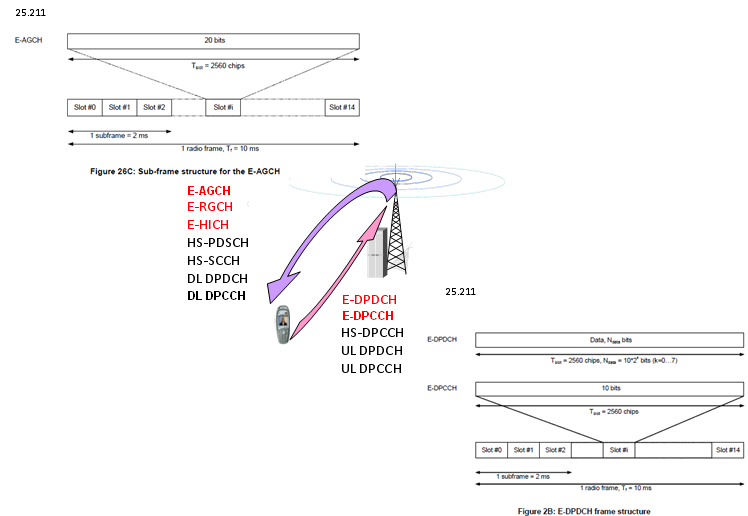
HSUPA adds three downlink and two uplink channels. They run next to the HSDPA and Release 99 channels, not instead of them.
Downlink, in red : E-AGCH, E-RGCH and E-HICH. The black ones below them, HS-PDSCH, HS-SCCH, DL DPDCH and DL DPCCH, are HSDPA and Release 99 channels.Uplink, in red : E-DPDCH and E-DPCCH. HS-DPCCH, UL DPDCH and UL DPCCH stay as they were.E-AGCH frame, top left : 20 bits per slot, and 3 slots make one 2 ms subframe. So one E-AGCH subframe holds 60 bits.E-DPDCH and E-DPCCH frame, lower right : the E-DPDCH carries Ndata = 10 x 2k bits per slot, and the E-DPCCH carries 10 bits per slot. Both use the same 2 ms subframe and 10 ms radio frame as the DPCCH.
As in HSDPA, several new channels were introduced to implement HSUPA and they are as follows :
i) E-DPDCH
ii) E-DPCCH
iii) E-HICH
iv) E-RGCH
v) E-AGCH
Later releases added more channels around these five. For example, Release 11 uplink MIMO added the S-E-DPDCH, the S-E-DPCCH and the downlink E-ROCH. This page stays with the original five.
E-DCH is the transport channel : the E-DPDCH carries it, and the other four channels control it.Two uplink, three downlink : the UE sends data and control, and the Node B sends grants and acknowledgements.The Release 99 DPCCH stays : it is the power and phase reference for the E-DPDCH and the E-DPCCH.
How do the HSUPA channels compare with HSDPA ?
Many readers meet HSDPA first, so a mapping to the HSDPA channels is a quick way in. The mapping works for the job of each channel. It does not work for how the channel is shared, and the paragraph below explains why.
Briefly speaking, E-DPDCH is equivalent version of HS-PDSCH and E-DPCCH is equivalent to HS-SCCH and E-HICH is equivalent to HS-DPCCH. But there is a main difference between these HSUPA channels and HSDPA channel. E-DPDCH and E-DPCCH are dedicated channels whereas HS-PDSCH and HS-SCCH are shared channel, but this is understandable because in HSDPA case the source and target of the data transmission is one-to-many but in HSUPA case the source and target is one-to-one, so it is understandable to use dedicated channels in HSUPA.
The table below puts the pairs side by side.
Job |
HSDPA |
HSUPA |
Difference |
Data |
HS-PDSCH |
E-DPDCH |
HS-PDSCH is shared and uses SF16. E-DPDCH is dedicated and uses SF256 down to SF2. |
Control for the data |
HS-SCCH |
E-DPCCH |
HS-SCCH names the UE, the codes and the HARQ process. E-DPCCH needs none of these and carries only E-TFCI, RSN and the happy bit. |
ACK/NACK |
HS-DPCCH |
E-HICH |
HS-DPCCH is uplink and also carries CQI. E-HICH is downlink and carries only the ACK/NACK. |
Scheduling |
none on the air |
E-AGCH, E-RGCH |
The HSDPA scheduler and the data are both in the Node B. The HSUPA scheduler needs a channel to tell the UE its grant. |
The HARQ process is the clearest difference in the table. HS-SCCH must name the process, because HSDPA HARQ is asynchronous. The E-DPCCH does not name it, because the E-DCH process follows from the CFN and the subframe number.
Same jobs, opposite direction : the data, its control and its ACK/NACK all exist in both, but with the roles of UE and Node B swapped.Dedicated instead of shared : each UE has its own E-DPDCH and E-DPCCH, because each UE is a separate source.Scheduling needs extra channels only in the uplink : this is the subject of the next section.
Why does HSUPA need grant channels ?
In the uplink, every UE adds interference at the Node B receiver. So the Node B has to decide how much power each UE may use, even though the data sits in the UE. The two grant channels carry that decision.
There are another big difference between HSDPA and HSUPA. It is about scheduling issue. Regardless of whether it is HSDPA or HSUPA, the scheduler (the decision maker) is on Node B, not on a UE. For scheduling we need two very important information, the channel quality and buffer status information. In HSDPA, the information that the decision maker (the scheduler) needs to get from the target of the transmission is only channel quality information and this information was provided via HS-DPCCH and the buffer status information is already available to the scheduler because the transmission buffer is located in the same place (node B) as the scheduler. So in HSDPA the transmitter (node B) can send the data anytime the situation is allowed, but in HSUPA case the transmitter (UE) cannot send the data anytime it wants to send. Before the UE send the data, it has to check whether the target (the reciever, Node B) is ready and has enough resource to recieve the data. For UE to check the status of the reciever (node B) and get the approval from the node B, E-AGCH (Absolute Grant Channel) and E-RGCH (Relative Grant Channel) are used. Node B (the scheduler) send the scheduling grants to UE on when and at what data rate the UE can transmit the data.
The buffer status travels the other way, from the UE to the Node B. It goes inside the E-DCH data as the Scheduling Information of 25.321, and the happy bit on the E-DPCCH adds a quick yes or no about the current grant.
The difference between E-AGCH and E-RGCH are
i) E-AGCH is a shared channel and E-RGCH is a dedicated channel
ii) E-AGCH is typically used for large changes in the data rate and the E-RGCH is used for smaller adjustments.
One more detail makes the grant easier to read. A grant is not a data rate but a power ratio, the maximum E-DPDCH to DPCCH power ratio. The UE turns it into a transport block size itself, based on its own power and its own data.
Two more points belong here. Only the E-AGCH and E-RGCH of the serving cell can raise the grant. A non-serving cell in the E-DCH active set can send an E-RGCH too, but it can only say DOWN or HOLD, so it can protect itself from interference.
The grant is a power ratio : the Node B controls interference, and the UE picks the data rate inside that limit.E-AGCH for jumps, E-RGCH for steps : an absolute value costs more bits than an UP, DOWN or HOLD.Neighbour cells can only push down : a non-serving E-RGCH says DOWN or HOLD, never UP.
What does each HSUPA physical channel carry ?
The sections above describe what the channels are for. This section gives the numbers of 25.211 and 25.212, which a reader needs when checking a log or a test equipment setting.
Channel |
Direction |
Spreading factor |
What it carries |
E-DPDCH |
UL |
256 down to 2 |
The E-DCH transport block. Up to 2xSF2 plus 2xSF4 codes. BPSK, and from Release 7 also 4PAM, which gives 16QAM on the complex plane. |
E-DPCCH |
UL |
256 |
10 information bits per TTI: 7 bits of E-TFCI, 2 bits of RSN and the happy bit. They are coded to 30 bits per 2 ms subframe. |
E-HICH |
DL |
128 |
One ACK/NACK as a 40 bit signature sequence per slot, over 3 slots for the 2 ms TTI and 12 slots for the 10 ms TTI. |
E-RGCH |
DL |
128 |
UP, HOLD or DOWN as a signature sequence. 3 or 12 slots from the serving radio link set, and 15 slots from a non-serving cell. |
E-AGCH |
DL |
256 |
A 5 bit Absolute Grant Value and a 1 bit scope, with a 16 bit CRC masked by the E-RNTI. The result is coded to 60 bits for one 2 ms subframe. |
The E-HICH and the E-RGCH share one channelisation code between several UEs. Each UE gets its own signature sequence out of 40 on that code, and 25.211 hops the signature from slot to slot. The E-AGCH is different. It is one code for many UEs, and the UE finds its own message by the E-RNTI in the CRC.
The TTI changes the timing but not the structure. With the 10 ms TTI, the E-DPCCH and the E-AGCH send the same subframe content in all five subframes of the radio frame. The E-HICH and the E-RGCH use 12 slots instead of 3.
Uplink codes grow with the rate : the E-DPDCH goes from one SF256 code up to 2xSF2 plus 2xSF4.Signatures, not codes, for E-HICH and E-RGCH : one SF128 code serves many UEs.The E-RNTI addresses the E-AGCH : a UE decodes every E-AGCH subframe and keeps only the ones whose CRC matches.
Reference
[1] 3GPP TS 25.211 v19.0.0 - clause 5.2.1.3, E-DPCCH and E-DPDCH, clause 5.3.2.4 and 5.3.2.5, E-HICH and E-RGCH, and clause 5.3.3.14, E-AGCH
[2] 3GPP TS 25.212 v19.0.0 - clause 4.8.4.1, E-DPDCH configurations, clause 4.9, coding for E-DPCCH, and clause 4.10, coding for E-AGCH
[3] 3GPP TS 25.321 v19.0.0 - clause 9.2.5, signalling of control information for FDD E-DCH