Before a UE has a dedicated channel, nobody can send it TPC commands. So the first uplink transmission of an access, the PRACH preamble, has to guess its own power. The UE makes that guess from its own downlink measurement and a few broadcast values. It then ramps the power up until the Node B answers on the AICH. Let's go through the initial power formula first, then the ramping, and then a measured example from a conformance test.
- How does the UE set the power of the first preamble ?
- What happens when the AICH does not answer ?
- What does the test capture show ?
- Reference
How does the UE set the power of the first preamble ?
The first preamble is sent in open loop, so the UE has to estimate the path loss by itself. It knows the P-CPICH transmit power from system information and measures the P-CPICH received power, and the difference is the path loss. It then adds the uplink interference at the Node B and a margin, so that the preamble arrives with a usable SIR.
Initial PRACH (The first PRACH that UE transmit) is determined by the following formula.
Initial RACH Preamble Power = Primary CPICH TX Power – CPICH_RSCP + UL_Interference + Constant Value
CPICH_RSCP is the power directly measured by UE and all other parameters are calculated (obtained) from system information. The related parameter and system information is as follows.
|
System Information |
Information Element |
Example Value |
|
SIB3 |
Maximum Allowed UL Tx Power |
21 dBm |
|
SIB5 |
Primary CPICH Power |
-8 dBm |
|
Power Ramp Step |
3 dB |
|
|
Mmax |
2 |
|
|
NB01min |
10 |
|
|
NB01max |
10 |
|
|
SIB7 |
UL Interference |
-92 |
25.331 clause 8.5.7 gives the same formula as Preamble_Initial_Power = Primary CPICH TX power - CPICH_RSCP + UL interference + Constant Value. The UE reads "Primary CPICH Tx power" and "Constant value" from SIB6, or from SIB5 or SIB5bis when the cell does not broadcast SIB6. It reads "UL interference" from SIB7. The UE also recalculates the value whenever one of these broadcast parameters changes.
The table above has no row for two of the parameters. Constant Value is the SIR margin of the formula. It sits in the same PRACH system information as the Primary CPICH Tx power, and 25.331 allows -35 to -10 dB. Preamble Retrans Max sits next to the Power Ramp Step, inside PRACH-PowerOffset, and it limits the number of preambles in one ramping cycle.
Let's put in the numbers of the test that the capture below comes from. Primary CPICH TX power is -8 dBm, UL interference is -92 dBm, and Constant Value is -10 dB. The test sets Îor to -70 dBm and CPICH_Ec/Ior to -10 dB, so the UE measures a CPICH_RSCP of about -80 dBm. The first preamble is therefore -8 - (-80) + (-92) + (-10) = -30 dBm. This is the value that 34.121-1 expects for the first preamble.
The table below lists the value range of each parameter, as 25.331 v19.0.1 defines it.
Parameter |
25.331 IE |
Range |
Where |
Primary CPICH Tx power |
PrimaryCPICH-TX-Power |
-10 to 50 dBm |
SIB5 / SIB6 |
Constant value |
ConstantValue |
-35 to -10 dB |
SIB5 / SIB6 |
Power Ramp Step |
PowerRampStep |
1 to 8 dB |
SIB5 / SIB6, PRACH-PowerOffset |
Preamble Retrans Max |
PreambleRetransMax |
1 to 64 |
SIB5 / SIB6, PRACH-PowerOffset |
Mmax |
RACH-TransmissionParameters |
1 to 32 |
SIB5 / SIB6 |
NB01min, NB01max |
NB01 |
0 to 50 |
SIB5 / SIB6 |
UL interference |
UL-Interference |
-110 to -70 dBm |
SIB7 |
Maximum allowed UL TX power |
MaxAllowedUL-TX-Power |
-50 to 33 dBm |
SIB3 / SIB4 |
CPICH_RSCP is the only measured value : Everything else in the formula comes from system information, so a wrong broadcast value shifts every first preamble in the cell.Constant Value sets the margin : A higher value makes the first preamble louder. This shortens the ramp but raises the interference of each access.UL interference is the moving part : It follows the cell load. SIB7 carries it with an expiration time factor, and the UE recalculates the initial power whenever a broadcast value changes.
What happens when the AICH does not answer ?
If UE fail to get AICH for the PRACH, it increment the PRACH power by Power Ramp Step (SIB5) and transmit the PRACH again. UE repeat this process until it gets AICH or it retried the specific number specified in SIB5.
25.214 clause 6.1 gives the details of the ramp. After each preamble without an acquisition indicator, the UE picks the next available access slot and a new random signature. It raises the preamble power by Power Ramp Step and counts down the Preamble Retransmission Counter. The UE never transmits above the maximum allowed power, so the ramp flattens at that level. When the counter reaches zero, layer 1 reports "No ack on AICH" to MAC.
MAC then decides whether to start another ramping cycle. Mmax is the maximum number of cycles, and when it is exceeded, MAC reports a RACH failure to the higher layers. A negative acquisition indicator works differently. The UE stops the ramp at once, and MAC starts the backoff timer TBO1. TBO1 is NBO1 x 10 ms, where NBO1 is drawn at random between NB01min and NB01max. The test in the last section sets both to 10, so a backoff there would be a fixed 100 ms.
When a positive acquisition indicator arrives, the UE sends the message part three or four access slots after the last preamble, depending on AICH_Transmission_Timing. The control part of the message is sent at the power of the last preamble plus Pp-m. The data part is set from the control part with the gain factors of the transport format.
Two limits stop a ramp : Preamble Retrans Max limits the preambles in one cycle, and Mmax limits the number of cycles.No answer and NACK are handled differently : No answer lets the ramp continue. A NACK stops it and starts the TBO1 backoff.The message power follows the last preamble : The preamble that got the ACK is the one that set the power of the message part.
What does the test capture show ?
A power versus time plot is the easiest way to check the whole procedure at once. The first preamble checks the open loop formula, the spacing of the steps checks the ramp, and the last burst checks the message part.
Following screenshot is an example of PRACH transmission and retransmission. This is from a test resultl of 34.121 8.4.2.1. In this test case, Network intentionally does not send AICH so that UE keep sending PRACH with specified power increment in the specified number of times.
The plot below shows the UE output power over 200 ms, with a scale from -86.60 dBm to 13.40 dBm. The labels on the left mark the initial preamble power and one power step. The bracket at the bottom marks the run of preambles, and the wider burst after it is the message part.
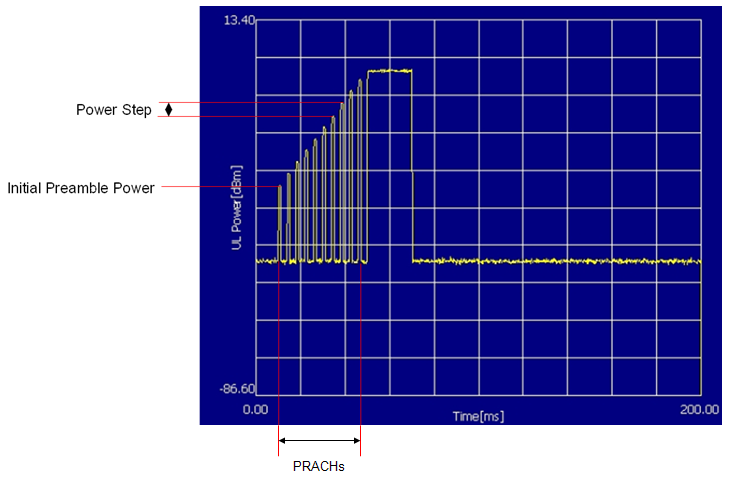
PRACH power ramping in 34.121-1 test 8.4.2.1. Ten preambles rise in equal steps, and the message part follows the last one.
Initial Preamble Power : The first spike sits about 44 dB below the top of the scale, which is close to -30 dBm. This matches the value computed in the first section. 34.121-1 accepts +/- 9 dB for it under normal conditions.Power Step : The spikes rise by a constant step, which is the Power Ramp Step of 3 dB. The accuracy requirement for each step is +/- 2 dB.PRACHs : The bracket covers ten preambles. The UE transmits nothing between them, so the trace falls back to the noise floor.Message part : The wide burst after the preambles is the message part. It sits about 3 dB above the last preamble, which is the difference that the test expects.
One detail of the test explains why the ramp stops at ten preambles. The SS does not send an AICH for the first preambles, so the UE keeps ramping. 34.121-1 then requires an ACK on the AICH after the SS has received 10 preambles. The UE stops the ramp and sends the message part. Preamble Retrans Max is 12 in this test, so the UE would have sent two more preambles without that ACK.
Why is the message 3 dB above the last preamble when Pp-m is 0 dB? In this test, βc and βd are both 15. So the data part adds the same power as the control part, and the sum is 3 dB above the control part alone.
The capture checks all three steps : Open loop power, ramp step and message offset can all be read from one plot.The ACK decides where the ramp ends : Without the ACK after preamble 10, the UE would continue until Preamble Retrans Max.Message power is control plus data : Pp-m sets the control part, and the gain factors add the data part on top.
Reference
- 3GPP TS 25.214 v19.0.0 : Physical layer procedures (FDD)
- 3GPP TS 25.321 v19.0.0 : Medium Access Control (MAC) protocol specification
- 3GPP TS 25.331 v19.0.1 : Radio Resource Control (RRC); Protocol specification
- 3GPP TS 25.133 v19.0.0 : Requirements for support of radio resource management (FDD)
- 3GPP TS 34.121-1 v16.2.0 : User Equipment (UE) conformance specification; Radio transmission and reception (FDD); Part 1: Conformance specification