The UE may use Discontinuous Reception (DRX) in idle mode in order to reduce power consumption. When DRX is used the UE needs only to monitor one Page Indicator, PI, in one Paging Occasion per DRX cycle.
This raises a practical question. The UE sleeps most of the time, so how does it know which frame to wake up for, and which bits to read in that frame? The answer comes from the IMSI and a few parameters in system information. The UE and the network run the same formulas, so both arrive at the same frame and the same indicator without any signalling between them. This page lists the inputs, shows the channel that carries the indicator, gives the formulas from 25.304 and works through one example.
- Factors affecting Paging Cycle
- Structure of Paging Indicator Channel - PICH
- How these Params are interrelated ?
- Example
- Reference
Factors affecting Paging Cycle
Paging in UMTS is a two step process. The UE first checks a short Paging Indicator on the PICH, and it reads the actual paging message on the PCH only when that indicator is set. The list below names every value that goes into finding the right frame and the right indicator. Some of them the UE reads from system information, and the others it calculates.
- DRX Cycle : to be calculated
- DRX Index : to be calculated
- PI (Paging Indicator): to be calculated, a short indicator that is transmitted on the PICH to tell the UE that there is a paging message on an associated paging channel carried by the SCCPCH. If the PI bits are set in the paging occasion (SFN), the UE reads the paging message on the PCH transmitted on the associated SCCPCH.
- Np (18,36,72,144) : pi-CountPerFrame in SIB5, number of paging indicators per radio frame
- IMSI : from USIM
- K (Number of SCCPCH) : sCCPCH-SystemInformationList value in SIB5, Equal to the number of listed SCCPCHs which carry a PCH
- DRX Cycle Length : to be calculated
- k (DRX cycle length coefficient)
- SCCPCH Number : to be calculated
Only three inputs come from outside the UE. The IMSI comes from the USIM. K and Np come from SIB5, where K counts only the SCCPCHs that carry a PCH. An SCCPCH that carries only FACH does not count. Everything marked "to be calculated" follows from these three and from k.
The DRX cycle length coefficient k needs a closer look, because the UE can hold more than one value of it. For the CS domain, the UE reads the IE "CN domain specific DRX cycle length coefficient" from the CN domain system information in SIB1. For the PS domain, the UE and the SGSN can agree on their own value in the DRX parameter IE of the NAS attach or routing area update. If they agree on none, the value from system information applies. A UE attached to both domains stores both values and uses the shorter DRX cycle. In the ASN.1 of 25.331, the CN value is INTEGER (6..9), so the idle mode DRX cycle is 64, 128, 256 or 512 frames, which is 0.64 s to 5.12 s.
Paging reads two channels : The PI on the PICH tells the UE whether to read the PCH on the associated SCCPCH.Only IMSI, K, Np and k are inputs : The SCCPCH number, the DRX index, the PI and the paging occasion are all calculated from them.The shortest DRX cycle wins : A UE attached to the CS and the PS domain monitors paging with the shorter of the two cycles.
Structure of Paging Indicator Channel - PICH
The PICH is the channel that the UE wakes up for. It is a fixed rate physical channel with SF=256, and its only job is to carry paging indicators. So the UE can decide from a few bits whether it needs to receive a whole SCCPCH frame.
The diagram below shows one PICH radio frame of 10 ms. It holds 300 bits, b0 to b299. The green bits b0 to b287 carry paging indicators. The grey bits b288 to b299 are not transmitted.
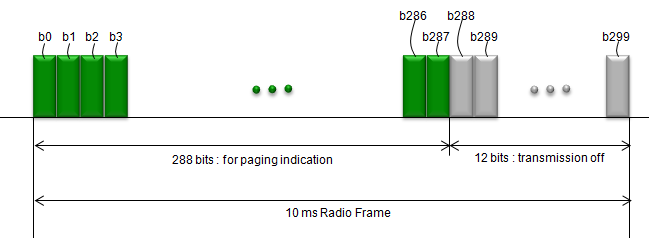
Only 288 of the 300 bits in a PICH frame carry paging indicators, and the network divides them evenly among the Np indicators.
288 bits : for paging indication : These are b0 to b287. They hold the Np paging indicators of the frame.12 bits : transmission off : The last 12 bits, b288 to b299, are DTX. 25.211 reserves them for possible future use.10 ms Radio Frame : One PICH frame has the same length as one radio frame, so every SFN has its own PICH frame.
The number of bits in each indicator depends on Np. The table below follows from 288 divided by Np.
|
Number of PIs per Frame (= Np) |
Number of bits per PI |
|
18 |
16 |
|
36 |
8 |
|
72 |
4 |
|
144 |
2 |
If every bits in a PI is '1', it means there is a paging for you
Two more details from 25.211 matter when you look at the PICH in a measurement. First, the UE does not find its indicator at a fixed place in the frame. The PI from higher layers maps to the indicator Pq, and q depends on the PI, on the SFN of the frame and on Np. So the position of the indicator changes from frame to frame. Second, the PICH frame starts 7680 chips before the SCCPCH frame that carries the paging message. This gap is 2 ms, and it gives the UE time to decode the indicator before the PCH frame starts.
A set indicator does not mean that the paging is for this UE. Many UEs share the same PI, so the indicator only tells the UE to read the PCH. The UE then checks the identities in the PAGING TYPE 1 message on the PCH.
Fewer indicators means more bits per indicator : With Np=18, each PI is 16 bits long and more robust. With Np=144, each PI is only 2 bits long, but fewer UEs share one PI.The indicator position moves with SFN : The UE computes q in each frame, so it cannot read the same bits every time.PICH comes 2 ms before PCH : The 7680 chip offset lets the UE decide in time whether to receive the SCCPCH frame.
How these Params are interrelated ?
Now let's connect the inputs to the outputs. The formulas below come from 25.304 subclauses 8.1 and 8.3, written for FDD. Each one answers one of the questions the UE has: which SCCPCH, which frame, and which indicator.
SCCPCH Number = Index of selected SCCPCH = IMSI mod K
DRX Index = IMSI div 8192
PI = DRX Index mod Np
DRX Cycle Length = 2k frames (for FDD)
Paging Occasion (SFN) = (IMSI div K) mod (DRX Cycle Length) + n * DRX cycle length
, where n = 0,1,2,…
The IMSI in these formulas is the decimal number that its digits spell. 25.304 gives the example IMSI 12, which counts as twelve and not as 1 x 16 + 2 = 18. The SCCPCHs are indexed from 0 to K-1 in the order in which SIB5 lists them.
The page shows the FDD form of the paging occasion. The full formula in 25.304 is {(IMSI div K) mod (DRX cycle length div PBP)} x PBP + n x DRX cycle length + Frame Offset, and the DRX cycle length is MAX(2k, PBP). PBP and Frame Offset are for TDD. For FDD, PBP is 1 and Frame Offset is 0, so the full formula becomes the one above.
Notice that the paging occasion and the PI use different parts of the IMSI. The paging occasion uses IMSI div K, and the PI uses IMSI div 8192. So two UEs with the same paging occasion usually still get different PIs. A UE without an IMSI, for example during an emergency call without a USIM, uses IMSI = 0 and a DRX cycle length of 256 frames, which is 2.56 s.
Three formulas, three answers : IMSI mod K picks the SCCPCH, the paging occasion picks the frame, and DRX Index mod Np picks the indicator.n repeats the occasion every DRX cycle : The UE wakes up once per DRX cycle length, as long as the SFN stays below its maximum.TDD adds PBP and Frame Offset : Use the full 25.304 formula when you compute paging occasions for TDD.
Example
Let's run the formulas with real numbers. The cell below has four SCCPCHs with a PCH and a DRX cycle length coefficient of 6. The IMSI is a 14 digit test IMSI.
IMSI = 23415123456789
K = 4 (4 SCCPCH each carrying PCH)
DRX length coefficient (k) = 6
IMSI mod K = 23415123456789 mod K = 1 (SCCPCH1 is selected)
DRX Cycle Length = 26 = 64 frames
Paging Occasion (SFN) = (IMSI div K) mod (DRX Cycle Length) + n * DRX cycle length
= (23415123456789 div 4) mod 64 + n * 64
= 5853780864197 mod 64 + n * 64
= 5 + n*64
= 5, 69,133,197,…
The UE therefore wakes up in every 64th frame, which is every 640 ms. The SFN runs from 0 to 4095, so the UE has 64 paging occasions in one SFN cycle, and SFN 4037 is the last one before the SFN wraps around.
The example stops before the PI, so let's finish it. The DRX Index is 23415123456789 div 8192 = 2858291437. The PI is 2858291437 mod Np. This IMSI gives PI = 13 for each of the four allowed values of Np, 18, 36, 72 and 144. So with Np = 18, the UE checks paging indicator 13 of 18 in SFN 5, 69, 133 and so on, on the PICH that belongs to SCCPCH1.
The SCCPCH follows the last digits of the IMSI : With K = 4, IMSI mod K depends only on the last two digits, 89 here.A larger k saves power but slows paging : k = 6 gives a cycle of 640 ms, and k = 9 gives 5.12 s. A paging can wait up to one full cycle before the UE reads it.Check the SFN, not the time : In a log, the UE should read the PICH in SFN 5 + n x 64. A paging in any other frame is missed by this UE.
Reference
- 3GPP TS 25.304 v19.1.0 : User Equipment (UE) procedures in idle mode and procedures for cell reselection in connected mode
- 3GPP TS 25.211 v19.0.0 : Physical channels and mapping of transport channels onto physical channels (FDD)
- 3GPP TS 25.331 v19.0.1 : Radio Resource Control (RRC); Protocol specification
- 3GPP TS 24.008 v20.0.0 : Mobile radio interface Layer 3 specification; Core network protocols; Stage 3