Connected Car
A modern car talks to satellites, to cellular networks, to roadside units, to other cars and to the phones inside it. Each of these links uses a different radio technology, and each serves a different purpose. This page first pins down what "connected" means for a car, and then goes through the wireless links one by one.
What is it ?
What is Connected Car ? It is literaly a Car connected to the world outside of the car ? More specifically 'connected WIRELESSLY to the world outside'. (What is the point of connecting a car to outside NOT WIRELESSLY :)).
It seems that this connection meant 'connection to internet' but as any other technology the term 'connection' has taken wider and wider implication. Now, it tend to mean 'any wireless connection connecting a car to another communication node out side of the car'. I think it is getting even wider recently covering the wireless communication inside of the car and Car Radar/Anti-Collision system as well.
It helps to sort these connections by the partner at the other end. The industry uses the term V2X, vehicle to everything, for this. V2N, vehicle to network, is the link to a cellular network and through it to the Internet and the car maker's servers. V2I, vehicle to infrastructure, is the link to roadside units such as traffic lights. V2V, vehicle to vehicle, links cars that are close to each other. V2P, vehicle to pedestrian, links the car to a device that a person carries.
The services changed as the links were added. The first connected services were telematics, such as stolen vehicle tracking and emergency calls after a crash. In the EU, the eCall emergency call has been mandatory in new car models since 2018. Next came infotainment, navigation with live traffic, and remote functions in a phone app. Today the same cellular link also carries over-the-air software updates. The V2V and V2I links serve a different goal. They exchange position, speed and warnings between vehicles and the road. A car can then react to a danger that its own sensors cannot see yet.
Connected means wireless : every link that makes a car "connected" is a radio link to something outside the car, or inside it.V2X names the partner : V2N for the network, V2I for infrastructure, V2V for other vehicles and V2P for pedestrians.The goals differ by link : V2N carries services and software updates, while V2V and V2I carry safety messages.
How they get connected ?
How a car connected to the world outside ? What kind of wireless communication systems are used for the connection ? Followings are typical way of connection.
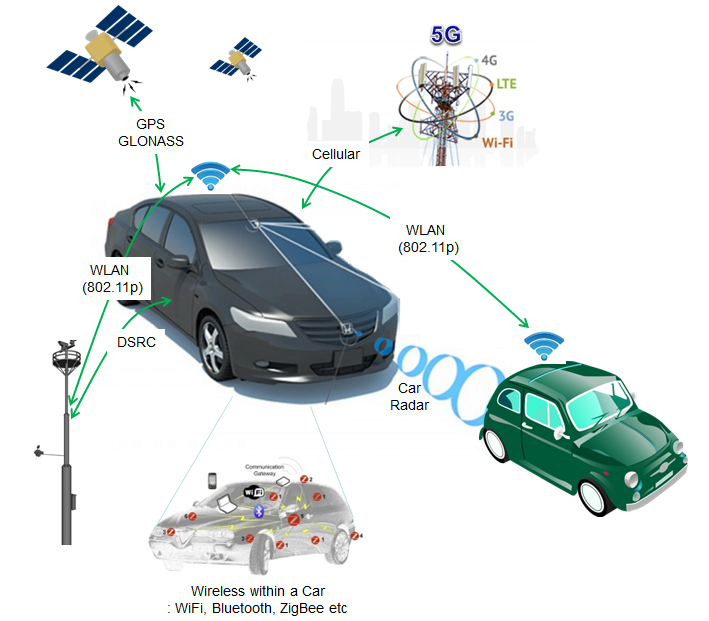
Figure 1. Typical wireless connections of a car. No single radio covers every partner, so a connected car carries several radios at the same time.
GPS, GLONASS : the satellites give the car its position and time. This link is receive only.Cellular : the mast labelled 3G, LTE, 4G and 5G connects the car to the network and the Internet. This is the V2N link.WLAN (802.11p) : the arrows marked 802.11p connect the car to the roadside pole and to the other car. These are the V2I and V2V links.DSRC : Dedicated Short Range Communication is the name used for the 802.11p based V2X system, here shown toward the roadside pole.Car Radar : the rings toward the other car show a radar that measures distance and speed. It senses the other car, and it does not exchange data with it.Wireless within a Car : WiFi, Bluetooth, ZigBee and similar links connect phones and devices inside the car.
The 802.11p and DSRC links in Figure 1 now have a competitor. 3GPP added LTE-V2X in Release 14. It adds a direct link between vehicles, called the sidelink or PC5 interface, which works without the base station. Release 16 then added NR V2X on the 5G radio. So a car can send V2V messages over two different radio families, 802.11p based and cellular based. The two families do not interoperate on the air. For 802.11p the IEEE has also defined a successor, 802.11bd.
Both families use the 5.9 GHz band. In the US, the FCC reassigned the lower 45 MHz of that band to unlicensed use in 2020. It kept the upper 30 MHz, 5.895 to 5.925 GHz, for C-V2X. In Europe, the 802.11p based system is called ITS-G5. The car radar works in a different band, usually 76 to 81 GHz, so it does not compete with the V2X links.
A connected car carries several radios : GNSS, cellular, a V2X radio, radar and in-car WiFi and Bluetooth.V2X has two radio families : 802.11p / DSRC / ITS-G5 on one side, and LTE-V2X and NR V2X on the other.The 5.9 GHz band is shared by both V2X families : the regulator in each region decides which one gets the spectrum.
Video Links
The videos below show the 802.11p based V2X system at work, from product demos to open source software. They also discuss the technical and commercial problems of V2V and V2I networks.
- IEEE 802.11p for Car-to-X Communication: Introductory demo by NXP
- IEEE 802.11p real-world video transmission
- IEEE 802.11p / WAVE Channel Switching Demo
- Wireless Networks for Cars
- Technical and Commercial challenges of V2V and V2I networks
- Inside the Connected Car - Autoline This Week 1735
- [FOSDEM 2014] Towards an Open Source IEEE 802.11p Stack