In many cases, we get confused by the role of Default EPS Bearer and Dedicated EPS Bearer. I think the best way to clear the confusion would be to understand the detailed information elements (parameters) defining these two bearer.
Two NAS messages create these bearers, and they are the clearest place to start. The picture below sets a decode of each one beside the other, and the questions after it say what the difference between the two field lists means in practice.
- What does each message actually carry ?
- What separates the two bearers ?
- Why does a dedicated bearer carry a TFT ?
- Who decides that a dedicated bearer is set up ?
- Reference
What does each message actually carry ?
One NAS message creates each bearer, and 24.301 gives the two messages different mandatory field lists. Reading those lists against each other answers most of the questions on this page before any of them is asked.
First take a look at the decoded message for Default EPS Bearer and Dedicated EPS Bearer.
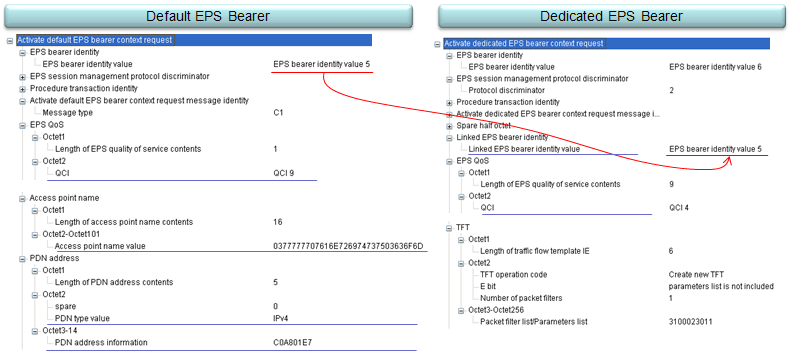
- The left pane decodes an activate default EPS bearer context request. Its EPS bearer identity value is 5 and its QCI is 9. Its access point name contents run to 16 octets, and its PDN address gives PDN type value IPv4 with the address C0A801E7.
- The right pane decodes an activate dedicated EPS bearer context request. Its own EPS bearer identity value is 6, and its QCI is 4.
- The red arrow runs from the left pane's EPS bearer identity value 5 to the right pane's linked EPS bearer identity value, which reads EPS bearer identity value 5. The arrow is the link between the two bearers.
- The right pane carries a TFT and the left pane does not. Its TFT operation code reads create new TFT, its number of packet filters is 1, and its packet filter list reads 3100023011.
- Neither pane carries the other's fields. No access point name and no PDN address appear on the right, and no linked identity and no TFT appear on the left.
Those absences are not an accident of this capture. 24.301 Table 8.3.6.1 makes EPS QoS, access point name and PDN address mandatory in the default bearer message. 24.301 Table 8.3.3.1 makes linked EPS bearer identity, EPS QoS and TFT mandatory in the dedicated bearer message. EPS QoS is the only one of the five that appears on both lists.
The field lists are fixed : 24.301 makes the access point name and the PDN address mandatory in one message. It makes the linked EPS bearer identity and the TFT mandatory in the other.EPS QoS is the shared field : it is the only mandatory information element that both messages carry, and it is where the QCI sits.The arrow is a field, not a drawing : linked EPS bearer identity carries the identity of the default bearer, and the picture draws that as an arrow.
What separates the two bearers ?
The field lists differ, and the questions below give the consequences one at a time. Two of the answers hold in almost every live network and still need a qualification, so the qualification follows each of them directly.
Let me give a couple of questions to help you understand the behaviour of these two bearers.
What are the information that Default EPS has but Dedicated EPS bearer does not ?
The answer is "APN Name" and "PDN type/PDN Address".
Then What kind of PDN address does Dedicated EPS Bearer will use ?
The answer is "Dedicated EPS Bearer uses the PDN address of Default EPS Bearer it is linked to".
Then how a Dedicated EPS Bearer knows which Default EPS Bearer it is linked to ?
The answer is that it is via a information element called "Linked EPS Bearer Identity" (See the arrow shown in the picture above)
What are the information that both Default EPS Bearer and Dedicated EPS Bearer has ?
The answer is "QCI".
Can Default EPS Bearer and Dedicated EPS Bearer can have the same QCI value ?
The answer is "No, they must have different QCI value".
23.401 puts that rule on a pair of parameters rather than on the QCI alone. Take one UE and one PDN connection. Two service data flows are not mapped to the same EPS bearer when their QCIs differ, or when their service-level QCI is the same and their ARP differs. 23.203 states the binding from the other side: a service data flow binds to the bearer that carries the same QoS class identifier and ARP. Two bearers of one PDN connection can therefore carry the same QCI, as long as their ARP differs.
What is the relation between Default EPS Bearer and an APN ?
The answer is "there is one-to-one relationship between them. One Default EPS Bearer is alllocated for one APN.
The exact relation runs through the PDN connection rather than through the APN. 23.401 defines a PDN connection as the association between a PDN represented by an APN and a UE represented by one IPv4 address or one IPv6 prefix. One default bearer is established per PDN connection. A UE may hold more than one PDN connection to the same APN, and 23.401 then requires all of them to be served by the same PDN GW.
The default bearer owns the address : the PDN address belongs to the PDN connection, so every dedicated bearer on that connection uses it.The link is one field wide : linked EPS bearer identity names the default bearer, and nothing else in the dedicated bearer message points back to it.QCI and ARP separate bearers together : the same QCI can appear on two bearers of one PDN connection when their ARP differs.
Why does a dedicated bearer carry a TFT ?
A bearer is only useful once the UE and the network agree on which packets travel over it. The TFT is where that agreement is written down, and its absence from the default bearer message is what leaves the default bearer as the general case.
23.401 calls the TFT the set of all packet filters associated with an EPS bearer. The uplink filters form the UL TFT and the downlink filters form the DL TFT.
Every dedicated EPS bearer is associated with a TFT. A TFT may also be assigned to the default EPS bearer. The left pane in the picture above carries none, and that is a common case rather than a rule.
The UE routes uplink packets by the filters. It evaluates the uplink packet filters of every TFT in increasing order of evaluation precedence index, and it sends the packet on the bearer whose filter matched first.
That algorithm needs one bearer to carry whatever matched no filter. 23.401 states that at most one EPS bearer exists without any uplink packet filter, and that the default bearer is the only bearer that may be without one.
The picture above shows the dedicated bearer creating its filter set. Its TFT operation code reads create new TFT, and it declares a single packet filter.
The TFT decides what travels on the bearer : it is the set of packet filters the UE matches an uplink packet against.Only the default bearer may have no uplink filter : 23.401 allows at most one such bearer, and names the default bearer as the one.A default bearer may still be given a TFT : the picture above shows one without a TFT, and 23.401 permits one with.
Who decides that a dedicated bearer is set up ?
Both messages travel from the network to the UE, so neither bearer is something the UE asks for and receives. What differs between them is where the parameters inside the message come from.
24.301 gives both messages the direction network to UE. The default bearer message arrives during attach or during a PDN connectivity request. The dedicated bearer message arrives later, on a PDN connection that already exists.
Subscription sets the opening QoS of the default bearer. In 23.401 the MME sets those initial bearer level values from the subscription data it retrieved from the HSS.
A dedicated bearer has no such source. 23.401 states that subscription data for bearer level QoS parameters does not apply to dedicated bearers. For WB-E-UTRA the decision to establish or modify one can only be taken by the EPC, and the QoS values are always assigned there.
One more restriction separates the two. A default bearer shall be a non-GBR bearer, while a dedicated bearer may be GBR or non-GBR. 23.401 gives the reason in a note: the default bearer provides connectivity throughout the lifetime of the PDN connection, and that motivates restricting it to non-GBR.
Their scope is narrower in one more way. 23.401 supports dedicated bearers only for the IP and Ethernet PDN connectivity services in this release.
Both messages come from the network : 24.301 gives each of them the direction network to UE.Subscription reaches the default bearer only : the MME takes its initial QoS from HSS data, and 23.401 says that data does not apply to a dedicated bearer.Only a dedicated bearer can be GBR : 23.401 requires the default bearer to be non-GBR, because it remains established for the life of the PDN connection.
Reference
The documents below are the sources for the field lists and the bearer rules quoted on this page. A version is named only where the text was read in that version.
- 24.301 : 3GPP - Non-Access-Stratum (NAS) protocol for Evolved Packet System (EPS); Stage 3, v20.0.0. Table 8.3.6.1 and Table 8.3.3.1 give the contents of the two messages in the picture.
- 23.401 : 3GPP - General Packet Radio Service (GPRS) enhancements for E-UTRAN access, v20.0.0. Clause 3.1 defines the PDN connection, clause 4.7.2.1 defines the default and dedicated bearers and the TFT, and clause 4.7.5 carries the QCI and ARP mapping rule.
- 23.203 : 3GPP - Policy and charging control architecture, v20.0.0. Clause 6.1.1.4 defines bearer binding, and it is the source of the rule that binds a service data flow to the bearer with the same QoS class identifier and ARP.