5G Idle Mode Procedure
The term Cell Selection Criterion can be somewhat vague, since cell selection may be considered from several different perspectives and may involve multiple criteria. In a broad sense, whether a UE can select a particular cell is influenced by several fundamental factors. First, the signal transmitted by the cell must be strong enough and have sufficient quality for the UE to detect and recognize the cell. Second, the PLMN associated with the cell must be acceptable to the UE according to its PLMN selection rules and subscription information. Finally, the type of service provided by the cell and the UE's ability or permission to use that service must also be considered. Therefore, cell selection can broadly be viewed in terms of signal strength and quality criteria, PLMN selection criteria, and service type criteria.
Followings are the details I want to talk about in this note.
- Reading the S-criterion : what Srxlev and Squal actually are
- Every term in the equation, and where it comes from
- A worked example, and the same cell failing
- The SIB1 fields that carry these parameters
- Qoffsettemp : the penalty the network never signals directly
- Field value to real value : the mapping table
- When a cell is detected but never used
In short, cell selection would be influenced by following factors.
i) Is the cell transmitting power strong enough to be recognized/detected by the UE ? (Signal Strength/Quality Criteria) ii) Is the PLMN of the cell acceptable to the UE ? (PLMN selection criteria) iii) Is the service type of the cell acceptable to the UE ? (Service Type criteria)
It is worth noticing how those three split up before we go on, because only the first of them is what this page is about. Criteria
But in most of the situation when we say "Cell Selection Criteria", it is likely to say the first criteria (Signal Strength/Quality Criteria). This signal quality criterion as descrbed in 38.304 - 5.2.3.2 as follows.
According to this criterion, UE would not start registration even though it sucessfully detected a cell and even decoded MIB and SIBs unless the Srxleve > 0 and Squal > 0. So if a device does not even initiate the PRACH process even when it successfully decoded all the MIB and SIBs, checking on this criteria would be a good first step for the troubleshooting. (Of course, this is not the only issues for this case. there may be USIM issue and Band Indicator Issue, PLMN issues etc).
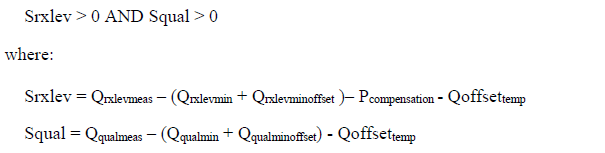
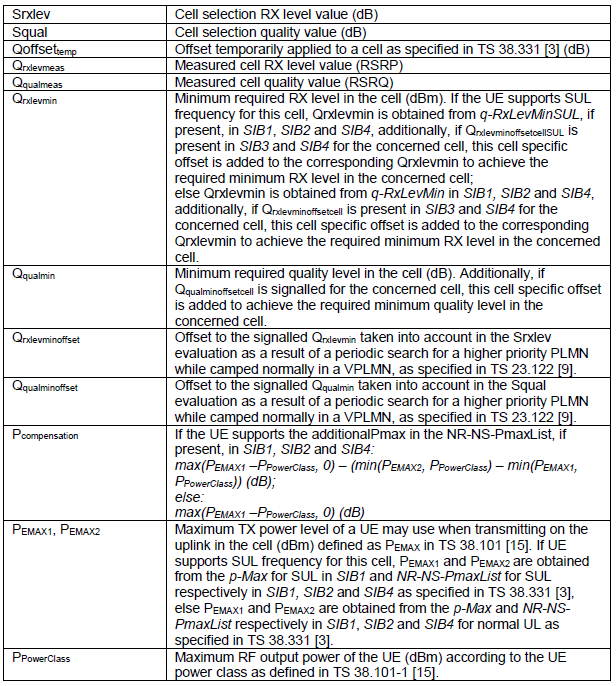
Reading the S-criterion : what Srxlev and Squal actually are
The two equations in the first picture are short, but almost everything that confuses people about them comes from one detail in the second picture. Look at the first two rows of that table :
     Srxlev   Cell selection RX level value  (dB)
     Squal    Cell selection quality value   (dB)
Once you read it that way the whole first equation becomes one sentence :
Srxlev =Qrxlevmeas - (Qrxlevmin +Qrxlevminoffset ) -Pcompensation -Qoffsettemp | | | | what I measure what the cell demands what my own radio a temporary (RSRP, dBm) (from SIB1, dBm) costs me (dB) penalty (dB)Squal =Qqualmeas - (Qqualmin +Qqualminoffset ) -Qoffsettemp | | | what I measure what the cell demands the same penalty (RSRQ, dB) (from SIB1, dB)
Read left to right : take what I measured, subtract what the cell requires, subtract what my own hardware costs me, subtract any penalty I have earned on this cell. If anything is left over, the cell is usable.
Why there are two gates and not one
The criterion is
| Srxlev | Squal | |
|---|---|---|
Built from |
||
Answers |
Is the signal strong enough ? |
Is the signal clean enough ? |
Blind to |
Interference - a strong cell buried in noise still scores well |
Absolute level - a clean but very weak cell still scores well |
Has a Pcompensation term ? |
RSRP tells you how loud the cell is. RSRQ tells you how much of what you are receiving is actually this cell rather than everything else. A cell can easily be loud and useless - a lab with a strong interferer, or a dense urban site with heavy neighbour overlap - and in that case Srxlev is comfortably positive while Squal goes negative. That single case is why 3GPP did not settle for one equation.
Every term in the equation, and where it comes from
This is the second picture rewritten as a lookup table, with the source of each value added. The definitions are as 38.304 words them.
| Symbol | What 38.304 says it is | Where the UE gets it |
|---|---|---|
Measured cell RX level value (RSRP) |
||
Measured cell quality value (RSRQ) |
||
Minimum required RX level in the cell (dBm) |
||
Minimum required quality level in the cell (dB) |
||
Offset to the signalled Qrxlevmin taken into account in the Srxlev evaluation |
||
The same idea, applied to Squal |
||
max(PEMAX1 - PPowerClass, 0) dB, or the longer form when additionalPmax is supported |
Computed by the UE from p-Max broadcast in SIB1 and |
|
Offset temporarily applied to a cell as specified in TS 38.331 |
Pcompensation : an uplink term hiding inside a downlink criterion
Every other term in Srxlev is about the downlink - what the UE can hear. Pcompensation is not. It is about whether the UE can
Pcompensation = max(P_EMAX1 -P_PowerClass , 0 ) [dB]P_EMAX1 the maximum uplink power thecell allows, from p-Max in SIB1P_PowerClass the maximum output power theUE can actually produce and when the UE supports additionalPmax in NR-NS-PmaxList :Pcompensation = max(P_EMAX1 - P_PowerClass, 0) - ( min(P_EMAX2, P_PowerClass) - min(P_EMAX1, P_PowerClass) ) [dB]
Take the usual case first. A power class 3 handset can produce 23 dBm, and the cell broadcasts p-Max = 23 dBm. Then max(23 - 23, 0) =
Now suppose the cell demands more than the UE can give: p-Max = 26 dBm against a 23 dBm handset. Then Pcompensation =
The logic behind this is worth stating plainly, because it explains the whole term.
And now the note from the previous section answers itself :
A worked example, and the same cell failing
Numbers make this concrete. Take a plausible domestic cell and a power class 3 handset :
Broadcast in SIB1 Measured by the UE q-RxLevMin = -60 RSRP (Qrxlevmeas) = -95 dBm -> Qrxlevmin = -60 x 2 = -120 dBm RSRQ (Qqualmeas) = -12 dB q-QualMin = -18 dB p-Max = 23 dBm UE power class 3 -> P_PowerClass = 23 dBm q-RxLevMinOffset = absent -> 0 dB not roaming, no higher-priority PLMN search connEstFailOffset = no penalty active -> Qoffsettemp = 0 dBPcompensation = max(23 - 23, 0) =0 dB Srxlev = -95 - ( -120 + 0 ) - 0 - 0 =+25 dB > 0PASS Squal = -12 - ( -18 + 0 ) - 0 =+6 dB > 0PASS -> the cell satisfies the S-criterion
25 dB of level margin and 6 dB of quality margin. Now change one thing only - put an interferer next to the UE so the cell is just as loud but much dirtier. RSRP does not move ; RSRQ collapses :
RSRP (Qrxlevmeas) = -95 dBmunchanged RSRQ (Qqualmeas) =-20 dB was -12 dB Srxlev = -95 - ( -120 + 0 ) - 0 - 0 =+25 dB > 0PASS Squal = -20 - ( -18 + 0 ) - 0 =-2 dB < 0FAIL -> the criterion is AND, so the cell isrejected
This is the case worth remembering. The signal bar on a test tool would look excellent - 25 dB of level margin - and the UE still refuses to camp. If you are chasing a device that sees a cell, decodes everything, and then does nothing, an Srxlev that looks healthy tells you almost nothing on its own. You have to check Squal too.
One more variation, this time on the uplink side. Leave the radio conditions good and only raise the cell's p-Max above what the handset can produce :
p-Max =26 dBm , UE power class 3 -> P_PowerClass = 23 dBmPcompensation = max(26 - 23, 0) =3 dB Srxlev = -95 - ( -120 + 0 ) -3 - 0 =+22 dB (was +25 dB)
Three dB of the margin is gone, and nothing about the received signal changed. On a strong cell this is invisible. On a cell right at the edge of coverage it is the difference between camping and not camping, and it will look completely inexplicable if you are only watching RSRP.
Out of the variables used in the equation, only Qrxlevmeas and Qqualmeas is the value UE really measures when it turns on and most of other parameters are determined by a specific SIB (SIB1 in LTE case) or calculated by some other predefined values.
That sentence is the practical summary of the table above, and it is worth restating as a count : of the eight symbols in the two equations,
The SIB1 fields that carry these parameters
Following is the part of LTE SIB1 which is related to Cell Selection Criterion and Cell Selection Procedure. Following is overall information and functionality of SIB1 information element.
SIB1 ::=        SEQUENCE {
    cellSelectionInfo                   SEQUENCE {
        q-RxLevMin                          Q-RxLevMin,
        q-RxLevMinOffset                    INTEGER (1..8)      OPTIONAL,
        q-RxLevMinSUL                       Q-RxLevMin          OPTIONAL,
        q-QualMin                           Q-QualMin           OPTIONAL,
        q-QualMinOffset                     INTEGER (1..8)      OPTIONAL
    }    OPTIONAL,   -- Need S
    cellAccessRelatedInfo               CellAccessRelatedInfo,
    connEstFailureControl               ConnEstFailureControl   OPTIONAL,
    si-SchedulingInfo                   SI-SchedulingInfo       OPTIONAL,
    servingCellConfigCommon             ServingCellConfigCommonSIB    OPTIONAL,   -- Need R
    ims-EmergencySupport                ENUMERATED {true}             OPTIONAL,   -- Need R
    eCallOverIMS-Support                ENUMERATED {true}             OPTIONAL,   -- Cond Absent
    ue-TimersAndConstants               UE-TimersAndConstants         OPTIONAL,   -- Need R

    uac-BarringInfo                     SEQUENCE {
        uac-BarringForCommon                UAC-BarringPerCatList     OPTIONAL,   -- Need S
        uac-BarringPerPLMN-List             UAC-BarringPerPLMN-List   OPTIONAL,   -- Need S
        uac-BarringInfoSetList              UAC-BarringInfoSetList,
        uac-AccessCategory1-SelectionAssistanceInfo CHOICE {
            plmnCommon                      UAC-AccessCategory1-SelectionAssistanceInfo,
            individualPLMNList              SEQUENCE (SIZE (2..maxPLMN))
                                               OF UAC-AccessCategory1-SelectionAssistanceInfo
        }   OPTIONAL
    }     OPTIONAL,   -- Need R

    useFullResumeID                     ENUMERATED {true}    OPTIONAL,   -- Need N
    lateNonCriticalExtension            OCTET STRING         OPTIONAL,
    nonCriticalExtension                SEQUENCE{}           OPTIONAL
}
The whole of cellSelectionInfo is
The
ConnEstFailureControl ::= SEQUENCE {
   connEstFailCount                    ENUMERATED {n1, n2, n3, n4},
   connEstFailOffsetValidity           ENUMERATED {s30, s60, s120, s240, s300, s420, s600, s900},
   connEstFailOffset                   INTEGER (0..15) OPTIONAL
}
Qoffsettemp : the penalty the network never signals directly
Qoffsettemp is the one term in the equation that no SIB field is named after, and the ASN.1 above is where it comes from. The three fields of ConnEstFailureControl work together as a small state machine :
  UE fails RRC connection establishment on this cell
                 |
                 v
  count reaches connEstFailCount   (n1, n2, n3 or n4 attempts)
                 |
                 v
  apply Qoffsettemp = connEstFailOffset to this cell only
     -> Srxlev and Squal both drop by that many dB
     -> the cell may now fail the S-criterion and be passed over
                 |
                 v
  keep the penalty for connEstFailOffsetValidity
                 (s30, s60, s120, s240, s300, s420, s600 or s900 seconds)
                 |
                 v
  penalty expires, Qoffsettemp returns to 0, cell is a candidate again
So this is a self-healing mechanism for a cell that answers but cannot complete a connection - an overloaded cell, a cell with a broken uplink, a cell whose PRACH configuration is wrong. Rather than letting the UE hammer at it forever, the UE marks it down for a while and looks elsewhere. Then it forgets, and tries again.
Now you may have a couple of questions of q-RxLevMin. The first question of what kind of power this represents ? Is it RSSI or RSRP or RSRQ ? How the value of this IE maps to real power value (dBm) ? You can get the answers to these two questions at once from 36.331.
38.331 has a description as follows.
That first definition answers your own question directly, and the answer is worth pulling out : it is
Field value to real value : the mapping table
The second half of your question - how the IE value maps to a real power - has a different answer for almost every field, which is exactly the sort of thing that causes an off-by-a-factor-of-two bug in a log parser. Here they are together :
| Field | ASN.1 range | Actual value | Range and default |
|---|---|---|---|
INTEGER (-70..-22) |
-140 to -44 dBm. Mandatory when cellSelectionInfo is present |
||
INTEGER (1..8) |
2 to 16 dB. Absent means |
||
INTEGER (-43..-12) |
-43 to -12 dB. Absent means |
||
INTEGER (1..8) |
1 to 8 dB. Absent means |
||
INTEGER (0..15) |
0 to 15 dB. Absent means |
Two traps live in this table. The
When a cell is detected but never used
This is the situation your paragraph near the top describes - the UE decodes MIB and SIB1 perfectly and then simply does nothing, with no PRACH ever sent. The S-criterion is the right first suspect, and the equations tell you exactly which quantities to go and look at, in order :
| What you see | Which term is doing it | What to check |
|---|---|---|
RSRP is weak, everything else normal |
Srxlev genuinely negative. The honest failure - the cell really is too weak |
Qrxlevmeas against q-RxLevMin x 2 |
RSRP looks strong but the UE still will not camp |
RSRQ against q-QualMin. Look for an interferer or heavy neighbour overlap |
|
Fails only on some UE models, same cell, same place |
p-Max in SIB1 against the UE power class |
|
Worked a moment ago, now the UE ignores the cell entirely |
connEstFailCount, connEstFailOffset, connEstFailOffsetValidity |
|
Only fails while roaming |
q-RxLevMinOffset, and whether the UE is in a VPLMN |
|
S-criterion passes but there is still no PRACH |
Not this page's problem. Criteria ii) and iii) from the top - PLMN or service type |
USIM, band indicator, PLMN list, cellBarred - as your own note says |
The last row matters as much as the others. The S-criterion is a necessary condition, not a sufficient one. Passing it only means the radio is good enough ; the cell still has to belong to a PLMN the UE is allowed to use, in a tracking area it is allowed to be in. Those are the other two criteria you listed at the very top of this page, and they are covered on the Cell Selection page.