SDL stands for Supplimentary Downlink. It may sound similar to SUL, but I think the motivation for SDL is a little bit different from SUL. The main motivation of SUL would be for improving the coverage by easing the UL power restriction in high frequency (refer to SUL page for further details), but the main motivation for SDL would not be for coverage expantion, it would be more for improving the utilization of spectrum resources which has been under-utilized
SDL Frequency Bands
One column does all the defining work here. An SDL band has no uplink at all, and the table records that as N/A rather than as a frequency range. Everything else about SDL follows from that empty column.
The frequency spectrum allocated for SDL by 3GPP are as follows :
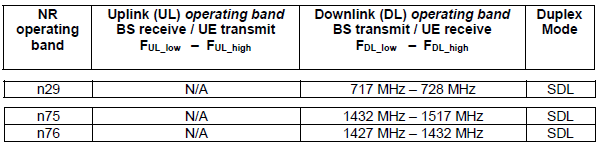
The uplink column reads N/A on every row : that is not an omission in the table. There is no uplink half of the band to record, which is what separates SDL from an ordinary FDD band.The duplex mode column says SDL rather than FDD or TDD : 38.101-1 treats it as a duplex mode in its own right, alongside FDD, TDD and SUL.The two 1.4 GHz bands meet exactly : n76 covers 1427 to 1432 MHz and n75 starts at 1432 MHz. Together they span the L-band allocation with no gap between them.
How SDL is Used
A band with no uplink cannot carry a connection on its own. A UE has no way to run random access on it, and no way to send an Ack for anything it receives. So SDL is never used alone, and the drawing below shows what it is used with instead.
The concept and use case of SDL can be illustrated by Rahim Navael as shown below. Rahim kindly approved me to share the illustration in my note.
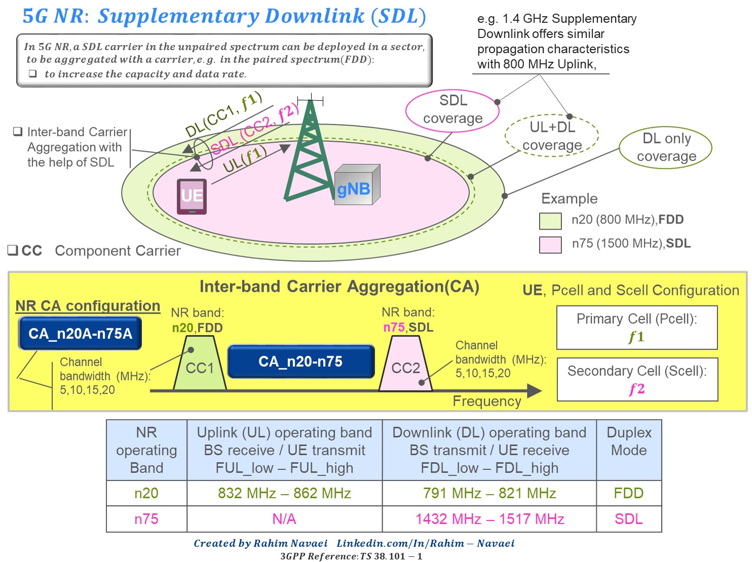
Image Source : Rahim Navaei's linked in post
Three arrows, and only two frequencies : the drawing marks DL(CC1, f1), SDL(CC2, f2) and UL(f1). Both downlink carriers reach the UE, and the single uplink returns on f1 only.The coverage ovals do not match : UL+DL coverage is drawn smaller than DL only coverage, because the uplink runs out before the downlink does.The Pcell is f1 and the Scell is f2 : the panel on the right assigns them that way round, and it could not be the other way. The primary cell has to have an uplink.The worked example is a real combination : n20 at 800 MHz as the FDD anchor and n75 at 1500 MHz as the SDL carrier, which 38.101-1 lists as CA_n20-n75.
The note at the top right is the part to read carefully. It explains why that particular pairing was chosen. A 1.4 GHz supplementary downlink offers propagation similar to an 800 MHz uplink. The SDL carrier therefore reaches roughly as far as the anchor's uplink already does. The extra capacity arrives across the whole area where the UE can still be heard, and not only near the tower.
That is the practical shape of SDL. Downlink demand is larger than uplink demand in almost every network, and unpaired downlink spectrum exists that nobody can use as a standalone band. Aggregating it onto an FDD anchor converts spectrum that would otherwise go unused into downlink capacity, and it costs no uplink at all.
SDL is always a secondary cell : the absence of an uplink rules it out as a PCell. It can only be added to a connection that already exists on another band.Inter-band carrier aggregation is the mechanism : nothing about SDL is new radio behaviour, and the UE aggregates it exactly as it would any other downlink SCell.The anchor choice is a propagation decision : an SDL carrier is worth little where it covers more ground than the anchor uplink. The UE cannot reply from there.
SDL and SUL
The opening of this page says the two sound similar and are motivated differently. That is worth setting out side by side, because the names differ by one letter and the problems they solve are opposites.
SUL adds an uplink carrier at a lower frequency, so that a UE at the cell edge can still be heard. SDL adds a downlink carrier, so that a UE that is already well within coverage can be given more capacity. One extends reach and the other extends throughput.
|
SUL |
SDL |
An extra uplink carrier, usually at a lower frequency than the main band. |
An extra downlink carrier, on unpaired spectrum. |
|
Uplink coverage. The UE runs out of transmit power before the downlink runs out of reach. |
Downlink capacity, in an area the network already covers. |
|
At the cell edge. |
Wherever the anchor uplink still works. |
|
Part of the same serving cell. The UE chooses between the normal uplink and the supplementary one. |
A separate secondary cell, added by carrier aggregation. |
|
SUL. Eleven bands carry it in the current release. |
SDL. Four bands carry it : n29, n67, n75 and n76. |
The last row is the quickest way to tell them apart in a band table. Look at which column reads N/A. An SUL band has no downlink, and an SDL band has no uplink, and neither can be used without a paired band beside it.
SUL is about reach, SDL is about capacity : one moves the uplink to a frequency that carries further. The other adds downlink where coverage is already fine.They attach to a connection differently : an SUL carrier belongs to the serving cell itself, while an SDL carrier arrives as a separate SCell.Both are useless alone : each supplies only one direction, so each needs a paired band to complete the link.
Reference
[1] A New Era for Enhanced Mobile Broadband - Mediatek/Whitepaper
[2] 38.101-1 v20.0.0 : NR - User Equipment (UE) radio transmission and reception, Part 1 Range 1 Standalone. Table 5.2-1 and the carrier aggregation configurations were read.