Calculus is the mathematics of change over very small intervals. This page is the entrance to the calculus pages on this site. It shows the symbols you will meet, explains why the same ideas feel much harder once more variables appear, and maps each idea to the page that covers it.
- What Symbols Will You Meet in Calculus?
- Why Does Calculus Get Harder with More Variables?
- How Does Each Idea Extend to More Variables?
What Symbols Will You Meet in Calculus?
Simply put, Calculus is a branch of mathematics that studies the concepts as shown below. In short, it is mainly about 'change of something within very small interval'. Followings are some of mathmatical symbols you would see in the calculus course. Some of these you may already be familiar with and some of them you may already be scared of -:). Find which symbols (concepts) you are familiar with and which ones you have never seen before.
The most basic concept of 'Calculus' is the concept of 'Slope' that you learned in high school math or physics. (If you want to refresh the concept of 'slope', see the slope/derivative page).
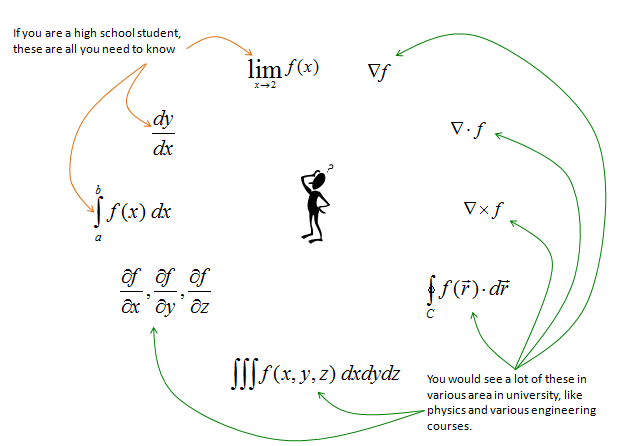
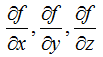
The orange arrows mark the high school set : the limit of f(x) as x → 2, the derivative dy/dx and the definite integral of f(x) from a to b. The Limit, Slope/Derivative and Integration pages cover them.The green arrows mark what engineering courses add : the partial derivatives ∂f/∂x, ∂f/∂y and ∂f/∂z, the gradient ∇f and the divergence ∇⋅f. The same group holds the curl ∇ x f, the line integral along a curve C and the triple integral over a volume.Each green symbol has its own page : see Gradient, Divergence, Curl and Line Integral. The triple integral extends the ordinary integral, so it starts from the Integration page.The green set is the orange set with more variables : every green symbol is still a limit, a slope or a sum. What changes is the number of inputs and outputs, which is the subject of the next two sections.
Why Does Calculus Get Harder with More Variables?
It seems that the first exposure to the concept of calculus is different depending on country. At least, when I was in school, I was tought about the basic concept of these in high school. The first thing I was tought was about lim, differentiation and integration with a single real variable and I didn't have much problems understanding those concepts, but when I come across these concepts about multi variable and complex variables, everything started confusing me. For long time, my question has been "Why I am getting so much confused and fail to get clear understanding these concepts when I have just a couple of more variables, whereas I didn't have much difficulties with a single variable in high school ?"
Actually I have had similar question for most of the area in mathematics. Conceptually what we are supposed to deal with in Engineering is the one we already covered in high school. The only difference seems to be just extension of dimensions. I kept asking myself why the similar concepts look so complicated and difficult whereas I didn't have much problems in high school.
I think it would be because of a couple of major factors as follows.
i) Extension of Dimension is not as simple as you might think. (So don't expect it to be simple and be prepared to put a lot of effort and time to learn the same thing in increased dimension).
ii) Many math courses/lectures skips the basic concepts based on assumtion that those were already covered in some previous courses. But this assumption does not always work due to followings.
a) It was covered in some previous courses, but they were already forgotten
b) It was covered in previous course but there would be some missing links between what was covered in previous course and what is convered in current courses, but nobody explains about the missing link.
For example, text book, teachers, lecturers spend a lot of time and effort to explain following concept with various different way of approaches (text, graph, illustrations).

But when they teach following concept, they don't spend much time and effort to explain basic idea. It seems that they just assume that student would understand this concepts easily based on what they have learned about the single variable case as mentioned above. But at least, that assumption didn't work for me. I may learn how to solve a problem in terms of mathematical operations, but I don't think I have clear understanding of what is the real meaning of the problem and what is real meaning of the solution that I myself came out.
What I am trying to do in this post is to explain the important concepts of calculus even for multi variable case in such a way that they are explained in high school math or pre-calculus course. Of course, this would not be as easy as I may think and will take long time and effort. I know I should be prepared to keep updating these pages at least for a couple of years.
How Does Each Idea Extend to More Variables?
Let's make the difficulty from the previous section concrete. Every idea in the single variable course has a counterpart with more variables. The counterpart keeps the same meaning, but it adds one new question each time: in which direction?
The table below lines up the three core ideas of calculus against their multi-variable and vector field forms. The last column names the page on this site that covers each one.
Idea |
One variable |
Several variables |
Vector field |
Pages |
Limit |
x approaches a value from the left or from the right |
(x, y) approaches a point along any line or curve |
each component of the vector approaches its own value |
|
Rate of change |
one slope, dy/dx |
one slope per variable, the partial derivatives, collected into the gradient ∇f |
divergence and curl, which combine the partial derivatives of several components |
|
Accumulation |
the integral of f(x) dx from a to b |
double and triple integrals over an area or a volume |
line and surface integrals, which add up a field along a curve or across a surface |
The limit row shows the new question most clearly. With one variable, x can approach 2 only from the left or from the right. With two variables, the point (x, y) can approach the origin along any line or curve. The limit exists only if every path gives the same value.
Take f(x, y) = (x2 - y2)/(x2 + y2) near the origin. Along the x axis the value is 1. Along the y axis it is -1, and along the line y = x it is 0. In general, along y = mx the value is (1 - m2)/(1 + m2), which depends on m. So this function has no limit at the origin, although each straight-line slice of it looks harmless.
More variables means more directions, not new ideas : a partial derivative is an ordinary slope taken along one axis while the other variables stay fixed.The direction question returns at every step : limits depend on the path, the derivative becomes a gradient that points somewhere, and an integral needs a curve or a surface to run over.Vector fields add a second layer : the output is also a vector. So a rate of change can mean spreading, which divergence measures, or turning, which curl measures.A simple reading order follows the table : start with Slope/Derivative and Limit, continue with Differentiation and Integration, and then move to Vector Field, Gradient, Divergence and Curl.