We have learned very important two operations for vectors, inner product and cross product. Combining these two operation we can produce extremely useful tool. This tool is so widely used that it has it's own name, called 'Scalar Triple Product'.
The scalar triple product takes three vectors and returns one number: the cross product of two of them, dotted with the third. I'll first show where the combination appears naturally, with plates in sunlight. Then we'll define the product formally, compute it with a determinant, and see why its value is a volume.
- Which plate gets the strongest light ?
- How do the cross product and the inner product work together here ?
- What is the scalar triple product and what does its value mean ?
Which plate gets the strongest light ?
A concrete problem makes the combination of the two products easy to follow. Several flat plates face the sun at different tilts, and we want to rank them by how much light they receive. The answer depends on one angle per plate.
Let me give you a situation where we can use the concept of Scalar Triple Product.
We have a multiple planes connected to each other with different tilt and light (sun) is shining over them as shown below.
Now let's think about which plane (plate) would have the strongest light. Any idea ?
Intuitively you would guess that the plate getting the light closer to right angle (perpendicular to the plane/plate).
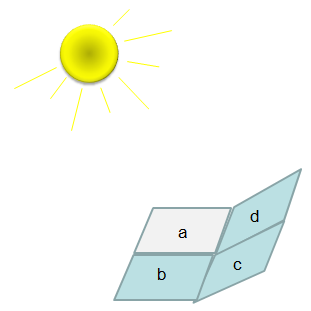
Figure 1. Four plates, a to d, with different tilts under one light source. Each plate faces the sun at a different angle.
How can we know how closer to the right angle a plate is getting the light ? The idea is like this.
i) Draw a vector which is perpendicular to the plane/plate(Let's label this vector as s).
ii) Draw a vector which connector a corner of the plate to the center of the light(Let's lavel this vector as l )
iii) Calculate the angle between the two vectors (s and l). If this angle closer to 0, it means the it is getting the light closer to the right angle.
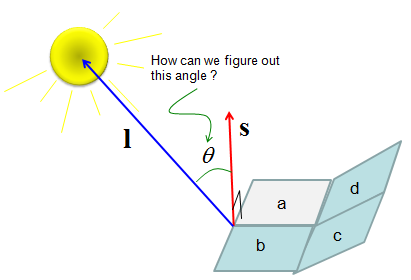
Figure 2. The angle that decides the brightness. The red normal s of plate a and the blue vector l toward the sun meet at the angle θ.
The physics behind the ranking is the cosine law of illumination. A plate of area A under parallel light receives power in proportion to A cos θ. At θ = 0 the plate faces the sun directly. At θ = 60 deg it receives half as much, and at θ = 90 deg the light only grazes it.
s is the normal of the plate : it stands at a right angle to the plate surface.l points from the plate to the light : for a distant sun, l has nearly the same direction for every plate.A smaller θ means more light : the received power per unit area follows cos θ.
How do the cross product and the inner product work together here ?
Each step of the procedure above needs one product. The cross product builds the normal s from two edges of the plate. The inner product then measures the angle between s and l.
Now let translate this procedure into mathematical forms.
First, we have to get a vector which is perpendicular (normal) to a plane (plate). Any idea on this ?
This is where you can use the concept of 'Cross Product'. If you draw two vectors starting a corner of the plate running along the sides as marked in green arrow shown below. The cross product of the two vectors would give you a vector which is perpendicular to the plate.
Now the next step would be to figure out the angle between the angle between vector s and l. This is what Inner Product is used for.
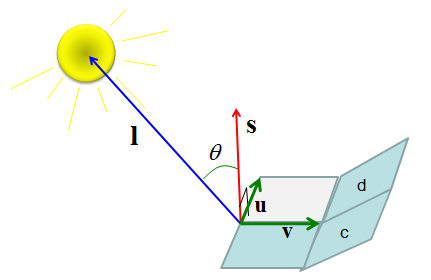
Figure 3. Two green edge vectors u and v run along the sides of plate a. Their cross product gives the red normal s.
Following is the mathematical description for the procedures explained above.
First, get the vector s which is perpendicular to a plate by 'Cross Product' as shown below.

Second, by a little bit of rearrangement of Inner Product equation, you can get the angles between the vector s and vector l.

The equation above shows the general form of the inner product rule, written with the letters u and v. On this page, u and v are the plate edges of Figure 3, so do not plug them in here. Their angle is the corner angle of the plate. The angle of Figure 2 uses s and l instead: cos θ = (s ⋅ l) / (|s| |l|).
Now put the two steps together. Replace s with u x v, and the numerator becomes (u x v) ⋅ l. This single expression is the scalar triple product. It already contains most of the answer, because |u x v| is the area of the plate. So (u x v) ⋅ l = area x |l| x cos θ. With the same l for every plate, this number is proportional to the light that each plate receives, and you can rank the plates without computing any angle.
The cross product gives the normal : s = u x v is perpendicular to both edges and so to the plate.The inner product gives the angle : cos θ = (s ⋅ l) / (|s| |l|).The order of u and v sets the side : v x u points to the other side of the plate, and the triple product changes sign.A negative triple product means the back side is lit : the light comes from behind the normal, at an angle over 90 deg.
What is the scalar triple product and what does its value mean ?
We have used the expression without a formal name. Let's define it for any three 3D vectors, compute it in one step, and read its value as a volume.
For three vectors a, b and c, the scalar triple product is a ⋅ (b x c). The result is a scalar, which gives the product its name. Written out, it equals the determinant of the 3 x 3 matrix whose rows are a, b and c.
a = [1 2 3],  b = [4 5 6],  c = [7 8 10]

b x c       = [ 5*10 - 6*8 , 6*7 - 4*10 , 4*8 - 5*7 ] = [2 2 -3]
a . (b x c) = 1*2 + 2*2 + 3*(-3) = -3

det | 1  2  3 |
    | 4  5  6 |  = -3
    | 7  8 10 |
The absolute value is a volume. The three vectors span a slanted box, a parallelepiped. Its base is the parallelogram of b and c, whose area is |b x c|. The height is the part of a along the normal of that base, which the inner product extracts. So |a ⋅ (b x c)| is base area times height, and the box above has volume 3. The sign tells you whether a, b and c form a right-handed set.
For the plate example, take the edges u = [2 0 0] and v = [0 3 0], and the light vector l = [1 1 4]. Then u x v = [0 0 6], and the triple product is 24. The plate area is |u x v| = 6 and |l| = sqrt(18) = 4.243. So cos θ = 24 / (6 x 4.243) = 0.943, and θ = 19.5 deg.
The three vectors can rotate : a ⋅ (b x c) = b ⋅ (c x a) = c ⋅ (a x b). Swapping any two vectors flips the sign.Zero means the vectors lie in one plane : the box is flat and has no volume. With c = [7 8 9] instead of [7 8 10], the product is 0, and the matrix is singular.The determinant is the fastest way to compute it : one 3 x 3 determinant replaces a cross product followed by an inner product.A nonzero value means a basis : three vectors with a nonzero triple product are linearly independent and span all of 3D space.