Mathematical definition of 'Series' is 'sum of all the terms in a sequence'. (It means that you need to have understanding of the concept of sequence first).
Is it too dry definition ?
Here goes my own definition which I hope is more practical. It may not be very accurate in pure mathematical aspects but I hope it would sound more familiar and less scary -:)
According to my definition, a Serieas is
- a mathematical tool to split a complicated mathematical object (function) into multiple (in most case, infinite number of ) simpler objects (functions)
- a mathematical tool to approximate a function (usually complicated function) with sum of simpler functions.
Both views are useful, and this page covers both. I'll start with the formal definition and the partial sum. Then I'll show how a series builds a complicated shape from simple pieces. The last section asks when an infinite sum gives a finite number.
- How is a series built from a sequence ?
- Why do engineers build a function from simple pieces ?
- Does an infinite series add up to a finite number ?
How is a series built from a sequence ?
Going back to the formal mathematical definition, the definition of a seriese can be illustrated as shown below. As you see.. when you are given a sequence, just take the summation of all the elements within the sequence, it becomes as Series.
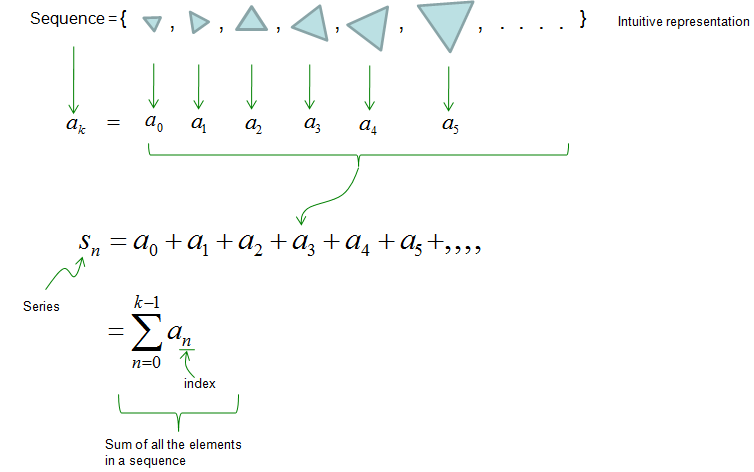
Figure 1. A series is the sum of the elements of a sequence. The sequence is the list, and the series is one number made from it.
Top row : the same triangle sequence as on the Sequence page, with the elements a0 to a5 under it.Middle : the series adds the elements one after another. The trailing commas mean that the sum goes on in the same way.Bottom : the sigma form writes the same sum compactly. The letter n under the sigma is the index, and it runs from 0 to k-1.The subscript on s : the picture writes sn and also uses n as the summation index. A clearer name is sk, because the sum depends on how many elements k are added, not on n.
The sum of the first k elements is called the k-th partial sum, sk = a0 + a1 + ... + ak-1. The partial sums form a new sequence, s1, s2, s3, ... For a finite sequence the series is simply the last partial sum. For an infinite sequence, the series is defined as the limit of the partial sums, if that limit exists. The last section of this page looks at that case.
A finite series can often be written in a closed form. For example, 1 + 2 + ... + n = n(n+1)/2. You can check it by writing the sum forward and backward and adding the two lines. Each column then gives n + 1, and there are n columns. For n = 100 the sum is 5050.
A series is one number, a sequence is a list : the series adds up the elements of the sequence.The partial sums form a sequence of their own : the value of an infinite series is the limit of that sequence.The sigma notation needs its limits : always check where the index starts and where it stops.
Why do engineers build a function from simple pieces ?
Following is a visualization of my definition of a Series. If you look at the object on the left hand side, you see an object that vaguely look like a rectangle. But if you take a closer look you would see some complicated structure in it. On the right side, you would see multiple rectangles and each of the rectangle is in simple shape. But combining all those simple rectangles on the right side, you can build a complicated object as shown on the left side.
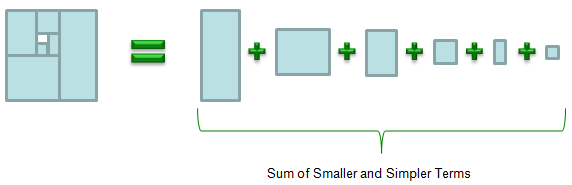
Figure 2. A complicated object as a sum of simpler ones. The pieces get smaller, so the first few pieces already give most of the shape.
Left : a rectangle with a nested pattern inside it.Right : the same area split into rectangles of decreasing size, joined by plus signs.Smaller and simpler terms : each piece is easy to describe by itself. Adding the first few gives a rough version, and each extra piece adds detail.
Most of the Series widely used in engineering area is more like my definition. For example, Taylor serieas is a tool to approximate any smooth function (usually complicated) with sum of multiple simple function called power function. As another example, you can think of Fourier Seriese. Fourier Series a tool to approximate any periodic function (usually complicated) with sum of multiple simple function called 'sin' and/or 'cos'. (I will talk in more detail about Taylor Series and Fourier Series in separate posts later).
Let's see the second kind at work. Take a square wave that is +1 for 0 < x < π and -1 for π < x < 2π. Its Fourier series is (4/π)(sin x + sin 3x/3 + sin 5x/5 + ...). The plot below shows the partial sums with 1, 3 and 10 terms, together with the square wave itself.
Figure 3. Fourier partial sums of a square wave. Each extra sine term adds detail and moves the sum closer to the square wave, except right at the jumps.
1 term : the single sine (4/π) sin x has a peak of 4/π = 1.273. It shows only the basic up and down shape.3 terms : sin 3x and sin 5x flatten the top and steepen the edges.10 terms : the flat parts are close to +1 and -1, with small ripples.Overshoot at the jumps : the peak next to each jump stays near 1.179, even with 50 terms. This is the Gibbs phenomenon. The overshoot gets narrower as terms are added, but it does not get lower.
At x = π/2 you can follow the partial sums as numbers. They are 1.273, 0.849, 1.103, 0.922 and 1.063 for 1 to 5 terms, and they approach the true value 1. The same idea is behind the Taylor Series, where the simple pieces are powers (x - a)n instead of sines.
A series splits a hard function into easy pieces : powers for a Taylor series, and sines and cosines for a Fourier series.Truncating the series gives an approximation : engineers keep only the first terms and accept a small error.More terms do not fix everything : at a jump, the Fourier partial sums keep an overshoot of about 9% of the jump size.
Does an infinite series add up to a finite number ?
An infinite series has infinitely many terms, so it is fair to ask whether the sum is a number at all. The answer depends on how fast the terms shrink. Terms that go to 0 are necessary, but they are not enough, and the harmonic series below is the standard warning.
A series converges when its partial sums converge, in the sense of the convergence of a sequence. The table below lists the partial sums sn of three series. The first term of each is at k = 1.
n |
Geometric, sum of 1/2k |
Harmonic, sum of 1/k |
Sum of 1/k2 |
1 |
0.5 |
1 |
1 |
2 |
0.75 |
1.5 |
1.25 |
5 |
0.96875 |
2.2833 |
1.4636 |
10 |
0.99902 |
2.9290 |
1.5498 |
100 |
1 - 2-100 |
5.1874 |
1.6350 |
1000 |
1 - 2-1000 |
7.4855 |
1.6439 |
limit |
1 |
none, grows without limit |
π2/6 = 1.6449 |
The geometric series is the one to remember. With a first term a and a ratio r, the partial sum of N terms is a(1 - rN)/(1 - r). When |r| < 1, rN goes to 0, and the infinite sum is a/(1 - r). For a = 1/2 and r = 1/2 this gives exactly 1. When |r| ≥ 1, the series diverges.
The harmonic series is the surprise. Its terms 1/k go to 0, but the sum still grows without limit. You can see why by grouping the terms. 1/3 + 1/4 is more than 1/2, and 1/5 + 1/6 + 1/7 + 1/8 is also more than 1/2. Every such group adds more than 1/2, and there are infinitely many groups. The growth is slow, close to ln n + 0.5772, so 1000 terms give only 7.49.
The series of 1/k2 shrinks fast enough and converges to π2/6. In general, the sum of 1/kp converges for p > 1 and diverges for p ≤ 1. A quick practical test is the ratio test. If |ak+1/ak| approaches a value below 1, the series converges like a geometric series.
The terms must go to 0 : if they do not, the series diverges. The reverse is not true.A geometric series converges when |r| < 1 : its sum is a/(1 - r).Slow shrinking is not enough : the harmonic series diverges, while the sum of 1/k2 converges.A computer cannot prove convergence by adding terms : the harmonic sum after 1000 terms looks like it is settling, but it is not.