This page is about the HS-SCCH of 1.28 Mcps TDD, the downlink control channel of HSDPA. Before a UE can decode its HS-PDSCH, it must know which slots and codes carry its data. It also needs the modulation, the transport block size and the HARQ process of that data. The HS-SCCH carries all of that for one UE. Let's look at the fields of HS-SCCH type 1 first, then at how the bits are coded, and last at the other HS-SCCH types.
HS-SCCH Type 1 Fields
HS-SCCH Type 1 (based on 25.222 4.6 Coding/Multiplexing for HS-SCCH). For 1.28 Mcps TDD, 25.222 v19.0.0 uses type 1 when the UE is not configured in MIMO mode and HS_DSCH_SPS_STATUS is FALSE. Type 1 may also be used when HS_DSCH_SPS_STATUS is TRUE, again without MIMO.
The diagram below lists the fields from left to right, with the size of each field in bits for each TDD chip rate. The 1.28 Mcps row is the one for TD-SCDMA. It differs from the 3.84 Mcps row in two fields: 5 bits of time slot information instead of 13, and 6 bits of transport block size information instead of 9.
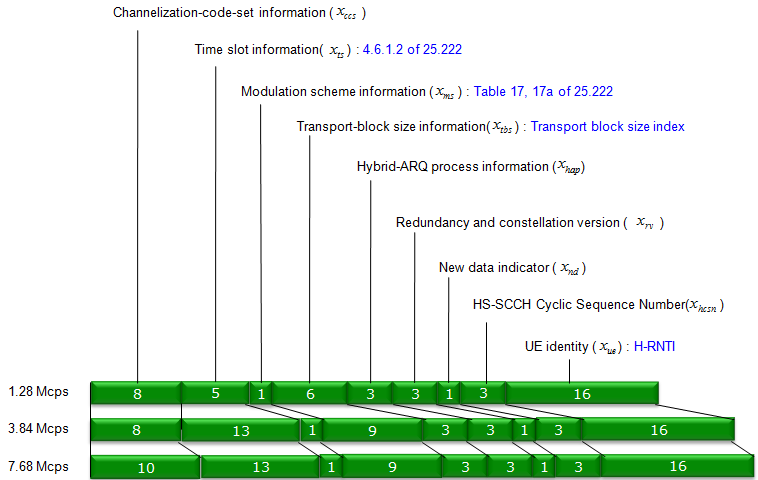
HS-SCCH type 1 fields for the three TDD chip rates. At 1.28 Mcps the HS-SCCH carries 30 information bits, and the 16-bit UE identity is added as a mask on the CRC.
Channelisation-code-set information takes 8 bits : 4 bits give the start code and 4 bits give the stop code, and the HS-PDSCH uses every code from start to stop.Time slot information takes 5 bits : bit n stands for timeslot n+1, so the bits cover TS2 to TS6. TS1 is always uplink and never carries HS-PDSCH. When higher layers allow TS0 for HS-PDSCH, the first bit stands for TS0 instead.Modulation scheme information takes 1 bit : 0 means QPSK and 1 means 16QAM. For a UE that supports 64QAM, 0 means QPSK or 64QAM, and the UE determines which one from the resources and the transport block size.Transport-block size information takes 6 bits : it is the index k into the 1.28 Mcps TDD tables of 25.321, shown on the HSDPA Transport Block Size page.Hybrid-ARQ process information takes 3 bits : it is the HARQ process identifier, MSB first.Redundancy and constellation version takes 3 bits : the value Xrv maps to the redundancy version parameters s and r, and for 16QAM and 64QAM also to the constellation version b.New data indicator takes 1 bit : the Node B increments it for each new MAC-hs PDU and keeps it for a retransmission.HS-SCCH cyclic sequence number takes 3 bits : the Node B increments it for each HS-SCCH sent to the UE, and the UE can use it to estimate its HS-SCCH BLER.UE identity is the 16-bit H-RNTI : it tells the UE that this HS-SCCH is addressed to it.
Coding and Mapping of HS-SCCH
The fields do not go on the air as plain bits. 25.222 clause 4.6 runs them through the same kind of chain as a transport channel, with a few fixed choices. The chain also explains how a UE finds its own HS-SCCH among several.
First, the 30 information bits are multiplexed into one sequence. Next, a 16-bit CRC is calculated over that sequence. The CRC is masked with the UE identity and then appended, so only the UE with that H-RNTI sees a correct CRC. After that, rate 1/3 convolutional coding protects the bits, and rate matching, interleaving and physical channel segmentation follow. Finally, the bits are mapped onto two physical channels, HS-SCCH1 and HS-SCCH2, both with SF = 16.
Counting the bits makes the chain concrete. The 30 information bits and the 16-bit CRC give 46 bits. Rate 1/3 convolutional coding adds 8 tail bits, so the encoder output is 3 x 46 + 24 = 162 bits. Rate matching then fits these bits into the data fields of the two physical channels. HS-SCCH1 uses time slot format #5 and HS-SCCH2 uses time slot format #0 of 25.221 Table 8F. So the HS-SCCH also carries TPC and SS commands, but no TFCI.
The UE identity is not sent as separate bits : it is applied as a mask on the 16-bit CRC.The HS-SCCH uses rate 1/3 convolutional coding : the general coding method of 25.222 clause 4.2.3 applies.One HS-SCCH in 1.28 Mcps TDD is two physical channels : HS-SCCH1 and HS-SCCH2 both use SF = 16.The HS-SCCH carries TPC and SS but no TFCI : its two physical channels use time slot formats #5 and #0 of 25.221 Table 8F.
Other HS-SCCH Types
Type 1 is not the only HS-SCCH format in 1.28 Mcps TDD. 25.222 v19.0.0 defines types 2 to 9 for 1.28 Mcps TDD only, for semi-persistent scheduling and for MIMO. The table below shows what each type is used for, so you can tell which layout to expect in a log.
HS-SCCH type | 25.222 clause | Used for |
Type 1 | 4.6 | Normal scheduling without MIMO, and optionally with SPS |
Order type A | 4.6A | A command to the UE, with no HS-PDSCH |
Type 2 | 4.6B | SPS initial transmissions, without MIMO or with MIMO SF mode SF1 |
Type 3 | 4.6C | SPS retransmissions in one sub-frame, without MIMO or with MIMO SF mode SF1 |
Type 4 | 4.6D | Single stream in MIMO or MU-MIMO mode, MIMO SF mode SF1 |
Type 5 | 4.6E | Dual stream in MIMO mode, MIMO SF mode SF1 |
Type 6 | 4.6F | SPS initial transmissions in MIMO mode, MIMO SF mode SF1/SF16 |
Type 7 | 4.6G | SPS retransmissions in MIMO mode, MIMO SF mode SF1/SF16 |
Type 8 | 4.6H | Single stream in MIMO or MU-MIMO mode, MIMO SF mode SF1/SF16 |
Type 9 | 4.6I | Dual stream in MIMO mode, MIMO SF mode SF1/SF16 |
Type 1 is the default HS-SCCH : it serves a UE that is not in MIMO mode.SPS has its own HS-SCCH types : types 2 and 3 cover SPS without MIMO or with MIMO SF mode SF1, and types 6 and 7 cover SPS with MIMO SF mode SF1/SF16.MIMO single stream and dual stream use different types : types 4 and 8 are single stream, and types 5 and 9 are dual stream.
Reference
- 3GPP TS 25.222 v19.0.0 : clause 4.6, coding and multiplexing for HS-SCCH, and clauses 4.6A to 4.6I
- 3GPP TS 25.221 v19.0.0 : clause 5A.3.10, HS-SCCH for the 1.28 Mcps option, and Table 8F
- 3GPP TS 25.224 v19.0.0 : use of the HCSN for the HS-SCCH BLER estimate
- 3GPP TS 25.321 v19.0.0 : New Data Indicator and HCSN handling in MAC-hs