N Frequency is the TD-SCDMA name for a multi-frequency cell. One cell uses several 1.6 MHz carriers, but only one of them carries the synchronisation signal and the common channels. That carrier is the primary frequency, and the others are the secondary frequencies. So the UE camps on the primary frequency, and RRC moves it to a secondary frequency when it sets up a connection. Let's follow that in a message flow first. Then we'll check which channels stay on the primary frequency and which RRC fields move the UE.
- How does a UE move to a secondary frequency ?
- Which channels stay on the primary frequency ?
- How does RRC signal the secondary frequency ?
- Reference
How does a UE move to a secondary frequency ?
A UE in idle mode can find only the primary frequency, because only that carrier has a DwPCH and a P-CCPCH. So every connection starts there, even when the traffic will run on another carrier.
The diagram below shows one Node B with three carriers. The primary frequency, Freq 1, carries the sync signal and the common channels. The secondary frequencies, Freq 2 and Freq 3, carry neither. The UE reads the BCCH and sends the RRC Connection Request on Freq 1. The RRC Connection Setup still comes on Freq 1, but it points the UE to Freq 2. Every message after that, from the RRC Connection Setup Complete to the RRC Connection Release, runs on Freq 2.
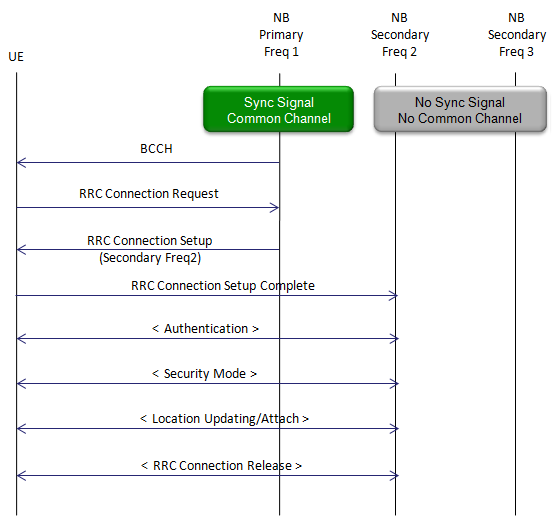
- BCCH : system information on the P-CCPCH of the primary frequency.
- RRC Connection Request : sent on the PRACH, which exists only on the primary frequency.
- RRC Connection Setup, Secondary Freq2 : sent on the S-CCPCH of the primary frequency. It makes Freq 2 the working frequency of the connection.
- RRC Connection Setup Complete, Authentication, Security Mode, Location Updating or Attach, and RRC Connection Release : sent on the dedicated channels of Freq 2.
- Freq 3 : not used by this UE. The network can give it to another UE in the same way.
Why build a cell like this? The common channels exist once per cell, on the primary frequency. Each secondary frequency adds traffic timeslots without another set of DwPCH, P-CCPCH, S-CCPCH and PICH. The UE also needs no cell reselection and no handover to reach a secondary frequency, because all the carriers belong to the same cell.
Every access starts on the primary frequency : The UE finds the cell, reads the BCCH and sends the RRC Connection Request there.The RRC Connection Setup moves the UE : It names the secondary frequency, and the dedicated channels run on that carrier.All the carriers form one cell : A move to a secondary frequency is not a handover.
Which channels stay on the primary frequency ?
The diagram says that a secondary frequency has no sync signal and no common channel. Let's check that statement channel by channel, because a few uplink channels are exceptions.
The table below lists the rules of 25.221 for a multi-frequency cell. Yes means that the channel can be sent on that type of carrier.
Channel |
Primary frequency |
Secondary frequency |
DwPCH |
Yes |
No |
P-CCPCH, carrying the BCH |
Yes |
No |
S-CCPCH, carrying the PCH and the FACH |
Yes |
No |
PICH |
Yes |
No |
PRACH |
Yes |
No |
UpPCH |
Yes |
Only for handover and the E-RUCCH procedure |
FPACH |
Yes |
Only for handover and the E-DCH procedure |
DPCH, HS-PDSCH, E-PUCH and the other traffic channels |
Yes |
Yes |
Beacon channels also stay on the primary frequency, and the P-CCPCH is always a beacon channel. For the traffic, one rule keeps things simple. The uplink and downlink traffic timeslots of one UE should be on the same carrier. The specification also suggests the same switching point on the secondary frequencies as on the primary frequency.
The UpPCH and FPACH exceptions matter for HSUPA and for handover. A UE with E-DCH may send the SYNC-UL of its E-RUCCH access on a secondary frequency. RRC can also name a separate FPACH frequency for the answer, as the next section shows.
Downlink common channels are primary only : DwPCH, P-CCPCH, S-CCPCH and PICH are sent only on the primary frequency.The PRACH never moves : UpPCH and FPACH can use a secondary frequency for handover and E-DCH, but the PRACH stays on the primary frequency.One UE uses one carrier for its traffic pair : Its uplink and downlink traffic timeslots should be on the same carrier.
How does RRC signal the secondary frequency ?
The flow above needs one extra piece of information in the RRC Connection Setup. The UE has to learn the secondary frequency, and it has to remember the primary frequency. The IE Multi-frequency Info carries this for 1.28 Mcps TDD only.
Following is based on
Multi-frequencyInfo-LCR-r7 ::=		SEQUENCE {
	-- If the secondary frequency is present, it indicates working frequency
	secondFrequencyInfo					FrequencyInfoTDD				OPTIONAL,
	fPachFrequencyInfo					FrequencyInfoTDD				OPTIONAL,
	--If a cell UpPCH uses other uplink service timeslot, it indicates the UpPCH position
	upPCHpositionInfo					UpPCHposition-LCR				OPTIONAL
}

FrequencyInfoTDD ::=				SEQUENCE {
	uarfcn-Nt							UARFCN
}
When a message carries both Frequency info and Second Frequency info, the UE treats the first one as the primary frequency and the second one as the secondary frequency. It stores the primary frequency, and it uses the secondary frequency as its working frequency. The comment in the ASN.1 says the same thing: a secondary frequency, when present, is the working frequency.
The two other fields concern the uplink access. The fPachFrequencyInfo names the carrier of the FPACH, and without it the UE uses the primary frequency. The upPCHpositionInfo is needed only when the UpPCH sits in another uplink timeslot instead of the UpPTS. Each frequency is a UARFCN, uarfcn-Nt, which is 5 times the carrier frequency in MHz. For example, a carrier at 2017.4 MHz is UARFCN 10087.
The same IE appears in other messages that move a UE, such as Cell Update Confirm, Radio Bearer Reconfiguration, Physical Channel Reconfiguration and Handover to UTRAN Command.
Two frequencies travel in one message : Frequency info gives the primary frequency, and Second Frequency info gives the working frequency.The UE keeps the primary frequency : It stores it, because the common channels of the cell stay there.The UARFCN is 5 times the frequency : For 1.28 Mcps TDD, Nt = 5 x F, with F in MHz.
Reference
- 3GPP TS 25.102 v19.0.0 : User Equipment (UE) radio transmission and reception (TDD)
- 3GPP TS 25.221 v19.0.0 : Physical channels and mapping of transport channels onto physical channels (TDD)
- 3GPP TS 25.331 v19.0.1 : Radio Resource Control (RRC); Protocol specification