In UMTS, data passes through three kinds of channels on its way to the air interface. RLC delivers logical channels to MAC, MAC delivers transport channels to the physical layer, and the physical layer sends physical channels. This page shows how these three layers connect for a UE in CELL_DCH state in Release 99, before HSDPA and HSUPA existed. The later releases are covered in Channel Mapping : Cell DCH R6 and Channel Mapping : Cell DCH R7.
- What does the Release 99 CELL_DCH mapping look like ?
- Why does each logical channel go where it goes ?
- What do rb-id and LCID in the diagram mean ?
- Reference
What does the Release 99 CELL_DCH mapping look like ?
A UE in CELL_DCH has a dedicated connection, but the cell keeps sending its common channels at the same time. So the diagram below shows both. It has three rows, which are the logical channels at the top, the transport channels in the middle and the physical channels at the bottom. The labels above the top row give the radio bearer identity, rb-id, and the logical channel identity, LCID, of each dedicated logical channel.
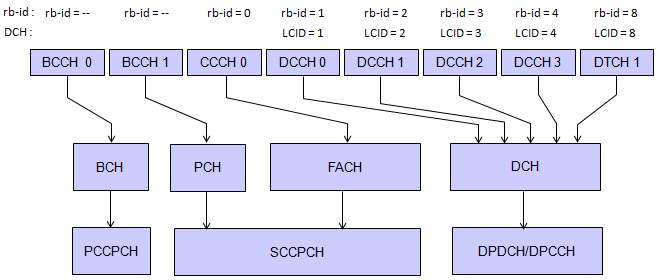
Reading the diagram from left to right, the channels fall into three groups.
- BCCH 0 goes to the BCH, and the BCH goes to the PCCPCH. This path carries the MIB and the SIBs.
- BCCH 1 goes to the PCH, and CCCH 0 goes to the FACH. Both the PCH and the FACH go to the SCCPCH.
- DCCH 0 to DCCH 3, with rb-id 1 to 4, and DTCH 1, with rb-id 8, all go to the DCH. The DCH goes to the DPDCH/DPCCH.
The right side of the diagram is the part that makes this CELL_DCH. All signalling radio bearers and the user data share the dedicated transport channel. The common channels on the left stay in the cell for every UE, but a UE in CELL_DCH does not use the FACH or the PCH for its own data.
Three layers, three rows : logical channels from RLC, transport channels in MAC, physical channels in layer 1.Common channels stay in the picture : BCH, PCH and FACH belong to the cell, not to one UE.Everything dedicated goes on the DCH : four DCCHs and one DTCH go to the DCH, and the DCH is sent on the DPDCH.
Why does each logical channel go where it goes ?
The mapping in the diagram is not arbitrary. TS 25.301 lists every connection between logical channels and transport channels that the protocol allows, separately for uplink and downlink. The diagram picks the downlink connections that a Release 99 cell uses in CELL_DCH.
For the common channels, TS 25.301 allows the BCCH on the BCH or on the FACH, and the PCCH on the PCH. The CCCH uses the FACH in the downlink and the RACH in the uplink. Later releases add the HS-DSCH for BCCH and PCCH, and the E-DCH for CCCH, but none of those exists in Release 99.
One label in the diagram needs a note. The box that feeds the PCH is labelled BCCH 1. In TS 25.301, the PCH carries the PCCH, which is the paging control channel, and the BCCH is never mapped to the PCH. So read BCCH 1 as the paging channel of the cell.
For the dedicated channels, TS 25.301 allows the DCCH and the DTCH on the RACH and the FACH as well as on the DCH, and later releases add the HS-DSCH and the E-DCH. In CELL_DCH of Release 99, the network maps both of them to the DCH. This gives them a dedicated code and inner loop power control.
At the physical layer, TS 25.211 gives each transport channel its carrier. The BCH goes on the Primary CCPCH, which has a fixed rate of 30 kbps with SF 256. The FACH and the PCH go on a Secondary CCPCH, either on the same one or on separate ones. The DCH goes on the DPDCH, while the DPCCH beside it carries only layer 1 control bits such as pilot, TPC and TFCI.
BCCH goes to BCH or FACH : the MIB and the SIBs use the BCH on the Primary CCPCH.PCCH is the only user of the PCH : the box labelled BCCH 1 in the diagram plays the PCCH role.In CELL_DCH, DCCH and DTCH use the DCH : the same logical channels can use RACH and FACH in CELL_FACH.DPDCH carries data, DPCCH carries control : both belong to the same dedicated physical channel.
What do rb-id and LCID in the diagram mean ?
The labels above the diagram connect two layers. The rb-id is the identity that RRC uses for a radio bearer, and the LCID is the number that MAC puts in the header when several logical channels share one transport channel. Let's take them one at a time.
TS 25.331 fixes the role of the first radio bearers. RB0 carries all messages on the CCCH. RB1 carries DCCH messages in RLC UM, and RB2 carries DCCH messages in RLC AM. RB3, and optionally RB4, carry the RRC messages with NAS signalling. So DCCH 0 to DCCH 3 in the diagram are the four signalling radio bearers RB1 to RB4. The CCCH has no rb-id in the diagram, because it always uses RB0. The user plane radio bearers use identities from 5 up to 32, and in this setup DTCH 1 uses rb-id 8.
The LCID is needed whenever several logical channels share one DCH. TS 25.321 puts a 4 bit C/T field in the MAC header in that case. The C/T value 0000 means logical channel 1, and 1110 means logical channel 15, so up to 15 logical channels can share one transport channel. In the diagram, each LCID is equal to its rb-id, which is a choice of this setup rather than a rule.
The diagram draws a single DCH box, and the row labelled DCH, which would give the transport channel identities, is empty. The signalling radio bearers and the user data can use one DCH or separate DCHs. So the diagram does not show which of the two this setup uses.
RB0 to RB4 have fixed roles : RB0 on CCCH, RB1 in UM, RB2 in AM, RB3 and RB4 for NAS messages.User radio bearers start at 5 : the DTCH here uses rb-id 8.LCID is the MAC C/T field : a 4 bit field that identifies up to 15 logical channels on one transport channel.
Reference
[1] 3GPP TS 25.301 v19.0.0 - Radio interface protocol architecture - clause 5.3.1.1.2, Mapping between logical channels and transport channels
[2] 3GPP TS 25.211 v19.0.0 - Physical channels and mapping of transport channels onto physical channels, FDD - Primary and Secondary CCPCH, DPCH
[3] 3GPP TS 25.321 v19.0.0 - MAC protocol specification - C/T field, Table 9.2.1-5a
[4] 3GPP TS 25.331 v19.0.1 - RRC protocol specification - clause 6.3, Signalling Radio Bearers, and RB-Identity