A WCDMA UE almost never sees a carrier frequency in MHz. The network gives it a channel number instead, the UARFCN, in system information, in measurement control and in handover commands. So when you read a log or set up test equipment, you move between UARFCN and MHz all the time. This page starts with the low, mid and high channels of Bands I to IX. It then shows the formula behind those numbers, and the bands that 25.101 added later. All values are checked against 25.101 v19.0.0.
The topics on this page are listed below.
- Which UARFCN values are the low, mid and high channels of Bands I to IX?
- How does a UARFCN map to a carrier frequency?
- Which FDD bands come after Band IX?
- Reference
Which UARFCN values are the low, mid and high channels of Bands I to IX?
RF tests are usually run on three channels per band: one near the bottom edge, one near the centre and one near the top edge. The edges show the worst case for filters and emissions, and the centre shows typical behaviour. So a table of low, mid and high channels is the first thing most engineers look up for a new band.
The table below lists nine operating bands, Band I to Band IX. Each band has a Downlink row and an Uplink row, and three columns: Low Channel, Mid Channel and High Channel. Every number in it is a UARFCN, not a frequency in MHz. The downlink value and the uplink value in the same column form one duplex pair.
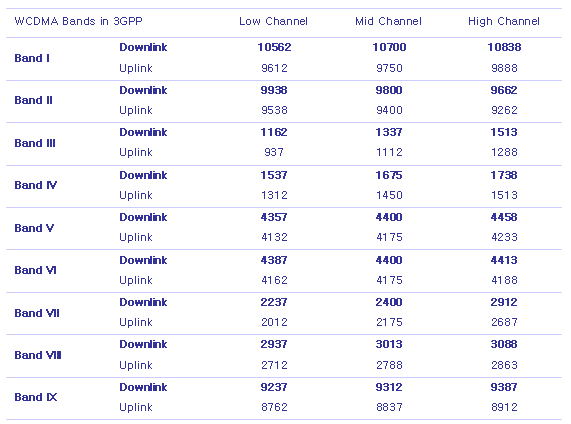
Low, mid and high channels of Bands I to IX. Each column pairs a downlink UARFCN with the uplink UARFCN at the default duplex distance.
Most Low and High values sit on the band limits : 25.101 Table 5.2 gives the supported range per band. For Band I it is 10562 to 10838 in the downlink and 9612 to 9888 in the uplink. These are exactly the Low and High columns.Band II is printed in reverse order : the Low column reads 9938 and the High column reads 9662. In 25.101 Table 5.2, 9662 is the lowest general Band II downlink channel and 9938 is the highest. The uplink row is reversed in the same way, 9538 and 9262. So read the Low and High columns of Band II swapped. The mid pair 9800 and 9400 is correct.The Band IV mid channel is not the centre of the band : 1675 is 2140 MHz and 1450 is 1740 MHz. The centre of Band IV is 2132.5 MHz in the downlink and 1732.5 MHz in the uplink. Even so, 1675 and 1450 are a valid duplex pair with the 400 MHz separation of Band IV.The Band VII high channel is an additional channel : 2912 and 2687 are outside the general Band VII range. That range is 2237 to 2563 in the downlink and 2012 to 2338 in the uplink. They come from the list of additional channels in 25.101 Table 5.2, and they correspond to 2687.5 MHz and 2567.5 MHz.The DL to UL gap is fixed per band : take the downlink UARFCN minus the uplink UARFCN. The result is 950 for Band I, 400 for Band II, 475 for Band IX and 225 for Bands III to VIII.
That last point matters in practice. In the Frequency info IE of 25.331 clause 10.3.6.36, the UARFCN downlink is mandatory, but the UARFCN uplink is optional. If the network leaves the uplink value out, the UE applies the default duplex distance of the band. So the network usually signals only the downlink channel, and the UE derives the uplink channel from the gap in the table.
A UARFCN is a channel number, not a frequency : convert it with the formula in the next section before you compare it with a spectrum analyser.Check Band II before you use this table : its Low and High columns are swapped.One downlink value is usually enough : the UE finds the uplink channel from the default duplex distance.
How does a UARFCN map to a carrier frequency?
The channel raster of UTRA FDD is 200 kHz, so every carrier centre is a multiple of 0.2 MHz. A channel number that counts in steps of 0.2 MHz is therefore just five times the frequency in MHz. The only question left is where each band starts counting, and that is what the offset in the formula decides.
25.101 clause 5.4.3 defines the UARFCN as follows, with every frequency in MHz.
- Uplink : NU = 5 x (FUL - FUL_Offset)
- Downlink : ND = 5 x (FDL - FDL_Offset)
The table below gives the band edges and the offsets of the general channels for Bands I to IX, taken from 25.101 Table 5.0 and Table 5.1.
Band |
UL frequencies MHz |
DL frequencies MHz |
FUL_Offset |
FDL_Offset |
TX-RX separation |
I | 1920 - 1980 | 2110 - 2170 | 0 | 0 | 190 MHz |
II | 1850 - 1910 | 1930 - 1990 | 0 | 0 | 80 MHz |
III | 1710 - 1785 | 1805 - 1880 | 1525 | 1575 | 95 MHz |
IV | 1710 - 1755 | 2110 - 2155 | 1450 | 1805 | 400 MHz |
V | 824 - 849 | 869 - 894 | 0 | 0 | 45 MHz |
VI | 830 - 840 | 875 - 885 | 0 | 0 | 45 MHz |
VII | 2500 - 2570 | 2620 - 2690 | 2100 | 2175 | 120 MHz |
VIII | 880 - 915 | 925 - 960 | 340 | 340 | 45 MHz |
IX | 1749.9 - 1784.9 | 1844.9 - 1879.9 | 0 | 0 | 95 MHz |
Let's check the formula against the channel table above. The Band I mid channel 10700 gives 10700 / 5 = 2140.0 MHz, the centre of the Band I downlink. Its uplink partner 9750 gives 1950.0 MHz, 190 MHz lower. For Band VIII, the mid channel 3013 gives 3013 / 5 + 340 = 942.6 MHz, and 2788 gives 897.6 MHz, 45 MHz lower.
Why do some bands need an offset at all? Several bands overlap in frequency. Band III and Band IX, for example, share 1844.9 to 1879.9 MHz in the downlink. Band IX uses offset 0 and Band III uses offset 1575. So the same carrier gets a different UARFCN in each band, and the number also tells the UE which band is meant. Bands V and VI are the exception, because both use offset 0. For their overlap, 25.101 lets the UE assume Band VI on a network whose Mobile Country Code is Japan, and Band V elsewhere.
The offset also explains the fixed DL to UL gap. The gap in UARFCN is 5 x (TX-RX separation - FDL_Offset + FUL_Offset). For Band III this is 5 x (95 - 1575 + 1525) = 225, the same as the 45 MHz bands.
Some bands also have additional channels, shifted by 100 kHz from the general raster. 25.101 Table 5.1A gives them their own offsets, which end in .1 MHz. For Band II the offset is 1850.1 MHz in both directions. So the additional downlink channel 412 is 412 / 5 + 1850.1 = 1932.5 MHz. Bands II, IV, V, VI and VII in the table above all have additional channels. Bands I, III, VIII and IX have none.
N = 5 x (F - offset) : the factor 5 comes from the 200 kHz raster.The offset keeps overlapping bands apart : one carrier can have two UARFCNs, one per band. Bands V and VI share offset 0, so the MCC decides.Additional channels use offsets ending in .1 : they put the carrier 100 kHz off the general raster, as the Band VII high channel of the table above shows.
Which FDD bands come after Band IX?
The channel table stops at Band IX, but 25.101 kept adding bands for many releases after that. A UE log from a live network can therefore show a UARFCN that is in none of the rows above. The table below lists the general UARFCN ranges of the later bands, from 25.101 Table 5.0 and Table 5.2.
Band |
UL frequencies MHz |
DL frequencies MHz |
UL UARFCN |
DL UARFCN |
X | 1710 - 1770 | 2110 - 2170 | 2887 - 3163 | 3112 - 3388 |
XI | 1427.9 - 1447.9 | 1475.9 - 1495.9 | 3487 - 3562 | 3712 - 3787 |
XII | 699 - 716 | 729 - 746 | 3617 - 3678 | 3842 - 3903 |
XIII | 777 - 787 | 746 - 756 | 3792 - 3818 | 4017 - 4043 |
XIV | 788 - 798 | 758 - 768 | 3892 - 3918 | 4117 - 4143 |
XIX | 830 - 845 | 875 - 890 | 312 - 363 | 712 - 763 |
XX | 832 - 862 | 791 - 821 | 4287 - 4413 | 4512 - 4638 |
XXI | 1447.9 - 1462.9 | 1495.9 - 1510.9 | 462 - 512 | 862 - 912 |
XXII | 3410 - 3490 | 3510 - 3590 | 4437 - 4813 | 4662 - 5038 |
XXV | 1850 - 1915 | 1930 - 1995 | 4887 - 5188 | 5112 - 5413 |
XXVI | 814 - 849 | 859 - 894 | 5537 - 5688 | 5762 - 5913 |
XXXII | N/A | 1452 - 1496 | N/A | 6617 - 6813 |
A few rows need care. Bands XV to XVIII are reserved in 25.101, and Bands XXIII and XXIV are not defined for UTRA FDD, so the numbering has gaps. In Bands XIII, XIV and XX, the downlink sits below the uplink, which is the reverse of the older bands. Band XXXII has a downlink only. 25.101 restricts it to dual band operation such as DB-DC-HSDPA, where its downlink pairs with the uplink of the other band.
Band numbers are not continuous : XV to XVIII are reserved, and XXIII and XXIV do not exist for UTRA FDD.Some bands use reverse duplex : in XIII, XIV and XX the downlink is the lower frequency block.Band XXXII is downlink only : a UE uses it only as the second band of a dual band configuration.
Reference
- 25.101 User Equipment radio transmission and reception FDD - v19.0.0, clause 5, Tables 5.0, 5.0A, 5.1, 5.1A and 5.2
- 25.331 Radio Resource Control - v19.0.1, clause 10.3.6.36 Frequency info