These snapshot is for Downlink channel only. No uplink is shown here. A code domain power display shows how the Node B shares its downlink power among the channelization codes. Each physical channel sits on its own OVSF code, so every new channel in a call setup appears as a new peak. This page follows one cell from switch off to an HSDPA call and shows the display at each step. First, let's see how to read the display, because the width and the height of a peak both carry information.
- How do you read a code domain power display ?
- What does the code domain show at each step of a call setup ?
- What do the numbers on the right side tell you ?
- Reference
How do you read a code domain power display ?
Before you compare the snapshots, you need to know what the horizontal axis means. A downlink DPCH in WCDMA can use any spreading factor from SF 512 down to SF 4. The display must put all of them on one axis.
The analyzer solves this with the OVSF code tree of TS 25.213. It shows every code at the lowest level of the tree, SF 512, so the axis runs from code 0 to code 511. The header in the snapshots shows this as CH / SF with SF = 512. A code at a higher level of the tree covers all the SF 512 codes below it. So a code with spreading factor SF fills 512 / SF neighbouring positions on the axis.
- An SF 256 code, such as the P-CPICH or the P-CCPCH, fills 2 positions.
- An SF 16 code, which every HS-PDSCH uses, fills 32 positions.
- An SF 8 code fills 64 positions.
The width of a peak therefore tells you the spreading factor, and the height tells you the power of that code. The vertical axis is in dB relative to the total power of the cell, so 0 dB would mean that one code carries all the power.
Two codes are always in the same place. TS 25.213 fixes the P-CPICH to Cch,256,0 and the P-CCPCH to Cch,256,1. So the first peak at the far left of the axis is always there when the cell is on. All other codes are assigned by UTRAN, which is why the page says that the exact location of each peak may vary.
The SCH is a special case. The P-SCH and the S-SCH use synchronisation codes of 256 chips, not OVSF codes. They are sent only in the first 256 chips of each slot. So the analyzer reports their power in separate rows on the right side, below the P-CPICH row.
Width gives the spreading factor : a code with spreading factor SF covers 512 / SF positions on the SF 512 axis.Height gives the relative power : each bar is in dB relative to the total cell power.P-CPICH and P-CCPCH are fixed : they always occupy the first four positions, codes 0 to 3 at SF 512.
What does the code domain show at each step of a call setup ?
The snapshots below come from one cell at six points of a call setup. They start with a Node B that is switched off and end with a running HSDPA call. Each new step adds one or more channels, so you can tell which channel belongs to which step by comparing a snapshot with the one before it.
Step 1 - The Node B does not transmit
Since network (Node B) is not tranmitting any signal, you don't see any special peak in the code domain and every code will be shown like noise.
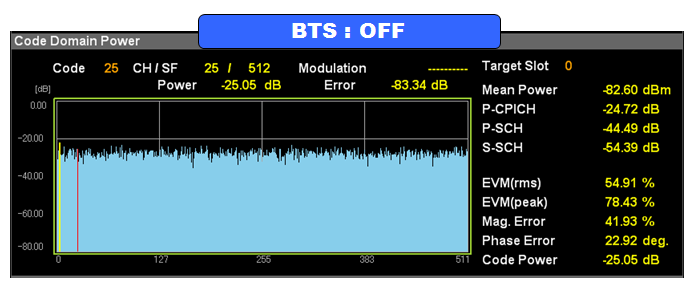
The title of the snapshot reads BTS : OFF. The trace is a flat floor at about -30 dB on every code, with no code standing out. The mean power is -82.60 dBm, which is only the noise at the analyzer input. The EVM values of 54.91 % rms and 78.43 % peak also show that there is no real WCDMA signal to demodulate.
Step 2 - The cell is on, with no UE
When the NodeB (or UE test equipment) is just turned on and transmitting MIB/SIB but no communication with UE. You would see some peaks for basic channel like SCH, PCPICH, P-CCPCH. Exact location of the peaks and size of the peak may vary depending on the channelization code number set by the NodeB (or equipment). See Overal WCDMA Channel Mapping for reference.
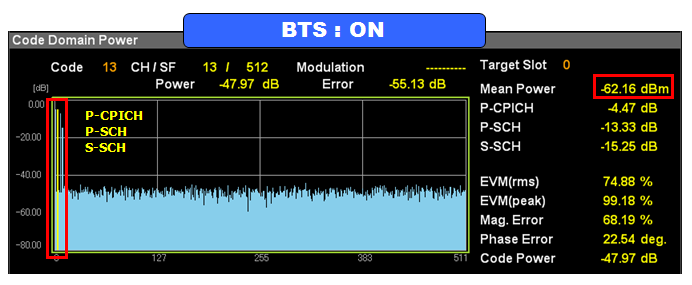
With the BTS on, the mean power rises to -62.16 dBm. The floor drops to about -50 dB, because the codes now have a real signal to compare with. The red box at the far left marks the peaks that the snapshot labels P-CPICH, P-SCH and S-SCH. The P-CPICH has -4.47 dB, and the P-SCH and the S-SCH have -13.33 dB and -15.25 dB. The P-CCPCH, which carries the BCH with the MIB and SIBs, sits right next to the P-CPICH on Cch,256,1.
Step 3 - Registration
If you turn on the UE and signaling message are exchanged between UE and Network, you would see a couple of new peaks for DPCCH, DPDCH. Exact location of the peaks and size of the peak may vary depending on the channelization code number set by the NodeB (or equipment)
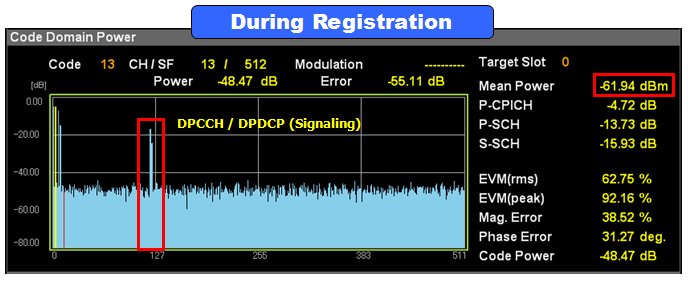
During registration, a new narrow peak appears near code 120 of 512, and it reaches about -15 dB. The snapshot labels it DPCCH / DPDCP (Signaling), where DPDCP is a typo for DPDCH. This is the downlink DPCH that carries the signalling radio bearers for the registration. The common channels at the left keep their levels, for example -4.72 dB for the P-CPICH.
Step 4 - Voice call
If you make a voice call and the call setup is complete, you would see some other peaks to carry Voice traffic. Exact location of the peaks and size of the peak may vary depending on the channelization code number set by the NodeB (or equipment)
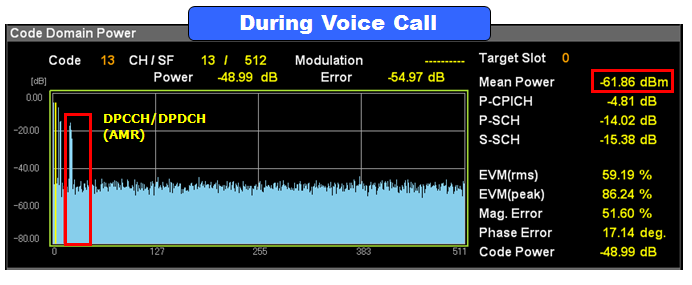
In the voice call, the peak moves to a code near the left end of the axis, and the snapshot labels it DPCCH/DPDCH (AMR). It is still narrow, so it is a code with a high spreading factor. An AMR voice call needs only a low bit rate, so the Node B does not need a wide code for it. The mean power stays at about -62 dBm.
Step 5 - Packet call on a Release 99 bearer
If you make a packet call with Non-HSPA bearer and the call setup is complete, you would see some other peaks to carry packet data traffic. Exact location of the peaks and size of the peak may vary depending on the channelization code number set by the NodeB (or equipment)
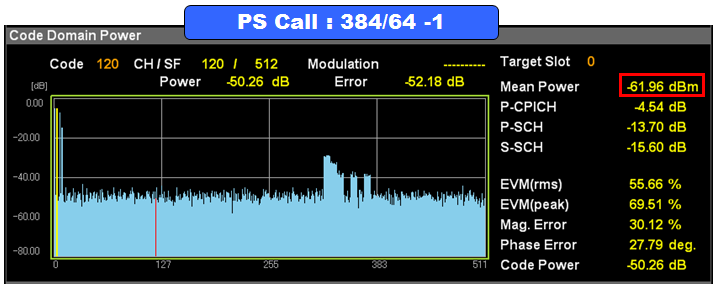
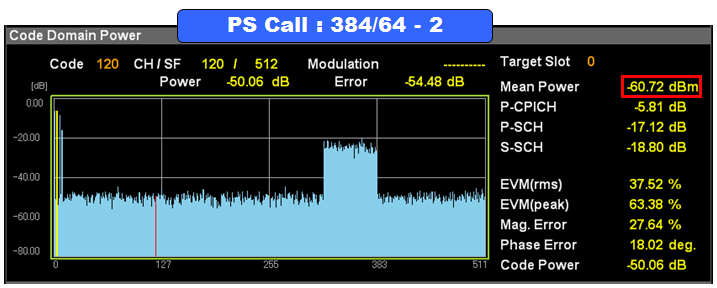
The two snapshots are marked PS Call : 384/64 -1 and PS Call : 384/64 - 2. The PS call uses a 384 kbps downlink and a 64 kbps uplink on a dedicated channel. Both snapshots show activity in the region around code 320 to code 384 of 512. In the second one the whole region is raised as one block at about -25 dB. That block is about 64 positions wide, which is the width of one SF 8 code. In the first one only some bars in the same region are raised, and they are lower. The mean power is -61.96 dBm in the first snapshot and -60.72 dBm in the second.
Step 6 - Packet call on an HSPA bearer
If you make a packet call with HSPA bearer and the call setup is complete, you would see some other peaks to carry packet data traffic. You would see a lot more codes are activated. Exact location of the peaks and size of the peak and how many peaks you would see may vary depending on the channelization code number and number of HS-PDSCH channel set by the NodeB (or equipment)
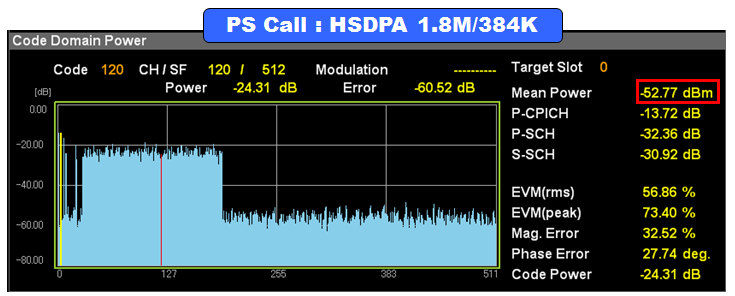
The snapshot is marked PS Call : HSDPA 1.8M/384K. A wide raised block now covers the left part of the axis, from near code 30 up to about code 224, at about -22 dB. This block is made of HS-PDSCH codes. Each HS-PDSCH uses SF 16, so each code fills 32 positions, and several of them side by side form one wide block. The mean power rises to -52.77 dBm, almost 10 dB above the earlier steps.
Each call type has its own footprint : a narrow peak for signalling and voice, a 64 position block for the 384 kbps bearer, and a very wide block for HSDPA.The common channels never move : P-CPICH and P-CCPCH stay at the left end in every snapshot after the BTS is on.The HSDPA call raises the total power : the mean power is almost 10 dB higher than in the voice call, and most of it sits in the HS-PDSCH block.
What do the numbers on the right side tell you ?
The bars show where the power goes, but the numbers on the right side are easier to compare from one snapshot to the next. Keep in mind that the channel values are in dB relative to the total power, while the mean power is in dBm. So one absolute value and several relative values move together.
The table below collects the values from the snapshots. The table keeps the power rows and leaves out the EVM rows, because the power rows are the ones that follow the channel setup.
Snapshot |
Mean Power |
P-CPICH |
P-SCH |
S-SCH |
BTS : OFF |
-82.60 dBm |
-24.72 dB |
-44.49 dB |
-54.39 dB |
BTS : ON |
-62.16 dBm |
-4.47 dB |
-13.33 dB |
-15.25 dB |
During Registration |
-61.94 dBm |
-4.72 dB |
-13.73 dB |
-15.93 dB |
During Voice Call |
-61.86 dBm |
-4.81 dB |
-14.02 dB |
-15.38 dB |
PS Call : 384/64 -1 |
-61.96 dBm |
-4.54 dB |
-13.70 dB |
-15.60 dB |
PS Call : 384/64 - 2 |
-60.72 dBm |
-5.81 dB |
-17.12 dB |
-18.80 dB |
PS Call : HSDPA 1.8M/384K |
-52.77 dBm |
-13.72 dB |
-32.36 dB |
-30.92 dB |
Look at the P-CPICH column together with the mean power. From BTS : ON to the voice call, the mean power stays near -62 dBm and the P-CPICH stays near -4.5 dB. So the dedicated channels add very little to the total power. In the HSDPA call, the mean power rises by about 9.4 dB, from -62.16 dBm to -52.77 dBm. At the same time the P-CPICH falls from -4.47 dB to -13.72 dB, which is a drop of about 9.3 dB.
The two changes are almost equal, and that is the point. The absolute P-CPICH power did not change. Only the total grew, so the P-CPICH became a smaller share of it. A UE measures CPICH Ec/Io in the same way, as the CPICH power relative to the total received power. So a loaded HSDPA cell shows a lower CPICH Ec/Io even when its CPICH RSCP stays the same.
Mean power is absolute, channel values are relative : a channel value can fall while its absolute power stays the same.HSDPA raised the total power by about 9 dB : the P-CPICH share fell by the same amount.The same effect appears in CPICH Ec/Io : a busy cell looks worse in Ec/Io than in RSCP.
Reference
[1] 3GPP TS 25.213 v19.0.0 - Spreading and modulation, FDD - OVSF code tree and the fixed P-CPICH and P-CCPCH codes, clause 5.2.1
[2] 3GPP TS 25.211 v19.0.0 - Physical channels and mapping of transport channels onto physical channels, FDD - SCH, clause 5.3.3.5, and HS-PDSCH, clause 5.3.3.13