IoT(Internet Of Things)
SigFox is an LPWAN that sends very small messages over very long distances. It is also a business model. SigFox, or a partner operator in each country, runs the whole network, and a customer only buys connectivity for its devices. This page shows the network architecture first, and then compares SigFox with LoRa, the other widely known unlicensed LPWAN.
What does a SigFox network look like ?
Let's start with the whole chain, from a sensor to the application that uses its data. The diagram below shows sensor nodes, gateways, the SigFox Cloud and the customer side, with the radio numbers written around them.
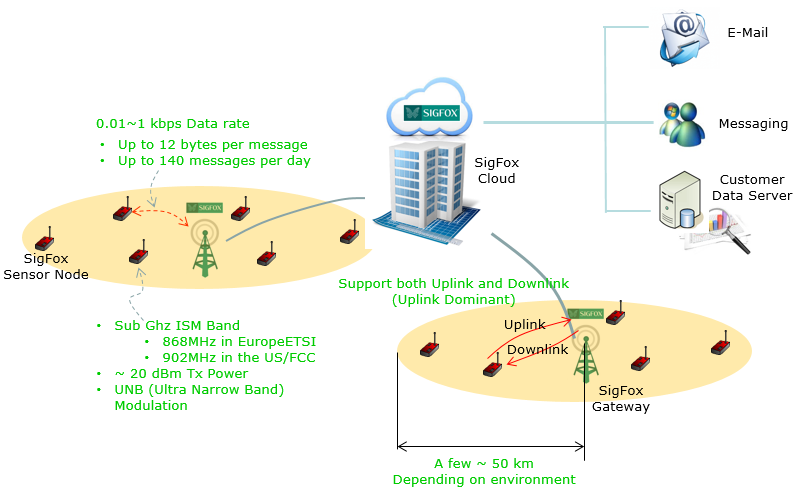
- SigFox Sensor Node : the device. It sends 0.01 to 1 kbps, up to 12 bytes per message and up to 140 messages per day.
- Radio : a Sub Ghz ISM Band, 868MHz in Europe under ETSI and 902MHz in the US under FCC, about 20 dBm Tx power and UNB, Ultra Narrow Band, modulation.
- SigFox Gateway : the base station. It supports both uplink and downlink, but the uplink dominates, and it reaches a few km up to 50 km depending on the environment.
- SigFox Cloud : the core of the network. All gateways forward their messages to it.
- E-Mail, Messaging and Customer Data Server : the customer side. The SigFox Cloud delivers each message to the application of the customer.
The small numbers explain the long range. UNB modulation puts each message into a very narrow channel, around 100 Hz wide. The receiver then needs to listen only to that narrow band, so it collects very little noise, and it can decode a very weak signal. The price is the data rate. In Europe the uplink runs at 100 bps, so even a 12 byte message stays on the air for a noticeable time.
The message limit follows from that air time. In the 868 MHz band a device may transmit only 1% of the time, and this duty cycle rule allows about 140 messages per day. The downlink is even more limited, with a few short messages per day. So SigFox suits a device that reports a value now and then, such as a meter reading or an alarm, and it does not suit a device that needs frequent commands.
Like LoRaWAN, a SigFox device does not attach to one gateway. Every gateway in range can receive its message and forward it to the SigFox Cloud, which removes duplicates. This reception by several gateways also makes the uplink more reliable.
UNB trades data rate for range : a very narrow channel collects little noise, so a weak signal is still decoded.12 bytes and 140 messages per day are hard limits : an application must fit its data into them.The uplink carries almost all traffic : the downlink is kept to a few short messages per day.The SigFox Cloud is the only way in : customer servers receive the data from the cloud, not from the gateways.
How does SigFox differ from LoRa ?
SigFox and LoRa target the same devices, and their architecture diagrams on this site look almost alike. Let's put the numbers side by side, because the differences sit in a few rows rather than in the overall picture.
Item |
SigFox |
LoRa |
Band |
Sub Ghz ISM Band |
Sub Ghz ISM Band |
Tx power |
about 20 dBm |
about 20 dBm |
Modulation |
UNB, Ultra Narrow Band |
Chirp spread spectrum |
Data rate |
0.01 to 1 kbps |
0.3 to 100 kbps |
Range |
a few km up to 50 km |
a few km up to 45 km |
Who runs the network |
SigFox or its partner operator |
anyone, a private owner or an operator |
The radio rows are close. Both use the same bands and the same power. They differ in how they reach the weak signal level. SigFox narrows the band, and LoRa spreads the signal with a chirp. LoRa therefore covers a wider range of data rates and can raise its rate when a node is close to a gateway.
The last row is the larger difference. With LoRa, a company can buy its own gateways and run its own Network Server, as the LoRa page describes. With SigFox, the network belongs to the operator, and the customer runs neither the gateways nor the SigFox Cloud. So the choice between the two is often a choice between owning the network and buying a service.
The radios differ in method, not in band : narrow band for SigFox, spread spectrum for LoRa.LoRa has the wider rate range : up to 100 kbps, against 1 kbps for SigFox.SigFox is always a service : LoRa can be a service or a private network.