Data between UE and Network (or another UE) go through various components on the data path. In most case, the resource allocation and the data path is configured statically or semi-statically. We cannot say all those components are optimized for each individual user or each individual use case (e.g, rush time traffic, regular hour traffic, eMBB, IoT etc). However, in ideal case where you can configure resource allocation and parameters of the components along the data path dynamically (by automation), we may define a set of parameters of all the components on the data path in most optimal way for specific UEs or specific use cases. The specific set of parameters assigned for the UEs or use cases is called a 'Slice' of the network. Network Slice is a logical concept of splitting all the resources along the data path into multiple sets, each of which is optimized for specific UEs or use cases.

Figure 1. The five stages a slice has to cover. A parameter set that stops at any one of them is not an end to end slice. That is why every box on the path has to be configurable from outside.
- The RAN block on the left is drawn as four stacked resources, which is the part of the picture that is genuinely split. The other stages are drawn as topologies rather than stacks.
- Edge Transport and Transport are drawn as router meshes with coloured paths through them. Different colours mean different routes for different slices, not different link speeds.
- Edge Service and Core Network / Service are compute rather than transport, so what gets sliced there is capacity and placement.
- The banner across the top is the requirement. Every one of these has to accept a configuration change at run time, and that is what the next section is about.
Followings are the list of the topics we want to look into
- Implementation Requirement
- Slicing vs 5QI(QoS) vs DNN(APN)
- Network Slicing vs Private Network
- Signaling for Network Slicing
- Who decides which slide to use ?
- Identification of Network Slice
- So many different types of NSSAIs
- Get the Test Procedure and Log / Amarisoft TechAcademy
- YouTube
- Reference
Implementation Requirement
I don't think there is any specification which explicitely defines all the details on how to implement these slices. But by the nature of dynamic configuration changes, we would easily guess that all the network elements along the data path should be constructed in such a way to change the configuration by remote control and automation. That's why the concept of network slicing can easily be achievable in 5G where most of the network components are designed for virtualization and the components along the transport (e.g, routers) is designed as SDN (Software Defined Network).
The reason the specification is quiet on this is that the work splits into two halves, and only one of them is a 3GPP problem. How a slice is requested, identified and selected is signalling, and 23.501 and 24.501 define it in detail. How a slice is actually built out of routers, servers and radio schedulers is an implementation matter, and 3GPP describes it only at the level of management and orchestration. 28.530, listed in the references of this note, gives concepts, use cases and requirements rather than a construction method.
Three domains have to be sliced separately and then joined, and Figure 1 shows all three. The RAN has to divide its scheduler and its radio resources. The transport network has to keep separate paths across the same fibre. The core has to place and size the network functions. Each of these is a different technology with a different controller, and the slice only exists once all three agree.
That joining is where the difficulty sits. A slice is only as good as its weakest domain, so a carefully sliced RAN feeding an unsliced transport network delivers no guarantee at all. It is also why the word orchestration appears so often around this topic. Somebody has to hold the end to end view, because none of the three domain controllers can see the other two.
The signalling is specified and the construction is not : 23.501 and 24.501 define how a slice is identified and selected, while how it is built is left to the vendor.Three domains, three controllers : RAN, transport and core are sliced by different technologies, and a slice exists only when all three have been configured.The weakest domain sets the SLA : an unsliced transport network cancels the benefit of a sliced RAN, however carefully the RAN was configured.Virtualization is what made it practical : remote configuration of every element on the path is the precondition, and that is why slicing arrived with 5G rather than earlier.
Slicing vs 5QI(QoS) vs DNN(APN)
Since Network Slicing is a concept of configuraing all the component along the end to end communication path, it can do everything that QoS(5QI in case of NR) and DNN(APN). That is, a certain aspect of network slicing and QoS and API overlaps. Due to this, we are often confused with these three concepts.
In short, I would say Network Slicing would be a superset of QoS and APN. That is, Network Slicing can do everything that QoS and APN do, but not in vice versa, meaning that there are certain aspect of Network Slicing that cannot be done by QoS or APN.
- Streaming video: A streaming video service requires a high data rate and low latency to deliver high-quality video content. In this case, QoS can be used to prioritize video traffic and allocate more network resources to ensure a smooth and uninterrupted viewing experience for users. Network slicing, on the other hand, can be used to create a separate slice for the video service, with customized QoS parameters and resource allocation, ensuring that the video service has the necessary resources to deliver high-quality video content.
- VoNR : QoS and network slicing are both used to support VoNR services in 5G networks, but they serve different purposes. QoS is used to define and enforce specific performance requirements for VoNR traffic, such as low latency and low packet loss. This is critical for ensuring that VoNR services provide a high-quality user experience. Network slicing, on the other hand, can be used to create separate slices for different VoNR services with customized QoS parameters and resource allocation. This enables the network to provide differentiated voice services that are tailored to meet the specific needs of different users and applications. For example, a network slice can be created for emergency services with high priority and guaranteed resources, ensuring that emergency voice calls are always delivered with the highest quality and reliability.
- Industrial automation: Industrial automation requires ultra-low latency and high reliability to support real-time control of machines and systems. QoS can be used to provide the required level of performance and service for industrial automation traffic, but it may not be sufficient to guarantee the necessary level of reliability. In this case, network slicing can be used to create a separate slice for industrial automation, with customized QoS parameters, resource allocation, and security policies, ensuring that the industrial automation traffic has the necessary level of reliability and security.
- Autonomous vehicles: Autonomous vehicles require low latency and high bandwidth to support real-time communication and decision-making. QoS can be used to allocate more network resources to the autonomous vehicle traffic, but it may not be sufficient to provide the necessary level of performance and service. In this case, network slicing can be used to create a separate slice for the autonomous vehicle service, with customized QoS parameters and resource allocation, ensuring that the autonomous vehicle traffic has the necessary level of performance and service.
But there are still some of the network slicing feature that cannot be done by QoS. For example, both Network Slicing and QoS can differentiate SLA between different application type (e.g, SLA between VoNR and eMBB), but QoS cannot differentiate the SLA within the same application. For example, QoS cannot differentiate the SLA between one UE (subscriber, also called a tenant) for the same application (e.g, VoNR) whereas Network Slicing can do.
Network Slicing vs Private Network
As you may notice from previous sections, there are many different ways of slicing the network. Let's suppose the Opeartor Y sliced network as illustrated below. In this example, we see a slice (i.e, dedicated network) for BMW group and FIAT group. From the point of BMW group and FIAT, it would be as if they have their own private network. That is, Network Slicing can be used as a way of implementing Private Network in wider sense of meaning. You may not say this cannot be a private network since the Operator Y would use licensed spectrum. I also agree that a keyword for Private Network was 'Unlicensed Spectrum', but in many case the meaning of technical terms varies (expands in most case) and I think the meaning of Private Network also has evolved to encompass various use case like this. I think this type of Private Network would attract attention not only from private company but also from Network Operators. To be hones, I don't think the private network based on Unlicensed Spectrum would be a strong motivation to existing operators, but this type of private network would be attactive to the established network operators as well.
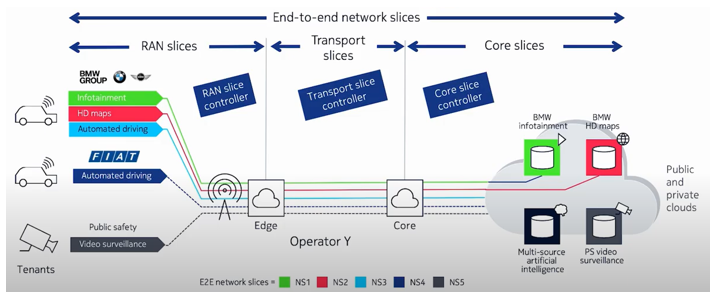
Source : 5G network slicing: automation, assurance and optimization of 5G transport slices
Figure 2. The same three domains as Figure 1, drawn from the tenant side. Each coloured line is one end to end slice, and a tenant can hold several of them at once.
- Three tenants appear on the left, not two. BMW GROUP, FIAT and a public safety user each enter the network with their own services.
- BMW holds three slices on its own : Infotainment on NS1, HD maps on NS2 and Automated driving on NS3. One tenant with several slices is the normal case rather than the exception.
- FIAT Automated driving is drawn on NS3 as well, the same slice as BMW uses for the same service. A slice is defined by the service it carries, and it is not automatically private to one tenant.
- The three controllers across the top are the joining problem of the previous section made visible. RAN, transport and core each have their own, and the E2E arrow above them is what has to be orchestrated.
Signaling for Network Slicing
Network slicing signaling process happenes at a few different stages like Initial Attach, PDU Establishment, Policy Change. Probably the most important step would be the process at Initial Attach. PDU Establishment would be mostly for defining various QoS Flow and Polich Change would be to associate the specific slices to a specific UE/Application as specified in the Policy Rules.
Following is the brief signaling flow at initial attach related to network slicing.
- When UE send Registration Request it specifies NSSAI. 3GPP defines a few large group of slice service/type as described here. By this NSSAI in Registration Request message UE tells Network saying that I want to get access to this and this type of slice.
- Then this requested Slice Information is tranferred to UDM. UDM check if the requested slice is allowed for the specific UE. If it is allowed, the UDP accept the request. If not, it rejects the request.
- Once the slice request is accepted, (with a few more steps of checkups on core network side) the acceptance is notified to UE with a few additional information like Configured NSSI, NSSI Inclusion Mode etc.
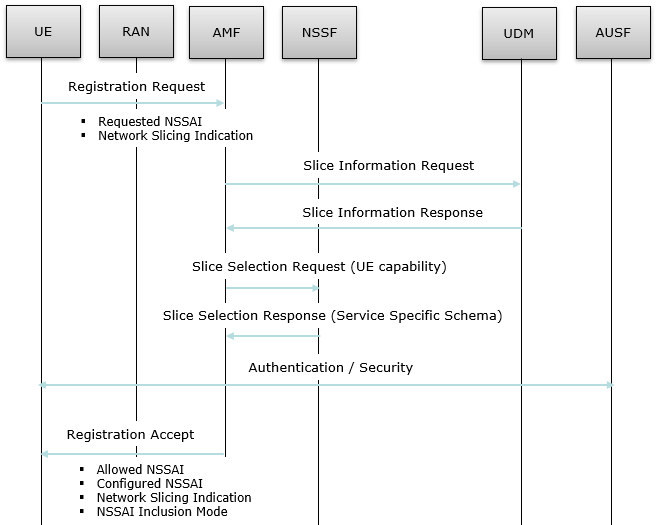
Source : Recreated from MAS5G: Move Around Smartly in 5G (IEEE)
Figure 3. Two NAS messages at the edges and four core network exchanges in between. The UE sees only the first and the last, which is why a UE side log cannot explain a slice that was refused.
- The UE contributes Requested NSSAI and Network Slicing Indication, and it contributes them once, in the Registration Request.
- The AMF asks the UDM first, with Slice Information Request and Response. That is the subscription check, and it decides what the UE is entitled to.
- The AMF then asks the NSSF, with Slice Selection Request carrying UE capability and Slice Selection Response carrying the service specific schema. That is the selection step, and it decides which slice instance actually serves the UE.
- Authentication and security run against the AUSF after the slice questions have been settled, not before.
- The Registration Accept carries four things back : Allowed NSSAI, Configured NSSAI, Network Slicing Indication and NSSAI Inclusion Mode.
Followings are the IE (Information Elements) involved in the signaling shown above.
- Registration Request.Network Slicing Indication
- Registration Accept.Allowed NSSAI
- Registration Accept.Network Slicing Indication
- Registration Accept.NSSI inclusion mode
The procedure explained above is just about the request and accept process for a specific slice. It does not really create any data pipe (slice). Setting up the real data pipe and associating the pipe with a slice happens at later step using the following procedure.
|
Step |
Direction |
Message |
Type of NSSAI |
|
1 |
UE -> NW |
||
|
2 |
UE <- NW |
||
|
3 |
UE -> NW |
||
|
4 |
UE <- NW |
||
|
5 |
UE <- NW |
Manage UE Policy Command |
Refer to this note |
|
6 |
UE -> NW |
Manage UE Policy Complete |
|
Who decides which slide to use ?
Of course, the final decision is done by network since network functions as a master in almost every communication, but the network slice selection can be triggered by either UE or Network or Both. It depends on a variety of factors such as the type of service or application, the location and capabilities of the mobile phone, and the network conditions.
The mobile phone will typically have a UICC that stores the credentials of the slice it is authorized to use. When the phone connects to the network, it will use the credentials to authenticate with the network and request access to a specific slice.
The network can also decide which slice to assign to the mobile phone based on the type of service or application the phone is trying to access. For example, if the phone is trying to access a high-bandwidth video streaming service, the network may assign it to a slice that has a higher capacity for handling video traffic.
Additionally, Network can also use the mobile phone's location, device capabilities, and other information to decide which slice to assign to it. For example, if the mobile phone is located in an area with a high density of users, the network may assign it to a slice with a lower capacity to ensure fair usage of resources.
This signaling procedure can be illustrated in other way as well illustrated by Rahim Navael as shown below. Rahim kindly approved me to share the illustration in my note.
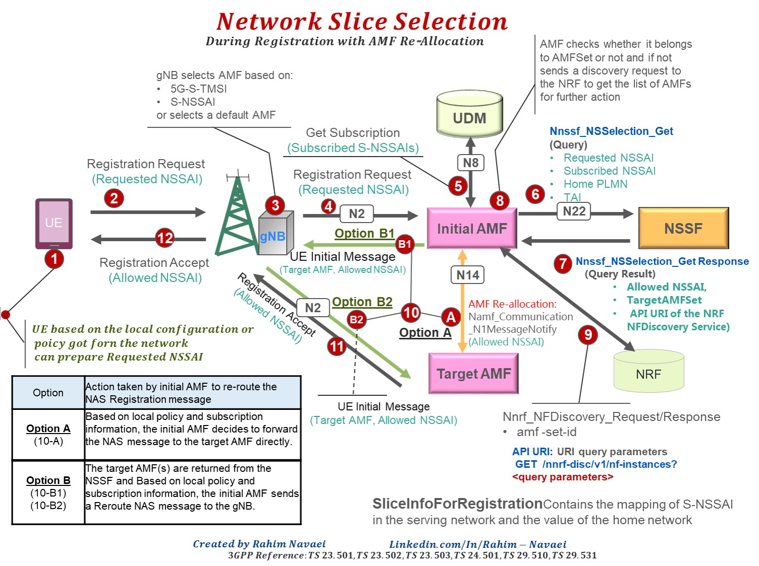
Image Source : Rahim Navaei's linked in post
Figure 4. The same registration as Figure 3, with the AMF re-allocation case drawn in. The numbered steps run 1 to 12, and the branch at step 10 is where the two options separate.
- The gNB picks the initial AMF from the 5G-S-TMSI and the S-NSSAI, or falls to a default AMF when neither helps. Slice information is therefore used before the core is even reached.
- The initial AMF queries the UDM over N8 for the Subscribed S-NSSAIs, then the NSSF over N22 with Nnssf_NSSelection_Get, carrying Requested NSSAI, Subscribed NSSAI, Home PLMN and TAI.
- The NSSF answers with Allowed NSSAI, Target AMF Set and the API URI of the NRF discovery service. The initial AMF then asks the NRF for the AMF instances in that set.
- Option A at step 10-A forwards the NAS message to the target AMF directly over N14, using Namf_Communication_N1MessageNotify.
- Option B at steps 10-B1 and 10-B2 sends a Reroute NAS message back to the gNB, and the gNB then delivers the UE Initial Message to the target AMF.
- Either way the UE sees one Registration Accept with the Allowed NSSAI at step 12, and nothing about the re-allocation reaches it.
High level description of the Network Slice selection process can be described as follows. The details are specified in 3GPP 23.501-5.15.5.2.1
- The UE initiates registration with the 5G network by sending a Registration Request message to the 5G Core Network (5GC).
- The Registration Request message includes a list of requested NSSAIs that the UE wants to use for the current registration.
- The 5GC receives the Registration Request message and checks the requested NSSAIs against the allowed NSSAIs configured for the 5G network slice.
- If the requested NSSAIs are allowed by the network, the 5GC selects a network slice based on the configured NSSAIs and sends a Registration Accept message to the UE.
- The Registration Accept message includes the allowed NSSAI and other information necessary for the UE to access the network slice.
- The UE receives the Registration Accept message.
- The 5GC keeps track of the configured NSSAI for each network slice in its database. When a UE initiates a registration, the 5GC uses this information to select the appropriate network slice based on the requested NSSAI.
- When UE want to establish a data session, it specifies a selected NSSAI in UL NAS Transport during PDU session establishement procedure. --> You may not specifies the selected NSSAI at this step, network would assign a default NSSAI as the selected NSSAI.
- If Network can use the selected NSSAI from UE, it would send PDU session establishment accept message with S-NSSAI which indicates the Selected NSSAI.
As illustrated above, most of the important configuration of Network Slice is done in core network side, meaning you need to get the detailed understanding on Signaling for the related corenetwork interface. You may refer to followings notes for corenetwork details.
Identification of Network Slice
The identification of a Network Slice is indicated by a NAS Information Element called S-NSSAI(Single Network Slice Selection Assistance Information) as structured as below. S-NSSAI is made up of two field SST (Slice/Service Type) and SD (Service Differentiator). SD is an optional field. SST has 8 bit field length implying that it can indicates a total of 255 different slice types.
The SST field may have standardized and non-standardized values. Values 0 to 127 belong to the standardized SST
range. Values 128 to 255 belong to the Operator-specific range.
< 23.003 - Figure 28.4.2-1: Structure of S-NSSAI >
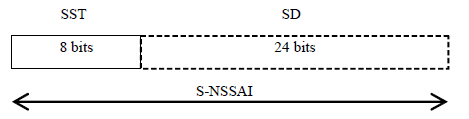
- SST indicates Slice Service Type which is a mandatory item.
- SD indicates a kind of slice ID within the SST which is an option item. This is used to indicates a specific slices in case where there are one or more slices are supported in the same SST.
- The solid box and the dashed box are the drawing saying which field is mandatory. SST is solid, SD is dashed, and the dashes mean optional rather than a different encoding.
- The widths give the size. An S-NSSAI is 8 bits when it is SST alone, and 32 bits when the SD is carried with it.
The SST standardized in 3GPP as of now are as shown. Only 5 (as of 23.501 version 17.5.0) out of 127 possible types that can be configured by SST field.
< 23.501 v17.5 - Table 5.15.2.2-1 - Standardised SST values >
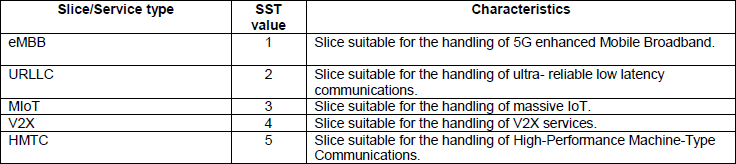
That table is quoted at version 17.5.0, and the list has grown since. 23.501 v20.2.0 standardises seven values rather than five, and the two highlighted rows below are the ones the image predates.
Slice/Service type |
SST value |
Characteristics |
eMBB |
1 |
Slice suitable for the handling of 5G enhanced Mobile Broadband. |
URLLC |
2 |
Slice suitable for the handling of ultra-reliable low latency communications. |
MIoT |
3 |
Slice suitable for the handling of massive IoT. |
V2X |
4 |
Slice suitable for the handling of V2X services. |
HMTC |
5 |
Slice suitable for the handling of High-Performance Machine-Type Communications. |
Two notes travel with that table in the specification, and both matter more than they look. The first is that a PLMN does not have to support every standardised value, and that a service listed against one SST can also be carried by another. The second is that GSMA NG.116 defines a mapping from its own Network Slice Types to these SST values. That is the document to consult when a requirement arrives in GSMA terms.
The SD field changes the character of the identifier rather than just adding detail to it. 23.501 calls an S-NSSAI a standard value only when it is a standardised SST on its own with no SD. Add an SD, or use an SST outside the standardised range, and the S-NSSAI becomes a non-standard value.
That distinction has a roaming consequence. A non-standard S-NSSAI identifies one network slice inside the PLMN it belongs to, and the UE must not use it in access stratum procedures in any other PLMN. So an operator that differentiates its slices with SD gains local control and loses the ability to have that identifier understood anywhere else.
Seven SST values are standardised, not five : HDLLC at 6 and GBRSS at 7 were added after the table above was captured.Standardised does not mean supported : a PLMN may implement any subset, and may serve the same service through a different SST.An SD makes the identifier non-standard : a standard value is a standardised SST with no SD, and anything else is local to one PLMN.Non-standard S-NSSAIs do not travel : the UE may not use them in access stratum procedures in any PLMN other than the one they belong to.The SD is 24 bits and optional : hexadecimal FFFFFF is reserved to mean that no SD value is associated with the SST.
So many different types of NSSAIs
When I am reading specification and other documents about network slicing, I was so confused by the variaties of NSSAIs mentioned in those document. I am trying to list those different types of NSSAIs here to clean my understanding and hopely to help other readers.
Before the logs, it helps to have the whole family in one place. Nine names appear in the specifications, and the differences between them are who sets them, which message carries them, and how many S-NSSAIs each may hold. The counts in the last column are the part most often missed, and they are all from 23.501 v20.2.0.
NSSAI |
Who provides it |
Where it appears |
How many S-NSSAIs |
Subscribed S-NSSAIs |
UDM, from the subscription |
Sent to the AMF. The UE never sees it |
At most 16 |
Configured NSSAI |
The serving PLMN |
Registration Accept, or UE Configuration Update Command |
Up to 16 |
Default Configured NSSAI |
Pre-configured in the UE |
Not signalled. Used when no Configured and no Allowed NSSAI apply to the PLMN |
- |
Requested NSSAI |
UE |
Registration Request, and AS signalling for AMF selection |
At most 8 |
Allowed NSSAI |
AMF, once the NSSF has selected |
Registration Accept, or UE Configuration Update Command |
At most 8 |
Partially Allowed NSSAI |
AMF |
The same messages as the Allowed NSSAI. Each S-NSSAI carries the TAs it is valid in |
At most 7, and at most 8 together with the Allowed NSSAI |
Rejected S-NSSAIs |
AMF |
Registration Accept, each with a cause |
At most 7 for those rejected partially in the registration area |
Pending NSSAI |
Serving PLMN |
Registration procedure, for slices awaiting authentication and authorization |
- |
Selected NSSAI |
UE, then confirmed by the network |
UL NAS Transport at PDU session establishment, and PDU Session Establishment Accept |
One per PDU session |
Four of those have no block of their own further down this section, and they are worth a sentence each. Subscribed S-NSSAIs live in the subscription and travel from the UDM to the AMF, so they never appear in a UE log at all. Partially Allowed NSSAI is a later addition that lets an S-NSSAI be valid in only some tracking areas of the registration area, with the list of TAs carried alongside it.
Rejected S-NSSAIs are returned with a cause, and the cause is what tells the UE whether to try again. Pending NSSAI covers the slices for which network slice-specific authentication and authorization has not finished, so the answer is neither yes nor no yet.
Figure 5 puts the same information in the order the UE meets it. The left column is what the UE already holds, the middle is what it asks for, and the right is everything the network can answer with.
Figure 5. The Requested NSSAI is the only one of these the UE composes itself, and it is built from what the left column holds. Everything on the right is the network answering, and one answer can contain all four kinds at once.
Eight is the signalling limit, sixteen is the storage limit : Requested and Allowed NSSAI carry at most eight S-NSSAIs, while the Configured NSSAI holds up to sixteen.One Registration Accept can carry four answers : Allowed, Partially Allowed, Rejected and Pending are not alternatives, and a single response may contain all of them.Subscribed S-NSSAIs never reach the UE : they travel from the UDM to the AMF, so a UE side log can show a slice being refused without showing why.Pending is not a rejection : it marks the slices whose authentication and authorization has not finished, and the answer arrives later.The Default Configured NSSAI is a fallback, not a default choice : it is used only when neither a Configured nor an Allowed NSSAI applies to the PLMN.
Protocol discriminator = 0x7e (5GS Mobility Management)
Security header = 0x1 (Integrity protected)
Auth code = 0xc2653407
Sequence number = 0x09
Protocol discriminator = 0x7e (5GS Mobility Management)
Security header = 0x0 (Plain 5GS NAS message, not security protected)
Message type = 0x41 (
5GS registration type:
Follow-on request bit = 1
Value = 1 (initial registration)
ngKSI:
TSC = 0
NAS key set identifier = 2
5GS mobile identity:
5G-GUTI
MCC = 001
MNC = 01
AMF Region ID = 128
AMF Set ID = 4
AMF Pointer = 1
5G-TMSI = 0x2fedc8c7
UE security capability:
0xf0 (5G-EA0=1, 128-5G-EA1=1, 128-5G-EA2=1, 128-5G-EA3=1, 5G-EA4=0, 5G-EA5=0, 5G-EA6=0, 5G-EA7=0)
0x70 (5G-IA0=0, 128-5G-IA1=1, 128-5G-IA2=1, 128-5G-IA3=1, 5G-IA4=0, 5G-IA5=0, 5G-IA6=0, 5G-IA7=0)
0xf0 (EEA0=1, 128-EEA1=1, 128-EEA2=1, 128-EEA3=1, EEA4=0, EEA5=0, EEA6=0, EEA7=0)
0x70 (EIA0=0, 128-EIA1=1, 128-EIA2=1, 128-EIA3=1, EIA4=0, EIA5=0, EIA6=0, EIA7=0)
NAS message container:
Protocol discriminator = 0x7e (5GS Mobility Management)
Security header = 0x0 (Plain 5GS NAS message, not security protected)
Message type = 0x41 (Registration request)
5GS registration type:
Follow-on request bit = 1
Value = 1 (initial registration)
ngKSI:
TSC = 0
NAS key set identifier = 2
5GS mobile identity:
5G-GUTI
MCC = 001
MNC = 01
AMF Region ID = 128
AMF Set ID = 4
AMF Pointer = 1
5G-TMSI = 0x2fedc8c7
5GMM capability:
0x03 (SGC=0, 5G-IPHC-CP CIoT=0, N3 data=0, 5G-CP CIoT=0, RestrictEC=0, LPP=0, HO attach=1, S1 mode=1)
UE security capability:
0xf0 (5G-EA0=1, 128-5G-EA1=1, 128-5G-EA2=1, 128-5G-EA3=1, 5G-EA4=0, 5G-EA5=0, 5G-EA6=0, 5G-EA7=0)
0x70 (5G-IA0=0, 128-5G-IA1=1, 128-5G-IA2=1, 128-5G-IA3=1, 5G-IA4=0, 5G-IA5=0, 5G-IA6=0, 5G-IA7=0)
0xf0 (EEA0=1, 128-EEA1=1, 128-EEA2=1, 128-EEA3=1, EEA4=0, EEA5=0, EEA6=0, EEA7=0)
0x70 (EIA0=0, 128-EIA1=1, 128-EIA2=1, 128-EIA3=1, EIA4=0, EIA5=0, EIA6=0, EIA7=0)
Last visited registered TAI:
MCC = 001
MNC = 01
TAC = 0x000064
S1 UE network capability:
0xf0 (EEA0=1, 128-EEA1=1, 128-EEA2=1, 128-EEA3=1, EEA4=0, EEA5=0, EEA6=0, EEA7=0)
0x70 (EIA0=0, 128-EIA1=1, 128-EIA2=1, 128-EIA3=1, EIA4=0, EIA5=0, EIA6=0, EIA7=0)
0xc0 (UEA0=1, UEA1=1, UEA2=0, UEA3=0, UEA4=0, UEA5=0, UEA6=0, UEA7=0)
0x40 (UCS2=0, UIA1=1, UIA2=0, UIA3=0, UIA4=0, UIA5=0, UIA6=0, UIA7=0)
0x19 (ProSe-dd=0, ProSe=0, H.245-ASH=0, ACC-CSFB=1, LPP=1, LCS=0, 1xSRVCC=0, NF=1)
0x80 (ePCO=1, HC-CP CIoT=0, ERw/oPDN=0, S1-U data=0, UP CIoT=0, CP CIoT=0, ProSe-relay=0, ProSe-dc=0)
0xb0 (15 bearers=1, SGC=0, N1mode=1, DCNR=1, CP backoff=0, RestrictEC=0, V2X PC5=0, multipleDRB=0)
UE's usage setting = 0x01 (Data centric)
LADN indication:
Length = 0
Data =
Network slicing indication = 0x00 (DCNI=0, NSSCI=0)
5GS update type = 0x01 (EPS-PNB-CIoT=no additional information, 5GS-PNB-CIoT=no additional information, NG-RAN-RCU=0, SMS requested=1)
- When providing a Requested NSSAI to the network upon registration, the UE in a given PLMN only includes and uses S-NSSAIs applying to this PLMN.
- The mapping of S-NSSAIs of the Requested NSSAI to HPLMN S-NSSAIs may also be provided (see 23.501-5.15.4.1.2 for when this is needed).
- The S-NSSAIs in the Requested NSSAI are part of the Configured and/or Allowed NSSAIs applicable for this PLMN, when they are available
- If the UE has received NSSRG information together with the Configured NSSAI, it only includes in the Requested NSSAI S-NSSAIs that all share a common NSSRG.
- If no Configured NSSAI and Allowed NSSAI for the PLMN are available, the S-NSSAIs in the Requested NSSAI correspond to the Default Configured NSSAI, if configured in the UE.
- S-NSSAIs that the UE provides in the Requested NSSAI which are neither in the Allowed NSSAI nor provided as a rejected S-NSSAI, shall, by the UE, not be regarded as rejected, i.e. the UE may request to register these S-NSSAIs again next time the UE sends a Requested NSSAI.
UE sends Requested NSSAI in following case. so if the case is in none of these, UE would not include the requested NSSAI.
- the UE has a configured NSSAI for the current PLMN (configured NSSAI is sent by the network in registration accept)
- or the UE has an allowed NSSAI for the current PLMN (allowed NSSAI is sent by the network in registration accept)
- or the UE has neither allowed NSSAI for the current PLMN nor configured NSSAI for the current PLMN and has a
- default configured NSSAI. default configured NSSAI is defined in the configuration of the UE in "default_nssai".
Protocol discriminator = 0x7e (5GS Mobility Management)
Security header = 0x2 (Integrity protected and ciphered)
Auth code = 0x59b0464b
Sequence number = 0x02
Protocol discriminator = 0x7e (5GS Mobility Management)
Security header = 0x0 (Plain 5GS NAS message, not security protected)
Message type = 0x42 (
5GS registration result = 0x09 (Emergency registered=0, NSSAA to be performed=0, SMS allowed=1, 3GPP access)
5G-GUTI:
5G-GUTI
MCC = 001
MNC = 01
AMF Region ID = 128
AMF Set ID = 4
AMF Pointer = 1
5G-TMSI = 0x4b63aa9a
TAI list:
Length = 7
Data = 00 00 f1 10 00 00 64
5GS network feature support:
0x03 (MPSI=0, IWK N26=0, EMF=not supported, EMC=not supported, IMS-VoPS-N3GPP=1, IMS-VoPS-3GPP=1)
0x00 (5G-UP CIoT=0, 5G-IPHC-CP CIoT=0, N3 data=0, 5G-CP CIoT=0, RestrictEC=both CE mode A and CE mode B are not restricted, MCSI=0, EMCN3=0)
T3512 value:
Value = 30
Unit = 5 (1 minute)
Emergency number list:
Length = 8
Data = 03 1f 19 f1 03 1f 11 f2
- The Allowed NSSAI received in a Registration Accept message or a UE Configuration Update Command applies to a PLMN when at least a TAI of this PLMN is included in the RA/TAI list included in this Registration Accept message or UE Configuration Update Command
- If the UE Configuration Update Command contains an Allowed NSSAI but not a TAI List, then the last received RA/TAI list applies for the decision on which PLMN(s) the Allowed NSSAI is applicable.
- If received, the Allowed NSSAI for a PLMN and Access Type and any associated mapping of this Allowed NSSAI to HPLMN S-NSSAIs shall be stored in the UE. The UE should store this Allowed NSSAI and any associated mapping of this Allowed NSSAI to HPLMN S-NSSAIs also when the UE is turned off, or until the network slicing subscription changes
- The subscription information shall include at least one default S-NSSAI
- The UDM sends at the most 16 Subscribed S-NSSAIs to AMF,i.e. the number that can fit in a Configured NSSAI. The subscription information the UDM sends to the AMF shall include at least one default S-NSSAI.
- The Subscription Information for each S-NSSAI may contain:
- a Subscribed DNN list and one default DNN; and
- the indication whether the S-NSSAI is marked as default Subscribed S-NSSAI; and
- the indication whether the S-NSSAI is subject to Network Slice-Specific Authentication and Authorization; and
- Network Slice Simultaneous Usage Group (NSSRG) information
Protocol discriminator = 0x7e (5GS Mobility Management)
Security header = 0x2 (Integrity protected and ciphered)
Auth code = 0x37ed3aa2
Sequence number = 0x03
Protocol discriminator = 0x7e (5GS Mobility Management)
Security header = 0x0 (Plain 5GS NAS message, not security protected)
Message type = 0x67 (UL NAS transport)
Payload container type = 1 (N1 SM information)
Payload container:
Protocol discriminator = 0x2e (5GS Session Management)
PDU session identity = 2
Procedure transaction identity = 2
Message type = 0xc1 (
Integrity protection maximum data rate:
Maximum data rate per UE for user-plane integrity protection for uplink = 0xff (Full data rate)
Maximum data rate per UE for user-plane integrity protection for downlink = 0xff (Full data rate)
PDU session type = 0x3 (IPv4v6)
Always-on PDU session requested = 1
Extended protocol configuration options:
Ext = 1
Configuration protocol = 0
Protocol ID = 0x8021 (IPCP)
Data = 01 00 00 10 81 06 00 00 00 00 83 06 00 00 00 00
Protocol ID = 0x0001 (P-CSCF IPv6 Address Request)
Data =
Protocol ID = 0x0003 (DNS Server IPv6 Address Request)
Data =
Protocol ID = 0x000a (IP address allocation via NAS signalling)
Data =
Protocol ID = 0x000c (P-CSCF IPv4 Address Request)
Data =
Protocol ID = 0x000d (DNS Server IPv4 Address Request)
Data =
Protocol ID = 0x000e (MSISDN Request)
Data =
Protocol ID = 0x0011 (MS support of Local address in TFT indicator)
Data =
PDU session ID = 2
Request type = 0x1 (initial request)
DNN = "internet"
Protocol discriminator = 0x2e (5GS Session Management)
PDU session identity = 1
Procedure transaction identity = 5
Message type = 0xc2 (
Selected PDU session type = 0x1 (IPv4)
Selected SSC mode = 0x1 (1)
Authorized QoS rules:
QoS rule 1:
QoS rule identifier = 1
Rule operation code = 1 (create new QoS rule)
DQR = 1 (the QoS rule is the default QoS rule)
Number of packet filters = 1
Packet filter identifier = 15
Packet filter direction = 3 (bidirectional)
Match-all
QoS rule precedence = 255
QFI = 1
Session AMBR:
Session-AMBR for downlink = 5000 Mbps
Session-AMBR for uplink = 2000000 kbps
5GSM cause = 0x32 (PDU session type IPv4 only allowed)
PDU address:
SI6LLA = 0
PDU session type = 1 (IPv4)
IPv4 = 192.168.3.2
Mapped EPS bearer contexts:
Mapped EPS bearer context 1:
EPS bearer identity = 5
Operation code = 1 (create new EPS bearer)
E = 1 (parameters list is included)
Number of EPS parameters = 2
Mapped EPS QoS parameters:
QCI = 9
APN-AMBR:
APN-AMBR for downlink = 4864000000 bits
APN-AMBR for uplink = 1792000000 bits
Authorized QoS flow descriptions:
QoS flow description 1:
QFI = 1
Operation code = 1 (create new QoS flow description)
E = 1 (parameters list is included)
Number of parameters = 2
5QI = 9
EPS bearer identity = 5
Extended protocol configuration options:
Ext = 1
Configuration protocol = 0
Protocol ID = 0x8021 (IPCP)
Data = 03 00 00 0a 81 06 08 08 08 08
Protocol ID = 0x000d (DNS Server IPv4 Address)
Data = 8.8.8.8
DNN = "internet.mnc001.mcc001.gprs"
- The Default Configured NSSAI, if it is configured in the UE, is used by the UE in a Serving PLMN only if the UE has no Configured NSSAI for the Serving PLMN.
- The UE may be pre-configured with the Default Configured NSSAI. The UE may be provisioned/updated with the Default Configured NSSAI, determined by the UDM in the HPLMN, using the UE Parameters Update via UDM Control Plane procedure
- Each S-NSSAI in the Default Configured NSSAI may have a corresponding S-NSSAI as part of the Subscribed S-NSSAI(s).
- If no Configured NSSAI and Allowed NSSAI for the PLMN are available, the S-NSSAIs in the Requested NSSAI correspond to the Default Configured NSSAI, if configured in the UE
YouTube :
- Demo: Network Slicing and end-to-end ICN Service Orchestration for Future Applications (Mar 2016)
- Network Slicing: Where is the money (Mar 2017)
- Network Slicing in Practice Cloudstreet Webinar (Oct 2017)
- Network Slicing and Private LTE in M-CORD (Dec 2017)
- Nokia tests 5G network slicing at Port of Hamburg (Nov 2018)
- 5G network slicing: automation, assurance and optimization of 5G transport slices (extended version) (Aug 2019)
- Ericsson showed live end to end 5G network slicing at Mobile World Congress LA (Nov 2019)
- ZTE 5G End to End Network Slicing Demo (Nov 2019)
- What is network slicing? (Apr 2020)
- Demo: Network Slicing with Blue Planet 5G Automation (May 2020)
- Network Slicing | Webinar (Aug 2020)
- Webinar - 5G Network Slicing Explained (Mar 2021)
- Webinar - Part06 5G Slicing High Level Call Flow (Mar 2021)
- LFN Webinar: 5G Dynamic Network Slicing via Open Source Projects (Mar 2021)
- 5G RAN and 5GC Network Slice Signaling - 5G NR Call Flows (Oct 2021)
- 5G Network Function - NSSF, AF, NEF & NRF (Oct 2021)
- 5G Network Function - PCF (Oct 2021)
- Network Function Virtualisation (NFV) and 5G Network Slicing (Oct 2021)
- 5G Network Slicing - Deep Dive (Feb 2023)
- Cisco Crosswork Network Controller Transport Slicing Deep Dive (Jun 2023)
- 5G SBP: Simplified E2E Network Slicing (Jun 2023)
Reference :
- 3GPP TS 28.530 - 5G; Management and orchestration; Concepts, use cases and requirements
- 3GPP TS 23.501 - 5G;System architecture for the 5G System (5GS)
- 3GPP TS 23.502 - 5G;Procedures for the 5G System (5GS)
- 3GPP TS 23.003 - (GSM);(UMTS);LTE;5G;Numbering, addressing and identification
- 3GPP TS 24.501 - D.2.1.2 Network-requested UE policy management procedure initiation (NAS Signaling)
- 3GPP TS 24.526 - 5.2 Encoding of UE policy part type URSP (NAS IE Structure)
- End to End Network Slicing in 5G System (Nokia, 2016)
- What is the difference between network slicing and Quality of Service? (Oct 2017)
- Network Slicing - Use Case Requirements (GSMA, Apr 2018)
- How Does Network Slicing Differ from QoS? (Apr 2020)
- Network Slicing (SamSung, Apr 2020)
- Network Slicing - Demystified (Jun 2020)
- What is the difference between network slicing and QoS in 5G? (Jun 2020)
- What is difference of the network slice selection in 4G and 5G networks? (Sep 2020)
- 4G QOS Vs 5G network Slicing (Oct 2020)
- UE policy information