Since many physical layer things (e.g, sub carrier spacing, OFDM symbol length) varies in 5G/NR, you would see many physical layer parameters are specified by equations and variables instead of specific constants values. It would be good to have a few fundamental timing units that are frequently used in various part of physical layer specification. In this note, I am trying to collect a list of basic timing units being used in NR specification.
- Basic Time Units
- Why is Tc defined this way ?
- Frame and Subframe Duration
- Which Unit is used for What ?
- Reference
Basic Time Units
Two sampling times appear throughout the physical layer specification. Most durations in NR are written as a multiple of one of them. The first is tied to the widest subcarrier spacing the definition allows. The second is tied to 15 kHz, and the ratio between the two is a constant with a symbol of its own.
38.211 - 4.1 General defines following Time Units.
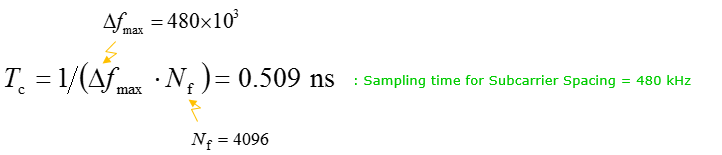
This (Tc) is basic timing unit in NR. The NR basic timing unit is defined to be the shortest/smallest sampling time possible which is the case of widest subcarrier spacing in NR as of release 15 specification (
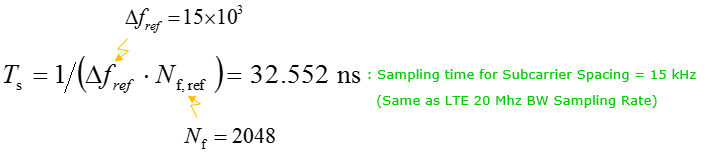
This (Ts) is another type of timing unit specifically for the case where the subcarrier spacing is 15Khz. This corresponds to the sampling rate for LTE 20Mhz BW
This (κ, Kappa) is the ratio between Ts and Tc. This is mostly used in the specification of NR PRACH format as shown here.

Tc is the reference for everything else : 1 divided by the product of 480 kHz and 4096, which gives 0.509 ns.Ts is the 15 kHz sampling time : 1 divided by the product of 15 kHz and 2048, which gives 32.552 ns.The two differ by exactly 64 : that ratio is κ, and PRACH formats are written in terms of it rather than in seconds.Ts is the LTE 20 MHz sampling rate : durations carried over from LTE therefore keep the values they had there.
Why is Tc defined this way ?
The definition gives three numbers and no reason for any of them. Why 480 kHz, why 4096, and why the reciprocal of their product ? None of the three is arbitrary. Each one answers a different constraint, and the constraints are worth separating.
Start with the shape of the equation, because it is ordinary OFDM. The useful symbol time is 1 divided by the subcarrier spacing. An FFT then cuts that symbol into Nf samples. So one sample lasts 1 divided by the product of the two, which is exactly what the equation says. The annotation on the Tc equation says the same thing in words: sampling time for subcarrier spacing = 480 kHz. Multiply the two constants and you get 1,966,080,000, so Tc is the sample period of a system running at about 1.96608 Gsample/s.
The next question is why the shortest sample period, rather than a convenient round one. NR subcarrier spacings run as 15 times 2 raised to the numerology, so they differ by powers of two. Every numerology therefore has its own sample period, and those differ by powers of two as well. Choose a coarse unit and the finer numerologies stop being whole numbers of it. Choose the finest and every coarser one is an exact multiple. That is what lets the specification write cyclic prefixes, guard periods and timing advance steps as integers rather than rounding them.
Now the part that I think actually fixed the two constants. 480 divided by 15 is 32, and 4096 divided by 2048 is 2. Multiply those and you get 64, which is κ. Put another way, 1.96608 GHz is exactly 64 times 30.72 MHz, and 30.72 MHz is the rate LTE used for a 20 MHz carrier. So the NR unit sits at a power of two multiple of the LTE one.
Figure 1. Tc and Ts are built by the same construction, and the two constants were chosen so that the rates differ by exactly 64. That power of two is what keeps every LTE duration an exact whole number of Tc.
That relationship is what makes the coexistence arithmetic exact. Every duration LTE already defined is a whole number of Tc, with no conversion error anywhere. The frame and the subframe keep 10 ms and 1 ms for the same reason. I read that as structural rather than incidental, because 3GPP gave the ratio its own symbol. A specification does not name a constant unless it uses one. And κ is used: the PRACH preamble format tables are written in κ rather than in seconds.
The 4096 is not incidental either. Keeping LTE's 2048 would still give a power of two, at 32 rather than 64. But Tc would then be twice as coarse. Doubling the FFT size gives finer resolution and keeps the clean relationship at the same time.
One more thing follows from all of this. Rel-15 never used 480 kHz, because its numerologies stopped at 240 kHz and its data numerologies at 120 kHz. The definition was written with headroom already in it. Rel-17 then added 960 kHz and left Tc alone, which the note in Basic Time Units already records. Leaving it alone was the right call. Tc is the denominator of every duration in every NR specification, so redefining it would change the numeric value of every timing field ever written.
One caution at the end, because a number like 1.96608 GHz invites it. Tc is not a clock rate that anyone has to build. No UE samples that fast merely because the specification counts in Tc. It is a common denominator for writing durations. A UE on 30 kHz subcarrier spacing runs a far slower converter and simply counts more Tc per sample.
The form is an OFDM sample period : 1 divided by subcarrier spacing times FFT size is the sample time of any OFDM system, and Ts is the same construction.Only the shortest sample period works : any coarser choice would leave the finer numerologies as fractions rather than integers.The 64 to LTE is the binding constraint : 32 comes from the subcarrier spacing and 2 from the FFT size, which is why κ has a symbol of its own.Δfmax is now a historical name : Rel-17 added 960 kHz and left Tc unchanged, because it is the denominator of every duration already written.It is not a required clock : Tc is how the specification writes a duration, not how a receiver has to sample.
Frame and Subframe Duration
The frame and the subframe are the two durations NR did not change. Both are defined in the same style as the sampling times, as a whole number of Tc rather than directly in seconds. Both also match the value LTE already used.
38.211 - 4.3.1 Frames and subframes defines following Time Units.
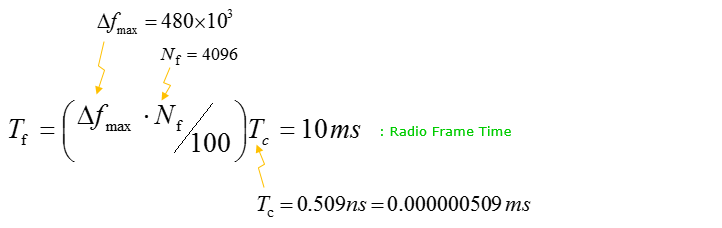
Tf stands for frame duration (the length of one radio frame) which is defined as follows. You would notice this is same as the radio frame duration of LTE.
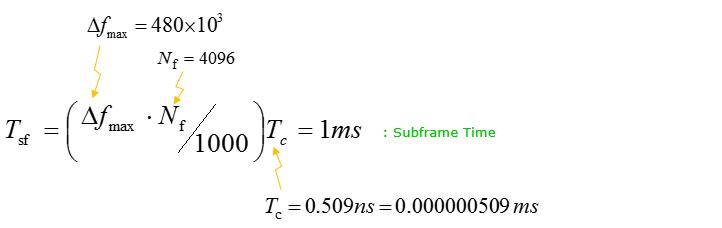
Tsf stands for subframe duration (the length of one subframe) which is defined as follows. You would notice this is same as the subframe duration of LTE.
Both equations hide a cancellation that is worth seeing. Tc is 1 divided by the product of Δfmax and Nf. The frame equation multiplies that same product by Tc, after dividing the product by 100. So the product and its reciprocal cancel. What survives is 1 over 100 of a second, and that is the 10 ms.
The subframe equation works the same way, with 1000 in place of 100. So neither result really depends on 480 kHz or on 4096. Both are a plain fraction of a second. Writing them in Tc is what keeps every duration in the specification in one unit.
Counting in Tc makes the scale concrete. One frame is 480000 times 4096 divided by 100 basic time units, or 19,660,800 of them. One subframe is a tenth of that, at 1,966,080. Those integers are what the specification means when it gives a duration as a number of Tc. They are large because Tc is small.
Both durations are multiples of Tc : neither the frame nor the subframe is defined directly in seconds.The constants cancel : 480 kHz and 4096 appear inside Tc and again in the equation, so each duration reduces to a plain fraction of a second.The divisor is the only difference : 100 gives the frame and 1000 gives the subframe, a factor of ten apart.The values are the LTE ones : 10 ms for a frame and 1 ms for a subframe are unchanged.The variation is in the slot count : the frame and the subframe stay fixed, and the number of slots per subframe is what the numerology changes.
Which Unit is used for What ?
Reading a time domain field in the specification means meeting a bare integer. Nothing next to it says which unit it counts. Pick the wrong one and you are wrong by a factor of 64, or by the numerology on top of that. So it is worth knowing which of these three quantities each part of the specification actually uses.
The default is Tc, and 38.211 states it directly. Clause 4.1 says the size of various fields in the time domain is expressed in time units of Tc, unless otherwise noted. So Tc is what an unlabelled duration counts in an NR physical layer specification. Everything earlier on this page follows that rule, the frame and the subframe included.
Ts is there for a different reason, and the symbol list in 38.211 says so plainly. It names Tc the basic time unit for NR and Ts the basic time unit for LTE. So Ts is not a second NR unit. It is LTE's unit, kept in the NR specification because the durations NR inherited were already written in it.
κ is neither of those. It is the conversion between them, and it has its own symbol because one family of tables needs it. PRACH preamble formats give their cyclic prefix and guard period as multiples of κ rather than in seconds, in 38.211 Tables 6.3.3.1-1 and 6.3.3.1-2. Format B1 uses a guard period of 72κ, B2 uses 216κ and B3 uses 360κ. The preamble format tables carry the rest.
Tc is used well beyond this page, and Timing Advance is the clearest case. NTA and NTA_offset are both counted in Tc. The 38.133 table of offset values gives 25600, 39936 and 13792 as plain Tc counts. One timing advance step is 16 times 64 times Tc, divided by 2 raised to the numerology.
One table covers the whole answer, for when you meet a number and need to know what to multiply it by.
|
Unit |
Value |
Where you meet it |
|---|---|---|
|
|
0.509 ns |
The default for any time domain field in 38.211. Frame and subframe durations, and the timing advance quantities. |
|
|
32.552 ns |
Durations inherited from LTE. 38.211 names it the basic time unit for LTE, not for NR. |
|
|
64 |
PRACH preamble format tables, where the cyclic prefix and the guard period are given as κ multiples. |
Tc is the default : 38.211 clause 4.1 puts every time domain field in Tc unless it says otherwise.Ts is LTE's unit, not a second NR one : the symbol list in 38.211 labels it the basic time unit for LTE.κ converts between the two : it is the only one of the three that is a pure number, and PRACH is where the tables use it.Guessing costs a factor of 64 : reading a κ count as a Tc count, or the reverse, is the mistake this section exists to prevent.
Reference
[1] 38.211 v19.4.0 : NR - Physical channels and modulation. Clause 4.1 defines the basic time unit for NR, and clause 4.3.1 defines frames and subframes.