As in WCDMA, in TDSCDMA SIB5 mostly configures physical layer configuration for common channels as PRACH, SCCPCH etc. For a TD-SCDMA cell, these are the channels a UE needs before it has a dedicated connection. The PRACH and the FPACH serve random access, and the S-CCPCH and the PICH serve paging and the FACH.
Since these are mostly about PHY configuration, you need to have detailed knowledge on physical layer as described in Frame Structure, RMC, RAB overview. Try to create a frame structure table as shown in RMC and fill out the table based on the information contained in SIB5.
SIB5 of a TD-SCDMA cell has an unusual shape. Its Release 99 part was written for 3.84 Mcps TDD, so most 1.28 Mcps TDD values travel in the v4b0 non-critical extension. You need to read both parts, and you need to know which Release 99 fields the UE ignores. Let's first place the channels in the frame, and then read the two captures that define them.
Physical Layer Information
Before reading the IEs, it helps to see where the common channels end up. The table below is the kind of frame structure table that the introduction asks you to build, filled from the SIB5 of this cell.
The table shows two 5 ms subframes side by side, which together make one 10 ms radio frame. Each column is a time slot, and the grey columns are DwPTS, GP and UpPTS between Slot 0 and Slot 1. Each row is one of the 16 channelisation codes of SF 16. The orange cells mark the common channels that SIB5 configures.
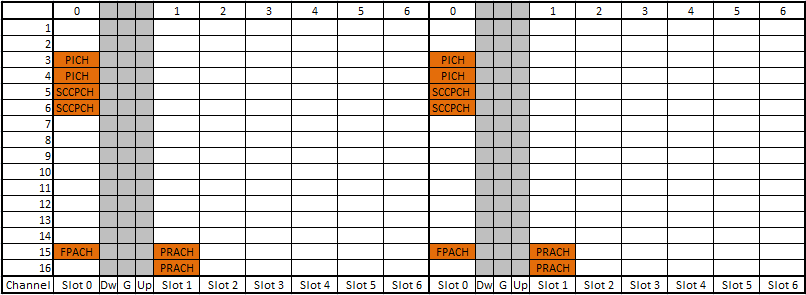
All downlink common channels share Slot 0, and the PRACH sits alone in Slot 1. The same allocation repeats in both subframes.
- PICH on codes 3 and 4 of Slot 0, from cc16-3 and cc16-4 in pich-Info
- SCCPCH on codes 5 and 6 of Slot 0, from cc16-5 and cc16-6 in secondaryCCPCH-Info
- FPACH on code 15 of Slot 0, from cc16-15 in fpach-Info
- PRACH on codes 15 and 16 of Slot 1. The PRACH uses the SF 8 code cc8-8, and one SF 8 code covers the positions of two SF 16 codes.
Codes 1 and 2 of Slot 0 are empty in the table, but they are not free. 25.221 subclause 5A.3.1 maps the P-CCPCH, which carries the BCH, onto the first two code channels of time slot 0 with SF 16. The table leaves them blank because SIB5 does not configure them.
The frame structure explains the choice of Slot 0 and Slot 1. 25.221 subclause 5A.1 splits the 10 ms frame into two 5 ms subframes. Each subframe has 7 traffic time slots of 864 chips, plus DwPTS of 96 chips, GP of 96 chips and UpPTS of 160 chips. Time slot 0 is always downlink and time slot 1 is always uplink. So these two slots exist in every UL/DL configuration, which makes them a safe place for common channels, and this cell uses them that way.
The grey columns matter for the next section. 25.221 subclause 5A.3.5 places the DwPCH in DwPTS and the UpPCH in UpPTS. The DwPCH carries the SYNC-DL code in every subframe, and the UE learns from it the set of 8 SYNC-UL codes that the cell uses for random access. The UpPCH carries the SYNC-UL code that starts random access.
So random access in this cell uses three places in each subframe. The first is UpPTS for the SYNC-UL code. The second is code 15 of Slot 0 for the FPACH answer. The third is codes 15 and 16 of Slot 1 for the RACH message. The next section reads the IEs that define each of them.
The table also shows how much of Slot 0 is left. The common channels use 7 of its 16 codes: 2 for the P-CCPCH, 2 for the PICH, 2 for the S-CCPCH and 1 for the FPACH. Codes 7 to 14 and code 16 remain for other downlink channels in Slot 0.
Slot 0 carries the downlink common channels : in this cell, the P-CCPCH, PICH, S-CCPCH and FPACH share its 16 codes.Slot 1 carries the PRACH : it is the one uplink slot that every configuration has.Code positions follow the OVSF tree : an SF 8 code such as cc8-8 occupies two SF 16 rows of the table.
PRACH - FPACH
In TD-SCDMA the UE does not send a RACH message straight away. It first sends a SYNC-UL code on the UpPCH and waits for an answer on the FPACH. So SIB5 has to describe three things and the links between them.
The capture below shows the random access part of SIB5. The upper block is the Release 99 prach-SystemInformationList, and the lower block is prach-SystemInformationList-LCR-r4 inside sysInfoType5-v4b0ext. The lines in red are the values used in the frame table above.
Decoded SIB5 PRACH and FPACH configuration from a tester log,
  +-prach-SystemInformationList ::= SEQUENCE OF SIZE(1..maxPRACH[16]) [1]
  | +-PRACH-SystemInformation ::= SEQUENCE [01011]
  |   +-prach-RACH-Info ::= SEQUENCE
  |   | +-modeSpecificInfo ::= CHOICE [tdd]
  |   |   +-tdd ::= SEQUENCE
  |   |     +-timeslot ::= INTEGER (0..14) [1]
  |   |     +-channelisationCodeList ::= CHOICE [sf8]
  |   |     | +-sf8 ::= SEQUENCE OF SIZE(1..8) [1]
  |   |     |   +-TDD-PRACH-CCode8 ::= ENUMERATED [cc8-8]
  |   |     +-prach-Midamble ::= ENUMERATED [direct]

  +-v4b0NonCriticalExtensions ::= SEQUENCE [10] OPTIONAL:Exist
    +-sysInfoType5-v4b0ext ::= SEQUENCE [00110] OPTIONAL:Exist
    | +-prach-SystemInformationList-LCR-r4 ::= SEQUENCE OF SIZE(1..maxPRACH[16]) [1] OPTIONAL:Exist
    | | +-PRACH-SystemInformation-LCR-r4 ::= SEQUENCE [11]
    | |   +-prach-RACH-Info-LCR ::= SEQUENCE
    | |   | +-sync-UL-Info ::= SEQUENCE
    | |   | | +-sync-UL-Codes-Bitmap ::= BIT STRING [11111111]
    | |   | | +-prxUpPCHdes ::= INTEGER (0..62) [62]
    | |   | | +-powerRampStep ::= INTEGER (0..3) [1]
    | |   | | +-max-SYNC-UL-Transmissions ::= ENUMERATED [tr8]
    | |   | | +-mmax ::= INTEGER (1..32) [2]
    | |   | +-prach-DefinitionList ::= SEQUENCE OF SIZE(1..maxPRACH-FPACH[8]) [1]
    | |   |   +-PRACH-Definition-LCR-r4 ::= SEQUENCE
    | |   |     +-timeslot ::= INTEGER (1..6) [1]
    | |   |     +-prach-ChanCodes-LCR ::= SEQUENCE OF SIZE(1..4) [1]
    | |   |     | +-TDD-PRACH-CCode-LCR-r4 ::= ENUMERATED [cc8-8]
    | |   |     +-midambleShiftAndBurstType ::= SEQUENCE
    | |   |     | +-midambleAllocationMode ::= CHOICE [defaultMidamble]
    | |   |     | | +-defaultMidamble ::= NULL
    | |   |     | +-midambleConfiguration ::= INTEGER (1..8) [8]
    | |   |     +-fpach-Info ::= SEQUENCE
    | |   |       +-timeslot ::= INTEGER (0..6) [0]
    | |   |       +-channelisationCode ::= ENUMERATED [cc16-15]
    | |   |       +-midambleShiftAndBurstType ::= SEQUENCE
    | |   |       | +-midambleAllocationMode ::= CHOICE [defaultMidamble]
    | |   |       | | +-defaultMidamble ::= NULL
    | |   |       | +-midambleConfiguration ::= INTEGER (1..8) [4]
    | |   |       +-wi ::= INTEGER (1..4) [4]
The upper block describes the PRACH in the 3.84 Mcps TDD form: timeslot 1, the SF 8 code cc8-8 and prach-Midamble direct. A 1.28 Mcps TDD UE does not use it. The ASN.1 of SysInfoType5-v4b0ext-IEs, in the listing further below, says that PRACH-RACH-Info in PRACH-SystemInformationList is ignored for a 1.28 Mcps TDD cell. The UE uses the LCR list instead. In this capture the values of the two blocks happen to match.
sync-UL-Info controls the SYNC-UL step. The bitmap 11111111 allows all 8 SYNC-UL codes of the cell. The value prxUpPCHdes 62 means -58 dBm, because the actual value is the IE value minus 120. 25.331 subclause 8.5.7 sets the power of the i-th SYNC-UL transmission as PUpPCH = LPCCPCH + PRXUpPCHdes + (i-1) x Pwrramp. With powerRampStep 1, each new attempt adds 1 dB. The value max-SYNC-UL-Transmissions tr8 allows up to 8 SYNC-UL transmissions in one power ramping sequence, and mmax 2 allows 2 synchronisation attempts.
Each entry of prach-DefinitionList pairs one PRACH with one FPACH, and this cell has one entry. The PRACH is in timeslot 1 on cc8-8, with the default midamble and midambleConfiguration 8. The actual midamble configuration is the IE value x 2, so it is 16. The FPACH is in timeslot 0 on cc16-15, with midambleConfiguration 4, which is 8. The value wi 4 is the WT of 25.224. It lets the UE wait up to 4 subframes after its SYNC-UL for the FPACH answer.
Let's put the values together in the order the UE uses them, as 25.224 subclause 5.6.3 describes.
- The UE selects one allowed SYNC-UL code and sends it on the UpPCH.
- It listens to the FPACH, in timeslot 0 on cc16-15, for the next WT = 4 subframes.
- If no answer arrives, it raises the power by the Power Ramp Step and sends again, up to the maximum number of transmissions.
- When the FPACH acknowledges its signature, the UE takes the timing and power values from the FPACH. It sends the RACH message on the PRACH in the subframe that comes 2 subframes after the acknowledgement.
The ASN.1 below shows the LCR definitions with their comments. Two conversion rules in it do not appear in the capture. The actual prxUpPCHdes is the IE value minus 120, and the actual midambleConfiguration is the IE value x 2.
Following is based on
SysInfoType5-v4b0ext-IEs ::=	SEQUENCE {
	--The following IE PNBSCH-Allocation-r4 shall be used for 3.84Mcps TDD only.
	pNBSCH-Allocation-r4 			PNBSCH-Allocation-r4			OPTIONAL,
	-- In case of TDD, the following IE is included instead of the
	-- IE up-IPDL-Parameter in up-OTDOA-AssistanceData.
	openLoopPowerControl-IPDL-TDD	OpenLoopPowerControl-IPDL-TDD-r4	OPTIONAL,
-- If SysInfoType5 is sent to describe a 1.28Mcps TDD cell, the IE PRACH-RACH-Info included in
-- PRACH-SystemInformationList shall be ignored, the IE PRACH-Partitioning and the
-- IE rach-TransportFormatSet shall be absent and the corresponding IE in the following
-- PRACH-SystemInformationList-LCR-r4 shall be used
	prach-SystemInformationList-LCR-r4	PRACH-SystemInformationList-LCR-r4	OPTIONAL,
	tdd128SpecificInfo				SEQUENCE {
		pusch-SysInfoList-SFN			PUSCH-SysInfoList-SFN-LCR-r4	OPTIONAL,
		pdsch-SysInfoList-SFN			PDSCH-SysInfoList-SFN-LCR-r4	OPTIONAL,
		pCCPCH-LCR-Extensions			PrimaryCCPCH-Info-LCR-r4-ext	OPTIONAL,
		sCCPCH-LCR-ExtensionsList		SCCPCH-SystemInformationList-LCR-r4-ext
	}																OPTIONAL,
	frequencyBandIndicator			RadioFrequencyBandFDD			OPTIONAL
}

PRACH-SystemInformation-LCR-r4 ::=	SEQUENCE {
	prach-RACH-Info-LCR					PRACH-RACH-Info-LCR-r4,
	rach-TransportFormatSet-LCR			TransportFormatSet-LCR			OPTIONAL,
	prach-Partitioning-LCR				PRACH-Partitioning-LCR-r4			OPTIONAL
}

PRACH-RACH-Info-LCR-r4 ::=		SEQUENCE {
	sync-UL-Info						SYNC-UL-Info-r4,
	prach-DefinitionList				SEQUENCE (SIZE (1..maxPRACH-FPACH)) OF
											PRACH-Definition-LCR-r4
}

SYNC-UL-Info-r4 ::=				SEQUENCE {
	sync-UL-Codes-Bitmap				Sync-UL-Codes-Bitmap,
	-- Actual value prxUpPCHdes = IE value - 120
	prxUpPCHdes						INTEGER (0..62),
	powerRampStep						INTEGER (0..3),
	max-SYNC-UL-Transmissions			ENUMERATED { tr1, tr2, tr4, tr8 },
	mmax								INTEGER(1..32)
}

PRACH-Definition-LCR-r4 ::=		SEQUENCE {
	timeslot							TimeslotNumber-PRACH-LCR-r4,
	prach-ChanCodes-LCR				PRACH-ChanCodes-LCR-r4,
	midambleShiftAndBurstType			MidambleShiftAndBurstType-LCR-r4,
	fpach-Info							FPACH-Info-r4
}

FPACH-Info-r4 ::=						SEQUENCE {
	timeslot							TimeslotNumber-LCR-r4,
	channelisationCode					TDD-FPACH-CCode16-r4,
	midambleShiftAndBurstType			MidambleShiftAndBurstType-LCR-r4,
	wi									Wi-LCR
}

MidambleShiftAndBurstType-LCR-r4 ::=	SEQUENCE {
	midambleAllocationMode				CHOICE {
		defaultMidamble						NULL,
		commonMidamble						NULL,
		ueSpecificMidamble					SEQUENCE {
			midambleShift						INTEGER (0..15)
		}
	},
	-- Actual value midambleConfiguration = IE value * 2
	midambleConfiguration				INTEGER (1..8)
}
The LCR list replaces the Release 99 PRACH info : a 1.28 Mcps TDD UE ignores PRACH-RACH-Info and reads prach-SystemInformationList-LCR-r4.SYNC-UL comes before the PRACH : in this cell the UE ramps the SYNC-UL power in 1 dB steps until the FPACH answers.One entry links one PRACH to one FPACH : the UE listens to the FPACH of its entry for up to WT subframes.
sCCPCH - PICH
The S-CCPCH carries the PCH and the FACH, and the PICH tells an idle UE when to read the PCH. SIB5 again splits both definitions between the Release 99 part and the LCR extension.
The capture below shows sCCPCH-SystemInformationList and the matching tdd128SpecificInfo in sysInfoType5-v4b0ext. The lines in red are the values placed in the frame table.
Decoded SIB5 S-CCPCH and PICH configuration from a tester log,
  +-sCCPCH-SystemInformationList ::= SEQUENCE OF SIZE(1..maxSCCPCH[16]) [1]
  | +-SCCPCH-SystemInformation ::= SEQUENCE [110]
  |   +-secondaryCCPCH-Info ::= SEQUENCE
  |   | +-modeSpecificInfo ::= CHOICE [tdd]
  |   |   +-tdd ::= SEQUENCE
  |   |     +-commonTimeslotInfo ::= SEQUENCE [11]
  |   |     | +-secondInterleavingMode ::= ENUMERATED [frameRelated]
  |   |     | +-tfci-Coding ::= ENUMERATED [tfci-bits-16] OPTIONAL:Exist
  |   |     | +-puncturingLimit ::= ENUMERATED [pl0-64]
  |   |     | +-repetitionPeriodLengthAndOffset ::= CHOICE [repetitionPeriod1] OPTIONAL:Exist
  |   |     |   +-repetitionPeriod1 ::= NULL
  |   |     +-individualTimeslotInfo ::= SEQUENCE
  |   |     | +-timeslotNumber ::= INTEGER (0..14) [0]
  |   |     | +-tfci-Existence ::= BOOLEAN [TRUE]
  |   |     | +-midambleShiftAndBurstType ::= SEQUENCE
  |   |     |   +-burstType ::= CHOICE [type1]
  |   |     |     +-type1 ::= SEQUENCE
  |   |     |       +-midambleConfigurationBurstType1and3 ::= ENUMERATED [ms8]
  |   |     |       +-midambleAllocationMode ::= CHOICE [defaultMidamble]
  |   |     |         +-defaultMidamble ::= NULL
  |   |     +-channelisationCode ::= SEQUENCE OF SIZE(1..16) [2]
  |   |       +-SCCPCH-ChannelisationCode ::= ENUMERATED [cc16-5]
  |   |       +-SCCPCH-ChannelisationCode ::= ENUMERATED [cc16-6]

  +-v4b0NonCriticalExtensions ::= SEQUENCE [10] OPTIONAL:Exist
    +-sysInfoType5-v4b0ext ::= SEQUENCE [00110] OPTIONAL:Exist
    | +-tdd128SpecificInfo ::= SEQUENCE [001] OPTIONAL:Exist
    | | +-pusch-SysInfoList-SFN ::= SEQUENCE OF OPTIONAL:Omit
    | | +-pdsch-SysInfoList-SFN ::= SEQUENCE OF OPTIONAL:Omit
    | | +-pCCPCH-LCR-Extensions ::= SEQUENCE OPTIONAL:Exist
    | | | +-tstd-Indicator ::= BOOLEAN [FALSE]
    | | +-sCCPCH-LCR-ExtensionsList ::= SEQUENCE OF SIZE(1..maxSCCPCH[16]) [1]
    | |   +-SCCPCH-SystemInformation-LCR-r4-ext ::= SEQUENCE [1]
    | |     +-secondaryCCPCH-LCR-Extensions ::= SEQUENCE
    | |     | +-individualTimeslotLCR-Ext ::= SEQUENCE
    | |     |   +-midambleShiftAndBurstType ::= SEQUENCE
    | |     |   | +-midambleAllocationMode ::= CHOICE [defaultMidamble]
    | |     |   | | +-defaultMidamble ::= NULL
    | |     |   | +-midambleConfiguration ::= INTEGER (1..8) [4]
    | |     |   +-modulation ::= ENUMERATED [mod-QPSK]
    | |     |   +-ss-TPC-Symbols ::= ENUMERATED [zero]
    | |     +-pich-Info ::= SEQUENCE [11111] OPTIONAL:Exist
    | |       +-timeslot ::= INTEGER (0..6) [0] OPTIONAL:Exist
    | |       +-pichChannelisationCodeList-LCR-r4 ::= SEQUENCE OF SIZE(1..2) [2]
    | |       | +-DL-TS-ChannelisationCode ::= ENUMERATED [cc16-3]
    | |       | +-DL-TS-ChannelisationCode ::= ENUMERATED [cc16-4]
    | |       +-midambleShiftAndBurstType ::= SEQUENCE
    | |       | +-midambleAllocationMode ::= CHOICE [defaultMidamble]
    | |       | | +-defaultMidamble ::= NULL
    | |       | +-midambleConfiguration ::= INTEGER (1..8) [4]
    | |       +-repetitionPeriodLengthOffset ::= CHOICE [rpp64-2] OPTIONAL:Exist
    | |       | +-rpp64-2 ::= INTEGER (0..63) [0]
    | |       +-pagingIndicatorLength ::= ENUMERATED [pi4] OPTIONAL:Exist
    | |       +-n-GAP ::= ENUMERATED [f4] OPTIONAL:Exist
    | |       +-n-PCH ::= INTEGER (1..8) [4] OPTIONAL:Exist
The Release 99 part gives the S-CCPCH position. The timeslotNumber is 0, TFCI is present, and channelisationCode lists cc16-5 and cc16-6. So the S-CCPCH uses two SF 16 codes in timeslot 0. The commonTimeslotInfo sets the TFCI coding to 16 bits and repetitionPeriod1, so the S-CCPCH is present in every frame.
The midamble in the Release 99 part, burst type 1 with ms8, is a 3.84 Mcps TDD field. The ASN.1 of IndividualTimeslotInfo-LCR-r4-ext says that timeslotNumber and tfci-Existence come from the Release 99 IndividualTimeslotInfo, while its midambleShiftAndBurstType is ignored. The LCR extension replaces it with the default midamble and midambleConfiguration 4, which is 8. It also sets QPSK modulation and ss-TPC-Symbols zero. Separately, pCCPCH-LCR-Extensions sets tstd-Indicator FALSE, so the P-CCPCH uses no TSTD.
The PICH is defined only in the LCR extension. SCCPCH-SystemInformation-LCR-r4-ext says that pich-Info in the Release 99 SCCPCH-SystemInformation shall be absent. The capture agrees: the presence bits [110] of SCCPCH-SystemInformation show tfcs and fach-PCH-InformationList, but no pich-Info. The PICH is in timeslot 0 on cc16-3 and cc16-4. 25.331 subclause 10.3.6.49 requires the codes list of a 1.28 Mcps TDD PICH to hold 2 codes.
The other PICH values set the paging timing. The choice rpp64-2 with offset 0 means a repetition period of 64 frames and a PICH length of 2 frames, placed where SFN mod 64 = 0. The value pagingIndicatorLength pi4 means 4 bits per paging indicator, which is LPI = 2 QPSK symbols in 25.221. The value n-GAP f4 puts 4 frames between the last PICH frame of a paging occasion and the first frame of its paging message. The value n-PCH 4 sets 4 paging groups.
25.304 subclause 8.3 combines these values for TDD. The Paging Message Receiving Occasion is Paging Occasion + NPICH + NGAP + {(DRX Index mod Np) mod NPCH} x 2. With this SIB5, NPICH = 2 and NGAP = 4. So a UE reads its paging message 6 frames after its paging occasion, plus 0, 2, 4 or 6 frames that depend on its paging group.
The ASN.1 below shows the LCR extension for the S-CCPCH and the PICH, with the comments that decide which Release 99 fields still apply.
Following is based on
SCCPCH-SystemInformation-LCR-r4-ext ::=	SEQUENCE {
	secondaryCCPCH-LCR-Extensions			SecondaryCCPCH-Info-LCR-r4-ext,
	-- pich-Info in the SCCPCH-SystemInformation IE shall be absent,
	-- and instead the following used.
	pich-Info									PICH-Info-LCR-r4			OPTIONAL
}

SecondaryCCPCH-Info-LCR-r4-ext ::=	SEQUENCE {
	individualTimeslotLCR-Ext				IndividualTimeslotInfo-LCR-r4-ext
}

IndividualTimeslotInfo-LCR-r4-ext ::=		SEQUENCE {
-- timeslotNumber and tfci-Existence is taken from IndividualTimeslotInfo.
-- midambleShiftAndBurstType in IndividualTimeslotInfo shall be ignored.
	midambleShiftAndBurstType			MidambleShiftAndBurstType-LCR-r4,
	modulation							ENUMERATED { mod-QPSK, mod-8PSK },
	ss-TPC-Symbols						ENUMERATED { zero, one, sixteenOverSF }
}

PICH-Info-LCR-r4 ::=				SEQUENCE {
	timeslot							TimeslotNumber-LCR-r4				OPTIONAL,
	pichChannelisationCodeList-LCR-r4	PichChannelisationCodeList-LCR-r4,
	midambleShiftAndBurstType			MidambleShiftAndBurstType-LCR-r4,
	repetitionPeriodLengthOffset		RepPerLengthOffset-PICH				OPTIONAL,
	pagingIndicatorLength				PagingIndicatorLength			DEFAULT pi4,
	n-GAP								N-GAP							DEFAULT f4,
	n-PCH								N-PCH							DEFAULT 2
}

RepPerLengthOffset-PICH ::=		CHOICE {
	rpp4-2								INTEGER (0..3),
	rpp8-2								INTEGER (0..7),
	rpp8-4								INTEGER (0..7),
	rpp16-2								INTEGER (0..15),
	rpp16-4								INTEGER (0..15),
	rpp32-2								INTEGER (0..31),
	rpp32-4								INTEGER (0..31),
	rpp64-2								INTEGER (0..63),
	rpp64-4								INTEGER (0..63)
}

PagingIndicatorLength ::=			ENUMERATED {
										pi4, pi8, pi16 }

N-GAP ::=							ENUMERATED {
										f2, f4, f8 }

N-PCH ::=							INTEGER (1..8)
Position comes from Release 99, midamble from LCR : the S-CCPCH timeslot, TFCI and codes come from the Release 99 part, and the midamble from the LCR extension.The PICH exists only in the LCR extension : pich-Info is absent from the Release 99 SCCPCH-SystemInformation.NPICH and NGAP set the paging delay : here the paging message starts at least 6 frames after the paging occasion.
Reference
- 3GPP TS 25.331 v19.0.1 : Radio Resource Control (RRC); Protocol specification, subclauses 8.5.7 and 10.3.6, ASN.1 clause 11
- 3GPP TS 25.221 v19.0.0 : Physical channels and mapping of transport channels onto physical channels (TDD), subclauses 5A.1 and 5A.3
- 3GPP TS 25.224 v19.0.0 : Physical layer procedures (TDD), subclause 5.6
- 3GPP TS 25.304 v19.1.0 : User Equipment (UE) procedures in idle mode and procedures for cell reselection in connected mode, subclause 8.3