In every E-DCH TTI, the UE decides by itself how many bits to send, and it tells the Node B its choice with the E-TFCI on E-DPCCH. The Node B only sets the limits through grants. So the choice depends on three things in the UE: the power it has left, the grant it holds, and the data waiting in its buffer. This page looks at the power limit first and then at the full set of selection rules in 25.321.
Transmit Power and E-TFCI Selection
How much power can the UE give to E-DCH in the next TTI? The diagram below shows the answer as a stack of power. The E-DCH only gets what is left after the dedicated channels, so the UE selects the E-TFCI to fit that space.
The vertical axis is UE transmit power, and the horizontal axis spans one TTI. The UL DPCCH Power line and the DPCCH + DPDCH block sit at the bottom, and the MAX UE TX Power line is at the top. The space between them is labelled Available Power for E-DPCCH/E-DPDCH.
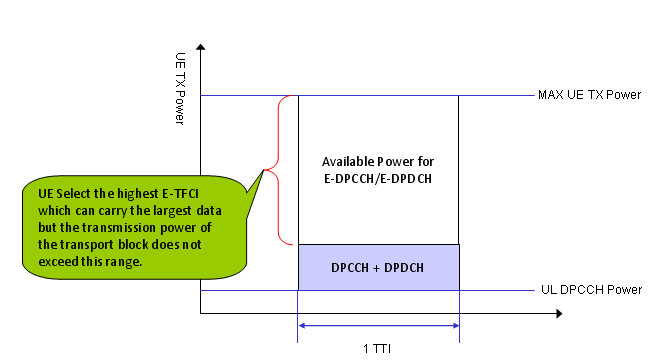
The UE selects the highest E-TFCI whose transmission power fits into the space above DPCCH + DPDCH and below the maximum UE transmit power.
MAX UE TX Power : the upper limit. It comes from the UE power class and from the maximum allowed uplink transmit power that the network configures.DPCCH + DPDCH : the Release 99 channels are served first. 25.321 requires a UE with both DCH and E-DCH to perform TFC selection before E-TFC selection.Available Power for E-DPCCH/E-DPDCH : the power that is left. A larger E-TFC needs more E-DPDCH power, so only the E-TFCs whose power fits here can be selected.UL DPCCH Power : the reference level. The E-DPDCH power is set by a gain factor relative to the DPCCH, so every E-TFC needs more absolute power when the DPCCH power is high.
The diagram leaves out HS-DPCCH. When HSDPA runs at the same time, the HS-DPCCH power comes out of the same space, and fewer E-TFCs fit.
25.321 turns the rule in the callout into two steps. First, the E-TFC restriction procedure of 25.133 marks each E-TFC as supported or blocked, based on its required power against the maximum UE transmit power. The E-TFCs in the minimum set, which RRC signals as E-DCH minimum set E-TFCI, always stay in the supported state. Then the E-TFC selection picks from the supported E-TFCs only.
E-DCH gets the leftover power : the dedicated channels and HS-DPCCH are served before E-DPDCH.Blocked E-TFCs cannot be selected : the E-TFC restriction procedure removes the E-TFCs that need more power than the UE has left.The minimum set is always allowed : so a UE at its power limit can still send a small transport block.
E-TFC Selection Rules in 25.321
Is the largest E-TFC that fits the power always the one that the UE sends? No, because power is only one limit. The grant from the Node B and the amount of data in the buffer limit the choice as well, and 25.321 clause 11.8.1.4 combines all three.
For scheduled data, the Serving Grant is a maximum E-DPDCH to DPCCH power ratio. The UE turns that ratio into a maximum number of bits with the reference E-TFCIs that RRC signals, using either extrapolation or interpolation between them. For non-scheduled data, the non-scheduled grant is already a number of bits.
With those numbers in hand, the UE applies the following rules:
Configured E-TFCS only : the UE considers only the E-TFCs of the configured E-TFCS.Data counted up to the grant : data of a scheduled MAC-d flow counts up to the Serving Grant, and data of a non-scheduled flow counts up to its non-scheduled grant.One HARQ profile : the power offset comes from the HARQ profile of the MAC-d flow that allows the highest priority data to be sent.Some E-TFCIs are never used : E-TFCI 120 in the 2 ms table 0, E-TFCI 115 in the 2 ms table 1, E-TFCI 121 in the 2 ms table 2, and E-TFCIs 101 and 102 in the 2 ms table 3.Priority first : the data allocation maximises the transmission of higher priority data.
The UE then sends the selected E-TFCI in the 7 bit E-TFCI field of E-DPCCH. The Node B reads that value to know the transport block size before it decodes E-DPDCH. The mapping from E-TFCI to transport block size depends on the E-TFCI table that RRC configures, which the E-TFCI Table Specification page explains.
Three limits, one choice : power, grant and buffered data together decide the E-TFCI.The grant is a power ratio : reference E-TFCIs convert it into a number of bits.The E-TFCI goes on E-DPCCH : so the Node B knows the transport block size of each TTI.
Reference
[1] 3GPP TS 25.321 v19.0.0 - clause 11.8.1.4, E-TFC Selection
[2] 3GPP TS 25.331 v19.0.1 - clause 10.3.6.99, E-DPDCH Info
[3] 3GPP TS 25.212 v19.0.0 - clause 4.9, Coding for E-DPCCH