This note will show how 5G moves from the first stage in Release 15 to a more complete and practical stage in Release 16. Release 15 was mainly about building the basic 5G framework. The main target was high data rate and large capacity. In simple terms, it was about making the data pipe bigger and faster. Release 16 keeps that foundation, but it pushes 5G into a more advanced phase. It makes the network smarter, more reliable, more power efficient, and more suitable for many new environments.
In Release 15, the main focus was eMBB. This means enhanced mobile broadband. The priority was to give users faster mobile internet by using wide bandwidth and technologies such as Massive MIMO. This was very important for smartphones and consumer data services. Release 16 shifts the focus more toward URLLC. This means ultra-reliable low-latency communication. The meaning of this shift is important. In smartphone service, a short delay or a brief pause may be inconvenient. In industrial control, remote operation, or autonomous driving, even a very small interruption can become a serious problem. Release 16 addresses this by adding features such as CoMP and improved HARQ. These features help make the radio link more stable and dependable.
Another important change in Release 16 is power efficiency. Early 5G implementations often caused higher battery consumption in user devices. Release 16 introduces new power saving mechanisms to solve this issue. One example is Wakeup Signal. With this approach, the UE does not need to wake up frequently just to check whether the network has data to send. Instead, the network sends a small signal only when the UE really needs to wake up. This reduces unnecessary activity and improves battery life. The overall idea is that the network becomes more efficient in the way it interacts with the device.
Release 16 also expands the way 5G coverage can be deployed. One major feature is IAB, which stands for Integrated Access and Backhaul. With IAB, one base station can connect to another base station through 5G radio links instead of relying only on fixed fiber connections. This makes deployment easier in locations where fiber installation is difficult or expensive. Another important feature is NR-U, which allows NR operation in unlicensed spectrum such as 5 GHz or 6 GHz bands. This gives operators and private network users more flexibility. As a result, 5G becomes easier to extend into new areas and new use cases. It starts to look more flexible and scalable, not only as a traditional cellular system but also as a more adaptive wireless platform.
Release 16 also strengthens positioning capability. Release 15 mainly relied on existing positioning systems such as GPS or GNSS. Release 16 introduces PRS, which stands for Positioning Reference Signal. With PRS, the 5G network itself can help estimate device location much more accurately. This is especially useful in indoor areas such as factories, warehouses, or dense urban locations where satellite signals are weak or blocked. This makes 5G more useful for industrial automation, robotics, and tracking applications that require precise location information.
Overall, the character of 5G changes noticeably from Release 15 to Release 16. Release 15 is mainly the foundation stage. It focuses on speed, capacity, and consumer broadband experience. Release 16 is the expansion stage. It focuses more on reliability, efficiency, precise positioning, flexible deployment, and industrial use cases. In that sense, Release 15 builds the pipe, and Release 16 makes the pipe smarter and extends it into many new domains.
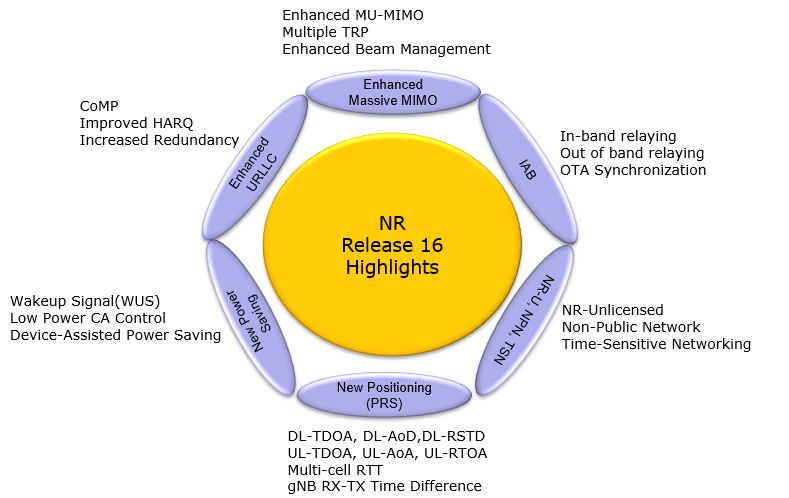
This illustration summarizes the main enhancement areas introduced in NR Release 16. It shows that Release 16 is not focused on just higher speed. It expands 5G toward better reliability, better efficiency, wider deployment flexibility, and more accurate positioning.
Enhanced Massive MIMO - Supports enhanced MU-MIMO for higher capacity and better multi-user operation.
- Supports multiple TRP so the UE can benefit from transmission from multiple points.
- Improves beam management to make beam selection and beam tracking more robust.
Enhanced URLLC - Introduces CoMP to improve reliability through coordinated transmission and reception.
- Improves HARQ operation for faster and more dependable retransmission handling.
- Uses increased redundancy to reduce the chance of packet loss in critical applications.
IAB (Integrated Access and Backhaul) - Supports in-band relaying using the same spectrum for both access and backhaul.
- Supports out-of-band relaying using separate spectrum for backhaul links.
- Enables OTA synchronization between nodes without requiring fiber connection.
NR-U / NPN / TSN - Allows NR operation in unlicensed spectrum such as 5 GHz and 6 GHz bands.
- Supports Non-Public Networks for private and enterprise deployments.
- Supports Time-Sensitive Networking for deterministic and low-latency communication.
New Positioning (PRS) - Supports DL-based positioning methods such as DL-TDOA, DL-AoD, and DL-RSTD.
- Supports UL-based positioning methods such as UL-TDOA, UL-AoA, and UL-RTOA.
- Uses multi-cell RTT to improve positioning accuracy.
- Measures gNB RX-TX time difference for more precise timing estimation.
New Power Saving - Uses Wakeup Signal (WUS) to reduce unnecessary UE wake-up operations.
- Improves low power active state behavior to reduce energy consumption.
- Supports device-assisted power saving mechanisms for better efficiency.
In-Depth Note for Release 16 Features
- Enhanced Massive MIMO
- eURLLC
- NR-U
- Positioning
- Sidelink
- IAB (Integrated Access / Backhaul)
- UE Assistance Information
- Power Saving
- 2 Step RACH
New RRC Messages and IEs for Release 16
Followings are RRC messages or IEs that are introduced newly in Release 16, but these are not all of the messages and IEs. They are just what attracted my attention personally -:). Don't try to understand every details here... just take a quick look and pick only a few that you are especially interested in and dig into it.
I have searched through a lot of documents to get some good picture of a new (release 16 in this case) and each of the documents has its own challenge.
- First I search through many of whitepapers from chipset vendor or network infra vendors. These are good to get some big picture of the new release but not much of details for engineers who are working in a specific subject matter.
- Then I search through WI(Work Item) document (RP-XXXXX). These documents usually gives more details than white papers, but not every WI is really implemented. so hard to figure out which part is really implemented as of now.
- Then I try to read through individual RS spec like 38.211, 38.212, 38.214 etc. These docs carries full details but very hard to get a big picture and in many cases it is not obvious which part is legacy and which part is new.
One good way to approach the new feature (at least good to me) would be check RRC specs (38.331) and check what kind of RRC messages or IEs are added. And then check other documents (like 38.211, 212, 214 etc and WI document and whitepapers) to find related to the new RRC message and IEs.
At a high level, these Rel-16 RRC parameters show that NR is no longer just a basic smartphone radio. The protocol starts to carry many more controls for reliability, power saving, positioning, IAB, private network support, sidelink, richer failure reporting, and more flexible scheduling. In simple terms, Release 15 built the main RRC framework. Release 16 uses that framework to carry many more detailed instructions and reports for advanced deployment scenarios.
The first thing to notice is the expansion of the DCCH message space itself. In DL-DCCH, new messages such as dlDedicatedMessageSegment-r16, ueInformationRequest-r16, dlInformationTransferMRDC-r16, and loggedMeasurementConfiguration-r16 show that the network needs more ways to send detailed control information, request UE reports, and manage more complex dual connectivity or measurement behavior. In UL-DCCH, new messages such as ulDedicatedMessageSegment-r16, dedicatedSIBRequest-r16, mcgFailureInformation-r16, ueInformationResponse-r16, sidelinkUEInformationNR-r16, ulInformationTransferIRAT-r16, and iabOtherInformation-r16 show the same direction from the UE side. The UE is no longer just acknowledging configuration. It is actively reporting problems, requesting system information on demand, providing sidelink information, and supporting IAB-related procedures.
DedicatedSIBRequest-r16 is one good example of the Rel-16 design philosophy. In earlier thinking, system information is mostly broadcast and the UE listens. In Rel-16, the UE can explicitly request only the SIBs it needs, including positioning-related SIBs. This means the system becomes more selective and more efficient. Instead of broadcasting everything aggressively, the network can provide information when requested. This reduces overhead and supports more specialized services such as positioning.
The positioning-related pieces are a major theme in Rel-16. PosSIB-ReqInfo-r16, RRC-PosSystemInfoRequest-r16, posSystemInformation-r16, dedicatedPosSysInfoDelivery-r16, NR-PRS-MeasurementInfo-r16, DL-PRS-Info-r16, SRS-PosResourceSet-r16, and SRS-PosResource-r16 all show that positioning is now treated as a first-class radio feature. The intuition is simple. Earlier cellular systems mainly focused on communication and treated positioning as an add-on. Rel-16 starts to make the radio network itself a positioning tool. That is why you see dedicated system information requests for position SI, PRS measurement definitions, and uplink positioning SRS resources.
IAB support is another clear Rel-16 signature. IABOtherInformation-r16 and the related IAB-IP request and report structures show that an IAB node is not just a normal UE. It needs transport-layer information such as IPv4 address counts, IPv6 prefixes, and traffic-specific address allocation for F1-C, F1-U, and non-F1 traffic. This means RRC is now helping a radio node bootstrap part of its backhaul behavior. bap-Config-r16, bap-Address-r16, bh-RLC-ChannelToAddModList-r16, and f1c-TransferPath-r16 extend this further. The intuition is that the radio access node itself can be connected over wireless, so RRC now has to configure not only access radio behavior but also some backhaul-related behavior.
ConditionalReconfiguration-r16 and daps-SourceRelease-r16 show the network moving toward faster and safer mobility handling. Conditional reconfiguration means the UE can receive handover-related preparation in advance and execute it only when the condition is met. This reduces reaction time. DAPS-related fields show support for dual active protocol stack mobility, where source and target links can overlap during transition. The intuition is that handover is no longer treated as a hard break-and-make event. Rel-16 tries to make mobility smoother and less risky.
NeedForGapsConfigNR-r16, targetCellSMTC-SCG-r16, and the richer measurement objects also show a stronger focus on practical measurement management. As the UE is asked to handle more carriers, more RATs, more beams, and more positioning signals, measurement gaps and measurement timing become more important. Rel-16 gives more explicit ways to manage that complexity.
The SIB1-v1610 and v1630 additions show that even basic system information is being extended toward newer use cases. idleModeMeasurementsEUTRA-r16 and idleModeMeasurementsNR-r16 improve idle mobility measurement handling. posSI-SchedulingInfo-r16 supports positioning system information scheduling. uac-BarringInfo-v1630 extends access control assistance. The intuition is that even idle mode becomes smarter because the network now has more services to advertise and more behavior to coordinate before connection setup.
UEAssistanceInformation-v1540 and v1610 are especially important because they show a philosophical change. In older systems, the network mostly tells the UE what to do. In Rel-16, the UE can tell the network what it prefers or what limitation it currently has. OverheatingAssistance lets the UE say, in effect, I am too hot, so reduce CC count, bandwidth, or MIMO layers. DRX-Preference, MaxBW-Preference, MaxCC-Preference, MaxMIMO-LayerPreference, MinSchedulingOffsetPreference, and ReleasePreference let the UE express power, complexity, or latency preferences. The intuition is that the network and UE are now negotiating practical operating points, not just following one rigid configuration.
IDC-Assistance-r16 is another example of this cooperative behavior. The UE can report which NR frequencies or frequency combinations are causing interference toward GPS, GLONASS, BDS, Galileo, NavIC, WLAN, Bluetooth, or other systems. This is very practical. Modern devices contain many radios and receivers in a small package. Rel-16 gives the UE a way to tell the network which combinations are problematic so scheduling and carrier activation can be adapted.
UEInformationResponse-r16 and all the related report structures show that Rel-16 greatly strengthens troubleshooting and analytics. measResultIdleNR-r16, logMeasReport-r16, connEstFailReport-r16, ra-ReportList-r16, rlf-Report-r16, and mobilityHistoryReport-r16 mean that the UE can provide much richer field evidence about what went wrong and what it observed. The intuition is that the network no longer wants just a final failure indication. It wants context. Which beams were good. Which neighbor cells were seen. How many random access attempts happened. Was there contention. Was RSRP above threshold. Did beam failure recovery fail. This is extremely useful for optimization and for hard-to-debug mobility or access failures.
The random access reporting additions are particularly revealing. RA-Report-r16, RA-InformationCommon-r16, PerRASSBInfo-r16, and PerRAAttemptInfo-r16 show that Rel-16 wants beam-level visibility into random access. The network can learn not only that RA failed, but also on which SSB or CSI-RS resource, how many preambles were sent, and whether contention was detected. This fits the beam-centric nature of NR much better than older cell-level thinking.
RLF-Report-r16 becomes much richer as well. It includes last serving measurements, neighbor measurements, failed cell identity, reconnect cell identity, failure cause, time since failure, RA information, and even location info. The intuition is that link failure in NR can happen for many reasons: classical radio degradation, beam failure, handover failure, LBT failure in unlicensed operation, backhaul recovery failure, and so on. Rel-16 reflects that new reality.
BeamFailureRecoverySCellConfig-r16 and CandidateBeamRS-r16 show that beam management is also becoming more explicit and more scalable. The UE can work with beam candidates identified either by SSB or CSI-RS, and even for SCells. This reflects the practical fact that in NR, keeping the right beam is almost as important as staying on the right cell.
The CellGroupConfig and related uplinkTxSwitchingOption-r16, simultaneousTCI update lists, and spatial update lists show more control over advanced multi-cell and multi-beam behavior. This is the type of RRC support needed when the radio is operating with more antennas, more panels, more cells, and more dynamic beam relations. The intuition is that one serving cell is no longer enough to describe the radio state cleanly. RRC needs grouped and coordinated updates.
ConfiguredGrantConfig gets a major Rel-16 expansion. This area supports grant-free or semi-persistent uplink operation with more flexibility. You see extra timers, repetition handling, multiple PUSCH per slot, COT sharing, HARQ process offsets, and autonomousTx-r16. This strongly reflects URLLC and NR-U style use cases. The intuition is that uplink scheduling cannot always wait for a fresh dynamic grant. Sometimes the UE needs highly predictable or repeated transmission opportunities, especially in low latency or shared-channel environments.
The DMRS, PDSCH, and PUSCH extensions also follow this same trend. New r16 flags and DCI-specific alternatives show that Rel-16 supports more dynamic interpretation of scheduling, more explicit DCI-0-2 and DCI-1-2 behavior, richer resource allocation, repetition control, minimum scheduling offset control, enhanced MIMO layer control, and more flexible HARQ/ACK operation. The intuition is that the scheduler is becoming more expressive. The network can fine tune how quickly data is scheduled, how it is repeated, how many layers are used, and how control fields are interpreted.
MinSchedulingOffsetPreference-r16, minimumSchedulingOffsetK0-r16, and minimumSchedulingOffsetK2-r16 are especially intuitive. They are about how much preparation time the UE needs between control and data. Smaller offset means lower latency, but it also means less UE processing time. Rel-16 lets both network and UE deal with this tradeoff more explicitly.
PhysicalCellGroupConfig shows another strong Rel-16 theme. DCP-Config-r16 with ps-RNTI and wake-up related fields is directly related to power saving. This is the control-plane support behind concepts like wake-up signaling. There are also many additions for enhanced HARQ-ACK codebooks, blind detection scaling, FR2 power control, NR-DC power control modes, and one-shot feedback. The intuition is that the control plane has to become smarter both for performance and for battery life.
NPN-Identity-r16 and related CAG and SNPN fields clearly show support for private networks. The network can now advertise and identify closed access groups, standalone non-public networks, and related identifiers such as NID. The intuition is that 5G is no longer only a public operator network. Factories, campuses, and enterprises need their own identity and access framework.
LBT-FailureRecoveryConfig-r16, invalidSymbolPattern-r16, CG-COT-Sharing-r16, and related parameters indicate support for unlicensed operation and shared channel access. These fields are there because in NR-U the UE and gNB must coexist with other users of unlicensed spectrum. So RRC has to configure behavior around channel occupancy, listen-before-talk failure, and how transmissions fit inside channel occupancy time.
The CLI-related structures such as MeasObjectCLI-r16, CLI-ResourceConfig-r16, RSSI and SRS CLI resources, and MeasResultCLI-r16 point to cross-link interference handling, especially important in TDD and dense deployments. The intuition is that in advanced NR systems, interference is not just something measured passively at cell level. It can be measured with dedicated resources and reported in a more targeted way.
The Rel-16 SSB mobility additions such as ssb-PositionQCL-Common-r16 and cell-specific QCL relations show refinement in beam and synchronization assumptions across cells. RMTC-Config-r16 and related measurement timing fields support more flexible synchronization and measurement of reference signals. This again reflects that beam-based mobility in NR needs more explicit signaling than legacy cell-based mobility.
The positioning SRS and PRS parameters deserve one more mention. SRS-PosResourceSet-r16, SRS-PosResource-r16, SRS-SpatialRelationInfoPos-r16, SSB-Configuration-r16, SSB-InfoNcell-r16, and DL-PRS-Info-r16 show that Rel-16 positioning is not just one measurement report added on top. It is a full signaling framework with its own resources, spatial relations, periodicities, and reference definitions. This is why Rel-16 can support much more advanced positioning behavior.
Overall, the high level intuition is this. Rel-15 RRC was mainly about establishing and maintaining a 5G data connection. Rel-16 RRC starts to become a richer operating system for the radio. It carries control for smarter mobility, finer scheduler behavior, better troubleshooting, power saving, precise positioning, private networks, IAB backhaul, unlicensed spectrum operation, and more cooperative UE-network behavior. In short, Release 16 makes RRC much more aware of real deployment complexity.
Overall intuition - Rel-16 RRC expands NR from basic connection control into a broader control framework for reliability, efficiency, positioning, IAB, private networks, sidelink, and richer failure handling.
- This overall expansion is visible in new message paths such as dlDedicatedMessageSegment-r16, ueInformationRequest-r16, dlInformationTransferMRDC-r16, loggedMeasurementConfiguration-r16, ulDedicatedMessageSegment-r16, dedicatedSIBRequest-r16, mcgFailureInformation-r16, ueInformationResponse-r16, sidelinkUEInformationNR-r16, ulInformationTransferIRAT-r16, and iabOtherInformation-r16.
Expanded DCCH message space - Rel-16 adds more specialized downlink and uplink dedicated control messages so the network and UE can exchange richer control, request, and diagnostic information.
- Related IE/message names are DL-DCCH-MessageType with dlDedicatedMessageSegment-r16, ueInformationRequest-r16, dlInformationTransferMRDC-r16, loggedMeasurementConfiguration-r16, and UL-DCCH-MessageType with ulDedicatedMessageSegment-r16, dedicatedSIBRequest-r16, mcgFailureInformation-r16, ueInformationResponse-r16, sidelinkUEInformationNR-r16, ulInformationTransferIRAT-r16, and iabOtherInformation-r16.
On-demand system information - Instead of forcing the UE to wait for all system information by broadcast, Rel-16 allows the UE to explicitly request only the SIBs it needs.
- This improves efficiency and supports more specialized information delivery such as positioning-related SIBs.
- Related IE names are DedicatedSIBRequest-r16-IEs, onDemandSIB-RequestList-r16, requestedSIB-List-r16, requestedPosSIB-List-r16, SIB-ReqInfo-r16, PosSIB-ReqInfo-r16, RRCSystemInfoRequest-IEs, and RRC-PosSystemInfoRequest-r16-IEs.
Positioning becomes a core function - Rel-16 makes positioning a built-in radio capability instead of a side feature.
- The network can deliver dedicated positioning system information and configure dedicated PRS and SRS resources for location estimation.
- Related IE names are dedicatedPosSysInfoDelivery-r16, posSI-SchedulingInfo-r16, posSystemInformation-r16, LocationMeasurementInfo with nr-PRS-Measurement-r16, NR-PRS-MeasurementInfoList-r16, NR-PRS-MeasurementInfo-r16, DL-PRS-Info-r16, SRS-PosResourceSet-r16, SRS-PosResource-r16, SRS-SpatialRelationInfoPos-r16, SSB-Configuration-r16, and SSB-InfoNcell-r16.
IAB support - Rel-16 extends RRC so that a wireless backhaul node can request and receive transport-related information such as IP address resources and traffic separation.
- This shows that RRC is no longer controlling only access radio behavior. It also helps bootstrap backhaul-related operation.
- Related IE names are IABOtherInformation-r16-IEs, ip-InfoType-r16, iab-IP-Request-r16, iab-IP-Report-r16, iab-IPv4-AddressNumReq-r16, iab-IPv6-AddressNumReq-r16, iab-IPv6-AddressPrefixReq-r16, IAB-IP-AddressAndTraffic-r16, IAB-IP-PrefixAndTraffic-r16, bap-Config-r16, iab-IP-AddressConfigurationList-r16, bap-Address-r16, bh-RLC-ChannelToAddModList-r16, bh-RLC-ChannelToReleaseList-r16, and f1c-TransferPath-r16.
Advanced mobility support - Rel-16 prepares mobility more proactively and reduces interruption during transition.
- Instead of reacting only after the radio condition changes, the network can pre-configure mobility actions and support smoother dual-link transition.
- Related IE names are conditionalReconfiguration-r16, daps-SourceRelease-r16, t316-r16, targetCellSMTC-SCG-r16, and DAPS-UplinkPowerConfig-r16 with p-DAPS-Source-r16, p-DAPS-Target-r16, and uplinkPowerSharingDAPS-Mode-r16.
Measurement and gap handling - As NR becomes more beam-based and multi-carrier, the UE needs more explicit control over when and how measurements are performed.
- Rel-16 strengthens measurement timing, gap handling, and beam-related measurement coordination.
- Related IE names are needForGapsConfigNR-r16, targetCellSMTC-SCG-r16, SSB-ConfigMobility, ssb-PositionQCL-Common-r16, ssb-PositionQCL-CellsToAddModList-r16, ssb-PositionQCL-CellsToRemoveList-r16, and RMTC-Config-r16 with rmtc-Periodicity-r16, rmtc-SubframeOffset-r16, measDurationSymbols-r16, rmtc-Frequency-r16, and ref-SCS-CP-r16.
Smarter idle mode and system information evolution - Even idle mode becomes more capable in Rel-16 because the UE may need to measure more RATs, support positioning, and apply refined access control.
- Related IE names are SIB1-v1610-IEs with idleModeMeasurementsEUTRA-r16, idleModeMeasurementsNR-r16, posSI-SchedulingInfo-r16, and SIB1-v1630-IEs with uac-BarringInfo-v1630 and uac-AC1-SelectAssistInfo-r16.
UE assistance and preference signaling - Rel-16 allows the UE to tell the network about thermal limits, battery-oriented preferences, and practical capability constraints.
- This changes RRC from one-way control into more cooperative control between UE and network.
- Related IE names are UEAssistanceInformation-v1540-IEs, OverheatingAssistance, reducedMaxCCs, reducedMaxBW-FR1, reducedMaxBW-FR2, reducedMaxMIMO-LayersFR1, reducedMaxMIMO-LayersFR2, and UEAssistanceInformation-v1610-IEs with idc-Assistance-r16, drx-Preference-r16, maxBW-Preference-r16, maxCC-Preference-r16, maxMIMO-LayerPreference-r16, minSchedulingOffsetPreference-r16, releasePreference-r16, sl-UE-AssistanceInformationNR-r16, and referenceTimeInfoPreference-r16.
Interference and coexistence awareness - A modern UE contains many radios and receivers, so the network must be aware of coexistence problems between NR and GNSS, WLAN, Bluetooth, and similar systems.
- Rel-16 allows the UE to report which frequencies or combinations cause internal interference problems.
- Related IE names are IDC-Assistance-r16, affectedCarrierFreqList-r16, affectedCarrierFreqCombList-r16, AffectedCarrierFreq-r16, AffectedCarrierFreqComb-r16, interferenceDirection-r16, and VictimSystemType-r16 with gps-r16, glonass-r16, bds-r16, galileo-r16, navIC-r16, wlan-r16, and bluetooth-r16.
Rich log and failure reporting - Rel-16 greatly improves post-failure visibility.
- Instead of just telling the network that something failed, the UE can report detailed context such as serving and neighbor measurements, beam information, random access attempts, and timing.
- Related IE names are UEInformationResponse-r16-IEs with measResultIdleEUTRA-r16, measResultIdleNR-r16, logMeasReport-r16, connEstFailReport-r16, ra-ReportList-r16, rlf-Report-r16, and mobilityHistoryReport-r16.
- Additional related IE names are LogMeasReport-r16, LogMeasInfoList-r16, ConnEstFailReport-r16, RLF-Report-r16, timeSinceFailure-r16, connectionFailureType-r16, rlf-Cause-r16, and locationInfo-r16.
Beam-centric operation - NR is strongly beam-based, so Rel-16 adds many controls and reports at beam level rather than only at cell level.
- This improves beam failure recovery, beam-level diagnostics, and beam-aware access handling.
- Related IE names are MeasResultServingCell-r16 with best-ssb-Index, best-ssb-Results, numberOfGoodSSB, MeasResultFailedCell-r16, BeamFailureRecoverySCellConfig-r16, rsrp-ThresholdBFR-r16, candidateBeamRSSCellList-r16, and CandidateBeamRS-r16 with ssb-r16 and csi-RS-r16.
Detailed random access visibility - Rel-16 gives the network a much more detailed view of random access behavior, including which beam was used and how many attempts were made.
- This is very useful for troubleshooting access failure in beam-based NR.
- Related IE names are RA-ReportList-r16, RA-Report-r16, RA-InformationCommon-r16, raPurpose-r16, PerRAInfoList-r16, PerRASSBInfo-r16, PerRACSI-RSInfo-r16, PerRAAttemptInfoList-r16, contentionDetected-r16, and dlRSRPAboveThreshold-r16.
Advanced uplink scheduling and configured grant - Rel-16 expands configured grant so the UE can support lower latency and more autonomous uplink behavior.
- This is useful for URLLC and for channel sharing environments such as NR-U.
- Related IE names are ConfiguredGrantConfig, cg-RetransmissionTimer-r16, cg-minDFI-Delay-r16, cg-nrofPUSCH-InSlot-r16, cg-nrofSlots-r16, cg-StartingOffsets-r16, cg-UCI-Multiplexing-r16, cg-COT-SharingOffset-r16, betaOffsetCG-UCI-r16, cg-COT-SharingList-r16, harq-ProcID-Offset-r16, harq-ProcID-Offset2-r16, configuredGrantConfigIndex-r16, configuredGrantConfigIndexMAC-r16, periodicityExt-r16, startingFromRV0-r16, phy-PriorityIndex-r16, autonomousTx-r16, pusch-RepTypeIndicator-r16, frequencyHoppingPUSCH-RepTypeB-r16, and timeReferenceSFN-r16.
Scheduling offset and processing-time awareness - Rel-16 makes the latency versus UE-processing-time tradeoff more explicit.
- The UE can indicate what scheduling gap is practical, and the network can configure smaller or larger offsets accordingly.
- Related IE names are MinSchedulingOffsetPreference-r16, preferredK0-r16, preferredK2-r16, preferredK0-SCS-15kHz-r16, preferredK0-SCS-30kHz-r16, preferredK0-SCS-60kHz-r16, preferredK0-SCS-120kHz-r16, preferredK2-SCS-15kHz-r16, preferredK2-SCS-30kHz-r16, preferredK2-SCS-60kHz-r16, preferredK2-SCS-120kHz-r16, minimumSchedulingOffsetK0-r16, and minimumSchedulingOffsetK2-r16.
Power saving enhancements - Rel-16 introduces more explicit signaling for low-power behavior and wake-up style operation.
- This helps reduce unnecessary UE activity and improves battery efficiency.
- Related IE names are DRX-Preference-r16 with preferredDRX-InactivityTimer-r16, preferredDRX-LongCycle-r16, preferredDRX-ShortCycle-r16, preferredDRX-ShortCycleTimer-r16, ReleasePreference-r16 with preferredRRC-State-r16, and DCP-Config-r16 with ps-RNTI-r16, ps-Offset-r16, sizeDCI-2-6-r16, ps-PositionDCI-2-6-r16, ps-WakeUp-r16, ps-TransmitPeriodicL1-RSRP-r16, and ps-TransmitOtherPeriodicCSI-r16.
Private network support - Rel-16 adds explicit signaling for non-public networks, including closed groups and standalone private identities.
- This allows NR to be deployed not only for public operators but also for enterprise and campus networks.
- Related IE names are NPN-Identity-r16, pni-npn-r16, snpn-r16, CAG-IdentityInfo-r16, cag-Identity-r16, manualCAGselectionAllowed-r16, NID-r16, and NPN-IdentityInfo-r16 with npn-IdentityList-r16, trackingAreaCode-r16, ranac-r16, cellIdentity-r16, cellReservedForOperatorUse-r16, and iab-Support-r16.
Unlicensed spectrum and shared channel support - Rel-16 adds controls needed when NR operates in shared or unlicensed spectrum where listen-before-talk and channel occupancy matter.
- Related IE names are LBT-FailureRecoveryConfig-r16, lbt-FailureInstanceMaxCount-r16, lbt-FailureDetectionTimer-r16, InvalidSymbolPattern-r16, symbols-r16, periodicityAndPattern-r16, CG-COT-Sharing-r16, duration-r16, offset-r16, and channelAccessPriority-r16.
Cross-link interference handling - In dense TDD systems, uplink and downlink interference between links can become a major issue.
- Rel-16 introduces dedicated measurement resources and reporting structures for CLI.
- Related IE names are MeasObjectCLI-r16, CLI-ResourceConfig-r16, SRS-ResourceConfigCLI-r16, RSSI-ResourceConfigCLI-r16, MeasResultCLI-r16, MeasResultListSRS-RSRP-r16, MeasResultListCLI-RSSI-r16, MeasResultSRS-RSRP-r16, and MeasResultCLI-RSSI-r16.
Enhanced PHY and scheduler integration - Rel-16 gives the scheduler much more detailed control over MIMO layers, repetition, DCI interpretation, resource allocation, and DMRS behavior.
- This helps support advanced deployment scenarios and finer performance tuning.
- Related IE names are PDSCH-Config with maxMIMO-Layers-r16, antennaPortsFieldPresenceDCI-1-2-r16, dmrs-SequenceInitializationDCI-1-2-r16, harq-ProcessNumberSizeDCI-1-2-r16, mcs-TableDCI-1-2-r16, numberOfBitsForRV-DCI-1-2-r16, priorityIndicatorDCI-1-2-r16, resourceAllocationType1GranularityDCI-1-2-r16, referenceOfSLIVDCI-1-2-r16, repetitionSchemeConfig-r16, and repetitionSchemeConfig-v1630.
- Other related IE names are PUSCH-Config with harq-ProcessNumberSizeDCI-0-2-r16, dmrs-SequenceInitializationDCI-0-2-r16, numberOfBitsForRV-DCI-0-2-r16, antennaPortsFieldPresenceDCI-0-2-r16, frequencyHoppingDCI-0-2-r16, codebookSubsetDCI-0-2-r16, maxRankDCI-0-2-r16, mcs-TableDCI-0-2-r16, priorityIndicatorDCI-0-2-r16, pusch-RepTypeIndicatorDCI-0-2-r16, invalidSymbolPattern-r16, ul-FullPowerTransmission-r16, and pusch-TimeDomainAllocationListForMultiPUSCH-r16.
- Additional related IE names are DMRS-DownlinkConfig with dmrs-Downlink-r16, DMRS-UplinkConfig with dmrs-Uplink-r16 and dmrs-UplinkTransformPrecoding-r16, and PTRS-DownlinkConfig with maxNrofPorts-r16.
PUCCH and HARQ/ACK flexibility - Rel-16 improves uplink control flexibility so the UE can support more advanced HARQ feedback timing, resource indication, and spatial relation handling.
- Related IE names are PUCCH-Config with resourceToAddModListExt-r16, dl-DataToUL-ACK-r16, ul-AccessConfigListDCI-1-1-r16, subslotLengthForPUCCH-r16, dl-DataToUL-ACK-DCI-1-2-r16, numberOfBitsForPUCCH-ResourceIndicatorDCI-1-2-r16, dmrs-UplinkTransformPrecodingPUCCH-r16, spatialRelationInfoToAddModList2-r16, spatialRelationInfoToAddModListExt-r16, resourceGroupToAddModList-r16, resourceGroupToReleaseList-r16, and sps-PUCCH-AN-List-r16.
- Other related IE names are PhysicalCellGroupConfig with pdsch-HARQ-ACK-Codebook-r16, pdsch-HARQ-ACK-OneShotFeedback-r16, pdsch-HARQ-ACK-OneShotFeedbackNDI-r16, pdsch-HARQ-ACK-OneShotFeedbackCBG-r16, downlinkAssignmentIndexDCI-0-2-r16, downlinkAssignmentIndexDCI-1-2-r16, pdsch-HARQ-ACK-CodebookList-r16, and ackNackFeedbackMode-r16.
SRS and positioning resource expansion - Rel-16 significantly expands SRS usage beyond ordinary sounding and connects it more strongly to positioning and advanced triggering.
- Related IE names are SRS-Config with srs-RequestDCI-1-2-r16, srs-RequestDCI-0-2-r16, srs-ResourceSetToAddModListDCI-0-2-r16, srs-PosResourceSetToAddModList-r16, and srs-PosResourceToAddModList-r16.
- Other related IE names are SRS-ResourceSet with pathlossReferenceRSList-r16, SRS-Resource with resourceMapping-r16, SRS-PosResourceSet-r16 with pathlossReferenceRS-Pos-r16, and SRS-SpatialRelationInfoPos-r16 with servingRS-r16, ssb-Ncell-r16, and dl-PRS-r16.
Overall shift - In simple terms, Rel-15 RRC mainly connects and maintains the UE, while Rel-16 RRC also helps optimize, diagnose, protect, position, and coordinate the UE in much more complex deployment scenarios.
- The clearest signs of this shift are the addition of message types and IEs such as conditionalReconfiguration-r16, dedicatedPosSysInfoDelivery-r16, bap-Config-r16, DCP-Config-r16, idc-Assistance-r16, DRX-Preference-r16, NPN-Identity-r16, LBT-FailureRecoveryConfig-r16, UEInformationResponse-r16-IEs, and ConfiguredGrantConfig.
Release 16 RRC ASN.1 definitions
The complete Release 16 ASN.1 material is shown below in a scrollable frame.
Open the complete Release 16 RRC ASN.1 listing in a separate page
Reference :
[2] Propelling 5G forward: A closer look at 3GPP Release 16 (Qualcomm Blog)
[3] 5G evolution: 3GPP releases 16 & 17 overview (Ericsson TechReview)
[4] The 5G Evolution:3GPP Releases 16-17 (5G Americas)
[5] 3GPPs 5G NR Release 16S 9 Most Critical Improvements To 5G
Reference : YouTube
[1] Explore 3GPP Rel-16 enhancements in Keysight Signal Studio and 89600 VSA (Keysight)
[2] Evolution of 5G from 3GPP Rel-15 to Rel-17 and Testing Challenges (Anritsu)
[3] 2020 09 24 12 00 ATIS Webinar 5G Standards Developments in 3GPP Release 16 and Beyond
[4] 5G Mobile mmWave Technology Evolution (Qualcomm)
[5] Experience 5Gs true potential with mmWave Spectrum (SamSung)
[6] Fastest 5G mmWave Speeds of 8.5Gbps Achieved Across Multiple Devices (SamSung)
[7] Live Qualcomm Massive MIMO 5G Demo (Qualcomm)
[8] Qualcomm 5G NR Industrial IoT Demo (Qualcomm)
[9] Coordinated Multipoint (CoMP) Technology for 5G Spectrum Sharing | Demo by Qualcomm | Digit.(Qualcomm)
[10] 5G Precise Indoor Positioning (Qualcomm)
[11] Qualcomm 5G NR Industrial IoT Demo (Qualcomm)
[12] Qualcomm, Bosch highlight 5G as an industrial enabler (Qualcomm)
[13] 5G CoMP for Spectrum Sharing (Qualcomm)
[14] 5G C-V2X Technology Evolution OTA Prototype (Qualcomm)
[15] How Cooperative Driving Works | Demo by Qualcomm's Automotive Solutions | Digit.in (Qualcomm)
[16] QUALCOMM - 5G NR C V2X (Qualcomm)
[17] Private 5G Network in Test Center from Siemens (Siemens)
[18] 5G NR Spectrum Sharing (Qualcomm)
[19] 5G CV2X in Action from Qualcomm at CES 2019 (Qualcomm)
[20] V2X Collaborative Environmental Perception